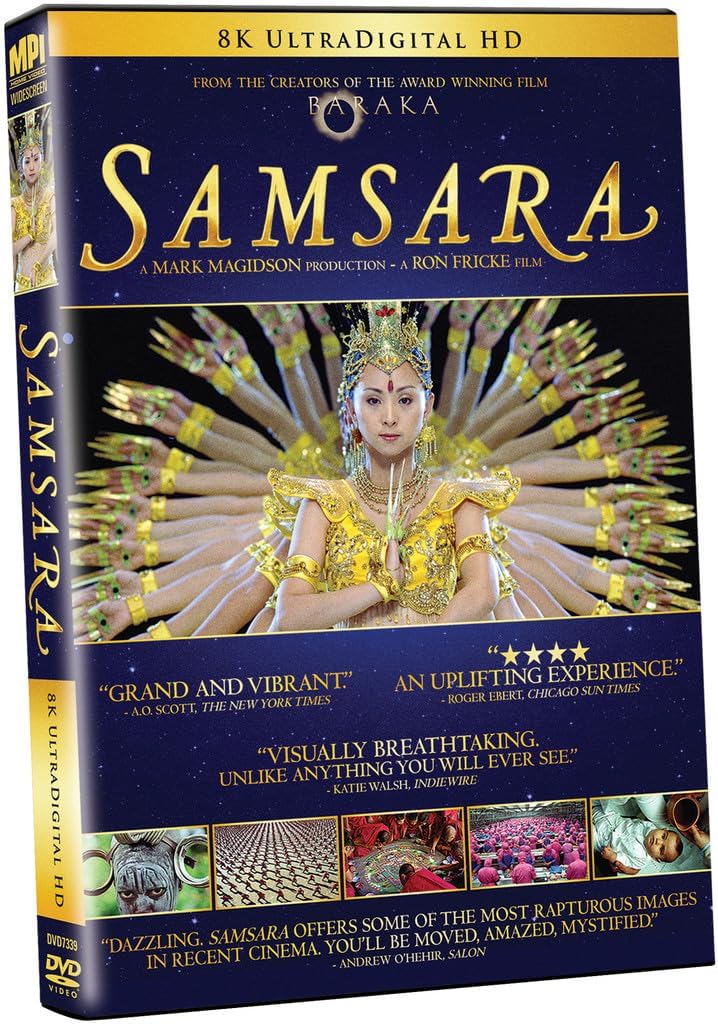

Samsara
ID del producto: 12453657
Buy anything from 5,000+ international stores. One checkout price. No surprise fees. Join 2M+ shoppers on Desertcart.
Desertcart purchases this item on your behalf and handles shipping, customs, and support to Mexico.
Prepare yourself for an unparalleled sensory experience. Filmed over a period of almost five years and in twenty-five countries, SAMSARA explores the wonders of the world from sacred grounds to industrial sites, looking into the unfathomable reaches of man's spirituality and the human experience. Photographed entirely in 70mm and transferred to 4K digital projection format, SAMSARA's mesmerizing images of unprecedented clarity illuminate the links between humanity and the rest of nature, showing how our life cycle mirrors the rhythm of the planet. Neither a traditional documentary nor a travelogue, SAMSARA is a guided meditation on the current of interconnection that runs through all of our lives. Filmed over five years, in locations in 25 countries, it is the kind of experience you simply sink into. --Roger Ebert, Chicago Sun Times SAMSARA stares at Asian temples, African tribesmen, and chickens bound for slaughter with the same blank eye. --Lisa Schwarzbaum, Entertainment Weekly The world SAMSARA gives us is strange and beautiful, and in places disturbing, but it also seems manageable, even in its vastness, and perhaps too easily consumed through beautiful images. --A.O. Scott, New York Times Review: Excellent.....the moral of the story is poignant and unspoken - I have no idea what the intended purpose of this film is....neither did I have any preconceived notions going into it or coming out of the experience....but what i took from it is that mankind is screwed....we've reached that point that nothing is sacred, and all things that make up the nature of our existence, sustenance and life are served to us via conveyor belts of many shapes and sizes and purposes....we are on that conveyor ourselves or are the conveyor. Spoiler, nothing said it more than the one asian girl in that slaughterhouse who's eyes, as she looked down at her labors, bespoke a sadness, frustration, looking for meaning in all this, and when she looked up at the camera for that one raw moment there was a terror in her eyes, terror mixed with sadness....there were flashes to ancient wonders and ancient cultures, the sand paintings, the rituals of prayer, dance were on display, things that were infinitely beautiful, cohesive and grand but not so messy, not so destructive to nature to our surroundings... so I don't know draw your own conclusion....it's very well done, the imaging, the film, the music...over before you know it and worth your time Review: Samsara - What an incredible movie, If you've seen the previous two Chonos and Baraka made by the same people you'll like this one. It is kind of like a meditational DVD, Samsara like the other two there is no talking just music and scenes of the world. Samsara if a movie of the world, birth life and death. It is beautiful movie but as life is there are a sew scenes that are disturbing because life sometimes is disturbing. In a lot of it they use I think it's called stop motion where you'll see a location and see hours in minutes. I bought Samsara because I had upgraded my Baraka to blu-ray and watching the documentary they mention Chronos and Samsara. I love Baraka so of course I wanted the other two but Samsara was the only one availible and I'm so glad I bought it. I can watch the two movies and see the beauty of the world.
| Customer Reviews | 4.6 out of 5 stars 1,928 Reviews |
G**M
Excellent.....the moral of the story is poignant and unspoken
I have no idea what the intended purpose of this film is....neither did I have any preconceived notions going into it or coming out of the experience....but what i took from it is that mankind is screwed....we've reached that point that nothing is sacred, and all things that make up the nature of our existence, sustenance and life are served to us via conveyor belts of many shapes and sizes and purposes....we are on that conveyor ourselves or are the conveyor. Spoiler, nothing said it more than the one asian girl in that slaughterhouse who's eyes, as she looked down at her labors, bespoke a sadness, frustration, looking for meaning in all this, and when she looked up at the camera for that one raw moment there was a terror in her eyes, terror mixed with sadness....there were flashes to ancient wonders and ancient cultures, the sand paintings, the rituals of prayer, dance were on display, things that were infinitely beautiful, cohesive and grand but not so messy, not so destructive to nature to our surroundings... so I don't know draw your own conclusion....it's very well done, the imaging, the film, the music...over before you know it and worth your time
M**E
Samsara
What an incredible movie, If you've seen the previous two Chonos and Baraka made by the same people you'll like this one. It is kind of like a meditational DVD, Samsara like the other two there is no talking just music and scenes of the world. Samsara if a movie of the world, birth life and death. It is beautiful movie but as life is there are a sew scenes that are disturbing because life sometimes is disturbing. In a lot of it they use I think it's called stop motion where you'll see a location and see hours in minutes. I bought Samsara because I had upgraded my Baraka to blu-ray and watching the documentary they mention Chronos and Samsara. I love Baraka so of course I wanted the other two but Samsara was the only one availible and I'm so glad I bought it. I can watch the two movies and see the beauty of the world.
J**K
Rainbow Portal
Early in the 1960s, the world film market began expanding into American consciousness. In addition to Fellini and Bergman, there was a small sub-genre masquerading as "documentary." I remember being much taken by MONDO CANE, WOMEN OF THE WORLD, and most esp. MALAMONDO (1963), a somewhat artificially constructed piece which made me aware for the first time of the jazzy, haunting music of one Ennio Morricone Not many films of this type followed (it was a sub-genre, after all). Fellini tried it off and on - most successfully with FELLINI'S ROMA - his affectionate, ironic view of the Eternal City he lived in. The clash of culture - "modern vs. ancient" - was never more effectively captured than in the Iron Mole sequence, where our polluted air destroyed long-buried Roman paintings. In the 80s, thanks to Godfrey Reggio and composer Philip Glass, we tumbled into the thoughtful, oft disturbing rabbit hole of KOYAANISQATSI (Life Out of Balance), which used stunning time-lapse images to show how the ever-increasing pace of technology might be carrying us to a most unwelcome place. Ron Fricke worked on this one. POWAQQATSI (Life in Transformation) carried this message/warning even further. In 1992 Ron Fricke released his own stunning BARAKA, the perfect blend of image, music and transcendental mood: a landmark in the the slow development of the "image" documentary. Now Fricke's follow-up - SAMASARA - has been released. It's a "trip" through gateways of color and beauty. It broadens the themes of BARAKA with even more mind-blowing images, all tied together at beginning and end by monks constructing/destroying an ornate sand painting. (It's the "journey", you see...) Give SAMSARA a try. Disconnect your electronic whee-devices, turn out the lights, and melt into yourself as you let its incredible rainbow world wash over you. You'll be surprised how mellow/wise you'll feel afterwards. Wine optional.
D**N
Samsara for the Senses
Ron Fricke is the only director whose movies I will buy sight unseen, collecting made easier by his 20-year moviemaking schedule. Samsara continues his explorations of the earth and humanity begun in Koyaanisqatsi and Chronos, and continued in the landmark film Baraka. Each film speaks with Fricke's voice in a different way, with the earliest Chronos being quite abstract and Samsara having what might almost be called a plot (Koyaanisqatsi was Fricke's cinematography and Godfrey Reggio's concepts). For a film having only visuals and music, Samsara becomes nearly political at times, with strong graphic statements about our cultures of guns and industrial agriculture, and some of the scenes are hard to watch (and liable to make one a vegetarian). But there is also an abundance of stunning landscapes and multilayered examinations of human religions and motivations. Like Baraka, the Blu Ray disk is an incredible reproduction of the 70mm film, and you'll wish you had a bigger screen (no matter how big it is), with a precise soundtrack that envelopes the room with sound. It is a showpiece for home theatre equipment, and an excellent continuation of Fricke's exploration of nature and culture.
F**.
A Feast for the eyes and ears.
It's difficult to explain this beautiful and thoughtful sound and image poem. There are exotic and unusual locales and people as well as some of the most striking and unusual moving images I have ever seen. You will see stunning places and witness events you never knew existed. I don't know if it can still be found on streaming Prime but if you find exotic locales, customs and people, you owe it to yourself to see this amazing adventure on some form of media. I saw it first on Prime but quickly bought the 4K Blu Ray for my collection. The picture and sound quality are fantastic.
D**S
Stunning and thought provoking
Stunning and thought provoking.
R**Y
Not taking risks doesnt pay off for Fricke. So much wasted potential on the narrative part of it.
Summary: Samsara tries to provide closure to a trilogy over decades of work and learnings from director Ron Fricke. Unfortunately, some errors after more than a decade of waiting overshadow the director's work. This feature film, in its final product, presents no novelty and even seems to reuse some previous shots used in Chronos. Moreover, some of the locations used in his previous films are also present here. This wears the novelty, considering the excellent work done by its composers in some of these scenes. Format: Samsara was released on Blu-Ray in 2011. It could be said that at a visual level, it is even more elaborate than Baraka. Filmed in 70mm and scanned at 8k, Quality leaves nothing to envy, surpassing even its predecessor. From the analyzed extras - a very good documentary that compensates for the lack of comments from the director - it is possible to understand more the vision of the work. Fricke considers it a guided meditation work. Direction: Samsara seems on paper, as the director explains it, to have the most mature vision of his three films. A guided meditation channeled through music that complements the selected scenes frame by frame. The latter is remarkable since both Baraka and Chronos were worked in reverse, which means that photography had to fit previously composed music. It is a shame to see the director reuse shots and locations having enough material that he could have used. Another situation that is not clear in the direction goes hand in hand with the first act of the film. During the first thirty or forty minutes of the movie, it seems some scenes are disconnected from each other. We could even say, this makes it feel a little forced in its development towards the second act. Their cuts and transitions are abrupt and do not generate the same impact as the ones in the second half. The positive fact is that Fricke performs a third act that wraps it properly giving closure in a way that it leaves the viewer satisfied. The latter is learning embodied in the film because it culminates in a better way when compared to his two previous movies. At a direction level, Samsara is a film that surpasses his previous works in concept but not in execution. It's a very mature film in relation to Baraka, it offers an excellent conclusion for the viewer, but it also brings some failures that discolor its achievements. Photography: One of the highest points of this film is photography. It was filmed in multiple locations in the world and the variety between them and similarities that portrays raises a criticism of society itself that Fricke exploits greatly. To say that it is more of the same is to give less credit to the work of this director because it visually demonstrates his own evolution in a very safe environment. Thus, his portraits are more elaborate, shorter time-lapses shine away but there's no risk-taking. The transition in moments of accelerated music is the best the film presents. The first part as previously mentioned is weak and does not convey the same coherence as the rest of the film. Opposite case the third act, where the director manages to tie all the emotions transmitted in his scenes to conclude the film masterfully. Soundtrack: Samsara's soundtrack is the highest point of the film. Subtle, with beautiful transitions that do not feel abrupt to the ear, the accompaniment he makes of photography is exquisite beat by beat. Unlike the criticism carried out in Baraka, the crescendo of the composition ends in a better way and allows the viewer to be better directed to reinforce the feeling that the director has sought. The originality of the music is also very promising. By not remind the viewer of Baraka, the music stands in its own. Probably, the change in the composition strategy had an impact on this, but the truth is that whatever the reason had been, it was for good. Narrative: The director takes us on a trip that he himself calls a guided meditation. However, unlike his previous works, the criticism, the symbolism, and meanings of many of his shots are not so clear. This does not mean that the work is not profound or relevant for analysis. On the contrary, some shots alone pose strong social criticism in our current society. The problem lies here in the fact that the shots cannot be reviewed alone. They do not cohesively tie-in and certainly this is a big miss compared to their previous work. The director should not guide the viewer completely, that is true, however, at the very least he must ensure that his work cohesively conveys the vision that he shares. This is where the main flaw of this film lies. It must be analyzed on its own and by doing so, the viewer could feel disoriented or simply satisfied to see "beautiful shots" but bored. The work, I am sure, was designed for much more, but fails to be consistent throughout its 100 minutes. Uniqueness: Samsara is a beautiful return to the genre that Fricke explored decades ago, but it's just that. It is a great advance in terms of editing where the film flows more harmoniously with the soundtrack. It's a very safe formula that the director repeats but even so, the narrative escapes through the tiles of its very foundation. It is a work of art that every cinephile should observe, and of course, anyone who appreciates photography should see the Fricke trilogy. However, moving from that to saying that the work poses a sociological-philosophical critique similar to what Baraka proposed and what's been done by Reggio, or stating that its narrative complements the auditory and visual part is an achievement this film cannot receive as it is.
A**R
Images can say a thousand words.
Another stunning installment of this kind of film making. Surprisingly this kind of artistic work is quite commonplace among the internet these days, i.e. Youtube, Vimeo to name a few. Even more so with the advent of new digital cinema cameras and drones, you can not account for the amazing composition and editing these film makers took to make this film. Amazing attention to detail and pacing. Highly recommend this if you're a fan these kinds of films. Disclaimer here as well, if you so happen to stumble across this and it bores you within the first few minutes, I would recommend watching something else. This isn't a Fast & Furious movie. There is a far deeper story to tell with this and the reality of our world may be too much for some people. Which is okay, but I would hesitate to turn this off and really challenge yourself into checking this out. Just for the experience. Enjoy watching.
Trustpilot
Hace 3 semanas
Hace 2 semanas