Some deliveries may take a little longer than usual due to regional shipping conditions.

Descargar la aplicación


Servicios al cliente
Sobre nosotros
Copyright © 2025 Desertcart Holdings Limited
Descargar la aplicación
Full description not available
T**Z
Five Stars
Hardcover version in perfect quality. Fast delivery. Thanks.
A**S
Mostly Oldies But Moldies
In the forward, the authors note that the publisher of the first two editions, Pearson, opted out of this third. I can see why. Almost all of the text is dated. While I don't have either of the earlier editions, the biblio for the chapters runs for the 1970s and 1980s for the most part. I expect the chapters are too, now that I've had the time to read through them. One might see this as a nose thumbing to newbies believing that only newbies know anything. On the other hand, up-to-date literature is always more appropriate. Unless the authors really assert that distributed database tech hasn't changed much since the 1980s. :)
A**.
Five Stars
Thanks awesome book
V**D
Hard to read book
The content is pretty good, but the book is written in a very cryptic language that's hard to follow.
S**S
A good book to get the most important concepts of DDS. Theory-Research Oriented.
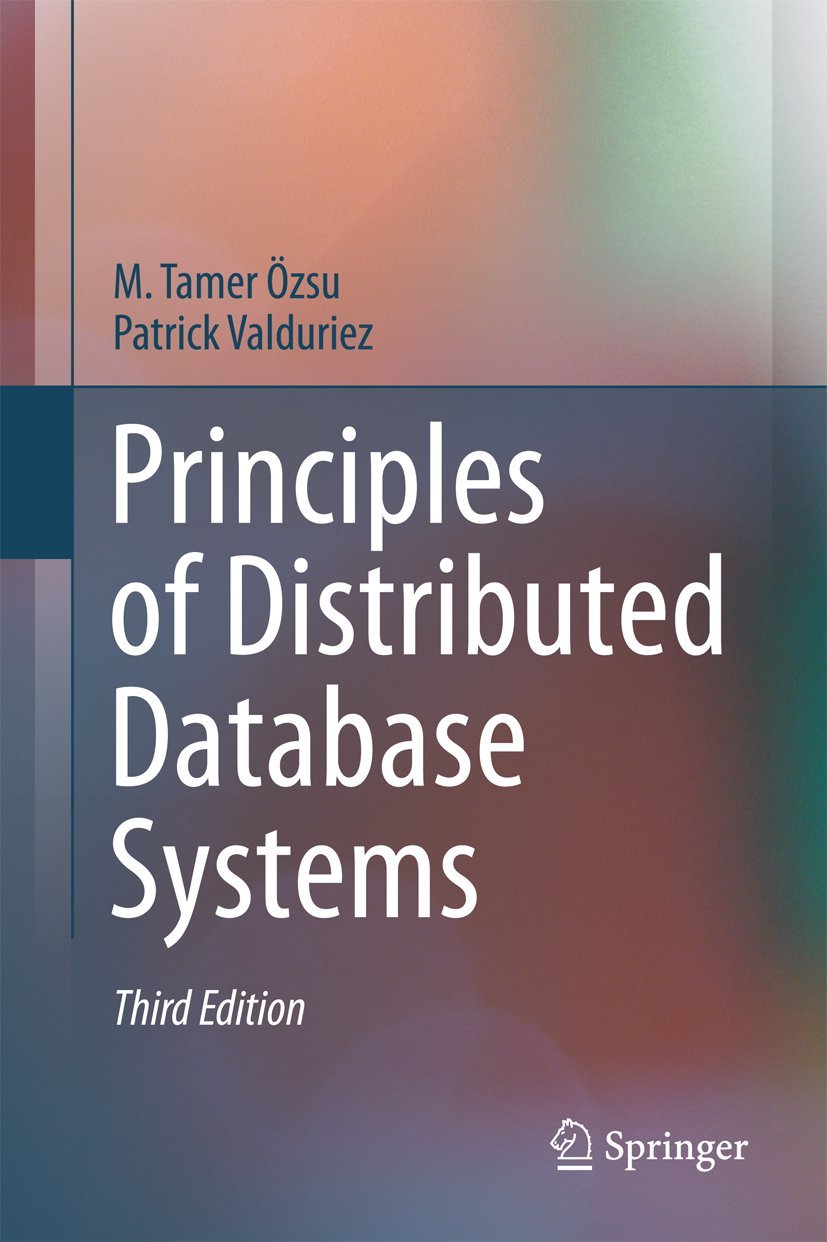
This book is a concept and theory oriented. It describes the union of database systems and computer networks technologies.First, they start with a brief introduction of DBMS and Computer Networks. If you do not know much about relational database management systems or computer networks then it is advised that you read chapter 2.Then, the authors continue with a description of Distributed Database Design. There are some important factors. For instance, the distribution design issues, specifically fragmentation and allocation.There are some chapters that talk about Database integration, access control, and query processing, however, I consider Chapters 10 to Chapter 13 the most relevant and interesting of the book. Chapter 10 provides a nice introduction to transaction management concepts (mutual consistency, transaction's definition, properties of transactions, and types of transactions). Then, Distributed Concurrency Control comes into place providing a very good description Serializability Theory. Moreover, they explain clearly concurrency control mechanisms (Locking-based, timestamp-based, and optimistic-based), at the end of the chapter you can observe deadlock management and relaxed concurrency control mechanisms. Finally, Distributed DBMS reliability is explained providing a nice understanding of failures and how to deal with those. Network partitioning is also discussed.Finally, what I like most about the book is the research-oriented content. There are plenty of resources at the end of each chapter that you can take advantage of (Bibliographic notes). For instance, in serializability theory, they mention and explain Papadimitriou paper which is easier to understand than the paper itself. The book is easy to read and you can extend your understanding reading the additional material.Hope this helps.
G**A
Good book, rude author
The book itself is not bad. But the author (Tamer) is the most rude of all...I tryed to contact him about the answers on the exercices (just the final answer, not the rationale...) and he said "he would NOT give it to students" and that I should "ask my teacher" (in capital letters).I wouldn't recommend buying the book just because of this rudeness.
M**O
A great book with fundamental concepts for Big Data Analysis
I've been using this book since its 2nd edition in my "Distributed & Parallel Database" grad and undergrad courses and I really like the way it is structured and the commented Bibliographic Notes, which closes every chapter.In these days of Big Data Analysis, Map/Reduce and Hadoop programming I find it even more important to settle the basis for data partitioning, data replication, reliability, data parallelism and data-flow optimization. These concepts are very well defined and are not restricted to DBMS. The 3rd Edition also contributes with distributed data management issues in cloud computing. The companion presentation slides also make my life much easier.
R**O
A great book with the principles needed for cloud data management
This is a very useful book. Despite the name, this book is covering the principles of many fundamental techniques that one has to master to architect cloud data management solutions. It is a must-read for those people interested in mastering this area. It covers the foundations for distributed data management providing a very good coverage of the main techniques and providing pointers to the most relevant papers on each area to go deeper when needed.
Trustpilot
Hace 2 semanas
Hace 2 semanas
Hace 3 semanas
Hace 1 mes