Desert Online General Trading LLC
Dubai, United Arab Emirates
Desert Online General Trading LLC
Dubai, United Arab Emirates


🔍 Discover the Power of Precision!
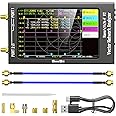
The Upgraded NanoVNA-F V2 is a state-of-the-art Vector Network Analyzer that operates within a frequency range of 50kHz to 3GHz. It features a large 4.3-inch touch screen, a high-capacity 5000mAh battery for extended use, and a durable aluminum housing. This device is perfect for measuring S-parameters, SWR, phase, and more, making it an essential tool for professionals in the field.


J**N
Works great for checking antenna SWR
I'm very impressed with this vector network analyzer. I'm using the NanoVNA-F to analyze the SWR of my ham radio antennas, which span from 1.8 MHz to 450 MHz. The 4.3" screen is easy to view and large enough that I can select options on the touchscreen with my index finger. Because it's portable (7 hours expected run time on 5 Ah rechargeable battery), I can take it up on the roof to fine tune a nine band vertical, or measure SWR in the convenience of the ham shack. Accuracy is outstanding and definitely better than the radio's built-in SWR meter. While using the VNA in the ham shack, I typically run PC software (NanoVNA Saver) to graph each band's SWR, which I can then save or print. The number of data points can also be increased using NanoVNA Saver. Do a Google search of NanoVNA PC software to find the file downloads. The user manual can also be downloaded, as well as firmware update information.UPDATE: The user manual for the NanoVNA-F can be dowloaded at deepelec dot com under the support page. The current filename is NanoVNA-F_Handheld_Vector_Network_Analyzer_Incomplete_Manual_v1.0.pdf. Despite the name, it looks fairly complete and includes firmware update instructions. I updated the firmware version from 0.0.4 to 0.0.5, which extended the frequency range up to 1.5 GHz. Firmware updating is very easy and can be done without removing the case. I'd suggest waiting a few days after new releases are announced before downloading and installing them, to allow time for new bugs to be resolved. The 0.1.1 release just came out a few days ago, which adds a TDR and improved marker functions. It's nice to see the frequent updates which add features and improve performance.
G**B
What an incredibly helpful piece of gear at a low price
This is an incredibly useful piece of gear for anyone involved in amateur radio. This makes tuning of antennas and feed lines much easier.We live in a magic age when we can get this level of quality and accuracy for this price range. (These sorts of products used to be tens of thousands of dollars).Do yourself a favor and buy one. You will learn a lot about radio science by learning how to use it.
E**E
WOW, WHAT A PIECE OF EQUIPMENT
lOTS TO LEARN, THANKFUL FOR YOU-TUBE
S**.
A very useful tool at a silly low cost. Great value.
I used to specify test equipment way back in the late 70's and early '80's. It is amazing how much capability you can now get for a silly low cost. The only thing I would stress is that you really need to keep your start and stop frequencies as close to the target frequency of interest as there are only 200 points in a scan. Once you have narrowed down the scan range, calibrate. Some folks seem to find this onerous, believe me back in the aerospace days when I was a wee engineer calibrations were a regular part of any test set up in the RF world. Other than that, once I got past being really rusty in my recollection of using s11/s21 two port measurements and interpreting them fairly well I'm completely pleased with this device. Maybe because I recall specifying over a quarter million in gear to fill a rack in an RF test set, I don't mind a few little oddities now and then in a device costing well under $150. It's been over forty years since I last plotted a Smith chart. It is mind blowing for me to have one generated quickly and to be able to see all the complex impedances interacting. Being able to wind a fast unun or balun on an unknown but "probably the right ferrite" core and validate the frequency capabilities of a core in minutes is wonderful. Not sure how much practical application I have now that I'm retired, but I'm back to playing with antennas, an old love. Being able to scratch that itch without taking hours of cobbled together test equipment sure is nice. Probably not going to be doing any strip line or micro strip line again in this lifetime, but it's pleasing to have such capability at a very low cost. More importantly, it is a really good value, not just cheap!
R**R
Small product lots of functions for the money
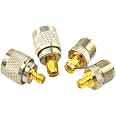
The VNA arrived quickly packaged in a nice plastic container with two coaxial cables, calibration standards (termination, open and short), and a couple barrel adaptors. This is an awesome little VNA (300KHz to 3GHz). After calibration, I did a fair amount of testing with known devices (attenuators, filters, and LNAs). I am accustomed to using VNA that cost $30K to $100K and this little guy does most of the same basic measurements. Of course there are significant limitations (one port measurements for example). This device is very easy to use. If a person is experienced in using Keysight (Agilent/HP) VNA, this little instrument is simple to use with no manual. If one needs a manual there are websites and wiki pages that have one for down load (free) because this instrument is based on open sourced firmware and hardware design.There are performance considerations.1) calibration could be better. The standard termination supplied measure (at DC) 51.5Ohms compared to my higher quality standard termination 50.1Ohms. Also one can see that after cal, with an open (or short) ripples can be seen in the return loss (positive return loss) and if a cable attached the smith chart show frequencies outside the edge. The issue is less noticeable with a more narrow frequency span. Because the sweep is only 101 points, cal over wider frequency sweeps not so good.2) I could not add more points to the sweep (seems 101 points is the max, am I wrong?). If one down loads the PC software, and then increase the sweep segments, the equivalent number of points can be increased (I've done 1010 points or ten sweep segments). Measurement results are excellent and advanced automatic filter characterization features work very well (CF, IL, +/-6dB points ..).3) sometimes when operating the device from the PC and then change menus on the device via touch screen, the display can become garbled showing random characters. Changing the menu to the top level (selecting successive <back> ) helps it self correct.4) Dynamic range is limited (I believe 60dB on this model). But, for most of my measurements I don't care. If someone is characterizing a duplexer (or n-plexer) for mobile communication devices, then they should not be using this device.Conclusions: I have not looked at the signal generator capabilities yet. Overall, for RF and Radio enthusiasts (and RF hardware design engineers), this is good instrument to have on the bench or in the tool box. I like it. so far ....
R**.
Great devise
Product was recommended to me by EE. BE USING IT SHORTLY .
Trustpilot
Hace 1 mes
Hace 3 semanas
Hace 2 semanas
Hace 4 días