We remain fully operational. Our teams are working around the clock to ensure your deliveries continue safely.

Descargar la aplicación


Servicios al cliente
Sobre nosotros
Copyright © 2025 Desertcart Holdings Limited
Descargar la aplicación


📖 Own a piece of literary history—1984, redefined for today’s visionary reader!
George Orwell’s 1984, presented in a 75th Anniversary large print paperback edition, offers 328 pages of dystopian brilliance. Published by Signet Classic, this mass market paperback combines readability with collectibility, ranking top in classic and dystopian fiction categories with stellar reviews from over 123,000 readers.

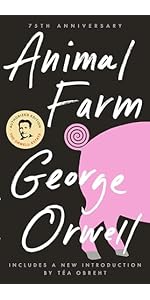
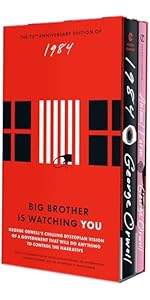


| ASIN | 0451524934 |
| Best Sellers Rank | #1,028 in Books ( See Top 100 in Books ) #3 in Classic Literature & Fiction #8 in Dystopian Fiction (Books) #123 in Literary Fiction (Books) |
| Book 3 of 8 | The English Edition |
| Customer Reviews | 4.6 4.6 out of 5 stars (123,534) |
| Dimensions | 4.19 x 0.9 x 7.5 inches |
| ISBN-10 | 9780451524935 |
| ISBN-13 | 978-0451524935 |
| Item Weight | 2.31 pounds |
| Language | English |
| Print length | 352 pages |
| Publication date | July 1, 1950 |
| Publisher | Signet |
| Reading age | 16+ years, from customers |
R**Y
Ages like a fine wine with a dark, full-bodied harbinger of doom, increasing with relevance as each year goes by.
What can be said about this book that has not already been said? Orwell’s despondent view of an evil utopia hits all the right notes. His vision into a near-possible future is stunning, depressing and all too understandable. A warning, a final prophesy written by a spirited visionary in the final stage of his life. Many have read this book early in their youth, most likely as part of their educational upbringing. 1984 and Animal Farm are standard, pedantic texts battle ready for disaffected youth to sink their teeth into. This book, among the greats, seems boundless in the echoes and touchstones resounding within its tome. In revisiting the text many years later, one will find that Orwell’s words seem strangely even more relevant than they were at first blanch. Perhaps even more so than they were when original meted out and scratched into paper during the author’s self-imposed exile in the Scottish isle that was his final home so many years ago. There are so many elements here that have such deep and broad depth that will keep this work of literature relevant for many more years. Orwell invented the terms “Big Brother” and “Thought Crime” and dove unrepentantly into issues of privacy, personal freedom and individualism. All this before the revolution of the internet! He also fretted over the degradation of language (OMG!) and the breakdown and bastardization of society’s communal bonds, family bonds, bonds of friendship and the abolishment of simple love. His vision of a mechanized society (one that even turns books out by machines), is more than a decry by a luddite so much as it concerns the debasement or obliteration of the individual and sense of self. Orwell’s main thrust seems to be right at the heart of man and the core inner lust for domination and power, simply for its own sake. That ever-present evolutionary tendency to thrive at all costs without purpose or direction, and the ability of that singular impetus to take over and distort all else toward its own end. He digs that up out of the blackest parts of the human heart and disgorges it upon the shoreline of society receding tide as if to say, “This too is what you are. Do not kid yourself.” For me, this book was rough. The tone was bleak. Throughout. Unflinchingly somber and hopeless. Yet, the story of the protagonist and his struggle amid this world turned upside down, is relatable and believable. Despite the obvious despair and immeasurable odds, we do feel for Winston Smith (the protagonist) and we do root for him. We follow him in his desperation to find something, some way to express himself and make a dent in the impenetrable wall that has become the totalitarian society which he is a part. We feel his constant fear and ever present distrust of everything—almost. The little glimmers of possibilities, even when they are squashed, keep your interest and balance the grim-gray that pervades everything. One thing that struck me was that the female character Julia, is an interesting addition. She has a good amount of gumption and serves more than just a goal or love interest. She is fleshed out pretty well and adds a lot of dimension to the story by sharing the protagonist’s goals, but also coming from a slightly different more realistic viewpoint. Another thing I found interesting in reading this book in present time was how insular the story is. We are just as stuck as the protagonist. All news of the outside world and the society is filtered to the reader through the regime in power. We never really know who to trust or when something might be real or made up or mere speculation. Nothing ever really seems certain. The story never ever escapes this – there is never an Oz-like “Man behind the Curtain” moment. Not really. We are told how some things work, and sometimes by sources that are deemed more reliable than others, but we don’t truly find out. This tight view point, keeps up a claustrophobic feeling that forces the storyline to remain connected to the protagonist’s individual struggle. Even though Winston Smith is concerned with larger concepts and a revolutionary struggle on a society level–the story remains individualistic. However, the tale is not a man’s struggle with himself, it is a man’s struggle to find himself among others; the interrelatedness of things and how important that is. The totalitarian regime in power has distorted this effect and is manifesting control by continually putting up road blocks and pseudo-constructed, societal norms to hamper true progress and growth. Even still, the individual struggles to find their place in society. As the story goes on, I think it is clear that most of this doomed society continues to struggle with this. And the powers that be, must expend an immense amount of effort and expense to constantly suppress this. In the end, can that really work? Have a care. Big Brother is watching. Podcast: If you enjoy my review (or this topic) this book and the movie based on it were further discussed/debated in a lively discussion on my podcast: "No Deodorant In Outer Space". The podcast is available on iTunes, YouTube or our website.
A**E
Great book
Good quality great read everybody should read this once in their lifetime
H**N
interesting to read this 76 years after it was written
Time to read this book again If you haven’t read this book since you were required to read it in high school or college, many years or decades ago, it’s extremely worthwhile to read it again. Much has happened since you last read it. You’ve also changed you’re own perspective. I last read it in high school in 1974, but was recently motivated to read it again after reading Anne Applebaum’s fantastic book, Iron Curtain, which reconstructs, from the everyday-person’s point of view, how after WW II, the Soviet Union conquered Eastern Europe and wiped out civil society in Eastern Europe after conquering it. I’ve heard the phrase “dystopian world” used to describe this book, and I disagree. This book is a clear reaction to and comment on the Soviet takeover of it’s own country and especially Eastern Europe that was occurring while Orwell wrote. Orwell, who I just learned died young at age 46 years old, just a few years after the book came out in 1949, wrote this book in 1947 in the middle of that take over, and it is interesting to read it again, 75 years later, to hear Orwell’s thoughts on what was occurring, as it was occurring anew. As I am writing this in 2023, Russia is trying to wipe out Ukrainian culture, saying it never was a country, systematically bombing its museums and cultural buildings and television towers, forcing residents to use Russian money and passports, and forcing schools in Ukraine to only use the Russian language and Russian textbooks. The Wagner group story in Russian is being changed. In Russia there isn’t a television screen in everyone’s home, like a bathroom mirror, as depicted in the book, but, not too far off the mark, everyone is on the internet, and the Russian thought police certainly monitors what people type and post. I do have to say that for the last few hours of the book, I just waited to get it done with…the extended torture scenes where Orwell shows us how torturing Winston brainwashes him, the long appendix where the narrator goes over the 1984 dictionary, the idea of a permanent war with minimal true destruction as a way of controlling the population. I thought it was interesting that the book is premised on a nuclear war happening in the 1950’s, and the world being broken up into Russian, USA/British, and China spheres of influence—-actually not too far from where we are now, minus the nuclear war, assuming Ukraine doesn’t heat up. It is interesting that Russia has survived as a thought-controlling type of government. This was likely all new when Orwell wrote 1984 back in 1947. Lastly, as I am a lot more experienced compared with when I read this book in high school in 1974, I can now appreciate Orwell’s severe sarcasm. Orwell is not quite funny, but very frequently I found myself smirking and shaking my head. I did the audiobook, and Simon Prebble did well. As a parting thought, in our capitalist society our every thought is monitored by companies like Google, Amazon, and Facebook, and then sold and used to make money and manipulate what we do and think. Much of this information is also searchable by our own government under search warrant. Congressional hearings about this are currently underway. Don’t mistake me, I’m far from saying anything positive about Russia, but just saying….
A**R
Great Quality
I really like the size of this book. Great to slip into a bag to read anywhere! Has held up very well to being thrown around in my backpack. Also, this is an amazing book :D
R**S
True classic
Prescient. A must read and have in your library.
M**Z
Increíble ambientación, y gran historia. Deberían hacerle una película o serie. El personaje principal, Mrs Smith, encaja perfectamente con el ambiente.
V**G
Great book, a must read! The cover really fits with the theme of the book and looks great on the shelf
A**E
Roman le plus connu de George Orwell, devenu un classique de la SF dystopique, 1984 est un livre à lire au moins une fois dans sa vie. Je l'avais lu adolescente en Français, étudié le film en cours d'Anglais, j'ai voulu le relire en VO. Si vous suivez mes "C'est lundi, que lisez-vous ?", vous savez que j'ai pris du temps pour le relire. En effet, même si le niveau d'Anglais m'est accessible, ce livre demande une certaine concentration en VO, et chez moi c'est souvent bruyant avec les enfants ! Pour les quelques personnes qui ne connaissent pas l'intrigue, 1984 est l'histoire de Winston Smith, anti-héros, dont le rôle sert finalement à dépeindre les rouages d'une société totalitaire. Je parle d'anti-héros parce que son personnage est assez lâche, et quand il agit c'est de façon plutôt stupide. On ne peut pas dire que l'on s'attache vraiment à lui, mais il représente parfaitement le résultat de la dictature dans laquelle il évolue. L'histoire se présente en trois parties, la première expose la société gérée par le Parti et le symbole que représente Big Brother. La seconde est consacrée à l'histoire d'amour et la rébellion de Winston. La dernière est le résultat de cette-dernière. Si je dis qu'il faut lire ce livre au moins une fois, c'est pour la façon très juste avec laquelle l'auteur décortique le fonctionnement d'une société totalitaire. De l'embrigadement des jeunes, à la manipulation de l'information, en passant par la surveillance constante, 1984 est à la fois un rappel historique et actuel (cf la Corée du Nord ou même la Chine) et un avertissement pour le futur.
N**A
All in order.
N**T
+
Trustpilot
Hace 1 semana
Hace 3 semanas