We remain fully operational. Our teams are working around the clock to ensure your deliveries continue safely.

Descargar la aplicación


Servicios al cliente
Sobre nosotros
Copyright © 2025 Desertcart Holdings Limited
Descargar la aplicación

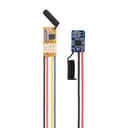
🚀 Tiny Tech, Massive Control — Command Your Space Wirelessly!
The ZABLL 3.7-12V Wireless Remote Control Switch is a miniaturized 433MHz RF transmitter and receiver set designed for flexible, reliable remote switching. With a compact PCB size of 25x11x8mm, it supports multiple working modes and operates across a broad voltage range (3.7V to 12V). Its stable wireless signal penetrates obstacles up to 50 meters, making it ideal for DIY projects, home automation, and security applications. Pre-paired for immediate use, this device offers professional-grade remote control with minimal setup.
| ASIN | B08F7FFQ14 |
| Best Sellers Rank | #172,895 in Tools & Home Improvement ( See Top 100 in Tools & Home Improvement ) #731 in Garage Door Keypads & Remotes |
| Brand | ZABLL |
| Brand Name | ZABLL |
| Circuit Type | 3-way |
| Connectivity Protocol | RF |
| Connector Type | Screw Terminals |
| Contact Material | Copper |
| Contact Type | Normally Open |
| Control Method | Remote |
| Controller Type | Push Button |
| Current Rating | 1 Amps |
| Customer Reviews | 4.0 out of 5 stars 64 Reviews |
| Item Dimensions | 0.98 x 4.33 x 0.43 inches |
| Item Weight | 9.07 g |
| Manufacturer | ZABLL |
| Material Type | Copper |
| Model | NO1J |
| Mounting Type | PCB Mount |
| Number of Positions | 1 |
| Operation Mode | Momentary, Toggle, Latched |
| Specification Met | CE |
| Switch Type | Push Button |
| Terminal | Through Hole |
| UPC | 732489635991 |
| Wattage | 12 watts |
G**P
Works great on 3VDC.
I was a little worried about whether or not these circuits would work on 3VDC since the title states "3.7 to 12VDC". Connected them to 3VDC (2 AA batteries) and it works flawlessly. I don't need to mess with the different available modes, so I don't know if they work or how hard it is to implement, but the momentary function works perfectly for me.
A**T
So far so good
So one side of the yard I have a pond, the other side is a 24vac valve. I'm using a fill relay which I also purchased on Amazon. The purpose is to fill the water up for the pond automatically. This needed to turn that relay on from about 100 feet; otherwise guess who gets to dig a big trench to run one tiny wire. This is the only product I found like this. The pond side uses 24vdc turns on a buck converter to 12v which turns this on. The other side is a 9vdc psu I had laying around. I will update this review when it fails!
P**R
Doesn’t work
Receiver drains its battery regardless of power to the transmitter. Transmitter on/off not received by the receiver. Multimeter tested in all respects (power in, power out, reception, etc).
S**S
I have two working for me
I purchased two of these to work with 3.7v and 7.4v liPo battery thingies. Only been using it for a few days, but one receiver is switching on at 7.4v and has about 4A running through it -- the power requirements from eight little electric motors, each of which would normally be powered by three AA batteries ... The instructions admittedly were confusing. They are the kind of thing that once you know how the transmitter + receiver works, the instructions then make sense...
S**A
Well I'm NOT a Happy User!!
Well I am not a happy user at all, since I have gone through two of these kits, and I am done. I am an Electronics Engineer by trade! I installed in a nice small plastic box, and powered the transmitter from the 12volt battery on my garage door opener. The receiver was 10 feet away driving a small Amazon supplied 12volt relay. I use it to light an LED parking light, without running wires across the ceiling. Everything worked great for two months, and then all of a sudden the transmitter board stopped working. Could figure it out, but I could place my thumb and for-finger across the little board and the receiver would light. Took it off and it would quit. Ordered a 2nd one, and just a few days ago the transmitter board stopped again, after working great. This time I used a regulator board from Amazon, and had adjusted the input VCC voltage to 12volts, then 11volts, then 9volts, and this board is dead again! I can do the same with two fingers and the same, remove and it quits! The range on this little board is amazing, when working, in that I can be inside of my 3300 sq' house, and the receiver lights the LED in the garage, thru multiple walls! I am now going to switch to another wireless switch transceiver, to get this resolved!! The board on the right is an Amazon optical sensor relay board to activate the transmitter!
P**R
iT'S A miricle!!
I needed a Transmitter/Receiver to monitor my garage door (Open or closed) (along with Arduino UNO's).. I have tried several NRF24L01 - and could NEVER get any of them to communicate.. As a last resort, tried these.. They worked first time!! (Amazing).. TRANSMITTER: Has 2 wires (POWER ONLY) - switch on power and it transmits, remove power it stops transmitting. RECIEIVER: Has 4 wires (2 for power, 2 for relay switch) Relay is closed when Transmitter is on, open when transmitter is off.. Like I said - worked on first try out of the box - VERY HAPPY - PLUS has excellent range!!
D**D
works great for my projects
ive bought quite a few of these for my projects and they work well.
M**N
Some Experimentation Required
This device is cheap and worked out of the box. Get very deep into them and you will find a couple good things and bad things. First: There are NO INSTRUCTIONS. You get the boards in a bag, and the extent of the instructions are what you find on this listing, lol! Second: Range is much greater than advertised. We found that it can receive at 155 meters, through buildings. Third: They CAN be programmed. Ignore reviews that say that they can't. There is a red LED on the receiver board that will flash in its own little mysterious language when you're playing with the programming contacts (the listing points out where they are. Short them out with a jumper wire to make edits). At risk of writing too long a review, here is what we figured out with programming, using ONE TRANSMITTER. The product listing states that you may use a second transmitter for on/off commands, but we did not dive into that. Holding the programming contacts together, with * representing an LED flash on the receiver board... (the boards will flash in increasing numbers) *: Stay on. Relay turns on with transmitter but does not disconnect until receiver loses power. **: Stay on for 0.5sec, then wait until next new signal from transmitter. Regardless of length of push, the relay stays on 0.5sec before turning off again. ***: Stay on until transmitter turns off, then on again. For example, one transmitter push turns relay on. Another push will turn it back off. ****: Stay on. Relay turns on with transmitter but does not disconnect until receiver loses power. *****: Stay on. Relay turns on with transmitter but does not disconnect until receiver loses power. ******: Stay on. Relay turns on with transmitter but does not disconnect until receiver loses power. *******: DELETE TRANSMITTER. The receiver will stop reacting to its transmitter, and waits for you to pair a transmitter with it. Adding a transmitter: Delete the previous transmitter. Now hold the learn contacts until seven flashes. Wait until the LED stays on solid. Now hold on the transmitter you wish to pair with the receiver. The LED will flash. Keep holding the learn contacts. The LED will flash again. Now the relay is in the original programming mode, where holding the transmitter on will hold the relay on. There is no way to return to this mode without deleting and repairing the transmitter. Believe me, we tried this a lot. SO, you can have one transmitter trigger more than one receiver/relay by programming multiple receivers to listen to one transmitter. We had to do this because... THE TRANSMITTERS WILL JAM EACH OTHER WHEN ON AT THE SAME TIME! That's right, if you power two transmitters next to each other at the same time, one or both of the corresponding receivers will fail to function. Also, walkie-talkie radio interference can jam the transmitter signal, especially when the receiver is far from the transmitter. An incoming call on the radio can cause the relay to trip on and off. Do with this what you may! The relays are neat and useful. I can't speak to defective boards, because the two we have bought work fine so far. (It's only been a week.) The lack of instructions is a real challenge that could be easily avoided with a tiny bit of effort from the manufacturer.
Trustpilot
Hace 3 semanas
Hace 2 semanas