
Descargar la aplicación


Servicios al cliente
Sobre nosotros
Copyright © 2025 Desertcart Holdings Limited
Descargar la aplicación
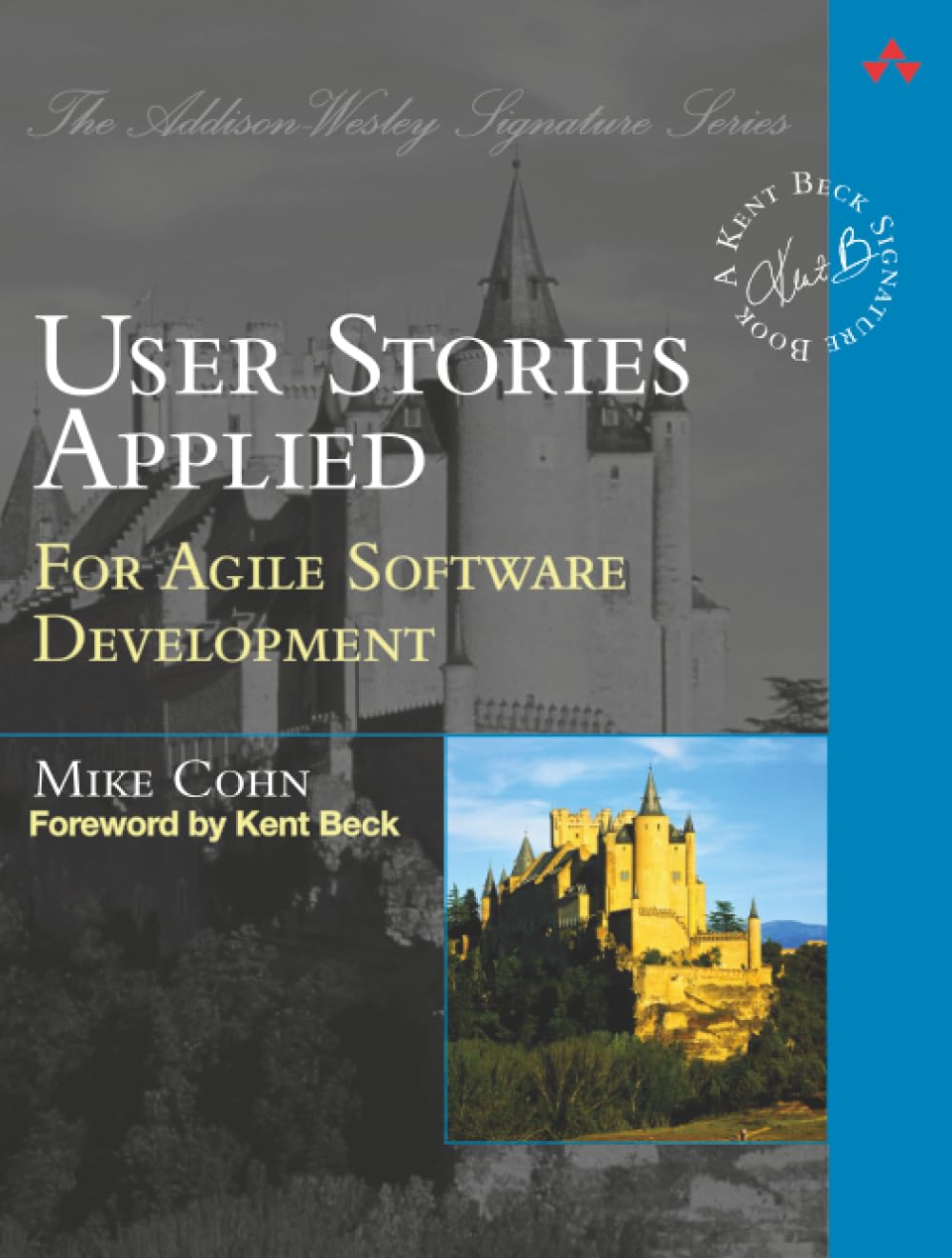
Buy Addison Wesley User Stories Applied: For Agile Software Development by Cohn, Mike online on desertcart.ae at best prices. ✓ Fast and free shipping ✓ free returns ✓ cash on delivery available on eligible purchase. Review: Coté contenu du livre : Le livre est extra. Il m'apporte pas d'éclaircissements sur les users stories et me permet de gagner en efficacité sur ce domaine. Coté état su livre : Une trace de cutter de 5 cm sur le livre. heureusement que le coup de cutter n'a pas été trop loin. Dommage. je fais donc attention pour ne pas provoquer la déchirure mais je garde le livre. J'ai mis un bout de scotch qui fait l'affaire. Review: Pure Gold! The first chapter will convince you why User stories are orders of magnitude better than the use cases you know and love. Each of the subsequent short chapters is tightly focused and covers a key aspect of user stories (e.g. writing good stories, user profile mapping. using stories in planning and estimating etc.). As you go through the book, you can see how the different pieces of user stories fit together and how user stories themselves fit into a software development process. (The book itself leans heavily towards an agile process such as Scrum or XP although the exact process does not really matter) Despite its directness and succinctness, it is a very engaging and thought-provoking book. If you want to understand behaviour-driven development, specification-by-example or user story mapping (each of which is adequately in a book by a key populariser/practitioner of the respective technique) you should really read this book first. And even if you never practice any of those techniques, you should still read this book if you want to learn how to capture software requirements effectively in the modern, agile, test-driven world. It is one of that crop of brilliantly written, painstakingly edited software engineering books written by luminaries in their fields, that were published by Addison-Wesley in the 2000s: Refactoring by Fowler, Test-Driven Deveopment by Beck, this book, Pattern-oriented software architecture I and II, Patterns of Enterprise Software Integration (Fowler et. al.) and many others. They remain as relevant and thought-provoking today as when they were first written.


| Best Sellers Rank | #128,653 in Books ( See Top 100 in Books ) #332 in Software Design, Testing & Engineering #49,147 in Textbooks & Study Guides |
| Customer reviews | 4.6 4.6 out of 5 stars (378) |
| Dimensions | 17.78 x 1.7 x 23.5 cm |
| Edition | Illustrated |
| ISBN-10 | 0321205685 |
| ISBN-13 | 978-0321205681 |
| Item weight | 499 g |
| Language | English |
| Print length | 304 pages |
| Publication date | 18 March 2004 |
| Publisher | Addison-Wesley Educational Publishers Inc |
C**N
Coté contenu du livre : Le livre est extra. Il m'apporte pas d'éclaircissements sur les users stories et me permet de gagner en efficacité sur ce domaine. Coté état su livre : Une trace de cutter de 5 cm sur le livre. heureusement que le coup de cutter n'a pas été trop loin. Dommage. je fais donc attention pour ne pas provoquer la déchirure mais je garde le livre. J'ai mis un bout de scotch qui fait l'affaire.
S**F
Pure Gold! The first chapter will convince you why User stories are orders of magnitude better than the use cases you know and love. Each of the subsequent short chapters is tightly focused and covers a key aspect of user stories (e.g. writing good stories, user profile mapping. using stories in planning and estimating etc.). As you go through the book, you can see how the different pieces of user stories fit together and how user stories themselves fit into a software development process. (The book itself leans heavily towards an agile process such as Scrum or XP although the exact process does not really matter) Despite its directness and succinctness, it is a very engaging and thought-provoking book. If you want to understand behaviour-driven development, specification-by-example or user story mapping (each of which is adequately in a book by a key populariser/practitioner of the respective technique) you should really read this book first. And even if you never practice any of those techniques, you should still read this book if you want to learn how to capture software requirements effectively in the modern, agile, test-driven world. It is one of that crop of brilliantly written, painstakingly edited software engineering books written by luminaries in their fields, that were published by Addison-Wesley in the 2000s: Refactoring by Fowler, Test-Driven Deveopment by Beck, this book, Pattern-oriented software architecture I and II, Patterns of Enterprise Software Integration (Fowler et. al.) and many others. They remain as relevant and thought-provoking today as when they were first written.
L**N
This excellent book is a must-have for anyone on an agile team - developers, testers, business experts, analysts - and for anyone who struggles with requirements, planning, or estimating on any software project. User Stories Applied is easy to read and digest. As the title suggests, its techniques are easy to apply and deliver huge value. Each chapter summarizes developer and customer responsibilities, and has questions whose answers are provided in an appendix. The book is full of real-life, concrete examples, allowing you to learn from the successes and failures of others. This book will give you many tools to help your projects succeed. Just a few of the most valuable topics: When are user stories too big, too small, too detailed, too general, too open ended, when are they not user stories, and how to correct all these. Why use user stories. How to handle requirements for infrastructure, performance, qualitative aspects, UI. How to ask questions to elicit requirements. How to cope when you don't have `on-site customers'. Practical ways to estimate stories. Monitoring velocity and progress. When to keep and when to discard artifacts. Mike explores the differences between stories and other techniques for delivering requirements: IEEE 380, use cases, scenarios. He points out many positive side effects of user stories, such as encouraging participatory design and tacit knowledge accumulation. I particularly like that the book emphasizes the team's responsibility to successfully complete each iteration. I enjoy Mike's illuminating bits of wisdom, such as the "everything takes 4 hours" example. I love the comprehensive example in Part IV. No matter what your level of experience, you'll put the ideas in this book to immediate and productive use.
C**N
Altro autore di riferimento per l'agile. Da leggere se interessa la metodologia. Linea guida semplice e di buon senso. Da studiare
S**P
Very well written book. It explains everything you need to understand Agile (a collaborative process involving customer and developers) and use it to deliver software that meets user expectations in an incremental way that allows for changes along the way, and achieve greater customer satisfaction, based on a more realistic approach for planning and estimating. The book is filled with clear examples. Most chapters end with a summary, questions (answered in an Appendix), customer and developer responsibilities. There is a whole process case study in an Appendix.
Trustpilot
Hace 4 días
Hace 2 meses