We remain fully operational. Our teams are working around the clock to ensure your deliveries continue safely.

Descargar la aplicación


Servicios al cliente
Sobre nosotros
Copyright © 2025 Desertcart Holdings Limited
Descargar la aplicación
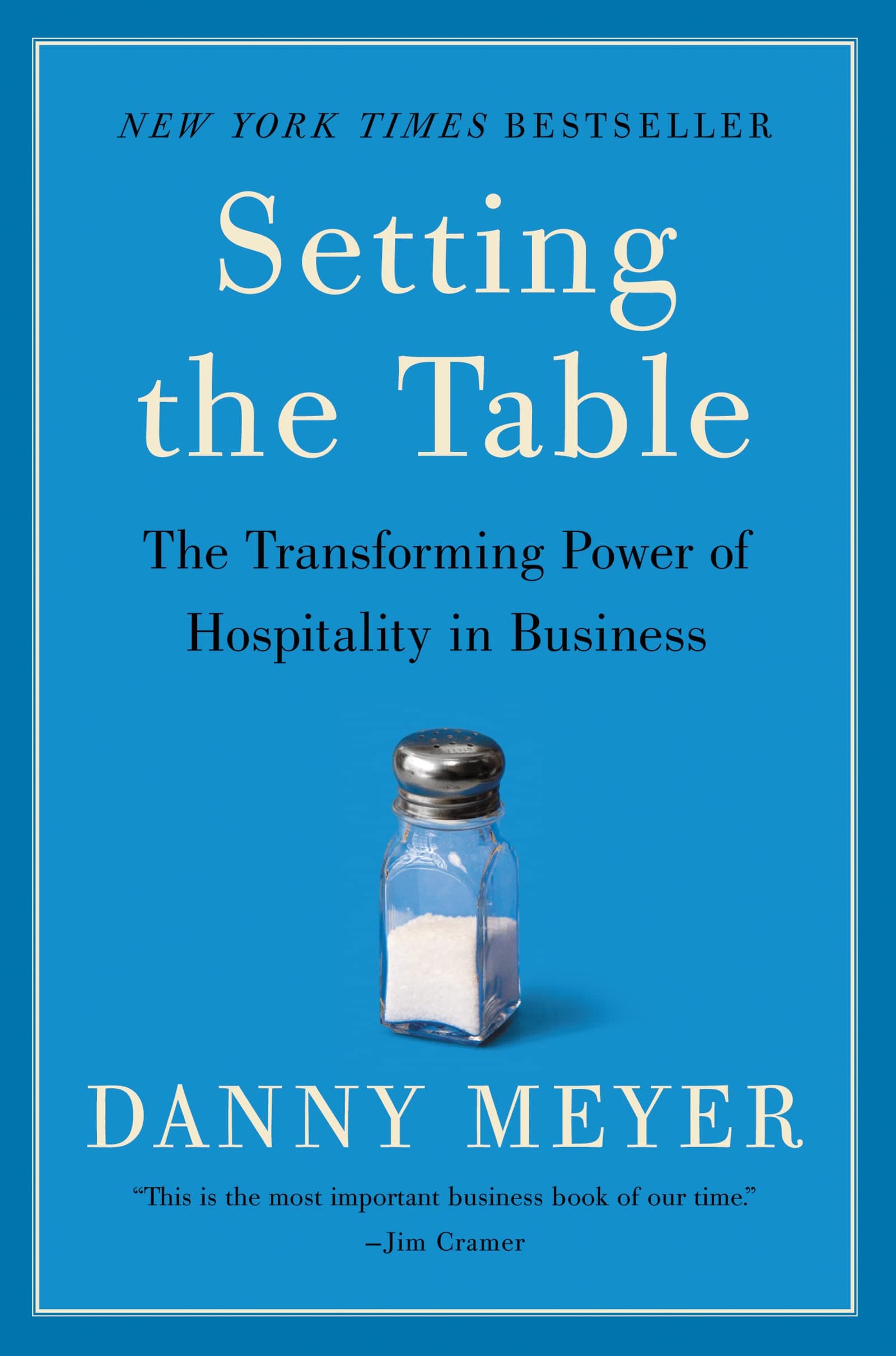
📖 Elevate your service game with the hospitality bible everyone’s talking about!
Setting the Table by Danny Meyer is a highly rated paperback bestseller that offers insider knowledge on hospitality and service excellence. With over 1,700 reviews averaging 4.6 stars, it ranks prominently in service and hospitality categories, making it a must-read for professionals aiming to lead with warmth and efficiency.


| Best Sellers Rank | #12,563 in Books ( See Top 100 in Books ) #7 in Service Industry #11 in Hospitality, Travel & Tourism Industry #21 in Biographies of Travelers & Explorers |
| Customer reviews | 4.6 4.6 out of 5 stars (1,721) |
| Dimensions | 13.49 x 1.93 x 20.32 cm |
| Edition | Reprint |
| ISBN-10 | 0060742763 |
| ISBN-13 | 978-0060742768 |
| Item weight | 295 g |
| Language | English |
| Print length | 336 pages |
| Publication date | 29 January 2008 |
| Publisher | ECCO |
J**G
amazing book
definitely a good one
S**A
Not printed properly, Paper quality is not up to the standard. Seems like a duplicate.
Not printed properly ,Paper quality is not up to the standard. Seems like duplicate.
K**Y
Fast delivery and a book worth reading.
G**Y
Me gustó que te cuenta su vida, antecedentes, historia y los aprendizajes de sus experiencias. Está entretenido al mismo tiempo que vas aprendiendo.
L**A
A book which shows a good mix of hiw to do good business with hospitality
D**N
Setting the Table by Danny Meyer provides lots of value for business leaders. I ranked this book five stars based on the value alone. The reader should be apprised that the book is written as a memoir of Mr. Meyer's experience in the restaurant business. As a business leader you should study excellence in your industry and outside of your industry and there are numerous take-aways in Setting the Table that can be applied to any business. Here are ten excellent points I took away from Mr. Meyer's book. 1. The Excellence Reflex - "A natural reaction to fix something that isn't right, or to improve something that could be better." The excellent reflex is a natural reaction that some people have and cannot be taught. Meyer trains his leaders how hire those that have it. 2. Employees can be categorized as Overwhelmers, Whelmers, and Underwhelmers. It is easy to identify Underwhelmers and get rid of them. The most dangerous employees are the Whelmers because "they infuse an organization and its staff with mediocrity...and send a dangerous message to your staff and guests that "average" is acceptable." 3. Coaching is correcting with dignity. 4. You obtain valuable leadership skills while managing volunteers. It requires you to consistently motivate employees beyond their earnings. 5. Create a sense of "shared ownership" with your customers by taking an interest in them and making them feel important. They will view you as a partner instead of a provider. 6. ABCD - Always Be Collecting Dots. You should aggressively collect lots of little information about your customer (dots) as they interact with your product or service. Then make the connection between the dots as a mechanism to improve your product or service to all customers. 7. Customers may love your product or service but the relationship that they have with you or your employees is what builds loyalty. Therefore you should take every opportunity to exceed expectations to create a lasting relationship. 8. Enlightened Hospitality - "We would define our successes and our failures in terms of the degree to which we had championed, first, one another and then our guests, community, suppliers and investors." This is an extremely powerful concept and is rooted in the integrity theme Meyer has throughout the book. You can't expect employees that don't treat each other with respect, who can't be hospitable with one another to then turn around and treat the customer with respect and high levels of hospitality a customer deserves. Poor relationships internal to the organization migrate to poor relationships external to the organization. Ultimately being last on the list benefits the investor by long term organizational success. 9. Judge your staff on 51 percent emotional job performance and 49 percent technical job performance. You can always teach technical while emotional is much harder if not impossible to develop. Lack of emotional job performance skills destroys teams and alienates customers. 10. "The road to success is paved with mistakes well handled" and "the worst mistake is not to figure out some way to end up in a better place after having made a mistake." The ten points above are obviously more powerful in the context of the book when illustrated with Mr. Meyer's stories and experiences. Dr. James T. Brown PMP PE CSP Author, The Handbook of Program Management
P**I
Great book. A hospitality must have
Trustpilot
Hace 2 días
Hace 1 mes