
Descargar la aplicación


Servicios al cliente
Sobre nosotros
Copyright © 2025 Desertcart Holdings Limited
Descargar la aplicación
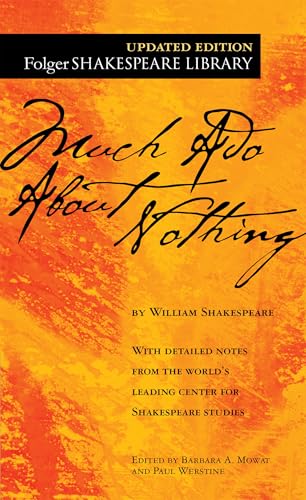


Buy Much ADO about Nothing by Shakespeare, William, Mowat, Dr, Werstine PH D, Paul online on desertcart.ae at best prices. ✓ Fast and free shipping ✓ free returns ✓ cash on delivery available on eligible purchase. Review: This edition is printed in relatively large text in a readable font with footnotes on every page. Included are introductory essays—which well worth one’s time. I am surprised by the sturdiness of the paperback edition’s glued binding, too. The play itself, of course, is lively and amusing, even if the many, many jokes about cuckoldry fly over modern readers’ heads. Review: A great comedy.
| Best Sellers Rank | #121,921 in Books ( See Top 100 in Books ) #43 in Dance #75 in Works of Shakespeare #131 in Drama & Play Types |
| Customer reviews | 4.6 4.6 out of 5 stars (2,936) |
| Dimensions | 10.48 x 2.54 x 17.15 cm |
| Edition | Annotated |
| ISBN-10 | 0743482751 |
| ISBN-13 | 978-0743482752 |
| Item weight | 136 g |
| Language | English |
| Print length | 304 pages |
| Publication date | 1 January 2004 |
| Publisher | Simon & Schuster |
B**N
This edition is printed in relatively large text in a readable font with footnotes on every page. Included are introductory essays—which well worth one’s time. I am surprised by the sturdiness of the paperback edition’s glued binding, too. The play itself, of course, is lively and amusing, even if the many, many jokes about cuckoldry fly over modern readers’ heads.
L**N
A great comedy.
M**E
Advertised as an annotated version. It was not annotated
I**N
No Fear Shakespeare’s "Much Ado About Nothing" is delightful. Shakespeare lived from 1564 to 1616. "Much Ado About Nothing" is ironic. Much that is interesting happens in this very well-crafted play. The "No Fear" procedure of placing the original Shakespeare language on the left pages with plain English translations on the right with frequent brief notes explaining ideas and behaviors that existed in Shakespeare's era but not today is excellent. The play has several "Ados" where people play tricks on others. Three result in favorable situations, one not so. (1) Beatrice and Benedick are very witty people. Whenever they meet, they mock each other in funny ways. Benedick never wants to marry because he is convinced all wives cuckold their husbands with lovers. Beatrice wants to remain a virgin until she dies because she dislikes being controlled by a husband. Women being subservient to men was considered proper during Shakespeare's era. Several friends devise a trick to make them fall in love. (2) Claudio is in love with beautiful, wealthy young Hero. A nobleman, Don Pedro, tells him he will woo her for him, get her to agree to the marriage, and then get her father's consent. Parents decided whom their daughters would marry in Shakespeare's era. (3) Don Pedro's illegitimate brother devises a plan to hurt Don Pedro, whom he despises, by ruining the happiness of Claudio and Hero. (4) When Don Pedro's trick to hurt Don Pedro seems to work, Friar Francis suggests a scheme to save the couple's happiness. There is humor in the pay in the speeches of two guards who get virtually everything wrong when they talk. But they save the day. There is also one disturbing item. In Act 2, Scene 3, Benedick says about Beatrice in Shakespeare’s language, "If I do not love her, I am a Jew." The plain English page changes this offensive wording to, "If I don't love her, I'm completely hard-heated." It explains in a note, "According to anti-Semitic stereotypes, Jews were supposed to be hard-hearted and lacking a sense of charity." Shakespeare also belittled Jews in his “The Merchant of Venice.” Interestingly, despite the play being built on ancient ideas, it is still enjoyable today.
L**E
I was a Librarian and had high school students coming in and complaining they couldn't understand or relate to the books...With these now they can!!
Trustpilot
Hace 1 semana
Hace 4 días