We remain fully operational. Our teams are working around the clock to ensure your deliveries continue safely.

Descargar la aplicación


Servicios al cliente
Sobre nosotros
Copyright © 2025 Desertcart Holdings Limited
Descargar la aplicación

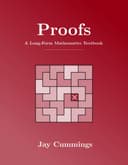
📈 Elevate Your Math Game with Proofs!
Proofs: A Long-Form Mathematics Textbook is an essential resource for students and professionals alike, offering a thorough exploration of mathematical principles, rigorous problem sets, and real-world applications to foster a deep understanding of the subject.
| ASIN | B08T8JCVF1 |
| Best Sellers Rank | #57,723 in Books ( See Top 100 in Books ) #3 in Discrete Mathematics (Books) #18 in Mathematical Logic #30 in Mathematics Study & Teaching (Books) |
| Customer Reviews | 4.8 4.8 out of 5 stars (1,031) |
| Dimensions | 8.5 x 1.16 x 11 inches |
| ISBN-13 | 979-8595265973 |
| Item Weight | 3.53 ounces |
| Language | English |
| Part of series | The Long-Form Math Textbook Series |
| Print length | 511 pages |
| Publication date | January 19, 2021 |
| Publisher | Independently published |
K**R
Tremendous
I can't say enough good things about this book. It's a math textbook that reads like an entertaining puzzle book. If, like me, you're interested in recreational mathematics, you will have encountered many of the examples before. Even so, you'll find many, many new insights. Lots of good exercises as well. And it goes beyond math; this is a great book on how to approach problem solving of any kind. The combination of rigor, rules-of-thumb, and intuition reminds me of Polya. Texts of this type should be required reading for college freshmen regardless. Plus, at this price, it's a real bargain! I plan to check out other books in this series. I bought it for the Kindle Fire, and it reads well on that device.
J**Y
Learn Proof Writing From A Master
I just finished reading another wonderful book by Jay Cummings. The book is titled "Proofs" and is intended to help the reader learn how to write diverse kinds of proofs from many different areas of mathematics. I especially liked Chapter 4 on Induction because the writing is very clear and to the point. He discusses both weak and strong induction and his examples are extremely well chosen. I especially like his writing style. He also writes about math proofs by induction that contain mistakes that can mislead the reader. His example of how all people have the same name is the same as a similar example not in his book that all horses have the same color. Trying to find the mistakes in these proofs can be a real challenge, but once you do it you will understand math induction even better than you did before. This book has a rather ambitious aim, as proof writing is all anyone does in upper division math courses. Trying to learn how to write proofs in such a wide open field is not easy. However, the author does not try to teach you any advanced math and that is another reason I am so attracted to his writing style. Here is another small but important example. In discussing functions, Jay explains that writing f(x) is standard for a 1-tuple, but writing f((x,y)) with an order pair is not necessary. This a small notational convention that can trip up some students. Jay gives you permission to be confused at times and is aware that even very small things can make your life complicated! Jay has written three books that are all very different. I recently learned that I read his three books in the reverse time order in which he wrote them. Nonetheless, I think most people will find his books very worth while. The "Proofs" book is as good as any and contains a lot of information.
A**R
Excellent for self-study
I really like this book (despite the author's awful sense of humor.) I'm pursuing self-study, and Cummings brings the reader along with clear explanations and very insightful exercises. However, I do use my favorite AI as my tutor/study group, to check my answers and discuss ideas. I do not have the AI solve the exercises for me, as Cummings makes amply clear that passive reading is ineffective. And it is. Ask me how I know. In any case, this is a wonderful introduction to understanding and writing proofs, without which we cannot do mathematics.
K**.
Approachable, optimistic, sincere, yet thorough - self-study approved
Jay effectively wields a sincere and conversational approach as he takes on the role of Sherpa to guide the reader on the arduous journey into the rigor and jargon-filled of formal mathematics. There are humorous footnotes, quirky diagrams/pictures, and insightful intuitions - all in an effort to acclimate the reader to a thinkspace where abstractions can crystallize into concepts more easily. He isn't shy about math being a tough and discouraging journey. The moment I knew I fell in love with this book is when I saw that Exercise 1.1 was to read Carol Dweck's "The Secret to Raising Smart Kids" - an insightful article that dispels the myth of people self-sorting into "good at math" and "bad at math". He constantly stresses that the ability to understand math is overwhelmingly a function of diligence, not some innate von Neumann-ian trait. He encourages confronting earnest failure/adversity and understanding that though frustration is discouraging, it is an indicator of progress and development. Jay is contagiously optimistic in guiding the reader through the journey and it cultivates more profound fulfillment when concepts finally "click". He has solutions to chosen (not all) exercises on his website - I can see why people are frustrated at this, because it can feel akin to having no 'supervision' to train your burgeoning 'neural math model', which can spark self-doubts as to whether you're navigating a problem correctly or not. However, for some other people, it's akin to pouring the alcohol down the drain for the alcoholic. I realize I an answer-aholic who often lets my frustration tempt me to look at the solutions to retro-verify whether my thinking was correct (and defeat the definition of an "exercise"), so I don't mind the lack of solutions as much. This just means it forces me frustration threshold to be a lot higher before I neurotically google/search for solutions online (which is my own shortcoming!). This is all to say that this book is an optimistic and humorous guide in approaching the fundamentals of formal math.
L**O
The ‘Introduction To’ sections of the book were my favourite and I loved the inclusion of open problems as it builds a curiosity towards mathematics.
D**J
Very good Math book
S**.
The Long-Form is plesant to read. A Fresh new way to learn math thinking.
N**K
Amazing book to start proofs!
R**E
Libro eccezionale che non richiede una conoscenza approfondita per poter essere compreso. Le spiegazioni sono molto chiare e le dimostrazioni piacevoli e divertenti da svolgere. L'approccio è molto informale ed aiuta a mantenere alto il livello di attenzione durante lo studio. Consigliatissimo!
Trustpilot
Hace 2 semanas
Hace 1 semana