We remain fully operational. Our teams are working around the clock to ensure your deliveries continue safely.

Descargar la aplicación


Servicios al cliente
Sobre nosotros
Copyright © 2025 Desertcart Holdings Limited
Descargar la aplicación
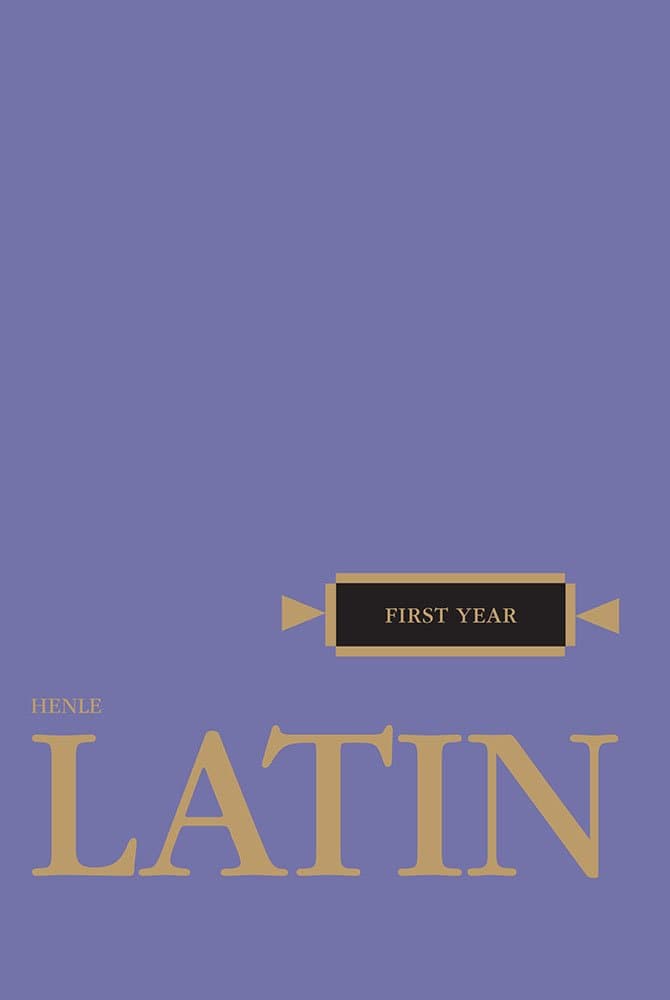
desertcart.com: Henle Latin First Year: 9780829410266: Robert J. Henle: Books Review: Still the best Latin text on the market. - As a Latin teacher, I have used a number of texts (Orberg, Jenney, Wheelock, Latin for Americans), but I have to say that Henle's Latin series is my favorite. Old school it is, but Henle's method is extremely effective. Students who work through the first volume will have a very solid grasp of the most important features of Latin grammar, a comfortable vocabulary designed to help them into Caesar's Gallic Wars (the primary content of Volume 2), and the ability to read and comprehend Latin. The text has a huge amount of exercises, primarily, but by no means only, translation from Latin to English and English to Latin, this second type being the true test of a student's ability to manipulate the language and test his mastery of the grammar and syntax. The entire 4-volume Henle series is designed for the traditional Latin Classical curriculum: grammar mastery, Caesar, Cicero, and finally Vergil, with a significant number of Christian readings as well (many taken from the Latin Vulgate Bible and liturgical hymns). I have found that students gain a great deal of confidence in their mastery of Latin from this book. Frequent repetition, constant review and re-entry of previously learned material guarantees solid learning. This book was written---as has been noted in another review---at a time when true mastery of the language was demanded and expected. Henle approaches his material methodically and clearly (the accompanying "Grammar" is essential as a supplement for all four volumes), but keeps a challenging pace and avoids boredom. It is true that in Volume 1, the vocabulary is kept somewhat lower (around 500 words) in the interests of mastering the grammar, but these are high-frequency words in Caesar and so are practical at the same time. The First Year text (Volume 1) moves through the five noun declensions, adjective agreement (both 1/2 declension as well as 3rd declension adjectives), and the entire present and perfect systems indicative (-io verbs, oddly, are not taught until much later in the book) plus other grammar topics in the first five Units (Book 1 has 14 Units in all), an ambitious but very doable goal due to the abundance of exercises. This allows students to read a wide variety of grammatical content at a comparatively early stage. Units 6 & 7 cover, among other things, the four tenses of the (active) subjunctive in indirect questions and purpose clauses. (Compare this to many texts which put off the subjunctive until 2nd year.) This means that by halfway through the text, the students have mastered much of Latin grammar and guaranteeing an eventual smooth transition into reading real Latin written by real ancient authors (Caesar, for a start). The only caveat is that those students who will ultimately be taking AP Latin (Caesar and Vergil according to the 2013 syllabus) will not be able to rely on the Henle texts alone. The Henle texts were written long before the AP program came into existence, and his excerpts from Caesar's "Commentarii de Bello Gallico" and (in Volume 4) Vergil's "Aeneid" do not completely correspond to the required readings of the AP syllabus. It is my personal belief that, particularly with Vergil, Henle offers a wider, more interesting sample of the text, but to take (and pass) the AP Exam, students will need to cover other passages from Caesar and Vergil (I recommend Mueller's text for "Caesar" and Boyd's text for the "Aeneid"). However, if you are homeschooling or otherwise not interested in the AP Latin program, stay with Henle through all four volumes. In short, a masterful text, the quintessential expression of the grammar-translation method at its best. Review: Great for beginners! - Loving this text book! It’s been easy to follow and teach with no prior Latin experience. Have it spiral bound for a lay flat experience.
| Best Sellers Rank | #37,106 in Books ( See Top 100 in Books ) #30 in Foreign Language Instruction (Books) |
| Customer Reviews | 4.7 out of 5 stars 501 Reviews |
R**A
Still the best Latin text on the market.
As a Latin teacher, I have used a number of texts (Orberg, Jenney, Wheelock, Latin for Americans), but I have to say that Henle's Latin series is my favorite. Old school it is, but Henle's method is extremely effective. Students who work through the first volume will have a very solid grasp of the most important features of Latin grammar, a comfortable vocabulary designed to help them into Caesar's Gallic Wars (the primary content of Volume 2), and the ability to read and comprehend Latin. The text has a huge amount of exercises, primarily, but by no means only, translation from Latin to English and English to Latin, this second type being the true test of a student's ability to manipulate the language and test his mastery of the grammar and syntax. The entire 4-volume Henle series is designed for the traditional Latin Classical curriculum: grammar mastery, Caesar, Cicero, and finally Vergil, with a significant number of Christian readings as well (many taken from the Latin Vulgate Bible and liturgical hymns). I have found that students gain a great deal of confidence in their mastery of Latin from this book. Frequent repetition, constant review and re-entry of previously learned material guarantees solid learning. This book was written---as has been noted in another review---at a time when true mastery of the language was demanded and expected. Henle approaches his material methodically and clearly (the accompanying "Grammar" is essential as a supplement for all four volumes), but keeps a challenging pace and avoids boredom. It is true that in Volume 1, the vocabulary is kept somewhat lower (around 500 words) in the interests of mastering the grammar, but these are high-frequency words in Caesar and so are practical at the same time. The First Year text (Volume 1) moves through the five noun declensions, adjective agreement (both 1/2 declension as well as 3rd declension adjectives), and the entire present and perfect systems indicative (-io verbs, oddly, are not taught until much later in the book) plus other grammar topics in the first five Units (Book 1 has 14 Units in all), an ambitious but very doable goal due to the abundance of exercises. This allows students to read a wide variety of grammatical content at a comparatively early stage. Units 6 & 7 cover, among other things, the four tenses of the (active) subjunctive in indirect questions and purpose clauses. (Compare this to many texts which put off the subjunctive until 2nd year.) This means that by halfway through the text, the students have mastered much of Latin grammar and guaranteeing an eventual smooth transition into reading real Latin written by real ancient authors (Caesar, for a start). The only caveat is that those students who will ultimately be taking AP Latin (Caesar and Vergil according to the 2013 syllabus) will not be able to rely on the Henle texts alone. The Henle texts were written long before the AP program came into existence, and his excerpts from Caesar's "Commentarii de Bello Gallico" and (in Volume 4) Vergil's "Aeneid" do not completely correspond to the required readings of the AP syllabus. It is my personal belief that, particularly with Vergil, Henle offers a wider, more interesting sample of the text, but to take (and pass) the AP Exam, students will need to cover other passages from Caesar and Vergil (I recommend Mueller's text for "Caesar" and Boyd's text for the "Aeneid"). However, if you are homeschooling or otherwise not interested in the AP Latin program, stay with Henle through all four volumes. In short, a masterful text, the quintessential expression of the grammar-translation method at its best.
K**S
Great for beginners!
Loving this text book! It’s been easy to follow and teach with no prior Latin experience. Have it spiral bound for a lay flat experience.
T**S
This is a very old-school Catholic textbook
This is a very old-school Catholic textbook from the days when you could expect promotion of the Catholic Church and its doctrine in every textbook, be it social studies or chemistry. But if you can deal with that, Henle's Latin is a gem of pedogogical sophistication--it's the kind of text that earned the Jesuits their reputation as great teachers. Basically the text relies on marvelously integrated reading passages, short clear grammatical descriptions (this is how you say it in English, and this is how Latin does it similarly/differently) and short translation and fill-in exercises and drills. There is no answer guide, but if you need one I believe somebody's written one. All the paradigms have been shifted to a separate text, Henle's Latin Grammar. The vocabulary has been kept to about 500 words, which means you'll get very comfortable using all of them. This first text is intended to get the student ready to read Caesar, but I must say it is refreshing to read commentary that doesn't fawn all over him, or over the Romans either. I've read so many texts from the 20s and 30s that read like pro-fascism. Henle wrote this text in 1945, and it shows in the jaundiced attitude towards "strong men" and expanding empires I used Wheelock's Latin in college and I loved it, but at this remove (40 years), I can see its deficiencies. If you want to read Latin you have to READ LATIN--the grammar, while essential, is of secondary importance. Jones & Sidwell is not unlike Henle, but more difficult to use. Also I really don't like the typography in Jones & Sidwell, or the small print either. I have similar problems with Oerberg's Lingua Latina (typography), and also it bores me--but its method (learning by reading) is very similar to Henle.
L**E
Highly recommend
Very informative, easy to read. Highly recommend.
A**E
Very solid Latin text
This classic Latin text, having stood the test of time and still in print after decades of use in schools and homes, offers a fairly simple, but rigorous introduction to reading and writing Latin. A diligent student will take from it, not only a useful grasp of vocabulary (which can be very helpful on the SAT as well as for those going into scientific or medical fields), but a better understanding of the English language, the experience of a mind-broadening exercise and the development of a more precise and logical way of thinking about language. The text is designed for high school (and three more volumes follow this first year text), but could be used as early as 6th or 7th grade if taken at a slower pace and with some supplementation. Its companion Grammar volume is an essential component. Henle uses a relatively brief vocabulary (focused primarily on Caesar's Gallic wars) in order to hone in on the grammar concepts. By the end of this book, a student should have a solid foundation and be ready to start translating some basic Ancient texts. This text does assume a certain grammar foundation prior to tackling Latin. Some of this can be reviewed while studying the Latin. A helpful prior grammar understanding would include: basic diagramming and an understanding of the following terms: subject, verb, direct object, indirect object, pronoun, adjective, adverb, conjunction, preposition, possessive adjective, predicatve nominative, etc. The downside of the limited vocabulary is that the rather un-varying vocabulary can make the book somewhat tedious. In our homeschool co-op, where I've been teaching Henle to a group of teens, it has worked quite well to spread this text out over two years, but supplement with other material. We have added some fun vocabulary to our working base from the "Latin is Fun" text by John Traupman (which we had studied before Henle). Each student also has a Latin dictionary. I frequently assign the students to write additional sentences (in English or Latin) for their fellow students to translate. These are particularly enjoyable when the students are encouraged to write funny sentences. We play some games on occasion - Latin Bees, Latin "Pictionary", Latin Rummy (write Latin words on playing cards and try to make grammatically correct, if silly, senntences), etc. We have also recently started reading from "Lingua Latina" by Hans Oerberg in addition to Henle. This has worked out well as pronunciation practice as well as helping the students think through some of the Latin without translating. Another fun assignment is a "Latin Treasure Hunt". I gave the students a list of common Latin words, phrases and abbreviations that are used in the U.S. today - such as "emeritus" and "bona fide" (you can find a very extensive list of such words in "Amo, Amas, Amat and More" by Eugene Erlich). The students translate the list and look for examples in text, print, conversation, on the Internet, etc. and see who can come up with the most. This has really opened my students eyes up to noticing relations between the Latin language and "real life." Finally, a good exercise for the mind that requires some of the same multi-level thinking skills as Latin is to play chess!
B**K
Old-School Latin Instruction -- Optime!
Okay, so there are a few things you need to know before you buy this book. First, it's a reprint of Volume One of a 1950's four-volume course written by a Jesuit priest, which means that it's both dated and unabashedly Catholic. Second, you will not get far in this text if you don't buy the accompanying Grammar that goes with it. Those things said, I will hasten to add that its vintage status and its Jesuit authorship mean one thing for those who are not overly sensitive to the decidedly un-PC: you WILL learn Latin. You will know Latin so thoroughly well that you will be able to read it without difficulty. Because Henle, you see, like a good Jesuit, assumes that you will need to do more than just recognize the words. He assumes that you will need to express yourself intelligently in Latin. Unlike many modern texts, which operate on the unfortunate assumption that English-to-Latin translation is unnecessary, Henle's text is replete with exercises that require just that. The result being that you will actually learn how to use the cases, thereby gaining a greater understanding of what they actually mean in Latin usage. As for the subject matter, it is fairly well balanced between vocabulary that is classical (think Caesar's Gallic Wars) and ecclesiastical, both of which are important for a well-rounded Latin experience. Henle marches you systematically through the five noun declensions and the accompanying adjectival declensions and drills you thoroughly before he starts throwing conjugation at you, which is, to my mind, about the best way to handle the first foray into the oft-underappreciated complexities of this fascinating language. All in all, an awesome old-school throwback to a time when Latin was seriously taught for a particular level of real mastery. My only regret is that Henle never wrote a corresponding series for Greek.
B**.
Easy to follow.
This has been used in colleges, but can be used easily for self-study. I've had a lot of Latin textbooks. But this is my favorite! It's not too technical or complex for home study. Easy to follow if you do the memorization. It's the easiest I've found for serious studies of the language,; also very interesting. It's been a standard text for quite a long time.
A**R
A very useful book with cogent explanations
I find that I really like this book. I think I like it better than Wheelock's because it has more excercises in it. The examples sentences contain a lot of Christian religious beliefs and words, such as God, Christ, Heaven, saving mankind, Mary, on and on and on. I'm not religious, so I just ignore the content as much as possible and concentrate on the grammar, which I find is easy to do. Inspite of the religious sentiments, I find that the examples, for me, at least, seem to be good at reinforcing the usage of grammar. On the whole, I'm pleased with the book, and have ordered not only First Year but also the other three years, and I plan to order the answer keys as well.
Trustpilot
Hace 1 mes
Hace 2 semanas