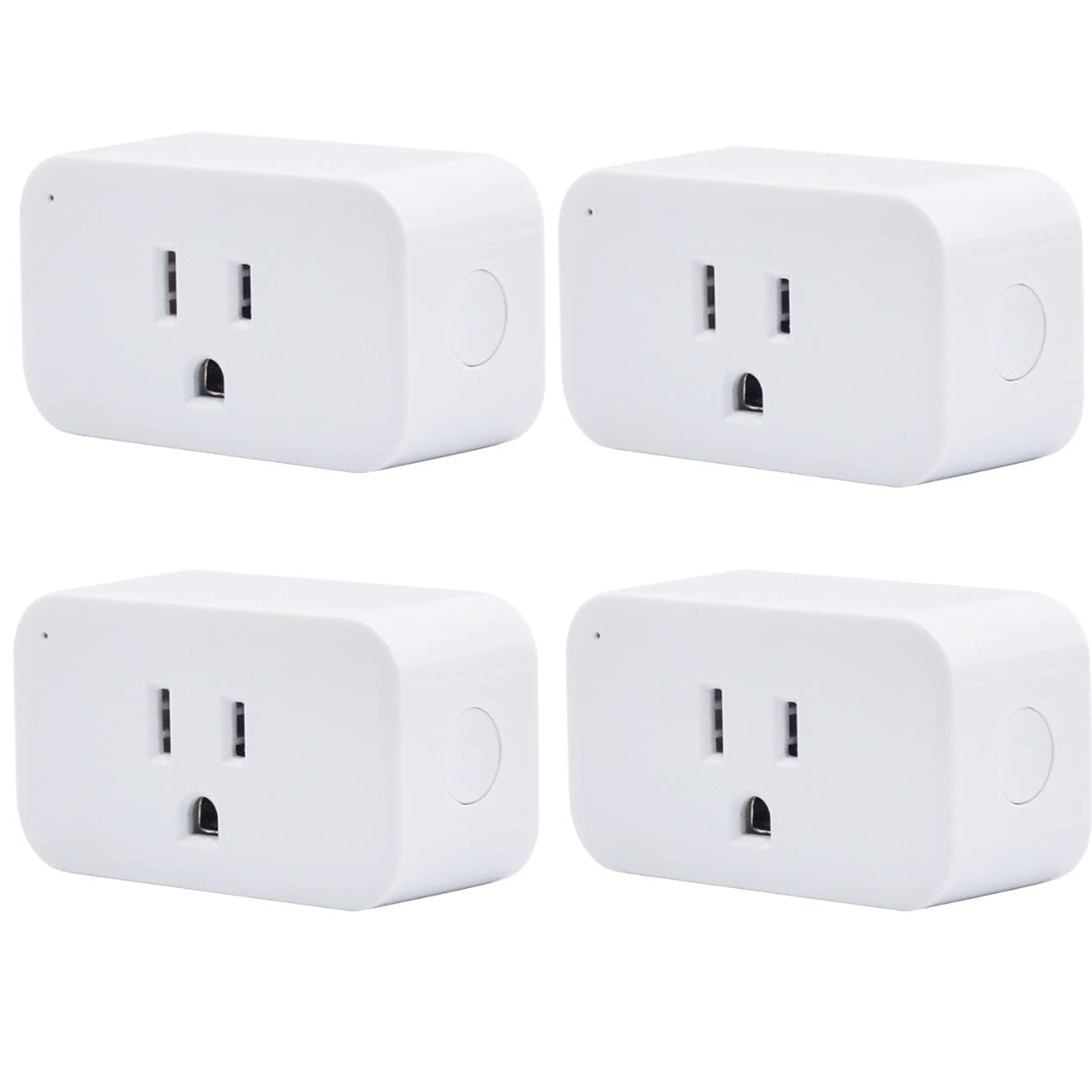
🔌 Power your smart lifestyle with effortless control and zero WiFi drama!
The THIRDREALITY Smart Plug 4 Pack offers 15A capacity smart outlets with Zigbee connectivity, acting as repeaters to strengthen your home mesh network. ETL certified and compactly designed, these plugs support voice commands via Alexa and other Zigbee hubs, feature built-in timers for scheduling, and receive OTA firmware updates for continuous improvement. Ideal for professionals seeking reliable, scalable smart home control without WiFi interference.


| ASIN | B09KNDM4VV |
| Best Sellers Rank | #2,502 in Tools & Home Improvement ( See Top 100 in Tools & Home Improvement ) #17 in Electrical Outlet Switches #45 in Home Automation Devices |
| Brand | THIRDREALITY |
| Brand Name | THIRDREALITY |
| Circuit Type | 1-way |
| Color | White |
| Connectivity Protocol | ZigBee |
| Connector Type | Type B/Nema 5-15r |
| Contact Material | Copper |
| Contact Type | Normally Open |
| Control Method | Voice |
| Controller Type | Amazon Alexa, SmartThings |
| Current Rating | 15 Amps |
| Customer Reviews | 4.5 out of 5 stars 1,354 Reviews |
| International Protection Rating | IP54 |
| Item Dimensions | 2.6 x 1.5 x 1.1 inches |
| Item Height | 28 millimeters |
| Manufacturer | Third Reality, Inc |
| Material Type | Acrylonitrile Butadiene Styrene, Polycarbonate |
| Model | 3RSP019BZ |
| Mounting Type | Plug-In Mount |
| Number of Items | 4 |
| Number of Positions | 1 |
| Operating Voltage | 120 Volts |
| Operation Mode | ON-OFF |
| Specification Met | ETL |
| Switch Type | TRIAC |
| Terminal | Blade |
| UPC | 850001595438 |
| Unit Count | 1.0 Count |
| Wattage | 1800 watts |
P**Y
Seamless Zigbee Smart Plug for Home Assistant
These THIRDREALITY smart plugs work perfectly within Home Assistant (I’m using ZHA), and the setup was smooth. They paired quickly, and I love the real-time energy monitoring—it’s great for tracking usage. The compact size doesn’t block the second outlet, which is a huge plus. I’ve had no connectivity drops, and they also act as Zigbee repeaters, which improved my mesh network. It’s a solid value for four plugs. Just remember, you do need a Zigbee hub to get started.
S**N
Works Perfectly with My Smart Setup
These smart plugs have been great so far. Home Assistant integration was a breeze! They also paired with my Echo hub in just a couple of minutes and have been totally reliable ever since. I use them for lamps and a coffee maker, and I like being able to track energy use and see what’s actually drawing power. The signal is strong too, acting like a repeater that keeps everything connected around the house. For a set of four, the price feels fair, and setup couldn’t have been easier.
D**S
Good reliable Zigbee Smart Plugs I have
Great device, affordable price, and pretty consistent so far. All 4 of them paired with no problem via ZHA on Home Assistant. They also have been a good repeater to the furthest part of the house and all reading good LQI. Energy Monitoring was nice touch although I had less intention of relying on this feature at first, which eventually became helpful in automating some of the small appliances I wanted to test out to start with. I had not had a plan on plugging in heavy load items while it says it’s 15A to be safe. But connectivity standpoint, size, the data that can bring back for my dashboard for monitoring have been pretty reliable. Love the Firmware update OTA. Definitely a good solid option of ZigBee Smart Plug.
R**Y
Evaluation of the THIRDREALITY Zigbee Smart Plug with Energy Monitoring
Title: An In-Depth Review of the THIRDREALITY Zigbee Smart Plug with Energy Monitoring Introduction: The THIRDREALITY Zigbee Smart Plug with Energy Monitoring has emerged as a noteworthy component in my smart home ecosystem. With an array of impressive features, this review delves into its strengths and areas that warrant consideration. Positive Aspects: A highlight of the plug is its effortless integration with Zigbee hubs, exemplified by its seamless connection to my Zigbee hub. The plug's compact design and diverse sensors, encompassing current (amps), power (watts), and power factor, offer a comprehensive insight into energy consumption. The flexibility to adjust measurement units within Home Assistant enhances the monitoring experience, providing personalized and insightful data. Uncovering voltage fluctuations in my 120V outlet was an unexpected yet invaluable discovery. This insight helped identify loose wiring issues, resulting in a stable 120V with minimal fluctuations—a testament to the plug's preventative capabilities. Ease of Integration and Startup Behavior: Connecting the THIRDREALITY Smart Plug to Home Assistant using only ZHA was remarkably straightforward. The user-friendly design is evident in the uncomplicated process of initiating pairing mode, achieved by holding the button while powered on until the LED flashes. The plug's compatibility with various Zigbee hubs ensures versatility in integration possibilities. A noteworthy feature, often overlooked, is the startup behavior. The plug offers the choice to dictate its state upon power restoration or when moved. Users can opt for the plug to start in the off position, on position, toggle between on and off, or resume its previous state. This level of customization adds a layer of convenience, tailoring the plug's behavior to individual preferences and specific scenarios. Reliability Under Stress: A rigorous stress test showcased the plug's resilience, enduring the simultaneous operation of a coffee maker and air fryer, drawing over 16 amps and 3,000 watts for a minute—well beyond its specified rating of <15V. This durability sets it apart from competing smart sockets prone to failure under similar conditions. Areas for Improvement: Despite its commendable features, the THIRDREALITY Smart Plug has room for enhancement. The slightly elevated price, especially during holiday promotions, raises concerns, as discovered through the Honey browser plugin. Such pricing fluctuations are questionable tactics and merit consideration. Additionally, the absence of robust customer support is a drawback, underscoring the importance of reliable channels for addressing queries or concerns. Furthermore, while the plug accommodates 15-amp outlets, users with 20-amp sockets may find limitations. Clarity on protective measures to prevent capacitor explosions and mitigate the risk of a house fire due to exceeding specified amperage would enhance the plug's safety credentials. In Conclusion: The THIRDREALITY Zigbee Smart Plug with Energy Monitoring impresses with its feature-rich design and resilience under stress. Prospective buyers should weigh its price point, consider the absence of robust customer support, and evaluate their specific amperage requirements. The addition of the startup behavior feature contributes to its versatility, allowing users to tailor the plug's behavior to their preferences and scenarios. Wrapping it up, whether there's a burst of positivity or a dash of negativity, some fresh revelations, or any overlooked gems, stay tuned! I'll be jazzing up my post with all the deets to keep you hooked and make it a must-read. Let the editing extravaganza begin!
T**E
Pair easily with Home Assistant
I’ve tried quite a few brands of smart plugs, WiFi and Zigbee. These and the Innr brand are the only two that I’ve tried that work flawlessly. They pair easily with Deconz in Home Assistant. They’re very responsive within HA and an added benny, they provide Wattage, Amperage and Voltage readings which you can include on buttons to always see the readouts for whatever’s plugged in. Second benny is they’re almost half the price of the Innr’s.
S**G
An excellent combination of performance, reliability and value
I have been so impressed with the quality and reliability of these plugs, that I now have five of them in use. Their firmware has been updated regularly, and I have recently updated mine to v1.00.98, dated September 8th, 2025. Contrary to other reviews that mention no support for power restore settings, these are the second generation models with power monitoring, and their power state upon power failure restoration can be set to "on", "off" or "previous state". My Zigbee Plus mesh network covers a 2400 sq. ft. two story home, and these plugs also act as Zigbee mesh repeaters, strengthening the overall performance of the network. Signal quality (LQI) ranges from 200-255. Two plugs are compact enough to fit into one duplex outlet. ETL certification is important for electrical and fire safety. The plugs are fully compatible with my home automation system that runs on HomeSeer V4, and HS4 uses the same outstanding Zigbee2MQTT front end as Home Assistant (HA). My system also runs a Z-Wave Plus mesh network, and whereas each protocol has its advantage, Zigbee Plus has advanced to the point where it is easier to setup, and it's cheaper than Z-Wave Plus. My plugs reliably and quickly control lamps, space heaters, an instant hot water heater, and other small electronics.
C**1
Works as advertised. Convenient, useful and informative.
Manual states that they are good for up to 15 amps, 1500 watts. Looks like it is good for it. I am running 1200+ watts through one right now. I thought I had killed one. I was wrong. We seemed to be having another power problem that cause one unit to flake out. A power outage the other day that turned out to be a bad connection at my house electric company meter proved that the socket itself had not gone bad. It was just 'scrambled' / 'confused'. The manual for these tells how to perform a factor reset. I did. It still would not show up in my zigbee devices. It took a lot of fussing to work out it was stuck in bluetooth pairing mode. Eventually I worked out how to get it out of that mode and become visible again as a zigbee device. Major pain in the butt. But it is back online and works correctly. So, verdict? It does work. It is responsive to zigbee commands. It works fine with household portable heaters. I took my newly recovered socket and put it onto a heater that has a nasty bug: If the power goes off at the heater, when it comes back on it is running at full power, with no high temperature limit. So I put it on the socket, and set the socket to not turn on after a power loss. That takes care of the risk if we are out of the house when a power outage occurs (however brief). I also put it there so I can monitor power use. That is a great feature on these. I can remotely see how much power the heater is drawing, and turn it off if I need to. Even when I am off in the wild world of fast food restaurants, or some such. Worth buying? Yes, if you are me. For the two reasons I noted above. If I go pickup another thermometer unit, I can setup a script that watches room temperature and can turn it on or off as needed automatically. Exactly what these are built for. I still stand behind the comment below about not using them for things like motors (that do not specifically have a 'soft start' feature). Those can kill any electronic switch not built for the power draw spike. ------ Old review.. take two grains of salt - I retract it.------ It looks like I managed to kill one by plugging in a room heater into it. This plug works great with Home Assistance , using Zigbee2MQTT. I could see from the power usage sensor that the heater was drawing up to 1300 watts. It seems to work fine. They have been connected together for a day or two. I even wrote an automation to turn it on in my home office before I start work. Just a few hours ago, I turned it off. But it did not turn off. The manual power button works on it. So I followed the instructions on how to wipe it back to factor default and re-pair to my Zigbee network. Removed the device from Home Assistant (HA) and stepped through pairing again. There she is! Add it back into HA and it shows up as a Zigbee Smart Plug from ThirdReality. But.. during the paring process there is an 'interview' stage where HA works out if the device is reporting sensor data and its attributes. This never completes. I bought the four pack and have only used two. So I delete this plug from HA and paired up another one. It paired up quickly and completed the 'interview' instantly. So... yeah.. Maybe just a bad one. Maybe I fried it. I have put the newly paired plug back on the heater. We shall see if it holds up over the next week. Outside of that consideration, I haven't had these very long. Not long enough to give a real review. Just share something you should know. Last little nugget of knowledge: Electronic switches (smart or just a timer) do not do well with major load spikes like running electric motors. That is why they are frequently suggested as not the right solution for things like pond or well pumps. You just burn them out. They do make electronic switches built to survive that workload. I will guess this is not that kind of switch. Be that as it may, so far these are working fine on low power draw workloads (like my desktop PC)
T**K
Both the power monitoring and non power monitoring versions work perfectly within Home Assistant
I have a total of six of these plugs now (4 basic, two with power monitoring) in my home. To be brief, I'm very satisfied with these so far. The four basic plugs act mostly as repeaters to help extend my mesh from my Home Assistant Pi in the front of the house to the boiler room in the back of the house (one floor down in the basement). With one plug in each room, with various amounts of obstructions between them, each maintains healthy LQIs to each other and to the sensors connected to them (above 60 in all cases, reaching 150 when they have an unobstructed LOS in one case). Honestly I could probably remove a plug or two without impacting the network's stability, but I'd rather have the peace of mind. One slight downside that I noticed was from one plug that had nothing plugged into it; if the plug was on but there was no load, it would make a buzzing noise. Turning it off stopped the noise, so I did that. I'm not sure if this happens with a load plugged in. The two energy monitoring plugs are connected to our washing machine and gas dryer (which both use standard 120v power cables). Each plug measures the following values, as described in Home Assistant while using ZHA: - AC frequency (Hz) - Power/active power (W) - Power factor (%, may show as Unknown or not show up at all) - Current/RMS current (A) - Voltage/RMS voltage (V) - Summation delivered (kWh, which appears to be cumulative over time) The readings appear to be generally sensitive at the lower end of the scale. Both machines are registered as pulling 1-2W when off and about 4W at idle, which allowed me to set up a threshold helper in HA that lets me know when the machine is on or off. I think the update frequency is somewhere on the order of 15-30 seconds, but I'm not entirely sure. For my purposes, it's more than fast enough. All plugs work perfectly when using ZHA. The pairing process was painless, all plugs support power on configuration, you can set up OTA firmware updates in ZHA with a config change, and it supports channel migration, so if you change your Zigbee network to use another channel they'll automatically update without needing to re-pair. All in all I'm quite satisfied with all of these plugs, especially at their current prices of 4 basic for $30 and one power monitoring for $12. UPDATE 2024/1/10: I recently had to re-set up my Home Assistant install, and both of the power monitoring plugs I owned before no longer show the nonfunctional Power Factor stat. This might have been disabled at some point in the past on ZHA's side, as the labels for each stat had been changed. I've updated the list above to reflect the new labels. Additionally, I picked up another power monitoring plug recently when they were on sale recently, and this new one has Power Factor both in the list and functioning. EDIT 2024/1/30: After some diagnostics, I've determined all three PM plugs are running the same firmware revision (0x10013048, or v72 if you convert the last three numbers from hex to decimal), but the older two don't show the power factor. This suggests to me there might have been a minor hardware revision to reenable that properly, so if you're looking to write automations or analytics that use it, be sure to check the plugs beforehand. Beyond that, all power monitoring plugs work identically.
Trustpilot
Hace 2 meses
Hace 3 semanas