We remain fully operational. Our teams are working around the clock to ensure your deliveries continue safely.

Descargar la aplicación


Servicios al cliente
Sobre nosotros
Copyright © 2025 Desertcart Holdings Limited
Descargar la aplicación
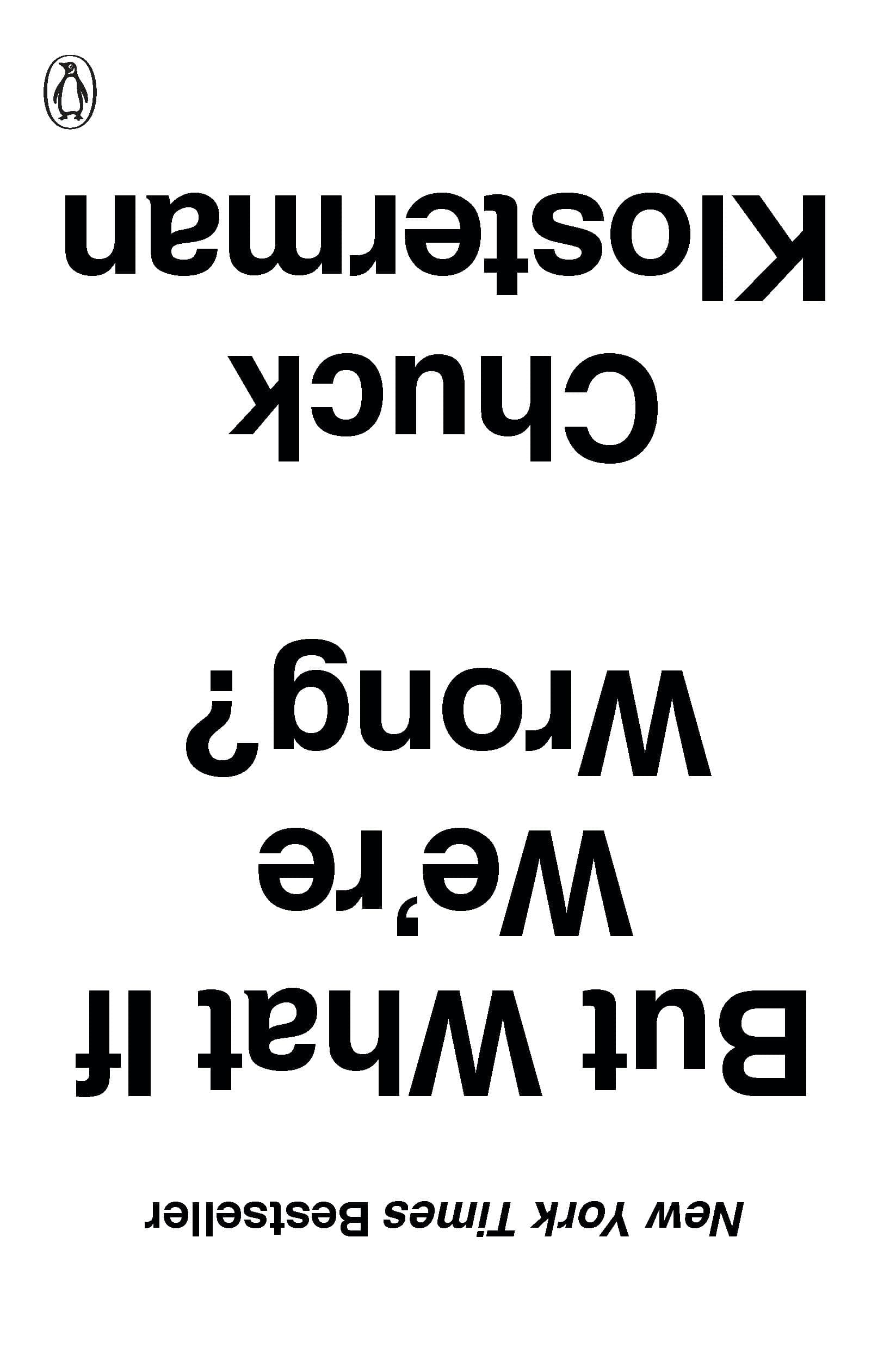
But What If We're Wrong?: Thinking About the Present As If It Were the Past [Klosterman, Chuck] on desertcart.com. *FREE* shipping on qualifying offers. But What If We're Wrong?: Thinking About the Present As If It Were the Past Review: ... Klosterman's newest book "But What if We're Wrong" is awesome. Its out there but it continues a trend ... - Chuck Klosterman's newest book "But What if We're Wrong" is awesome. Its out there but it continues a trend I find with him where reading his writing is almost like finding a better articulated and more edited version of some of my deep meandering thoughts. but maybe even more so in this book because of the topic. Guess i'm admitting i too am out there ;) The general question he asks is this: What will future generations see when they view this generation? What books will be studied from our century (as he puts it, who is going to be our century's kafka)? What about music; what will really define "rock n roll", or the even less defined genre of "Rock"? And as the title suggests: what if we're wrong about what we think is defining our generation? It seems we think history repeats itself, but then how could we ever predict how different today is compared to even 50 yrs ago? When he starts to delve into the sciences, he tackles the idea of paradigm shifts (taken from Thomas Kuhn's Structure of Scientific Revolutions) and the question of what can we expect next. This is where its almost freakish how similar this section gets with what i discuss in some of my honors classes (i.e. can we make predictions? Will we see the atom? Will we see the proton? Will we see the strings?) Highly recommending this book to all, sciencey or non sciency peeps. There are interviews with some amazing people: rockstar scientisits Neal De Grass Tyson, Brian Greene, director Robert Linklater, talking heads founder David Byrne, authors Jonathan Lethem and Junot Diaz and more. There are some classic Klosterman off the wall theories about pop culture (probably my favorite part is his coming to the conclusion that the tv show Roseanne may be what future generations will study when looking at the definitive 20th century television programming) and how the future might view it, there is some conspiracy theories, a lot of well crafted "let's pretend" scenarios, and most importantly there is a lot of epistemological questions that at the end of the day make for the difference between living without. To the negative reviewers: much of what you say is that you felt that it rambled, lost its way, provided no strong foundation for the arguments.... Unfortunately, epistemology is often characterized by that. Even Klosterman discusses this in the book: as he puts it the difference between a physicist and a philosopher is the difference between what and why? (one cares about what is the cause, the other about the meaning behind it) Thank you Chuck for putting in the time with this one. Seems you spent quite sometime interviewing, researching, and you put together a great read. Maybe not the definitive book of this generation (hahaha, sorry) but still an excellent book. Review: Rough around the edges but more than worthwhile - Klosterman is engaging in an interesting thought exercise. He's trying to problematics certainty by making arguments about how uncertain things can be. And while he often meanders and sometimes posits questionable premises of his own to further his argument, he's ingeniously protected by the underlying assumption of his project: that what seems to be wrong might be worth looking at (this of Course has its own set of logical circles to run). But if you view his book more as a reflection on our collective cultural evaluation of academia, athletics , arts and everything else you get a truly interesting and entertaining ideation of how we've done things and how we might continue to do them. Klosterman has written a book that at the very least points the so called epl-jersey wearing Donnie Dario attending hipsters a direction for becoming cultural experts and at best provides some insight into how we process genius and change (rationally and not)
| Best Sellers Rank | #161,129 in Books ( See Top 100 in Books ) #152 in Essays (Books) #306 in Popular Culture in Social Sciences #1,906 in Memoirs (Books) |
| Customer Reviews | 4.2 4.2 out of 5 stars (1,908) |
| Dimensions | 5.53 x 0.6 x 8.24 inches |
| Edition | Reprint |
| ISBN-10 | 0399184139 |
| ISBN-13 | 978-0399184130 |
| Item Weight | 8 ounces |
| Language | English |
| Print length | 288 pages |
| Publication date | April 25, 2017 |
| Publisher | Penguin Books |
J**.
... Klosterman's newest book "But What if We're Wrong" is awesome. Its out there but it continues a trend ...
Chuck Klosterman's newest book "But What if We're Wrong" is awesome. Its out there but it continues a trend I find with him where reading his writing is almost like finding a better articulated and more edited version of some of my deep meandering thoughts. but maybe even more so in this book because of the topic. Guess i'm admitting i too am out there ;) The general question he asks is this: What will future generations see when they view this generation? What books will be studied from our century (as he puts it, who is going to be our century's kafka)? What about music; what will really define "rock n roll", or the even less defined genre of "Rock"? And as the title suggests: what if we're wrong about what we think is defining our generation? It seems we think history repeats itself, but then how could we ever predict how different today is compared to even 50 yrs ago? When he starts to delve into the sciences, he tackles the idea of paradigm shifts (taken from Thomas Kuhn's Structure of Scientific Revolutions) and the question of what can we expect next. This is where its almost freakish how similar this section gets with what i discuss in some of my honors classes (i.e. can we make predictions? Will we see the atom? Will we see the proton? Will we see the strings?) Highly recommending this book to all, sciencey or non sciency peeps. There are interviews with some amazing people: rockstar scientisits Neal De Grass Tyson, Brian Greene, director Robert Linklater, talking heads founder David Byrne, authors Jonathan Lethem and Junot Diaz and more. There are some classic Klosterman off the wall theories about pop culture (probably my favorite part is his coming to the conclusion that the tv show Roseanne may be what future generations will study when looking at the definitive 20th century television programming) and how the future might view it, there is some conspiracy theories, a lot of well crafted "let's pretend" scenarios, and most importantly there is a lot of epistemological questions that at the end of the day make for the difference between living without. To the negative reviewers: much of what you say is that you felt that it rambled, lost its way, provided no strong foundation for the arguments.... Unfortunately, epistemology is often characterized by that. Even Klosterman discusses this in the book: as he puts it the difference between a physicist and a philosopher is the difference between what and why? (one cares about what is the cause, the other about the meaning behind it) Thank you Chuck for putting in the time with this one. Seems you spent quite sometime interviewing, researching, and you put together a great read. Maybe not the definitive book of this generation (hahaha, sorry) but still an excellent book.
A**K
Rough around the edges but more than worthwhile
Klosterman is engaging in an interesting thought exercise. He's trying to problematics certainty by making arguments about how uncertain things can be. And while he often meanders and sometimes posits questionable premises of his own to further his argument, he's ingeniously protected by the underlying assumption of his project: that what seems to be wrong might be worth looking at (this of Course has its own set of logical circles to run). But if you view his book more as a reflection on our collective cultural evaluation of academia, athletics , arts and everything else you get a truly interesting and entertaining ideation of how we've done things and how we might continue to do them. Klosterman has written a book that at the very least points the so called epl-jersey wearing Donnie Dario attending hipsters a direction for becoming cultural experts and at best provides some insight into how we process genius and change (rationally and not)
T**H
Thinking Future to Past
I enjoyed this book tremendously. Granted, part of the reason is that the topic Mr. Klosterman covers in it is one that I’ve spent some time turning over in my own mind through the years. Essentially, he is elucidating the difficulty in understanding what the world is going to be like in the future and how that future world will understand us. We tend to try to base our conclusions on how we understand the world today but, as history shows, the world tends to unfold in very unpredictable ways, making our predictions pretty much useless. (Of course, that doesn’t change the fact that it’s fun to try.) As a scientist, I tend to cringe with the arrogant certainty some people in the field tend to defend scientific knowledge. I have long wondered how scientists (if they’re still called that) of the twenty-sixth century will view us. Will it be with the same kind of derision that many view those of today view the sixteenth century? Surely they felt as certain about their understanding of the world as we do about ours. Though I have great respect for science and how it’s helped us create our world, I also think that the worldview of the future is likely to be so different from ours that we can’t even fathom it. Mr. Klosterman meditates on these subjects with the help of Neil de Grasse Tyson and Brian Greene and their varying points of view illustrate the difficulties quite nicely. Another interesting question for the writer is: which authors will still be read in a few hundred years? Or, which TV shows will be watched? Or, which musicians will still be listened to? Mr. Klosterman tackles all of these subjects well but I was struck by his approach to the music (since I’ve thought about this less than the literary question). I never considered it specifically but, as much as rock ‘n’ roll has seemed a universal musical language for me that must last forever, it’s just as likely to be the marching band music of the future. (For example, hip-hop is much more the default musical language for my children.) And the entirety of marching band music is captured by the name John Philip Sousa. (Or reggae—Bob Marley.) Which name will define rock ‘n’ roll in 2416? Elvis? Bob Dylan? The Beatles? Mr. Klosterman discusses these and what each would mean for future scholars’ understanding of rock ‘n’ roll. (Note: it will be very different from our understanding.) He also makes a good case for the Rolling Stones, Chuck Berry, or Journey. Mr. Klosterman may be pushing the limits here with his “one name” theory. Classical music still has plenty of names associated with it, for example. Still, his point is well taken. Overall, this book is excellent food for thought. After this book and his last, I Wear the Black Hat, I’m beginning to think that Mr. Klosterman and I think a lot alike. I don’t know what that say about me, exactly, but I do know that it means I’ve really enjoyed these books and recommend them highly.
A**K
Not my favorite of the Klosterman books
Not my favorite of the Klosterman books, and I'm a huge fan. At times it feels more like a documentary in book form, with Klosterman as the narrator. Now that CK is a fairly famous writer, a la Malcolm Gladwell (one of the "interviewees" here), he has access to a wide variety of intellectuals and he uses those to build his arguments around. I liked him better when he was follow the train of thought of his own idiosyncratic imagination, rather than asking Neil DeGrasse Tyson what he thinks. It's provocative in a way that makes it fun reading, but the extensiveness, which approaches academic writing, is not Klosterman's wheelhouse, I don't think.
A**A
Good book. It really makes you think about the significance of what you think is important in your life. Versus, what will actually be long lasting importance in the future. Helps you to appreciate the random and rare.
E**H
great read recommend it to anyone who wants to be confused
G**N
The author use a question mark. The answer is an exclamation point: yes, we are wrong. absolutely a recommended reading
A**O
Sometimes brilliant but mostly boring. Perhaps the book would be better if shorter. I didn't like when pages stuffed of funny remarks.
C**N
In a world where we tend to consume things that reinforce our viewpoint it’s interesting to read something that comes from a perspective other than “I am always right” - even taking the title as a piece of philosophy for every day living could be a useful approach. But I could be wrong.
Trustpilot
Hace 2 meses
Hace 2 semanas