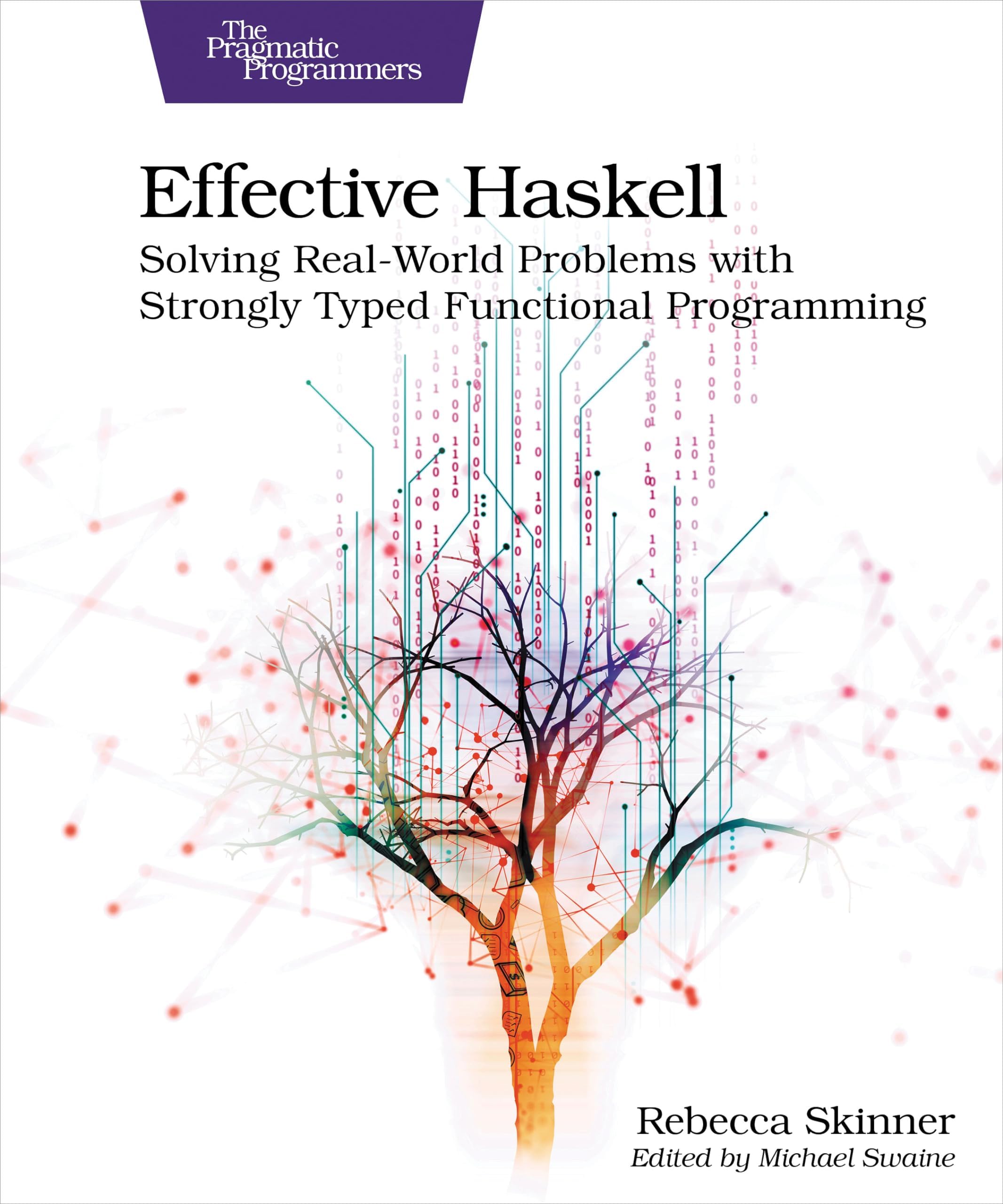
Effective Haskell: Solving Real-World Problems with Strongly Typed Functional Programming
ID del producto: 442044381
Buy anything from 5,000+ international stores. One checkout price. No surprise fees. Join 2M+ shoppers on Desertcart.
Desertcart purchases this item on your behalf and handles shipping, customs, and support to Mexico.
Effective Haskell: Solving Real-World Problems with Strongly Typed Functional Programming [Skinner, Rebecca] on desertcart.com. *FREE* shipping on qualifying offers. Effective Haskell: Solving Real-World Problems with Strongly Typed Functional Programming Review: Still reading but liking it a lot! - I've tried reading free online books and watching videos to get my head around Haskell, but there was still something missing. So far I'm finding that this book provides explanations for things that are weird/different about Haskell when introducing new concepts. This is making the consuming the material much more enjoyable and far less frustrating. It's my goal to make it through the entire book (600+ pages). Review: didn't like writing style, doesn't seem to deliver on promises, too big - I didn't realize before buying how big this book is - 600 pages! It should be split into different books. A lot of it is not "solving real-world problems" but the haskell language itself, types, monads, IO, etc. Which is all fine, but that is learning haskell, not solving real world problems with it. The intro makes a lot of promises about how things will progress slow, everything will be explained, step by step, etc, but then the author will spend several paragraphs and examples over something simple like creating lists and tuples, then suddenly you get a short discussion on writing pointfree functions and eta-reduction without enough walking through or description of that complication. and this is like page 20 of a book subtitled "solving real world problems". Not sure but the description on the site also mentions "Implement type-safe web services" as part of what the book covers but "web" does not occur in the index nor is there any chapter called "web services" and I'm not willing to give this author 600 pages to find out if web services are really covered or not. And I know I'm picky but some of the code examples seem unnecessarily complex for an intro to the language using multiple function compositions very early on, and even variable naming like a variable named `name` which actually contains a tuple like ("Ren", 10.00), so that when you see code like `fst name`, you wonder what the first element of a name is. And even the bit on recursion is short and poorly described for something so fundamental to haskell. anyway....overall seems not well organized or thought through and I wouldn't recommend it. Go read "learn yourself a haskell for great good" or "Get Programming With Haskell".
| Best Sellers Rank | #1,120,738 in Books ( See Top 100 in Books ) #17 in Functional Software Programming #31 in Parallel Computer Programming #1,282 in Programming Languages (Books) |
| Customer Reviews | 4.5 4.5 out of 5 stars (24) |
| Dimensions | 7.75 x 1.5 x 9.5 inches |
| Edition | 1st |
| ISBN-10 | 1680509349 |
| ISBN-13 | 978-1680509342 |
| Item Weight | 2.6 pounds |
| Language | English |
| Print length | 670 pages |
| Publication date | August 22, 2023 |
| Publisher | Pragmatic Bookshelf |
C**S
Still reading but liking it a lot!
I've tried reading free online books and watching videos to get my head around Haskell, but there was still something missing. So far I'm finding that this book provides explanations for things that are weird/different about Haskell when introducing new concepts. This is making the consuming the material much more enjoyable and far less frustrating. It's my goal to make it through the entire book (600+ pages).
B**P
didn't like writing style, doesn't seem to deliver on promises, too big
I didn't realize before buying how big this book is - 600 pages! It should be split into different books. A lot of it is not "solving real-world problems" but the haskell language itself, types, monads, IO, etc. Which is all fine, but that is learning haskell, not solving real world problems with it. The intro makes a lot of promises about how things will progress slow, everything will be explained, step by step, etc, but then the author will spend several paragraphs and examples over something simple like creating lists and tuples, then suddenly you get a short discussion on writing pointfree functions and eta-reduction without enough walking through or description of that complication. and this is like page 20 of a book subtitled "solving real world problems". Not sure but the description on the site also mentions "Implement type-safe web services" as part of what the book covers but "web" does not occur in the index nor is there any chapter called "web services" and I'm not willing to give this author 600 pages to find out if web services are really covered or not. And I know I'm picky but some of the code examples seem unnecessarily complex for an intro to the language using multiple function compositions very early on, and even variable naming like a variable named `name` which actually contains a tuple like ("Ren", 10.00), so that when you see code like `fst name`, you wonder what the first element of a name is. And even the bit on recursion is short and poorly described for something so fundamental to haskell. anyway....overall seems not well organized or thought through and I wouldn't recommend it. Go read "learn yourself a haskell for great good" or "Get Programming With Haskell".
M**N
It's great!
One of the best Haskell books I’ve read. Covers both the basics as well as the newer fancy features like DerivingVia, existential types and qualified constraints. Goes in depth and explains thunks, laziness pitfalls, and common optimization patterns like memoization and vectorization. Recommended!
G**S
A “must read” for people working in the area. Seems very well written and a full description of Haskell.
C**R
I've read quite a few introductory books on Haskell and this one is the best so far. At the very beginning, the author promises to show us the 'real-world Haskell'. And that's the case, indeed. The book covers most important language extensions (also collating GHC2021 and Haskell2010 editions); explains the subtle differences between ByteStrings, Strings, and Text; introduces the basics of .cabal file configuration; etc. So, everything that a beginner should know, and what is (sadly) lacking in other books. 5/5
Trustpilot
Hace 1 semana
Hace 1 mes