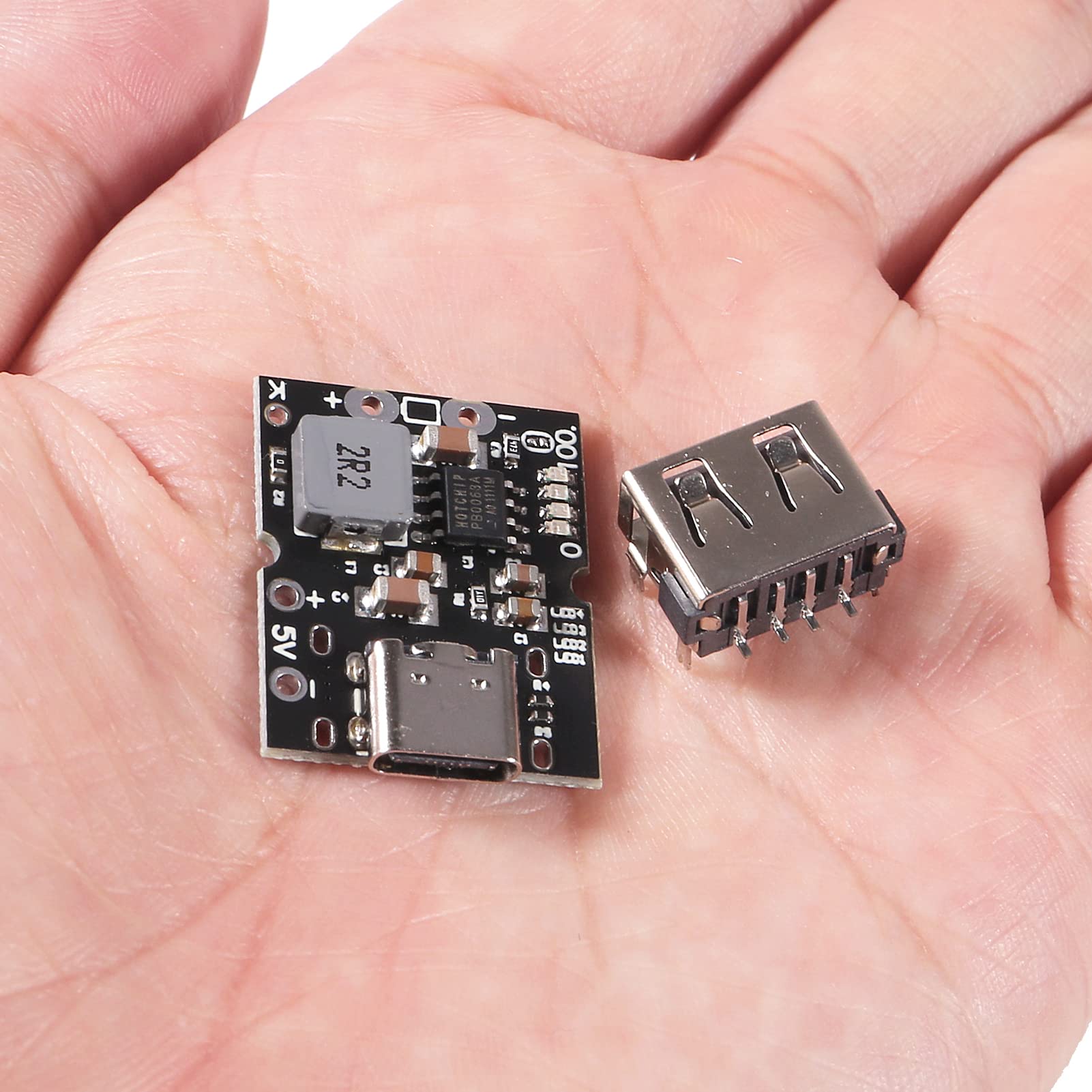


🔋 Boost your DIY power game with smart, solder-free charging innovation!
The DWEII 10PCS Type-C USB 5V 2A Boost Converter is a no-welding, step-up power module designed for DIY lithium battery chargers. Featuring a high 92.5% boost efficiency, smart battery protection with automatic charge cycle management, and an LED display for real-time status, it offers a professional-grade solution for custom power bank projects. Its auto shutdown under low load preserves battery life, making it a must-have for tech-savvy creators.
| ASIN | B09YD5C9QC |
| Best Sellers Rank | #90,068 in Tools & Home Improvement ( See Top 100 in Tools & Home Improvement ) #333 in Power Converters |
| Customer Reviews | 4.3 4.3 out of 5 stars (96) |
| Date First Available | April 12, 2022 |
| Item Weight | 1.76 ounces |
| Item model number | B09YD5C9QC |
| Manufacturer | DWEII |
| Package Dimensions | 5.16 x 3.82 x 0.63 inches |
D**M
Board to build 1-cell USB power bank. Good assembly quality, shielded SMD inductor.
This board uses FM5324 battery management and boost voltage regulator chip, has good assembly quality and does what is expected. SMD shielded inductor is a plus. The board has charge gage. On the minus side, the board behaves as other power bank supplies: it detects load current and if the current is below 80mA, it turns off the regulator. The current threshold is set in the chip and cannot be changed, and automatic shutdown cannot be disabled.
C**R
Does as it says, but with slight modification.
This works as intended and will charge my 21700 battery (slighter larger than an 18650). It has LED's which will indicate if it is charging and also display charge level. The problem is that once you solder the battery to the board there is no way to turn off from the LEDS or the board so it will eventually drain the battery. This was easily fixed by adding a normally open push button between the battery input and the 5v output
K**R
Okay as a charger
Update: Change from 2 to 4, because I found a flaw in one of my circuits. Basically an induced reverse current that I failed to see in testing. I don't want to burn up another device so I'm not going to verify as I only have a couple left, but I'm pretty sure my circuit flaw was the cause of my issue with the module. The module is okay as a charger (18650 battery). I'm not sure if my issue with the module is a bad circuit design on my part, but 3 of them burned up after applying a load with less than 1A current draw. I measured the load so am sure about the power draw. I'll use the remaining only for charging, as I don't trust the boost converter to provide 5V without worrying about a possible fire caused by a failed module.
J**E
Great device
Works well
P**3
Does exactly what I bought it for.
I got this to charge 18650s in parallel and produce a regulated 5v output. This does exactly that. This will be helpful to make various things like lanterns and watch chargers. I tried charging my phone with it and it worked for half a second and then started flashing at me so I don't recommend using them for that unless your phone doesn't take a lot to charge. It also doesn't seem to have a chip that allows the usb c poet to negotiate the voltage but that's fine. Also it seems like the usb c port on it is input only. Also fine for my uses.
R**Y
One had a short, check them with a ohm meter before plugging them in.
One out of the six modules has a short circuit across the USB power. Luckily I checked it before plugging it in or the magic smoke would have escaped. The source of the short could not be found by visual inspection, so it is likely a defective part or defective PCB. One out of the six modules were missing a capacitor, and two had nonwetting on the same capacitor. It is the capacitor that is connected to the USB-C, 5Vin and ground, and is located next to the power inductor. I was able to repair the nonwetted capacitors and borrowed the capacitor from the shorted board to replace the missing capacitor, so now 5 out of 6 are functional. So, if you buy these, make sure you do your own inspection before you plug them in, and there may be a risk of fire if they are left unattended.
M**D
Great for DIY Projects
I used these for a DIY camera and they work perfect!
M**M
Won’t stay on
Does not work as described. I was trying to use this to charge and boost a battery that I needed to run an art piece with a WS2812 LED strip with about 100 elements. No matter how heavy the load, it consistently shut off after 30 seconds and couldn’t be restarted by the button input to either ground or 5 Volts. I ended up going with a different board that charged only when I found I could run the strip directly off the battery, albeit at reduced brightness.
Trustpilot
Hace 1 mes
Hace 1 semana