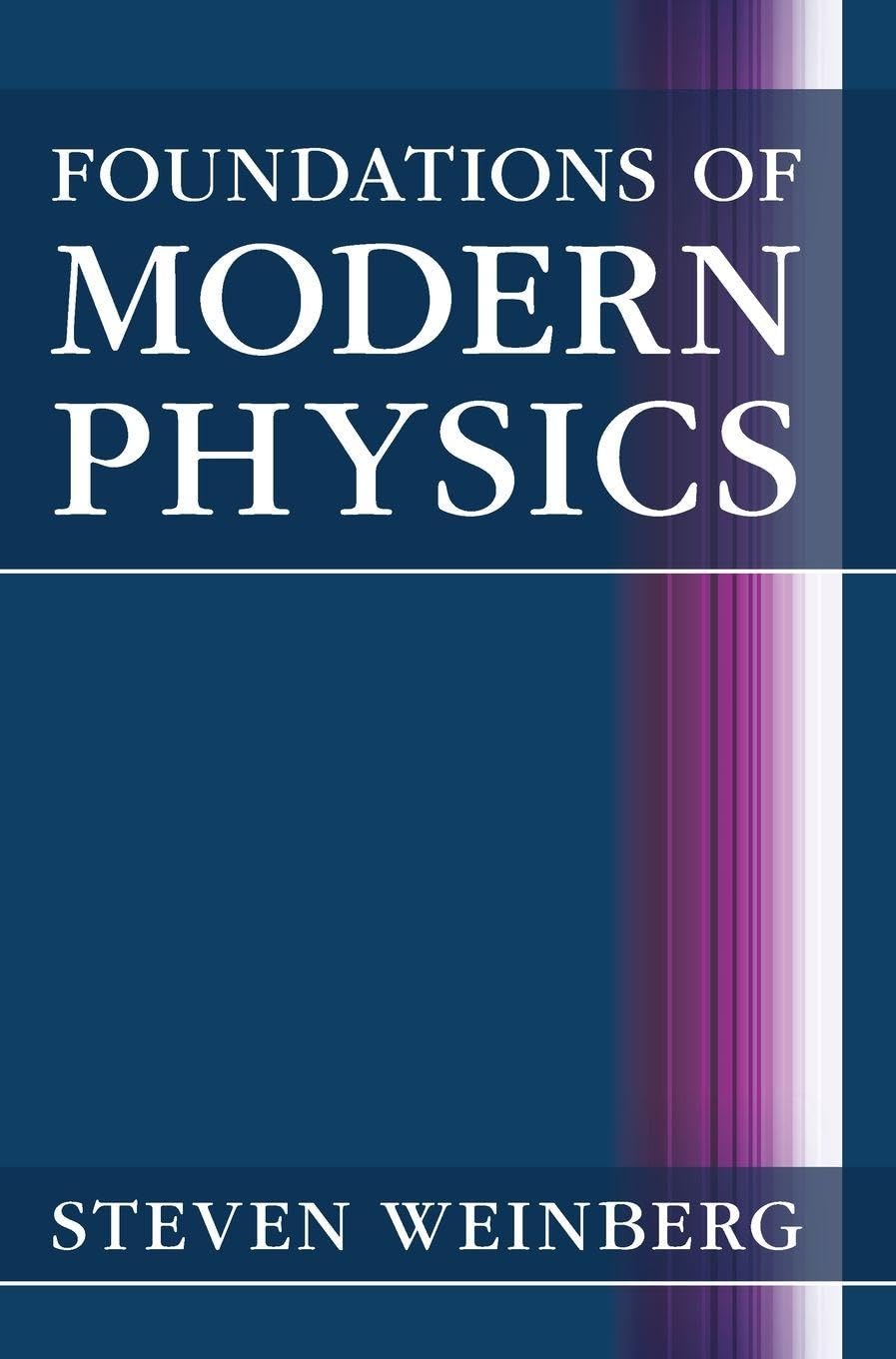
desertcart.in - Buy Foundations of Modern Physics book online at best prices in India on desertcart.in. Read Foundations of Modern Physics book reviews & author details and more at desertcart.in. Free delivery on qualified orders. Review: Rigor. Informacion. Profundidad - Este libro es una joya para cualquiera interesado en la fisica y en la ciencia en general. Comenzando por los principios mas basicos y simples termina con los conceptos mas avanzados, cubriendo un material que resume el curriculum de una licenciatura en fisicas. Todo ello con gran rigor y claridad. Muy interesante el peso especifico que asigna a nociones clasicas, que en otros textos se obvian a favor de conceptos mas modernos, pero que ayudan enormemente a entender como han evolucionado hasta la descripcion estandard moderna. Review: crackling with wisdom and insight on every page - It should come as little surprise that Steven Weinberg has written another winning exposition, suffused as it is with his many years worth of wisdom and insight (acquired through teaching and research). As I have alluded to in other reviews, my first encounter with Weinberg occurred 1977, his 'The First Three Minutes' especially its mathematical supplement. My second encounter, with study of his General Relativity and Cosmology (allowing time for me to hone prerequisites). That book was, and remains, a revelation to me. Then came his Quantum Theory of Fields (1995), and suddenly that topic made sense (the "why is it that way" kind of sense). As the years have progressed, I have made a deliberate attempt to study as much of Weinberg as I could, which brings me to his final text: Foundations of Modern Physics (the hardcover is sturdy, attractively and well-produced): (1) Not one to shy from historical ruminations, Weinberg provides some background to whet the appetite. Along the way, keep your eyes open for Enrico Fermi and Willard Gibbs (Gibbs, in regards to the proof and generalization of H-Theorem (page 35) and Fermi, in reference to alpha-decay (page 235). If historically more motivated, read Weinberg's book: To Explain The World, especially his technical notes. (2) Mathematics is used to great efficacy and in interesting manner (symmetry, dimensional analysis (page 60), power series expansion (page 49), inequalities (page 36). Calculus, in Weinberg's hands, becomes a sight to behold (I get the impression he truly enjoys using Calculus). (3) Sometimes, an opinion makes its way into the prose: "The Majorana alternative seems to me a more economical and plausible view." (page 250, regards neutrinos). Read: "It is the introduction of the concept of probability into physics that creates an asymmetry between past and future." (page 37). (4) Note: Max Born gets his due (equating one quantum postulate to another--see page 143, and top of page 145, also page 179) and through Born's exposition Atomic Physics (I add: many prerequisites can be located there). Weinberg refers to Born's appendix 33 (footnote, page 66). Enrico Fermi's "masterpiece of scientific exposition," Thermodynamics, is also referenced (page 24). (5) I highlight the exceptional chapter on Relativity. Read: "It is a general rule that if the time-component of a four-vector vanishes in all coordinate systems, then the whole four-vector vanishes." (page 112) and "General Relativity is a theory of the gravitational field, a quantity that keeps track of departures from inertial frames." (page 102). Minkowski diagrams are absent (Mermin is good at describing those--see, Space and Time in Special Relativity). (6) I highlight a section regards rotations (Read: "we would not want the rotation to change the total probability," pages 152-154). I highlight sections on charged particles in electromagnetic fields and gauge transformations (pages 195-198, and gauge invariance will recur). Brief, yet illuminating. You eventually arrive at Feynman diagrams (page 268), but in true Weinberg fashion, figures, diagrams, or pictures as pedagogic ploy, are scarce. (7) We are reminded: "the wave-function is not a field--it is a representation of a physical state." (page 251). We are reminded: "the spin operator has nothing to do with positions and momenta." (page 154). Words of wisdom abound. There is a separate index for names and subjects. There are footnotes and a bibliography (take note: Landau and Lifshitz, Fluid Mechanics). 28 interesting problems for involvement concludes the book (#17: "suppose the electron has spin 3/2 instead of 1/2….what would you expect…"). (8) In conclusion: My opinion is to utilize a combination of Weinberg's 'Foundations' in conjunction with his 'Lectures on Quantum Mechanics' and as prelude to his opus of Quantum Theory of Fields. By all means, study his 'Gravitation and Cosmology' updated with his tomes on 'Cosmology' and the terse, but illuminating: 'Lectures on Astrophysics'. Good texts do not have to be voluminous, as Weinberg shows us.
| Best Sellers Rank | #563,181 in Books ( See Top 100 in Books ) #451 in Mechanics #2,835 in Physics (Books) #8,045 in Engineering & Technology (Books) |
| Customer Reviews | 4.7 out of 5 stars 152 Reviews |
P**S
Rigor. Informacion. Profundidad
Este libro es una joya para cualquiera interesado en la fisica y en la ciencia en general. Comenzando por los principios mas basicos y simples termina con los conceptos mas avanzados, cubriendo un material que resume el curriculum de una licenciatura en fisicas. Todo ello con gran rigor y claridad. Muy interesante el peso especifico que asigna a nociones clasicas, que en otros textos se obvian a favor de conceptos mas modernos, pero que ayudan enormemente a entender como han evolucionado hasta la descripcion estandard moderna.
G**Y
crackling with wisdom and insight on every page
It should come as little surprise that Steven Weinberg has written another winning exposition, suffused as it is with his many years worth of wisdom and insight (acquired through teaching and research). As I have alluded to in other reviews, my first encounter with Weinberg occurred 1977, his 'The First Three Minutes' especially its mathematical supplement. My second encounter, with study of his General Relativity and Cosmology (allowing time for me to hone prerequisites). That book was, and remains, a revelation to me. Then came his Quantum Theory of Fields (1995), and suddenly that topic made sense (the "why is it that way" kind of sense). As the years have progressed, I have made a deliberate attempt to study as much of Weinberg as I could, which brings me to his final text: Foundations of Modern Physics (the hardcover is sturdy, attractively and well-produced): (1) Not one to shy from historical ruminations, Weinberg provides some background to whet the appetite. Along the way, keep your eyes open for Enrico Fermi and Willard Gibbs (Gibbs, in regards to the proof and generalization of H-Theorem (page 35) and Fermi, in reference to alpha-decay (page 235). If historically more motivated, read Weinberg's book: To Explain The World, especially his technical notes. (2) Mathematics is used to great efficacy and in interesting manner (symmetry, dimensional analysis (page 60), power series expansion (page 49), inequalities (page 36). Calculus, in Weinberg's hands, becomes a sight to behold (I get the impression he truly enjoys using Calculus). (3) Sometimes, an opinion makes its way into the prose: "The Majorana alternative seems to me a more economical and plausible view." (page 250, regards neutrinos). Read: "It is the introduction of the concept of probability into physics that creates an asymmetry between past and future." (page 37). (4) Note: Max Born gets his due (equating one quantum postulate to another--see page 143, and top of page 145, also page 179) and through Born's exposition Atomic Physics (I add: many prerequisites can be located there). Weinberg refers to Born's appendix 33 (footnote, page 66). Enrico Fermi's "masterpiece of scientific exposition," Thermodynamics, is also referenced (page 24). (5) I highlight the exceptional chapter on Relativity. Read: "It is a general rule that if the time-component of a four-vector vanishes in all coordinate systems, then the whole four-vector vanishes." (page 112) and "General Relativity is a theory of the gravitational field, a quantity that keeps track of departures from inertial frames." (page 102). Minkowski diagrams are absent (Mermin is good at describing those--see, Space and Time in Special Relativity). (6) I highlight a section regards rotations (Read: "we would not want the rotation to change the total probability," pages 152-154). I highlight sections on charged particles in electromagnetic fields and gauge transformations (pages 195-198, and gauge invariance will recur). Brief, yet illuminating. You eventually arrive at Feynman diagrams (page 268), but in true Weinberg fashion, figures, diagrams, or pictures as pedagogic ploy, are scarce. (7) We are reminded: "the wave-function is not a field--it is a representation of a physical state." (page 251). We are reminded: "the spin operator has nothing to do with positions and momenta." (page 154). Words of wisdom abound. There is a separate index for names and subjects. There are footnotes and a bibliography (take note: Landau and Lifshitz, Fluid Mechanics). 28 interesting problems for involvement concludes the book (#17: "suppose the electron has spin 3/2 instead of 1/2….what would you expect…"). (8) In conclusion: My opinion is to utilize a combination of Weinberg's 'Foundations' in conjunction with his 'Lectures on Quantum Mechanics' and as prelude to his opus of Quantum Theory of Fields. By all means, study his 'Gravitation and Cosmology' updated with his tomes on 'Cosmology' and the terse, but illuminating: 'Lectures on Astrophysics'. Good texts do not have to be voluminous, as Weinberg shows us.
A**E
Excellent
Excellent....a further masterpiece...his legacy
R**.
Good up to date overview
As a professional physicist and engineer, one increasing specializes as one gets older, meaning that many topics are not used or revisited for years. This book is a great way to review the important concepts and get up to date, at least at the overview level.
D**G
Full of info
Book has been written like a text book. Loved the detail information.
Trustpilot
Hace 2 meses
Hace 2 meses