We remain fully operational. Our teams are working around the clock to ensure your deliveries continue safely.

Descargar la aplicación


Servicios al cliente
Sobre nosotros
Copyright © 2025 Desertcart Holdings Limited
Descargar la aplicación

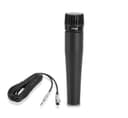

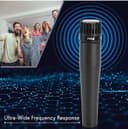


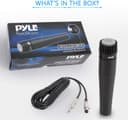
🎙️ Own the stage with clarity and confidence!
The Pyle PDMIC78 is a dynamic handheld microphone featuring a unidirectional cardioid pattern that minimizes background noise, delivering clear, punchy vocals. Built with a durable zinc alloy body and steel mesh windscreen, it’s designed for professional use in live and studio settings. With a wide frequency response (50Hz-15KHz), 600 Ohm impedance, and a 4.57m XLR cable included, it offers versatile connectivity ideal for karaoke, DJ setups, and amplified instruments—all at an accessible price point favored by beginners and pros alike.


| ASIN | B005BSOVRY |
| Antenna Location | Singing |
| Audible Noise | 70 Decibels |
| Best Sellers Rank | 130 in Musical Instruments & DJ ( See Top 100 in Musical Instruments & DJ ) 3 in Dynamic Microphones |
| Box Contents | Audio Connection Cable |
| Brand Name | Pyle |
| Colour | Black |
| Compatible Devices | Speaker |
| Connectivity Technology | wire |
| Connector Type | XLR |
| Country of Origin | China |
| Customer Reviews | 4.1 4.1 out of 5 stars (3,074) |
| Enclosure Material | Alloy Steel, Metal, Zinc |
| External Testing Certification | Não aplicável |
| Frequency Range | 40 -15000 Hz |
| Frequency Response | 15 KHz |
| Global Trade Identification Number | 00068889007039, 00611101539995 |
| Hardware Platform | Gaming Console, Karaoke Machine, PC |
| Impedance | 600 Ohms |
| Item Dimensions | 8.9 x 25.4 x 12.7 centimetres |
| Item Type Name | Pyle Pylepro PDMIC78 - Microphone |
| Item Weight | 590 g |
| Manufacturer | Pyle-Pro |
| Manufacturer Part Number | PDMIC78 |
| Maximum Frequency | 15000 Hz |
| Microphone Form Factor | Handheld |
| Minimum Frequency | 50 Hz |
| Model Name | Pyle |
| Model Number | PDMIC78 |
| Number of Channels | 1 |
| Polar Pattern | Unidirectional |
| Power Source | Corded Electric |
| Signal-to-Noise Ratio | 70 dB |
| Special Feature | Corded |
| UPC | 611101539995 688890070398 823019877919 068889007039 702248798861 809198925771 012304051107 |
| Unit Count | 1.0 count |
C**N
Fantastic Value for Money
A very good microphone for the price. From a sound quality point of view, I would say the PDMIC78 is comparable to a genuine SM57, but with a slightly brighter high end. Build quality from the outside is similar, but the the PDMIC78 is lighter (Due to the lack of an internal transformer). As with Pyles other microphones, this is also not balanced (not that most people will hear a difference), but that can be fixed in just a couple of minutes. I would recommend this mic to anyone on a budget, anyone starting out or even those who just need some extra SM57 style mics around the studio.
S**E
Decent SM57 clone, but beware the unbalanced output...
I mostly record electric guitars via modelling plugins, primarily Amplitube or Bias, but I wanted a decent mic for those rare occasions when I might want to record my little Marshall. For all I'd use it, it didn't make sense to splurge on an SM57, so this seemed like a good alternative - and for the most part, it is. It has quite a similar character to the 57, with the same brash midrange, but perhaps a little more scratchy in the high end. This is easily compensated for in EQ, though. My biggest caveat is this: I'm not sure if it's stated anywhere in the literature, but this mic has an UNBALANCED output, rather than the balanced output found in an SM57. This is perhaps why it's supplied with an XLR>jack lead rather than XLR>XLR. For most applications, this won't matter, but I found it caused problems with a dual mic setup using a Rode NT1-A in the rear of the guitar cab, and the Pyle with an XLR>XLR lead. My Focusrite Scarlett 2i2 interface, like most similar devices, supplies phantom power across all inputs. When engaged for the Rode, this caused a significant rise in noise and loss of signal quality for the Pyle mic. It could have been worse - phantom power can destroy an unbalanced mic. The info could be a lot clearer on this point. It was easily worked around, however, by simply using the XLR>jack lead. A quick google found a simple mod to turn the Pyle's output to balanced, but given the ease of just using the supplied lead, I'll probably not bother with that. All in all, this is a good value, and very usable, microphone.
M**S
For the money brilliant
I have given this microphone five stars because for the money it is brilliant. It sounds good and like the excellent SM57 it copies, it is a very good general purpose microphone. I've not used it yet on toms, snare or guitar cabinets, but I assume it will handle such roles well. I always preferred an SM57 on vocals to the almost ubiquitous SM58 provided the singer had a pure sounding voice, and I'm guessing that this mic will perform well in such a role too. It is far more feedback resistant than I dared hope; on test I could use it extremely close to and almost on axis with nearfield monitors without feedback, which is excellent. Incidentally, for anyone who has used an SM57 on snares, a role to which it is quite well suited although not as well suited as the sublime Sennheiser MD441, this cheapo Pyle Pro copy does have a distinct advantage. The SM57 top is held in place by a copper spring clip and all too often an over-enthusiastic drummer would knock the end off with his sticks,resulting in searches on hand and knees on the stage after the gig. Frequently, the clip would be lost and would result in a long wait for my supplier to obtain spares for me. This mic seems to be free of clip fastening. I've not discovered how the end is fixed but it does seem sturdier than on the mic it copies. This mic does have one significant disadvantage though which may not effect everyone, but as an avowed lover of capacitor mics, this microphone does not like phantom power. As yet I haven't found out why, but used on a desk with global phantom power, there is a distinctive mains-like hum. Using the mic with an active DI box enables the use of the mic noiselessly with phantom power switched on, but it does tie up a DI. A warning applicable to any mic as well as this one is that under no circumstances should you try and fit a male XLR connector to replace the 1/4 inch jack. The cable itself is totally unsuitable for use on a balanced microphone, but if anyone tried wiring a male XLR onto the cable in the same fashion as the female XLR, will end up destroying this (and any) microphone if connected to phantom power with the supplied cable. If uncertain of this warning, check 'phantom power' on t'internet. In summary, it does seem remarkable that anyone is able to manufacture a microphone of this quality, ship it half way around the world and sell it for under a tenner. Despite that, this is a perfectly useable mic and looks to be sturdily enough constructed to make it quite reliable in use. The 15 foot microphone cable is fairly naff, but the microphone itself would still be a bargain at twice the price.
J**S
Musicien amateur (guitariste et claviériste) depuis 10 ans, tourné vers le Rock Alternatif , le Stoner et le Métal, je souhaitais compléter mon set de micros instruments par un clone de sm57 (collé contre un baffle guitare 2x12, en complément du shure) Franchement ce petit micro payé 20 euros est une tuerie, surtout pour les sons saturés où il excelle. Sur tom batterie convainquant aussi et en dépannage en overhead pour les cymballes, plutôt bon (reprend très bien. les fréquences aigues). Plus de dynamique et de brillant (moins étouffé) que le SM57. Pour les sons purement acoustiques, cordes notamment, il colore plus le son, ça peut être sympa mais c'est pas là où il faut l'employer (le 57 non plus d'ailleurs).. Bref allez y les yeux fermés....très belle surprise !
C**N
¿Qué parece? Un clon del mítico SM57 ¿Qué es? Un clon del mítico SM57 ¿Cómo suena? Tan parecido a un SM57 que mucha gente no notaría la diferencia. ¿Cómo rinde? Muy correctamente, tanto en grabaciones como en directos. La construcción es sólida y el micro tiene un peso que da confianza a la hora de manipularlo. El sonido es bueno, aguanta transitorios sin ningún problema, la sensibilidad es buena. Grabando lo he utilizado para percusión y para amplificadores de guitarra sin ningún problema. Incluso combinándolo con un 58 con la cápsula descubierta para microfonear un amplificador se obtiene un estéreo muy interesante y agradable. El único defecto que le podría dar sería que de fábrica no aprovecha la salida balanceada, pero es algo que se soluciona con un poco de estaño y 2 minutos de maña. A pesar de ello, lo estuve utilizando sin balancear para algunas grabaciones y no me dio problemas de ruido ni de ningún otro tipo. También lo he comparado con algunos clones chinos del SM57 y el Pyle los supera con creces. Conclusión: Un SM57 siempre será un SM57, pero en lo personal puedo decir que estoy muy contento y volveré a comprar uno si lo necesito.
L**O
TRIVIA: Come hanno scritto in tanti è in pratica uno dei tanti cloni del 57, ma non marchiato shure, viene prodotto da un azienda Americana di tutto rispetto che costruisce i supi prodotti in cina, la Pyle ! Pyle non solo si occupa di microfoni ma anche di altre cose nel campo musicale come coni e amplificatori ecc. USO: Il Pyle PDMIC78 è un microfono robusto che vi arriva in una scatola d buona fattura con un cavo in dotazione. Il microfono si presta bene a tutti i tipi di strumenti , specialmente percussioni, riprese da amp chitarre e strumenti tipo sax ,clarinetti e flauti ecc. Per coloro che vorrebbero usarlo come mic voce dico subito che è meno adatto, ma con qualche accorteza è possibile usarlo anche per cantare ma solo su asta, è preferibile cercare un microfono per voce specifico (stile sm58). IN STUDIO: Ho provato questo microfono (ne ho 4) e vi posso garantire che alla resa dei conti a livello di ripresa ci sono delle differenze irrisorie, anzi ho preferito la ripresa timbrica del pyle rispetto al 57 originale. Molti storceranno il naso leggendo quello che scrivo ma spesso la maggior parte sanno solo criticare senza essere costruttivi o positivi. Cosa pretendere da un microfono che mi è costato 14 euro???? Invece resterete meravigliati !! CONNESSIONI: I microfoni arrivano già con connessioni bilanciate percui chi scrive il contrario è in errore. Il microfono in dotazione funziona ma vi consiglio sempre un xlr2 xlr per isolarvi dai rumori di fondo. Ma questo non significa che il cavo non è funzionante, se non avete nessuna pretesa anche il cavo in dotazione va bene (se non altro lo tenete come back-up) !! Vi lascio due consigli alternativi, usatelo sulla grancassa , sono rimasto scioccato dalla resa sonora e dall pressione che sopporta ! Provate due pyle come OH , un mic sul rullante e un mic nella cassa ,, risultato? senza parole !!! LIVE? :Ho provato anche dal vivo, confermo quello che scrino altrove, vanno bene ! CONCLUSIONE: Per il loro prezzo vanno bene, Sicuramente nel tempo un shure originale durerà di più specialmente se abusato dal vivo, d'altronde cosa volete ? un mic originale shure costa 120+ euro quindi inutile fare paragoni ,no?
J**.
The sound is excellent , i used for snare drum and congas, Bongos. The high end is better than famous SM 57
A**Z
Buen micrófono solo el cambio no es de la mejor calidad pero funciona muy parecido al sm57
Trustpilot
Hace 2 semanas
Hace 2 semanas