Some deliveries may take a little longer than usual due to regional shipping conditions.

Descargar la aplicación


Servicios al cliente
Sobre nosotros
Copyright © 2025 Desertcart Holdings Limited
Descargar la aplicación
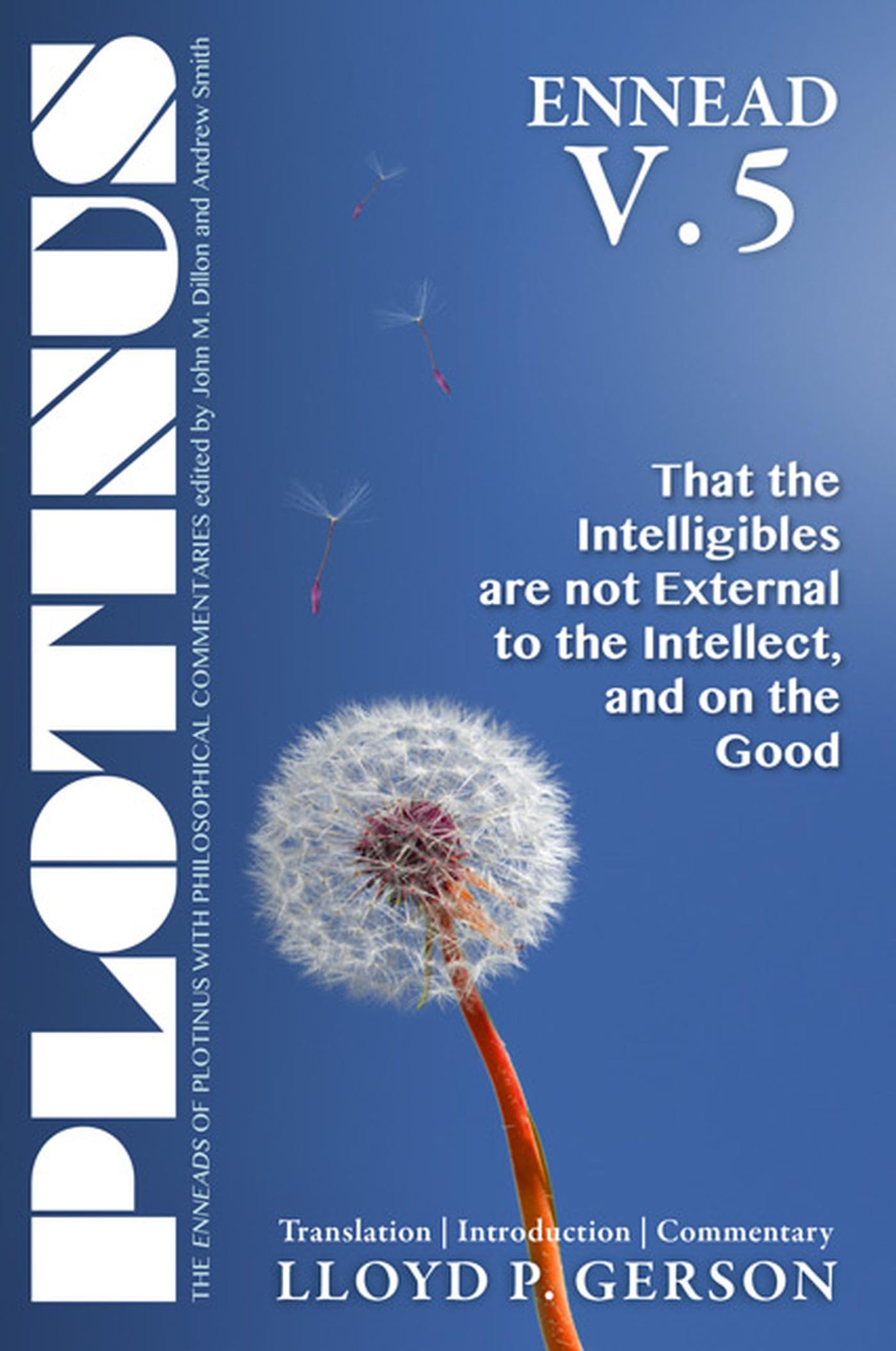
PLOTINUS ENNEAD V.5 (The Enneads of Plotinus): That the Intelligibles Are not External to the Intellect, and on the Good : GERSON L.P.: desertcart.co.uk: Books Review: Plotinus Ennead V.5 Gerson LP - The Enneads of Plotinus (205 – 270 CE), were discussions or lectures of Plotinus, organized by his student Porphyry, into 6 Enneads; each Ennead being made up of 9 chapters or Treatises, but not all the treatises were of the same length so Porphyry did a cut and paste job on them, so the Enneadic sequence does not represent the order in which they were written. This is an excellent series of new translations of the Tractates under the general editorship of John Dillon and Andrew Smith, which is slowly, too slowly for some lovers of Plotinus, developing with the aim of producing eventually a complete new translation and commentary of the entire corpus. There is a standard Greek edition published by Oxford, but for most people there are two options; the complete translation by Stephen McKenna which has a touch of Irish eloquence about it, or the complete translation by Armstrong which includes the original Greek but is more accurate, published Harvard in the Leob edition. There are of course a number of abridged Enneads, the Penguin one for example, uses McKenna’s translation and is edited by Dillon. All of the editions so far published, and those still yet to be published, follow the same pattern: a new translation, a detailed commentary, chapter by chapter for each tractate, reflecting current research, and a useful bibliography. But the whole production format is so reader-friendly, that the published ones are already introducing Plotinus to those who have not read him before. What the editors appear to have been shrewd about is the matching of Ennead Tractate to translator, who, must have ‘Greek’ as they say, and the simplest way of doing it is ascertaining interests, and that can be done through publications. In the case of this particular edition, Lloyd P Gerson has edited the ‘Cambridge Companion to Plotinus’, and is the author of Plotinus in the excellent Routledge ‘Philosophers’ series. One of the problems of aligning modern philosophers with philosophers of the past, is there is an academic convention that one sticks to the argument as an object, interpretations must be both rational and objective, so someone like Plotinus who sometimes writes directly from experience completely ignoring what else he might of said, will present particular challenges as noted by Armstrong, which he refers to (p.158). Professor Gerson has handled the problem beautifully: ‘Plotinus has extended discussion of how intellect attains the One. The crucial step in his reasoning is that the One is omnipresent, and is so in us. That is, we can only have an experience of the One if we abstract from any consideration that entails it is other than ourselves, as he says…’ (p.160) That is as apophatic as anything we will find in Plotinus. This is an excellent example of a very promising series. Review: If one would like a thorough and informed review of this book, one can Google it along with Bryn Mawr Classical Review or BMCR. The book is a valuable addition to the scholarship of Neo-Platonism. Note as well, from O'Daly's BMCR review "Gerson's translation is painstakingly accurate, achieving fluency and clarity without simplifying Plotinus' often hyper-concentrated style. If one compares it with the distinguished English translation by A. H. Armstrong, there are gains in precision as well as in contemporary idiom." I do, in fact, read Ancient Greek. I can aver from my own knowledge and experience that Plotinus cannot be both accurately and pleasantly translated. If you encounter more than a sentence or two of Plotinus in translation that seems to be very natural and clear English, the translator is getting highly interpretative. Too many reviews of Neoplatonic translations, like the one below, complain about how bad this translation or that translation is. Nearly all of these people cannot read Greek and have no informed opinion on the matter. There's a reason the translations are a hard read. It's not for lack of skill on the translator's part. Apologies, if this is a bit of rant. I'll update later with a review of the commentary itself. In the meantime, Google up O'Daly's review. ___ Now that I've finished the book, I can add a little more to counter Mr. Direct Revelation of the One and the "commandments" of Plato, Pythagoras, and Plotinus. I'm glad this book exists, though it is a little dense and less than ideally friendly. While nearly all of it is perfectly accessible to the Greekless, if you are not well prepared for unrestrained philosophical discourse, it may be rough going. For the most part, Plotinus' treatises are very condensed lecture notes that assume a great deal of prior knowledge. In a single paragraph he may be responding to several actual or possible objections to his argument, and elucidating what these objections are, as well as explaining Plotinus' arguments and their necessity is what Gerson focuses on. Plotinus naturally riffs off of Plato and Aristotle too, and Gerson comments on such passages, as well as providing cross-references to various ideas and phraseology within the Plotinian corpus. Gerson clearly intended this book as a resource even for his peers. It's about what you'd expect from a short commentary on Classical philosophy that assumes no deep knowledge of Greek. So, if you are looking for a commentary that makes Plotinus easy and very intelligible, this isn't it. That said, it's not without value for readers with some, but not thorough knowledge of classical philosophy. I stand somewhere between some and thorough myself, so it wasn't a cake walk, but it helped me get deeper into how to read Plotinus with comprehension. The question is whether you need to know the whys and why nots, and not just the whats, of Plotinian ontology, and whether you love ideas like semantic vs. ontology truth and autoexplicable vs. heteroexplicable. If a commentary on a less purely technical treatise, like Against the Gnostics, were as dense and detailed as this one, I would probably give it 3 - 3.5 stars, but given the technicality of the topic (whether the forms are within or without Intellect), it's fitting. I'd really rate it at 4, but I'm leaving the 5 to balance out the nonsense of the low review. The reason for the downgrade is simply that Gerson loses sight of the forest for the trees to some extent, and this could have been avoided. He provides a good outline just before the translation, but signposts are lacking within the translation itself, which is short (about 25 pages), but still dense, and within the much longer commentary (about 140 pages). Each chapter gets a brief rubric in the commentary, but it's generally short and somewhat inconsistent with the outline at the beginning (even including the line numbers). Given how many trees there are in this forest, and how difficult it is to read even one paragraph of Plotinus and keep it locked in your head, articulating the commentary more would have been greatly helpful. Add to this the small size of the pages, and the text gets atomized.
| Best Sellers Rank | 1,728,062 in Books ( See Top 100 in Books ) 39,077 in Philosophy (Books) |
| Customer reviews | 4.6 4.6 out of 5 stars (4) |
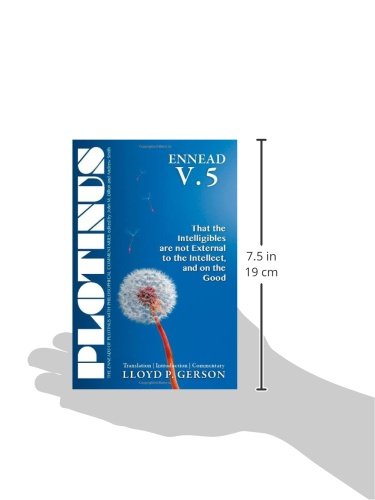
| Dimensions | 12.7 x 1.78 x 19.05 cm |
| ISBN-10 | 1930972857 |
| ISBN-13 | 978-1930972858 |
| Item weight | 263 g |
| Language | English |
| Print length | 1 pages |
| Publication date | 1 Jun. 2013 |
| Publisher | Parmenides Press |
M**B
Plotinus Ennead V.5 Gerson LP
The Enneads of Plotinus (205 – 270 CE), were discussions or lectures of Plotinus, organized by his student Porphyry, into 6 Enneads; each Ennead being made up of 9 chapters or Treatises, but not all the treatises were of the same length so Porphyry did a cut and paste job on them, so the Enneadic sequence does not represent the order in which they were written. This is an excellent series of new translations of the Tractates under the general editorship of John Dillon and Andrew Smith, which is slowly, too slowly for some lovers of Plotinus, developing with the aim of producing eventually a complete new translation and commentary of the entire corpus. There is a standard Greek edition published by Oxford, but for most people there are two options; the complete translation by Stephen McKenna which has a touch of Irish eloquence about it, or the complete translation by Armstrong which includes the original Greek but is more accurate, published Harvard in the Leob edition. There are of course a number of abridged Enneads, the Penguin one for example, uses McKenna’s translation and is edited by Dillon. All of the editions so far published, and those still yet to be published, follow the same pattern: a new translation, a detailed commentary, chapter by chapter for each tractate, reflecting current research, and a useful bibliography. But the whole production format is so reader-friendly, that the published ones are already introducing Plotinus to those who have not read him before. What the editors appear to have been shrewd about is the matching of Ennead Tractate to translator, who, must have ‘Greek’ as they say, and the simplest way of doing it is ascertaining interests, and that can be done through publications. In the case of this particular edition, Lloyd P Gerson has edited the ‘Cambridge Companion to Plotinus’, and is the author of Plotinus in the excellent Routledge ‘Philosophers’ series. One of the problems of aligning modern philosophers with philosophers of the past, is there is an academic convention that one sticks to the argument as an object, interpretations must be both rational and objective, so someone like Plotinus who sometimes writes directly from experience completely ignoring what else he might of said, will present particular challenges as noted by Armstrong, which he refers to (p.158). Professor Gerson has handled the problem beautifully: ‘Plotinus has extended discussion of how intellect attains the One. The crucial step in his reasoning is that the One is omnipresent, and is so in us. That is, we can only have an experience of the One if we abstract from any consideration that entails it is other than ourselves, as he says…’ (p.160) That is as apophatic as anything we will find in Plotinus. This is an excellent example of a very promising series.
A**R
If one would like a thorough and informed review of this book, one can Google it along with Bryn Mawr Classical Review or BMCR. The book is a valuable addition to the scholarship of Neo-Platonism. Note as well, from O'Daly's BMCR review "Gerson's translation is painstakingly accurate, achieving fluency and clarity without simplifying Plotinus' often hyper-concentrated style. If one compares it with the distinguished English translation by A. H. Armstrong, there are gains in precision as well as in contemporary idiom." I do, in fact, read Ancient Greek. I can aver from my own knowledge and experience that Plotinus cannot be both accurately and pleasantly translated. If you encounter more than a sentence or two of Plotinus in translation that seems to be very natural and clear English, the translator is getting highly interpretative. Too many reviews of Neoplatonic translations, like the one below, complain about how bad this translation or that translation is. Nearly all of these people cannot read Greek and have no informed opinion on the matter. There's a reason the translations are a hard read. It's not for lack of skill on the translator's part. Apologies, if this is a bit of rant. I'll update later with a review of the commentary itself. In the meantime, Google up O'Daly's review. ___ Now that I've finished the book, I can add a little more to counter Mr. Direct Revelation of the One and the "commandments" of Plato, Pythagoras, and Plotinus. I'm glad this book exists, though it is a little dense and less than ideally friendly. While nearly all of it is perfectly accessible to the Greekless, if you are not well prepared for unrestrained philosophical discourse, it may be rough going. For the most part, Plotinus' treatises are very condensed lecture notes that assume a great deal of prior knowledge. In a single paragraph he may be responding to several actual or possible objections to his argument, and elucidating what these objections are, as well as explaining Plotinus' arguments and their necessity is what Gerson focuses on. Plotinus naturally riffs off of Plato and Aristotle too, and Gerson comments on such passages, as well as providing cross-references to various ideas and phraseology within the Plotinian corpus. Gerson clearly intended this book as a resource even for his peers. It's about what you'd expect from a short commentary on Classical philosophy that assumes no deep knowledge of Greek. So, if you are looking for a commentary that makes Plotinus easy and very intelligible, this isn't it. That said, it's not without value for readers with some, but not thorough knowledge of classical philosophy. I stand somewhere between some and thorough myself, so it wasn't a cake walk, but it helped me get deeper into how to read Plotinus with comprehension. The question is whether you need to know the whys and why nots, and not just the whats, of Plotinian ontology, and whether you love ideas like semantic vs. ontology truth and autoexplicable vs. heteroexplicable. If a commentary on a less purely technical treatise, like Against the Gnostics, were as dense and detailed as this one, I would probably give it 3 - 3.5 stars, but given the technicality of the topic (whether the forms are within or without Intellect), it's fitting. I'd really rate it at 4, but I'm leaving the 5 to balance out the nonsense of the low review. The reason for the downgrade is simply that Gerson loses sight of the forest for the trees to some extent, and this could have been avoided. He provides a good outline just before the translation, but signposts are lacking within the translation itself, which is short (about 25 pages), but still dense, and within the much longer commentary (about 140 pages). Each chapter gets a brief rubric in the commentary, but it's generally short and somewhat inconsistent with the outline at the beginning (even including the line numbers). Given how many trees there are in this forest, and how difficult it is to read even one paragraph of Plotinus and keep it locked in your head, articulating the commentary more would have been greatly helpful. Add to this the small size of the pages, and the text gets atomized.
Trustpilot
Hace 2 semanas
Hace 2 meses