We remain fully operational. Our teams are working around the clock to ensure your deliveries continue safely.

Descargar la aplicación


Servicios al cliente
Sobre nosotros
Copyright © 2025 Desertcart Holdings Limited
Descargar la aplicación


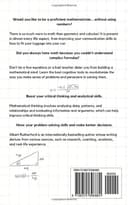
Buy Build a Mathematical Mind - Even If You Think You Can't Have One: Become a Pattern Detective. Boost Your Critical and Logical Thinking Skills. (Advanced Thinking Skills) on desertcart.com ✓ FREE SHIPPING on qualified orders Review: Makes you appreciate math. - This is a great book to read alongside "Making Numbers Count: The Art and Science of Communicating Numbers". What i love about this book is that it brings out that math involves asking "what if" and experimenting with those "what ifs". I don't know about you but math was presented to me in school as a finite system with only one answer/approach. The solution is for schools to create an environment that is conducive to divergent thinking, or as Sir Kem puts it, "the ability to see lots of possible answers to a question, lots of possible ways of interpreting a question". In other words, the author argues that problem-solving skills should be emphasized in math the way they are in other liberal disciplines and he presents various methods that teach you how to do this throughout the book. These methods consist of the following: 1. Develop a mathematical habit 2. Become a better pattern detective 3. Use probability and experimentation 4. Describe and speak in the language of math. 5. Tinker 6. Invent 7. VIsualize 8. Guess The author presents these methods in layman's terms and even presents simple exercises you can do to start applying them. Further, the author brings out how the creative process used to process music/art etc. is the same process used to process mathematics. In fact, some mathematicians have claimed that their critical discoveries came to them while sleeping (similar to a lot of brilliant musicians). In other words, everyone has the ability to learn and process mathematics, there isn't some unique aspect/attribute that you need to understand math. But ye I would recommend this book to anybody. IT breaks down the flaws in the current American mathematical education system, how to address these flaws, and how you can embrace/lov Review: Short, But Sweet - Rutherford does an admirable job of telling us how mathematicians think about the world, but it ended too quickly and didn't really tell us how to do math. Perhaps his plan was to leave us wanting more and to persuade us to buy another of his books on a similar topic. If that was his goal, he really does think like a mathematician.

| ASIN | B0BTGFK7FX |
| Best Sellers Rank | #113,425 in Books ( See Top 100 in Books ) #33 in Mathematics Reference (Books) #89 in Elementary Mathematics #112 in Applied Mathematics (Books) |
| Book 3 of 6 | Advanced Thinking Skills |
| Customer Reviews | 4.1 4.1 out of 5 stars (374) |
| Dimensions | 5 x 0.35 x 8 inches |
| ISBN-13 | 979-8375396880 |
| Item Weight | 6 ounces |
| Language | English |
| Print length | 152 pages |
| Publication date | January 29, 2023 |
| Publisher | Independently published |
M**.
Makes you appreciate math.
This is a great book to read alongside "Making Numbers Count: The Art and Science of Communicating Numbers". What i love about this book is that it brings out that math involves asking "what if" and experimenting with those "what ifs". I don't know about you but math was presented to me in school as a finite system with only one answer/approach. The solution is for schools to create an environment that is conducive to divergent thinking, or as Sir Kem puts it, "the ability to see lots of possible answers to a question, lots of possible ways of interpreting a question". In other words, the author argues that problem-solving skills should be emphasized in math the way they are in other liberal disciplines and he presents various methods that teach you how to do this throughout the book. These methods consist of the following: 1. Develop a mathematical habit 2. Become a better pattern detective 3. Use probability and experimentation 4. Describe and speak in the language of math. 5. Tinker 6. Invent 7. VIsualize 8. Guess The author presents these methods in layman's terms and even presents simple exercises you can do to start applying them. Further, the author brings out how the creative process used to process music/art etc. is the same process used to process mathematics. In fact, some mathematicians have claimed that their critical discoveries came to them while sleeping (similar to a lot of brilliant musicians). In other words, everyone has the ability to learn and process mathematics, there isn't some unique aspect/attribute that you need to understand math. But ye I would recommend this book to anybody. IT breaks down the flaws in the current American mathematical education system, how to address these flaws, and how you can embrace/lov
C**L
Short, But Sweet
Rutherford does an admirable job of telling us how mathematicians think about the world, but it ended too quickly and didn't really tell us how to do math. Perhaps his plan was to leave us wanting more and to persuade us to buy another of his books on a similar topic. If that was his goal, he really does think like a mathematician.
H**1
If you want to learn to think logically, read this book.
Very good book. It gives great examples of how math is around us and used in our everyday lives. To think like a mathematician is to think very logically. If you can think logically you can think about anything. Learning to build a mathematical mind will help in aspect of your life and that is what this book does. It shows you that you can think in mathematics. The writing was clear and entertaining. It is not at all like a typical math book. I definitely recommend this book.
R**7
Meh.
Kind of basic.
T**R
Historically bad at math - but this makes sense!
Many people have a complicated relationship with math. I think that's mostly because of bad teachers... as this book points it out, there are so many life areas where mathematical logic is used that have nothing to do with the numbers. Granted, one has to understand the basic principles of arithmetics - but basic basic, like how does addition or subtraction work. And you don't have to calculate in your head how much 14856+24321 is - although you can, and I learned in this book how. Point being, there is more to math than equations and geometry calculations. Really liked the chapters on tinkering and guessing. Good read overall. Would recommend it to everyone who likes to learn new things and train their minds in a chill way.
J**S
Math Enthusiast, I am not.
I never liked math. It was never easy for me to learn, but apparently I'm not the only one. In Albert Rutherford's book he mentions, "Ask any adult how they feel about math, and, aside from a few math enthusiasts, you’ll get a lot of lukewarm responses. People may say, “Ugh, I hated math,” or “I was never good at math!" That's definitely me. Buy I did find the book useful, however, I wish he'd provided more tips.
A**Z
Math.
Wonderful read. Enjoyed it tremendously.
I**N
Not worth it, waste of time
This book was a big disappointment, it does not help build anything. In the beginning it tells you what you learn, you don’t learn any of that. Each chapter states what you will learn and then they all end up going in another direction. Complete waste of time and money.
S**G
It was not easy to read. Sound more like a math book. First few chapters were meaningful. Latest ones were very ordinary
A**E
This is a lovely book to read for people who were afraid of mathematics and are rediscovering them now. It is little easy and lovely to read.
K**R
There's nothing scary about maths - providing you break it down. Albert Rutherford shows how maths and the 'real world' intertwine daily introducing life skills along the way. Splendid.
C**M
Just what I was looking for
A**T
Interesting.
Trustpilot
Hace 2 semanas
Hace 3 semanas