We remain fully operational. Our teams are working around the clock to ensure your deliveries continue safely.

Descargar la aplicación


Servicios al cliente
Sobre nosotros
Copyright © 2025 Desertcart Holdings Limited
Descargar la aplicación
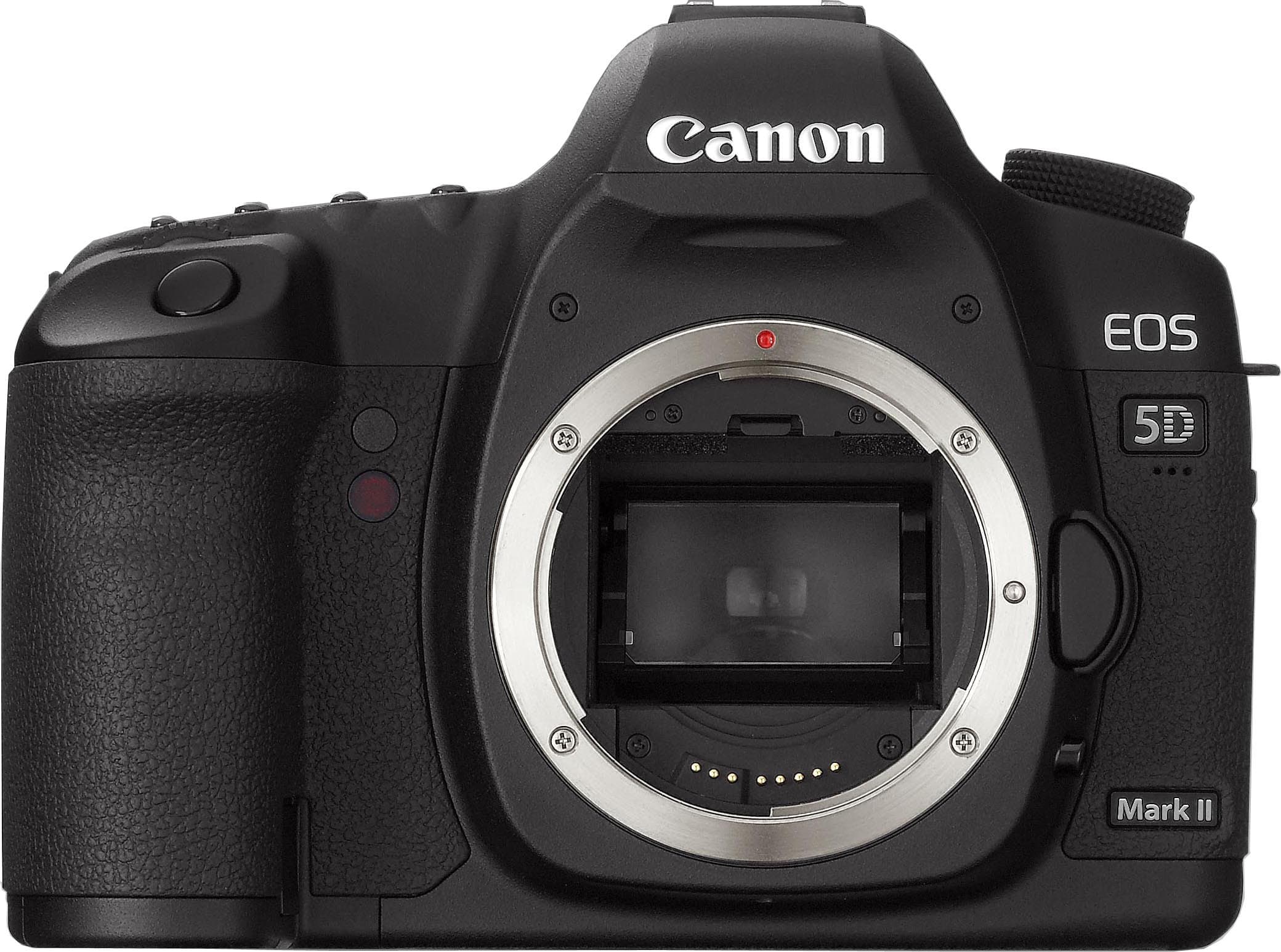


📷 Elevate your craft with the Canon 5D Mark II — where pro power meets timeless precision.
The Canon EOS 5D Mark II is a professional-grade digital SLR featuring a 21MP full-frame sensor, 3.9 fps continuous shooting, and Full HD video recording. Its rugged, water-resistant magnesium body and advanced Digic IV processor deliver exceptional image quality and reliability. Ideal for serious photographers seeking superior low-light performance and precise autofocus adjustments, this camera remains a workhorse for portrait, wedding, and studio photography.
| ASIN | B001E97GIK |
| Best Sellers Rank | 105,917 in Electronics & Photo ( See Top 100 in Electronics & Photo ) 186 in Digital SLR Cameras |
| Guaranteed software updates until | unknown |
| Item model number | 2764B015AA |
| Manufacturer | Canon |
| Product Dimensions | 7.5 x 15.2 x 11.35 cm; 810 g |
J**S
5D Mark 2000
In the past I have owned the Canon 20D, and then more recently the 5D. I've read reviews and craved this camera for a long time, and it is now finally in my grubby hands. Here's what I can say after only using it for a week: Noticeable changes from the 5D: - physical changes 1. It feels more sturdy and slightly bigger. 2. The screen is superb, automatically adjusts for ambient light conditions, and very clear. Zooming into photos is a real treat (if you managed to get it pin sharp, like from a tripod, it's especially stunning). I'd read about a new special coating on the screen (the same coating they now put on the front of the first sensor filter) to repel smudges etc, but it doesn't seem to do much. It does have a nice purple-blue sheen, but my nose still makes it messy after a while shooting. Note to self: shower more. Only kidding. 3. The sensor is full frame, 21MP and 14 bits per channel. This allows for smooth tones and lovely switches from light to shadow. Simply light years ahead of the 5D or any other camera (better in some comparisons I've read than even the 1Ds Mk III). 4. They moved the light button to the outside of the top lcd. Minor, but takes a second to remind myself about it. 5. The flash hotshoe is now bare metal instead of black (which ended up half metal anyway - lots of scratches from the 580 being put on and off. 6. The plastic flaps on the side that contain the ports are now way less awkward to use. 7. The main dial now has three custom fucntion sets there, which I have not used yet. 8. It's subtle, but the viewfinder is somehow more crisp - and slightly bigger. Just that bit more comfortable. And the autofocus points are that bit more easy to see without fiddling with the diopter. - software changes 1. There is a handy feature called "highlight tone priority" in the custom functions that shifts the dynamic range to hold the highlights. It also makes the minimum ISO only 200, but I've tried it and it seems to work very well. Possibly a little more noise in the shadows, but nothing noticeable. 2. Speaking of dynamic range, I do a fair bit of HDR photography and the AEB functions are now nicely linked to the Exposure Compensation function. On one screen you can shift the exposure up or down a stop, as well as expand to bracket three exposures of +/- 2 stops. Lovely addition. As in the 5D you can shoot all three exposures automatically by using the timer. 3. Oh my god I love this feature: lens micro focus adjustment. Previously only available to lucky owners of the 1D series, this allows you to check the autofocus feature of any lens, and adjust the focus if you find it to be slightly soft (e.g. the focus is slightly behind or in front of the target). I spent 3 hours last night in full-on nerd mode, and finally figured out a way to do it simply. Skip the next bit if you're not a total optic nerd. The more in-focus an image is, the larger the file size. By varying the micro-adjustment from -20 to +20 in stages, you can later review the file sizes of the images and the one with the largest file size (if you keep all parameters the same) will be the setting with the most accurate focus. To do this, set up the camera and lens on a tripod and get it exactly perpendicular to a target. The target should fill the frame. I taped an old "start here" poster from a printer to the wall, and used a level to level the tripod. Tether the camera to a laptop and use live view shooting. Defocus the lens manually. Go into the custom functions and select the adjust by lens, and set it to -20. Then click the autofocus on the laptop to focus it. I repeat this focus click 3 times to make sure it is perfect. Then shoot 4 shots (to get an average reading). Move the micro-adjustment to -10 and repeat at intervals of 10 until you reach +20. Make sure to defocus the lens manually each time to make sure you force the autofocus to work through the problem again each time. Lets say +10 gave the largest average file size. Then go back and shoot at +5, +10, and +15. Lets say you decide +10 is still best, then go for +7, +8, +9, +10, +11 until you find the perfect focus. Nerds rejoice!! Actually it's not just nerdyness for the sake of being nerdy - I spent 3 hours on my 85mm f/1.2 last night and it is now WAY better than it was previously. It's razor thin depth of field at f/1.2 is now slightly behind where it was at it'd default (0) setting. So instead of a lovely in-focus image of an eyebrow and the tips of eyelashes, I now get the eyeball itself in clear focus. This is obviously a lens issue, but the fact that I can fix it in-camera without sending my lens off for re-calibration is a joy!! 4. In general the digic 4 system is vastly better than the digic 2 I was used to on the 5D. Menu surfing is fast and intuitive, and in no time I was used to it. 5. The main screen is now used a lot more than I realized - there is a whole lot of information that pops up between shots - and you can now navigate using the small adjustment knob, and change your ISO or metering mode that way (as well as the old way of looking through the viewfinder, or using the top lcd). 6. As much touted, you can now also shoot full HD video. This is a bit fiddly, and it's hard to get used to how to change aperture etc. Also because it's not raw (a format I use all the time) I now also have to learn about the picture style settings. Using zoom or changing focus while shooting is not advisable, because the noise of the lens (even the relatively quiet USM lenses) is simply deafening on playback. A mic can be added, which I think I would do if I got seriously into making movies on the 5D. Movie buffs are drooling over the chance to use wide aperture lenses that don't cost a trillion dollars, but for me the HD function is more of a gimmick for now. Although if I have some time on my hands, maybe I'll get into it some day. You can shoot still frames while recording, and on playback there is just a tiny glitchy moment when the camera returns momentarily to being a still frame device. Overall this is a superb upgrade to the 5D. Aside from the size and name on the side, it's hardly the same camera at all. Yes it's expensive, and yes the 7D seems to have similar quality photos in terms of bit depth and image size, but for me full frame functionality of this camera is the main thing. L lenses (especially the wide angle ones) only really make sense on a full frame camera. Although wildlife shooters might argue against me there. The 5D was an amazing camera and I had years of joy with it. I look forward to years more with this one - and wonder what Canon will have to do in order to convince me to ever upgrade again. Beg, borrow, steal. Get one!!
C**M
12 Months of using the 5D Mark 2
We have been using the 5D Mark 2 for just over 12 months now. It is used for shooting anything from 'black tie' type functions to studio sittings, landscape shots to industrial shoots. We don't use the HD video capability as we are 'stills' photographers only. In my opinion the key elements of this camera are; FULL FRAME SENSOR HIGH ISO CAPABILITY BUILD QUALITY PROCESSOR QUALITY FULL FRAME SENSOR The full frame sensor enables a true wide angle shot to be taken with a 24mm lens. I know these days you can get 16mm lenses for 'ultra-wide' and of course fish eye lenses, but bear in mind only 10 years ago, most Pro's would be happy to have a 24mm lens on their film camera, and most amateurs could only dream of owning a 24mm lens! We use a 24-105 Lis, which gives great results coupled with this camera. At the 24mm end there is vignetting which is a consequence of the full-frame sensor. It is worth bearing in mind that all but the very best quality lenses have a sweet spot, this is one reason APS-C sensors were originally used on the Canon D-SLR's, to negate the vignetting and 'soft' focus issues caused by the digital sensor at wide angle, only the sweet spot of the lenses were available. If you move to a 5D Mark 2, you will have to be prepared to invest in some quality glass. Whilst the sensor is superb in terms of image recording quality, it also highlights lens quality issues. HIGH ISO CAPABILITY As I mentioned we shoot 'black tie' functions, and this camera comes in to it's own for this type of work. The light levels are invariably low, and quite often mixed light sources (especially if there is a disco set-up). We have used up to ISO 3200 for capturing images, and then printed these at A3 for clients with no noise issues on the print. Again we use 'L' lenses, normally the Canon EF 24-105mm f/4.0 L IS USM Lens and the Canon EF 70-200mm f/2.8 L USM Lens , and the quality of shot in these low light conditions is more than acceptable for selling of images and prints. Adversely, if you put the ISO down to 50, the image quality is stunning, some of the best I have seen from a digital SLR. BUILD QUALITY The magnesium body feels sturdy in your hands, the rubber socket covers are well made, and after 12 months we have had no issues with ingress in to these sockets. The camera is comfortable to hold, and is used by myself and my wife, who also says the camera is comfortable. One niggle I have is that the ISO button is not in the same place as on the 1d, Canon have moved the 'backlight' button for the LCD screens there. After 12 months, because I use the 1d as much as the 5D Mark 2, I am still occasionally pushing the wrong button to adjust my ISO when actually looking through the view finder. If you will only be using the 5D, this will not be a problem. PROCESSOR QUALITY The Digic IV processor is leaps and bounds ahead of the old Digic III. Tonal range recorded is excellent. We convert a lot of our images to black and white, and without any real post processing, we are getting great neutrals in the conversions. With some minor tweaking in Adobe CS5 Photoshop (PC) the results are very good. Colours are well represented, although I am yet to see a digital camera that records natural greens (grasses etc.) as they were, they invariably require some tweaking, especially for printed output. CONCLUSION If you are Pro or Semi-pro, this is definitely the Canon camera for you. It is well built, not too heavy, and is capable of producing great quality images when coupled with quality glass. If a very keen hobbyist, you will not regret it, but avoid pairing third party, or lower end Canon lenses with the body. If you are in to sports / wildlife, you would be better with the 7D (or 1D mark iii or iv if you can afford it). The hobbyists would be best to go for the 50d, as it's frame rate is excellent. I still use a 40D as a back up for my 1D Mark iii. Portraiture and wedding photographers should not need to think about which camera to buy. If you are a canon user, this should be your work horse.
M**E
5D mkii
Product as expcted
J**S
Canon EOS 5D Mark II is easily my camera of choice over the Nikon D700
I hope people will find this review useful. I'm one the few brave souls that has switched from Nikon to Canon in order to use this wonderful camera. After reading many reviews and being sold the idea of owning a Nikon by a pro press photographer friend, I bought a Nikon D700 and used it for a year. I also had both 50mm f/1.4 and 70-300mm Nikkor lenses. During that year I took some good images and about 30 of them have found their way onto online stock libraries and been downloaded a few times, but I never really got on with the camera. Back in earlier years I shot weddings and portraits as a hobby and used Olympus bodies (OM1 and OM2). I did all my own processing too, so I'm not new to photographic principals. Making the switch to digital with the D700 was not a good experience for me though. Being used to to film and (as a graphic designer) daily processing high quality images on a Mac, I found 12 megapixels often a little too constraining on larger jobs (double-page spread backgrounds for instance). And the camera never really 'allowed' me to mess about creatively. It's too clinical, too exact, too Nikon. In fact, I'd go as far as to say that I fell out of love with photography for a while, and quite often left my camera at home when going out walking etc. I just knew that photographically I wouldn't get what I wanted. OK, a lot of this has to do with my skills as a photographer, and my ability to use the Nikon to its full potential. But I think a great deal of the photographic experience is about the photographer's sensibilities, the ability to 'see' and create a striking image... without the camera getting in the way. The Nikon got in my way. I just had to sell it. Enter the Canon EOS 5D Mark ii. Straight out of the box it's a different animal. It doesn't feel as tough as the D700 but it's forgiving, easy to use, intuitive and, above all, creative. I have just one lens at the moment; an EF 85mm f/1.2 L ii USM. Images from it (and the camera) are staggering... and that's without any post processing. The video is unbelievable and adds an extra dimension to an already wonderful product. RAW files are capable of use at A2 size and (despite what I've read online) you can save just RAW files on their own... not only in combination with a secondary JPEG. The manual is well written, easily understood and pocket sized. I would use the word 'clunky' to describe Canon pro stuff. It's almost kind of 'loose' in a way. The Nikon D700 is clinical, something like a BMW... compared to the Canon, which is more like a Land Rover Defender. I know this all sounds a bit silly, but it's the way I think about things. I like to feel comfortable with what I use. I know which car I would rather drive. And I now know which camera I would rather create with. The Nikon D700 is a wonderful camera and no doubt it's right for many people. I'm not one of them. So if you're the arty type, you prefer real ale and you react to things instinctively, I would heartily recommend the Canon EOS 5D. To my mind, the Nikon D700 is a hard working tool for photographers in a hurry... who probably don't like beer. Finally: a word or ten about Amazon. I paid for express delivery and the camera took one day longer to arrive. Amazon refunded the difference between standard and express delivery immediately. These people understand the principle of retaining good customer relations. I trust them completely and would never hesitate to use them. Well done Amazon. I wish there were more companies like you on the net!
A**E
Wi-FI
Why is it described as having Wi-FI when it clearly doesn't? Yes, you can add some adapters perhaps to be able to use the Wi-FI. But... The Camera is a great camera depending on which one you get, if it is kept in mint condition or good working condition, the camera itself is a fantastic camera, it was used and still is being used by most professionals, including some movie industries, including Hollywood, movies such as Iron man II and many other movies were shot by this amazing camera. So if you can get this one or the Mark III go for it. You will not regret it, but make sure you don't get scammed.
A**R
Received three defected cameras in a row
I had a very bad experience. I bought a camera in "very good" condition only to find that it was completely defected after 10 minutes of usage. Full of unknown errors. I returned the camera an ordered a new one. This time the battery was simply dead. Once again, I returned the camera and decided to have faith that third time, is the time of luck. It arrived and I was happy to find that the battery was still alive. But then I turned on the screen. I saw a line of dead pixels across the left side of the screen. But maybe the dead pixels were only visible in the preview? No. All photos and videos had the same dead pixels line making all the produced media useless. Keep in mind that all this has been dragging on for over a month, while I have been forced to rent cameras for work instead. Also keep in mind that I had to pay for the delivery in order to return the defected cameras. Contacting the seller did not work. They did not respond to my inquiries. However, the most disappointing aspect of all this, is that all these errors should easily had been detected by turning on the camera before packaging.
B**A
Worth buying at this price
I've still only had this Camera a few weeks, so I'll weight my comments accordingly. It arrived in very good time (I live in the Scottish Northern Isles, so never hold my breath over delivery dates). It did require a bit of cosmetic cleaning, but really nothing to worry about. Certainly won't justify dropping a Star, but the Seller might want to think about that. Packaging was good and protected the Camera well. Once I charged the Battery, it was good to go. Please bear in mind that cost didn't include a Compact Memory Card or Spare Battery. The Card is of course essential if you want to take more than a couple of shots, and Compact Memory Card are not as common or cheap as they once were. I'd also say that any serious photographer has a fully charged spare Battery too. In terms of the Camera itself - well the 5Dii does what I expected. I've had a 550D from new which is about the same age, and that is fine Camera. Having used 5Ds in the past I had a shrewd idea of what to expect. Build quality is really good, and I have to say, living with this Camera and using it with a Cannon 50mm Prime lens (the 1.8 one) is a joy. I find a warmth in Standard Setting that I only normally anticipate with film. You'd have to work hard to take a bad picture with this Camera. In you are new to DSLRs, then just using it in Automatic Mode will up your game. I know Professionals who do this! The Daffodils Photo is in full Auto Mode. I've done a bit of video testing and it's good. Need really to install Magic Lantern to get the best from it. The 5D works with most of the lenses I have acquired for the 550D. I'm happy enough with that. With the arrival of Mirrorless DSLRs, prices for the 5D and other such, will inevitably be driven down. Great time to get one, as good picture last forever, and the advantages of mirrorless are not a deal breaker for me.
A**7
What a fantastic camera
Wow!. I had a canon 30D before and when I started using the 5D Mk II it blew me away. I haven't started to scratch the surface of what it can do but I'm already extremely happy. Don't expect to sit down and read the user manual before you use it - it's got 250 pages! I just put it to fully automatic and went shooting. The photos were excellent but there were some things not to my satsfaction (needed more aperture or shutter control) so I read the relevant bits of the manual and tried again. The ISO range of the camera is such that if you leave ISO speed in auto you will not get a bad photo (unless you are trying to use it at night in a dark room!). I took it into a gloomy cathedral recently and all the photos were brilliant. Then there's the video camera! It shoots video at HD TV quality with sound. The only real problem I see is that it takes such good photos I am now not satisfied with the quality of my lens. More expense on the horizon!
Trustpilot
Hace 2 días
Hace 2 semanas