Some deliveries may take a little longer than usual due to regional shipping conditions.

Descargar la aplicación


Servicios al cliente
Sobre nosotros
Copyright © 2025 Desertcart Holdings Limited
Descargar la aplicación


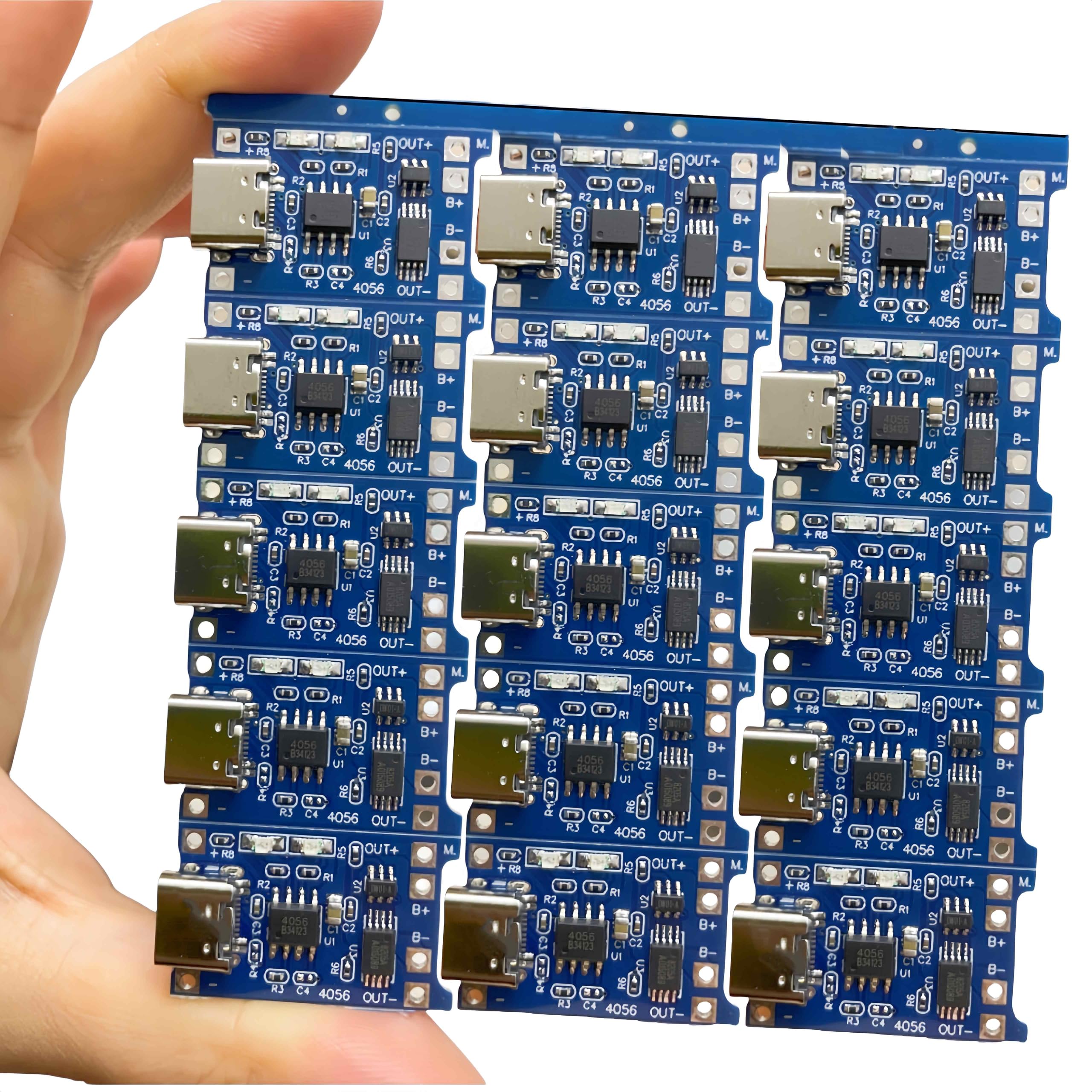
🔋 Charge smarter, stay powered longer — don’t get left in the dark!
This pack of 15 TP4056 lithium battery charger modules features a 5V/1A Type-C input, dual protection circuits for overcharge and overcurrent, and clear LED status indicators, making it an essential, reliable solution for safely charging and maintaining 18650 lithium-ion batteries.




| ASIN | B0DDGSHXQD |
| Best Sellers Rank | #1,481,177 in Automotive ( See Top 100 in Automotive ) #2,360 in Battery Chargers |
| Customer Reviews | 3.7 3.7 out of 5 stars (15) |
| Date First Available | August 18, 2024 |
| Item Weight | 1.44 ounces |
| Item model number | JK-BCM |
| Manufacturer | ELCCOTYA |
| Product Dimensions | 4.84 x 3.54 x 0.15 inches |
O**D
Functional inexpensive single cell lithium charger
These are cost effective charge controllers for single cell lithium batteries. Note that the listing specifically states 18650; in fact if you charge an 18650 with these you will be waiting for a while - charge is limited to 1A, which is the upper limit for the TP4056 chip that describes the charge logic. As constant current mode is constrained to 1A with these, it's probably OK to charge any single cell lithium battery that has a capacity of at least 1000mAh (but to be safe monitor temperature etc when you do this the first time). Note that it is possible (with some soldering) to modify the maximum charge rate of these boards - see the datasheet for TP4056 re: the Rprog resistor. I did some fairly extensive testing with one of these with an 18650; they work as described albeit slowly (see photos). Board quality is great - plated vias, FRP. The only oddities I've found with these are: * the placement of the output / bat "-" pads are very slightly too close together but not even enough so to really cause an issue. * The circuitry on this board does not appear to have anything intended to ensure that total stored energy (in e.g. caps) goes to zero when both power and battery are removed from it; it is possible for it to be "confused" for a period of time 'til all residual energy leaves the circuit. When this happens it invariably errs on the side of safety, meaning that it can get into a mode where it refuses to charge the battery any more. Just power it off and wait a while (or short the leads - or put some kind of high value resistor across the B pads) to fix this. * LOTS of waiting aside, I was unable to get this thing to charge an 18650 to 4.0V - it seemed to want to stop just before 4V - this happened 2-3 times (see graph - there are a number of restarts in it). These are a good deal - 4 stars (I'd like to have seen 4.2V on a charged battery)
F**I
Worked fine for my project! I like having extras for when I need them.
I recently purchased this lithium battery charging board, and it's been a useful addition for my projects. The board operates with an input voltage of 5V, and it's great that it has a charge cut-off voltage of 4.2V, which helps protect the battery during charging. One of the features I like is the Type-C USB port. This allows me to easily charge the lithium battery using my mobile phone charger. It's convenient to have a common charging option, and I appreciate the maximum charge current of 1000mA, which ensures a relatively quick charge. The design also includes solder joints for wiring the input voltage, making it handy for DIY projects. I appreciate the two-in-one charging and discharging protection function, which adds an extra layer of safety when using the board. The light indicators are clear and practical: a red light indicates that the battery is charging, while a blue light signifies that it’s fully charged. This feature makes monitoring the charging process simple and straightforward. Overall, I recommend this lithium battery charging board for anyone looking to charge lithium batteries efficiently and safely. It’s user-friendly, convenient for DIY applications, and has solid safety features!
B**T
Not a very useful/versatile design and not sure about the missing parts.
My biggest complaint about this board is not specific to this vendor, since this is one of dozens of clones available here. The oddity is the ~4.2 V output voltage which really isn't suitable for most applications (e.g. 3.3V or 5V) without additional modification. There are other similar boards out there at a similar price point that can generate a true 5V output or even be adjusted. I also was not happy with the stability (or instability) of the output. It oscillates quite a bit. I don't know if that has anything to do with the missing components that are called out on the PCB but not installed. They're cheap enough, but I probably won't be using them for anything.
F**S
They seem to work as advertised including protection.
I set up one unit as a test to make sure functionality was good. That unit shut off when the voltage was low and stopped before overcharging. These also seem to be capable of powering the device and charging the battery at the same time. Sort of like a mini uninterruptible power supply (UPS). The board is marked clearly so no extra instructions should be needed. The led is red while charging and it turns blue when the battery is full. They can charge via USB-C or a 5V power supply depending on your needs. They come in strips that you have to break apart which isn't unusual for circuit boards. There is perforation to make that easy. All in all I'm happy with these.
K**Y
Useless for USB-C
These boards, despite having a USB-C socket, will not actually work with a USB-C charger. The designer failed to implement the required two 5.1k pulldown resistors, which are needed to signal presence to a USB-C charger and request power. There isn't even a place for them on the PCB, and the pins on the USB-C socket have no pads. My guess is, they re-designed one originally intended for micro USB without considering how USB-C works. Additionally, the manufacturer packaging is plain cellophane, not ESD-shielding or even ESD-safe materials. So far, I haven't found a dead board, but they should at least be in the special pink plastic that doesn't generate static. Otherwise, it follows the datasheet implementation of the TP4056, aside from omitting a decoupling capacitor from input power to the chip. Shame, because this would be a good price for a bulk pack of these boards, but I can't recommend them if you actually want USB-C charging to work.
Trustpilot
Hace 2 semanas
Hace 2 meses