
Descargar la aplicación


Servicios al cliente
Sobre nosotros
Copyright © 2025 Desertcart Holdings Limited
Descargar la aplicación
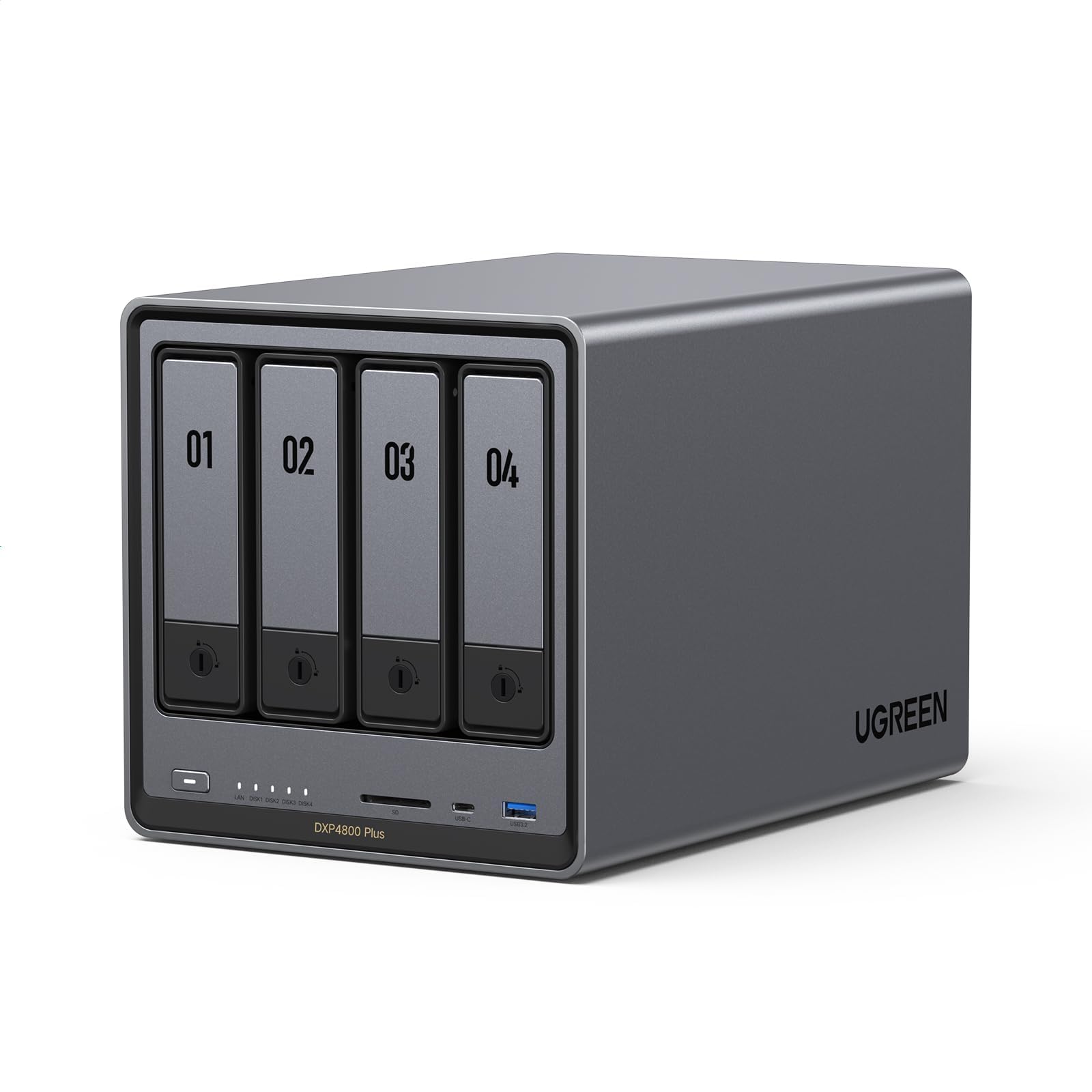
🚀 Elevate your data game with UGREEN NAS DXP4800 Plus — where speed meets smart storage!
The UGREEN NAS DXP4800 Plus is a cutting-edge 4-bay desktop NAS featuring an Intel Pentium Gold 5-core 4.4 GHz CPU, 8GB DDR5 RAM, and 128GB SSD for ultra-responsive performance. Equipped with 10GbE and 2.5GbE network ports plus dual M.2 NVMe slots, it supports up to 136TB of scalable storage. Designed for seamless cross-platform compatibility and advanced features like Docker and virtual machines, it’s perfect for professionals seeking powerful, flexible, and secure centralized storage with effortless backups and 4K HDMI output.


| ASIN | B0D22JRHZB |
| Batteries | 1 CR2032 batteries required. |
| Best Sellers Rank | #1 in Network Attached Storage (NAS) Devices |
| Brand | UGREEN |
| Color | Grey |
| Computer Memory Type | DDR5 SDRAM |
| Customer Reviews | 4.5 4.5 out of 5 stars (479) |
| Date First Available | September 11, 2024 |
| Flash Memory Size | 128 GB |
| Hard Drive | 136 TB Mechanical Hard Disk |
| Hard Drive Interface | Serial ATA |
| Hard Drive Rotational Speed | 7200 RPM |
| Item Dimensions LxWxH | 10.14 x 7.01 x 7.01 inches |
| Item Weight | 8.34 pounds |
| Item model number | DXP4800 Plus, 4-Bay |
| Manufacturer | UGREEN |
| Number of Processors | 1 |
| Number of USB 2.0 Ports | 2 |
| Number of USB 3.0 Ports | 3 |
| Operating System | UGOS Pro |
| Processor | 4.4 GHz |
| Processor Brand | Intel |
| Product Dimensions | 10.14 x 7.01 x 7.01 inches |
| RAM | 8 GB |
| Series | DXP4800 Plus |
C**C
Excellent Plex NAS – Powerful, Flexible, And A Big Step Up From Synology
1) PLEX DOCKER SETUP: Using Docker with the most popular Plex container (linuxserver/plex) on the Ugreen NAS was straightforward. I pulled the container from the built‑in Docker interface, pointed config and media paths to my shared folders, set network mode to host, and left almost all defaults. Even with my custom usernames and permissions, everything just worked. No hacking, no odd workarounds. 2) STORAGE CONFIG: I’m running two Seagate IronWolf Pro 28TB Enterprise NAS drives (ST28000NT000) internally as Drive 1 and Drive 3 in a JBOD‑style setup (data on 1, backup on 3). For future expansion I’ll add Drive 2 as data and Drive 4 as backup. The IronWolf Pros have been flawless so far—quiet, cool enough, and fast for Plex streaming and backup. 3) INTERNAL VS USB BACKUP: I also tested one of the 28TB Seagates in an OWC Mercury Elite Pro external enclosure (USB 3.2 Gen 1, 5Gb/s) as a backup drive connected to the Ugreen. The Seagate fit perfectly, the enclosure worked well, and performance was fine. In the end, though, keeping everything internal (all drives inside the Ugreen) was more efficient and cleaner for my backup scheme. 4) UGREEN VS SYNOLOGY (DS220+): I own a Synology DS220+ and originally used it as my Plex server. I eventually retired it from Plex duty because: (a) Synology was picky about third‑party drives and didn’t officially support large Seagate IronWolf Pro capacities the way I wanted; (b) memory expansion on the DS220+ is very limited; and (c) Docker/Plex on the Ugreen feels faster and less constrained. The Ugreen gives me more flexibility with drives, more headroom for RAM and containers, and overall better performance for a multi‑TB Plex library. 5) OVERALL EXPERIENCE & TIP: The Ugreen NAS has become my main Plex server and backup hub. Docker Plex runs smoothly, transcoding and library scans are snappy, and the hardware has handled large 28TB drives and backups without complaint. FINAL TIP: Use ChatGPT/AI during setup. I used an AI assistant heavily to walk through Docker, rsync backups, SMB mounts, IP changes, and cleaning up old Synology configs—saved a ton of time and guesswork.
J**N
Headline: The perfect entry point for NAS beginners!
Review: I’ve wanted to dive into the NAS world for a while, and the timing was perfect when I saw Ugreen entering the market. Even though I had some initial reservations about them being "the new kid on the block," after some research, I realized this is the ideal machine for someone who wants powerful hardware without the steep learning curve of more established brands. Pros: Tool-less Installation: Installing hard drives and SSDs was incredibly smooth and straightforward. User-Friendly Interface: The UGOS operating system is very intuitive. It feels modern and easy to navigate for a beginner. Build Quality: The chassis feels premium and solid, exactly what you’d expect from Ugreen’s hardware. Compatibility: I love that it allows you to use any brand of HDD/SSD without restrictions or compatibility warnings. Cons: External Power Brick: It uses an external power supply, which means one more cable/brick to manage behind your desk. App Ecosystem: Since Ugreen is new to the NAS market, their app store isn't as extensive as competitors like Synology or QNAP yet. Software Polish: While the UI is great, I noticed some translations (especially in the Spanish localized version) felt a bit clunky, though they are still perfectly understandable. Final Verdict: If you are a novice looking for a relatively powerful NAS that is easy to set up and looks great on your desk, this is it. It’s a solid investment for home storage and media.
J**D
This is well worth the money. Minor issue with 2 apps.
I have had this item for a few months now. Initially, I did some upgrades to the unit with no problems. I upgraded the RAM to 32GB (OWC 32GB (2x16GB) DDR5 4800 PC5-38400 CL40) and installed 4 Seagate Exos X18 16TB Enterprise HDD's in RAID-5 for a massive 48GB storage capacity. I also installed a samsung 990 EVO Plus 1TB NV SSD for caching. I decided to give the UGREEN OS a chance and kept it. So far everything seems very stable and for my use, movies, music and phone backup, this is doing the job really well. I also installed a 22TB external drive to backup my data just in case the NAS failed. All of the built-in software for the backup, moves and music are working very well. The noise level of the unit is very low, especially when the drives go to sleep. There is no noise at all that you can hear from about 5 feet away unless it is reading/writing, then you hear the drives but it is a low rumble that you would expect. The system itself is very easy to setup and once you create the online account, you can access your drive from anywhere. The only tricky part is getting the software installed on the Amazon Firesticks but there are instructions for that. I would definitely say that this is worth the spend. UPDATE: Almost a year in. The unit physically still works flawlessly. I have, however, found a few issues with the two main apps that I use. Theater and Music. First, the apps in general are great but there is a small flaw in teh Theater app where it has trouble detecting movies that have numbers in the beginning or end. The quick fix is the ability to go in and manually detect the movie. The Music app is good as well but has one major flaw that the developers have acknowledged but have not fixed. I have loaded a lot of music in folders (each folder is a CD) and the tracks are numbered. The app will ignore the numbers and only show the songs without it and sort based on that. Any mixed tracks that flow from one track to the next will NOT work since it will sort alphabetically without the numbers in the beginning. Also any tracks that have names that begin with numbers also have them hidden and ignored. I am not sure why this would be a feature, especially when you go to the Folder View tab to view the full name. It makes the app pointless for me. If you are planning on using the NAS for Music or Movies and want to use the UGOS Pro operating system, you should reach out to them to see if this has been resolved. Other than these two issues, the OS itself and the rest of the unit and apps work great.
T**Y
Definitely a solid NAS. I bought it 6 months ago and used a lot to write a detailed review. Pros: +Good quality hardware. +NVME & HDD storage pool options. +Ultra High speed access/transfers with 10Gbit Ethernet on NVME Storage pools. I think this is the key reason I have chosen this NAS. I can easily reach over 1GBytes/sec. speeds over the 10 GBit network (even can go faster with 2 ethernet link aggregation). I almost stopped using my external NVME drives after having this NAS. (This is really Great!!) Before this NAS I was planning to have Synology DS923+ and 10 Gbps network upgrade. But NVME storage pool is not available unless you don't purchase Synology nvme drives which is even more expensive than MacBook SSD upgrades!!! Besides you cannot find any Synology NVME over 2TB!!! Go to hell Synology!!!! +Silent cooling. +Very fast in general and Very fast startup/shutdown. (Thanks to having a separate NVME drive for operating system) Previously with my old QNAP NAS, it takes ages to boot up so I was never shutting it down and the times I don't it was consuming power for nothing. Now I don't hesitate to Shut down, it boots up less then a minute!! +Compatible with all HDDs I have. +Freedom for using and OS you want. Actually I am using with stock Operation System (UGOS Pro). But I have plans to try TruNAS someday. Cons: -Original Operation System is good, fast and stable, But still needs improvements. For example; manually adjusting the fan speeds, Or conditional adjustments like QNAP has "if X drives goes over 40C increase the fan speed". There few more things that I don't see in the their software, so still there is room for improvement. But still at least faster than QNAP's slow QTS system. -NVME cooling is not efficient. Actually fan doesn't have any effect on SSD cooling. Initially I was using 4TB WD SN850X. Several times I heard the FAN speed up when I was writing on SSD. I checked the system if there is another reason, CPU was cool everything was cool but NVME was over 50 C. And due to fan has no effect on SSD compartment it doesn't cool the SSD down and it blows high for nothing during this write process. So you have to find a cool working SSD with this NAS. But it is kind of hard since it is a NAS and the SSD you choose should have DRAM and TLC Nands. Mostly you can find this combination in higher and drives which are generally get hot. Seagate firecuda 530 and Samsung 990 Pro or any other cooler working SSDs are better options for this NAS. - Similer issue with above SSD compartment is very slim and you cannot use SSDs with original heatsinks. I already had a 8TB WD SN850X (with original heatsink) and I couldn't use it as well. I didn't want to remove the heating cuz I know it will be hell hot. In general finding the perfect SSD for this NAS is really tricky. But there are some 3D print options on the web to make this compartment larger to use heatsink or even to attach another fan for SSD compartment, but in my opinion FAN is unnecessary, if you can install a proper heatsink, I believe all SSD will be fine.
B**N
Amazing little NAS. Rock solid, performant, and it looks nice too. Installing and removing drives is very easy. Getting at the m.2 and memory is also reasonably easy. It has lots of CPU and memory (though I added another 8GB to mine). I can't comment on the software, as I installed TrueNAS Scale on it without ever even booting to the provided OS. Right now it's running nicely with 4 drives and several apps (Jellyfin, Immich, Syncthing, etc). No complaints!
I**N
Great build quality. The trays are plastic but not a deal breaker. Has a lot of bays for storage, 4x HDD and 2 M.2 with 128 GB built in storage. 8 GB is a little on the short side but thankfully it’s upgradable with ease. SD slot in the front is nice. Easy setup and great UI.
R**7
A good home or small office NAS. Works well, but the in-house Linux OS is very minimal. Hopefully there will eventually be more apps ported for it, or it will become open source. The NVMe drives don't need to be large and can be mirrored (RAID1) when used as cache. I used two 1TBs I had around, but only about 13-17% is being used. Only in operation for 10 days, so longevity no yet evaluated.
W**.
I upgraded to this unit coming off a two-bay Synology. I wanted more room for expansion, a bit more headroom on compute capacity, and I was also interested in experimenting with different operating systems. This delivers. Even though it's advertised as four-bay, I would functionally call it a six-bay, because it has two nVME slots, on top of the four hard drive slots. It has relatively good specs (balancing power and energy efficiency, and keeping in mind that most things a NAS does are not compute intensive), has a premium metal case, and noise mostly isn’t an issue (the exception is the dust filter over the fan at the back, it sometimes rattles. I solved that with some double-sided tape to cushion the metal-on-metal contact). Right off the hop, I installed the TrueNAS operating system on this unit, and it was painless. This unit has an HDMI out (an underrated feature) that displays the boot menu when you plug in a bootable USB, and it comes with a writeable SSD drive to which you can install the OS, and keep it hived off from storage. When running TrueNAS, the HDMI out will display the current IP address of the NAS to access its web UI from another device (handy!), and it also has a terminal interface to run various operations with keyboard input. I can't comment on how TrueNAS compares to the UGreen OS (because I never used it), but comparing it with Synology, and having read up on other alternatives like Unraid, my impression is that they're all functionally very similar. Synology has some first-party apps that you won't get anywhere else, but they're not special, there's popular open source alternatives to all of them. Every OS has its library of stock-configured apps (Synology's is relatively small), but to get full utility out of a NAS, you're going to need to figure out how to use Docker (easy if you know what you're doing, immensely confusing *until* you know what you're doing), and every operating system integrates with Docker images in a similar kind of way.
Trustpilot
Hace 1 día
Hace 1 mes