We remain fully operational. Our teams are working around the clock to ensure your deliveries continue safely.

Descargar la aplicación


Servicios al cliente
Sobre nosotros
Copyright © 2025 Desertcart Holdings Limited
Descargar la aplicación
Buy anything from 5,000+ international stores. One checkout price. No surprise fees. Join 2M+ shoppers on Desertcart.
Desertcart purchases this item on your behalf and handles shipping, customs, and support to Mexico.
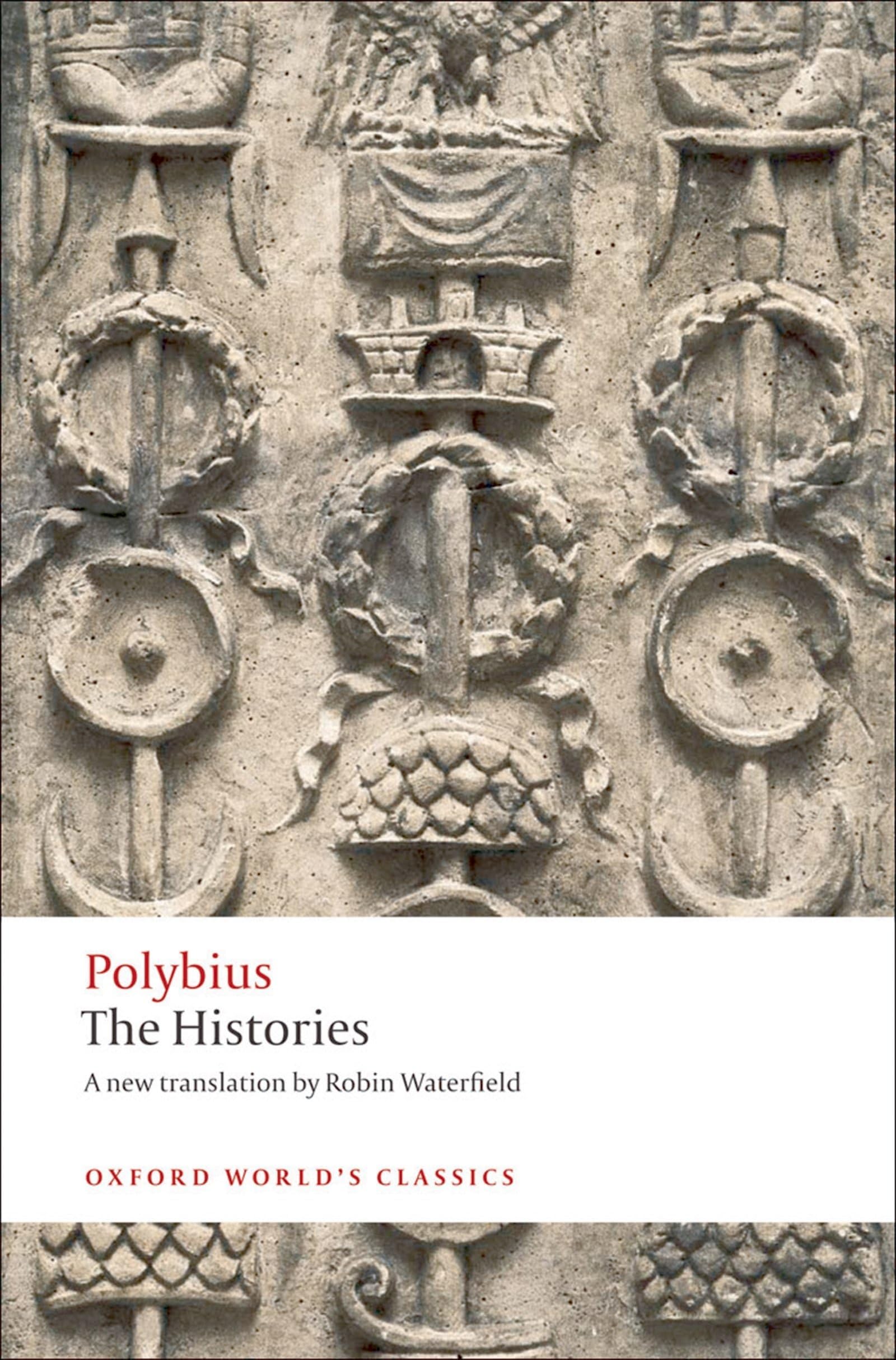
Buy The Histories by Polybius, McGing, Brian, Waterfield, Robin (ISBN: 8601411066481) from desertcart's Book Store. Everyday low prices and free delivery on eligible orders. Review: Amazing pre roman history. - Incredible. It really opens up the world history of pre roman times. Review: Terrific Edition - A great edition


| Best Sellers Rank | 181,990 in Books ( See Top 100 in Books ) 4,969 in Education & Reference Material for Young Adults 19,040 in History (Books) |
| Customer reviews | 4.7 4.7 out of 5 stars (211) |
| Dimensions | 19.56 x 3.05 x 12.7 cm |
| ISBN-10 | 0199534705 |
| ISBN-13 | 978-0199534708 |
| Item weight | 1.05 kg |
| Language | English |
| Print length | 560 pages |
| Publication date | 11 Nov. 2010 |
| Publisher | OUP Oxford |
| Reading age | 13 years and up |
S**T
Amazing pre roman history.
Incredible. It really opens up the world history of pre roman times.
D**D
Terrific Edition
A great edition
F**O
Excellent updating of language
A worthy replacement for the excellent but now rather dated edition published by Penguin Classics. Unfortunately, you cannot just throw out your old Penguin copy for, as other reviewers have pointed out, this edition only goes up to book 12 of Polybius. Never-the-less, this is a worthwhile addition, as Robin Waterfield is an excellent writer and classicist and has rendered Polybius into highly readable English, replacing the now rather stilted language of the Penguin edition, which is getting a bit long in the tooth. As for other reviews taking issue with aspects of Waterfield’s new translation (and one aspect in particular), while it is possible that he may have mistranslated or misunderstood the Greek word ‘lonche’ this is by no means certain and I suspect Mr Waterfield’s knowledge of Greek is far superior to ours. We do not really know what the word meant in the second century B.C. or just how it was understood by Polybius and his Greek audience. Claims that he was a technically correct writer are rather fantastical. He was not writing military history; he was trying to explain to his readers how their country (and the rest of the Mediterranean) had come under the yoke of the Romans. (And as he was writing under Roman patronage this means we cannot take everything he says at face value either.) Suggestions that he would have used a different word for this or that, make the assumption that all Greek words then meant the same as we understand them to mean now. Clearly this is nonsense. With reference to the sarissa for example, which some think means ‘pike’. According to Everson this probably meant nothing more than ‘long spear’ originally. Arguments about what words such as ‘lonche’ (or sarissa for that matter) may have meant over two thousand years ago are, frankly, pointless.
R**L
An excellent new translation
This comes across as a very nice new translation, which tackles what can be a difficult text to work with, given that Polybius wrote in the "koine" or the common dialect of Greek in the 2nd Century BC. Most Greek texts were written in, or in imitation of, 5th Century BC Attic. In addition, Polybius is also a technical writer for his time and speaks with precision. This where translators need a detailed contextual background and it is here that Robin Waterfield, like so many, comes a little unstuck. An example is the term "longchophoroi", which Loeb translates as "pikemen" and Waterfield renders as "spearmen". Neither is correct but the error is understandable as the word "longche" does mean "spear" but cannot mean "pike" as there is a specific word in the period for "pike" - "sarissa". Likewise, "phalangitai" is the word for "pikemen" and the original word is used in the context of skirmishing infantry - try skirmishing with a 21ft spear! The word "longche" is used in the context of a spear which is thrown, so is here being used to tell is that these "spearmen" are in fact skirmishers, so would be better rendered as "light foot", which would work well alongside "euzonoi" (the lightest foot) and distinguish them by their relative willingness to drive off their opposite numbers. Likewise the word "kathoplisma" (if I have spelt that correctly) has a whole story behind it but I'll leave that for another day. This is an excellent and readable translation. It is understandable that the fragmented books were left out as some are mere paragraphs and this absence is more than compensated for by Robin Waterfield's superb notes and textual explainations.
A**D
the only historian from the Hellenistic period whose work survived to such an extend
The Histories by Polybius are far less known than for instance The Histories by Herodotus and cover an entirely different period. As a result, the author and his book merit to be put in a well-deserved spotlight. Few people ever heard of Polybius and it may be useful to introduce him with a short biography. Polybius was born ca. 200 BC, probably in Megalopolis, which was the capital of the Achaean League (a federal organization of the Peloponnesus). His father played a leading political role and Polybius at the age of thirty was elected deputy-leader of the League. But his life changed dramatically when Macedonia lost its independency at the Battle of Pydna in 168 BC. This had far-reaching consequences for the rest of Greece. The Achaen leaders were deported to Rome, including Polybius, who spent seventeen years in the capital. However, as a highly educated Greek, he soon befriended Scipio Aemilianus, one of the most powerful men in Rome at that time. He also became friends with prince Demetrius held hostage in Rome and managed to arrange his escape from the city in 162 BC in order to reclaim his place on the Seleucid throne. Polybius accompanied Scipio during his campaign in Spain and went to Numidia, modern Tunisia. He tells us how he walked in the footsteps of Hannibal from Spain to Italy. In 149 BC, he was summoned to Carthage where, using his diplomatic skills brought them to comply with the demands of Rome. Not for long though for two years later Polybius joined Scipio again in his siege of Carthage. When that city fell, he travelled beyond Gibraltar to explore the coast of western Africa. For reasons that could not be determined, Achae revolted against Rome in 146 BC and lost the battle; as a result, the League was dismantled and proud Corinth was destroyed. Polybius apparently played an important role in the reconstruction of Greece, a gesture that was widely appreciated as Pausanias tells us that many cities of the Peloponnesus erected statues in honor of their fellow countryman. It is clear that Polybius led a very active life as politician, general and even explorer and it makes one wonder when and how he found the time to write. Beside his Histories, he wrote a study on tactics, a treatise on the habitability of the equatorial region, about the war of Rome against Numantia in Spain, and a biography of Philopoemen, a famous and skilled strategos of Achae. Unfortunately, the largest part of his works have not survived. Polybius’ Histories treated the rise of the Roman Empire in the Mediterranean in the period from 220 to 146 BC – a colossal job filling forty books of which only five have survived. Books 1 and 2 are basically an introduction to his work leading to the battle for power between Rome and Carthage, which spills over into Book 3 with the victory of Hannibal in 216 BC. In Books 4 and 5, Polybius turns to the situation in Greece and the eastern Mediterranean before that same date in order to match the chronology in which he likes to report events. Of the following books, which are not necessarily straight history and treat for instance of geography in Book 34, substantial excerpts also exist. From what transpires, he took the trouble to make a summary of his work in Book 40. So much precious information has been lost over the centuries! In his effort to explain what kind of constitutional structure Rome applied to conquer the world, it appears that in Book 6 Polybius developed a highly interesting theory about the recurrent cycle of government in which monarchy, aristocracy and democracy alternate. What makes Polybius stand out is his overall chronology as he reports the events as they develop simultaneously in the eastern and western end of the Mediterranean. It truly is a rare horizontal history and, what’s more, he is the only historian from the Hellenistic period whose work survived to such an extend. Since the Punic Wars are treated in detail, I found this the best history I ever read without getting lost or confused one way or another in those repeated conflicts that lasted on and off for 118 years. To keep track of time, the year in which the events took place are handily quoted in the margin. The translation made by Robin Waterfield is superb and reads with the clarity that is characteristic for him. The book has a great Introduction without which the Histories would be very hard to understand. It also includes a handy chronology of the events covered in the book and a set of three maps, one of the Mediterranean and a detailed one for both Greece and Italy.
B**.
It is a privilege to read the thoughts of an intelligent, perceptive man who lived more than 2100 years ago. Recommended for anyone looking for insight into the political structure of the Roman Republic, a philosophy of history and the work of historians, and of course the dramatic events of the Punic Wars.
P**S
Polyibius, a Greek, in his on-the-scene reporting of events of the Punic wars and its cause answers answers Hume's assertion that causes are simply habits of mind and not objectively real.
L**A
This edition contains less than half of the text. The numbering is lazy, too, so it is not easy to check what is missing. There is a complete translation which can cope easily with this one, available for free at Perseus.
A**R
A very engrossing read! If you want to know why and how did the Romans come to dominate their known world in ~fifty years while starting out as a small republic, there is no better source. The three maps in the beginning are, though not very exhaustive, quite sufficient for the timeline and events described. Perhaps a fourth and a fifth map detailing Carthage/Tunisia, Libya and other Mediterranean territories could've made it even better. The notes in the end are very helpful, too. Also, for a book that costs so little(₹549) the pages and the binding are in very good condition. A must read if you're a history enthusiast.
G**S
Excellent - neuf - état. Arrivé bien emballé.
Trustpilot
Hace 3 semanas
Hace 4 días