
Descargar la aplicación


Servicios al cliente
Sobre nosotros
Copyright © 2025 Desertcart Holdings Limited
Descargar la aplicación
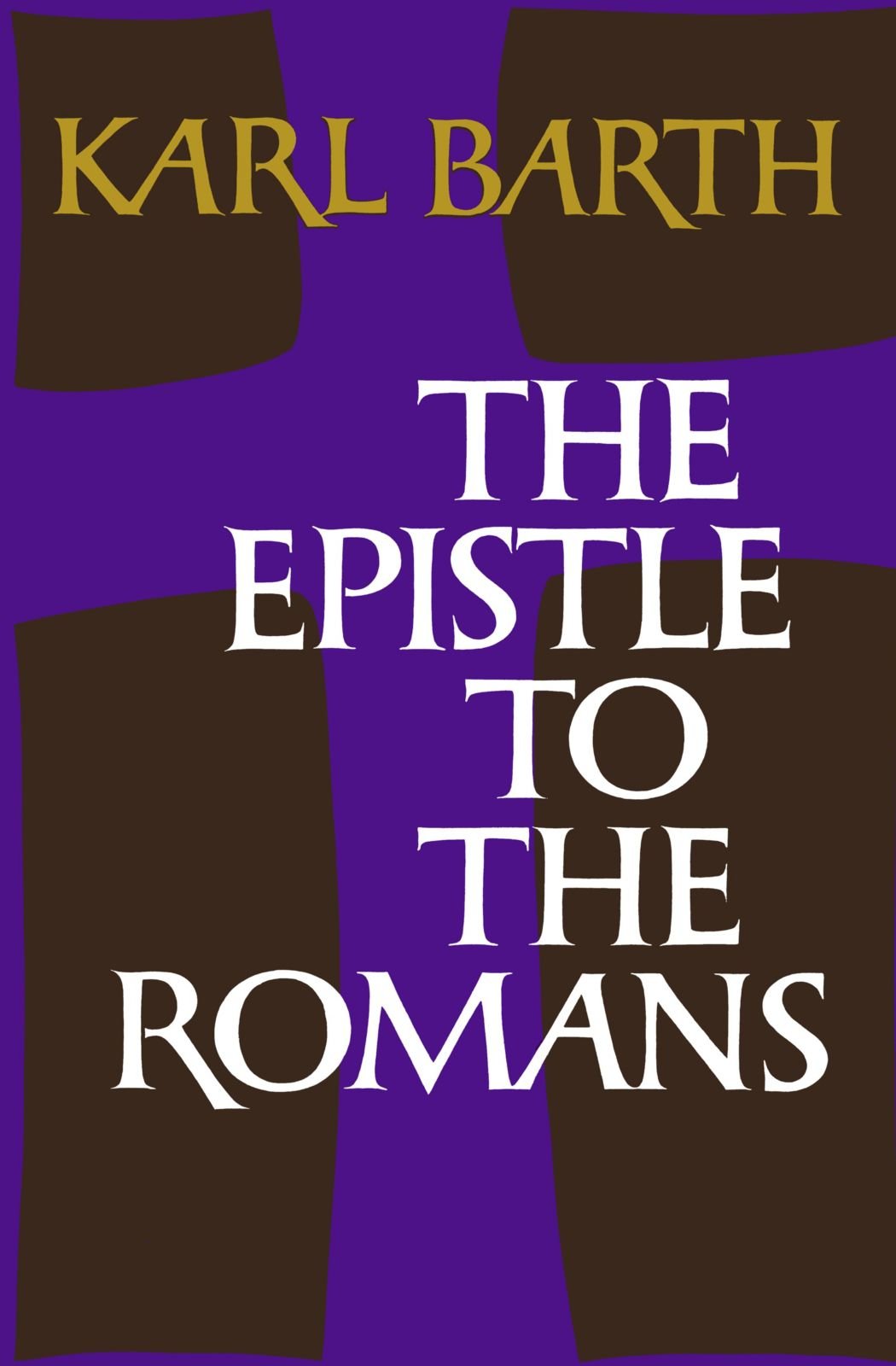
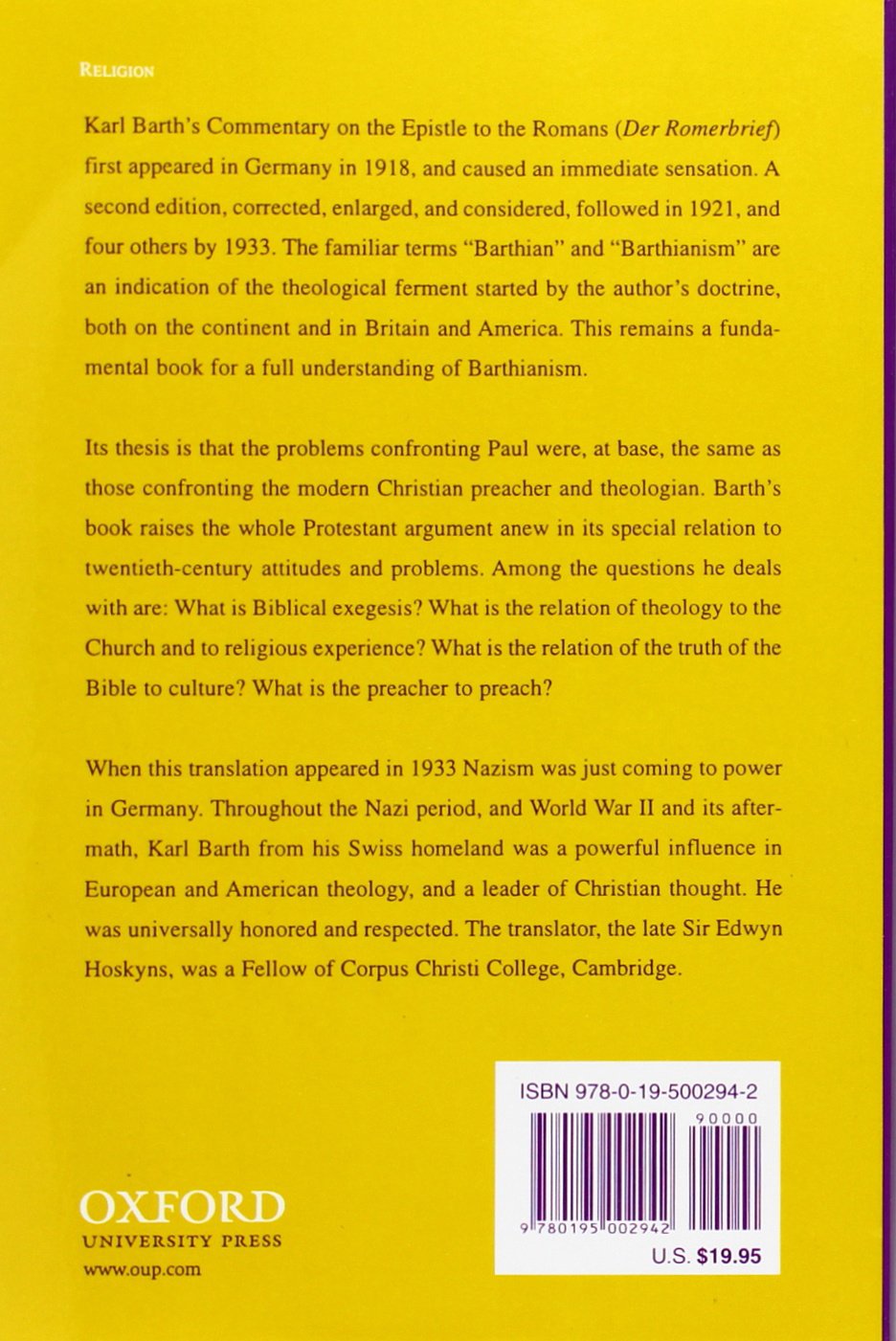

The Epistle to the Romans
B**Z
Epistle to the Romans, by Karl Barth
Karl Barth is considered by many people to be one of the most influential theologians of the 20th century. He was a pastor, professor and a prolific writer, his commentary on Romans being the work that introduced him to the world. My introduction to Barth came through some excerpts of his Church Dogmatics while I was in seminary and then from reading a collection of his later sermons. I recently read Eugene Peterson's memoir and he noted that Barth's Romans commentary exerted a powerful influence on his own early ministry. I have always enjoyed Peterson I took his recommendation and dove into Barth's Romans for myself. Having finished, I can perhaps best describe Romans as a sort of cross-country trip, one which exposed me to a vast landscape and nearly overwhelmed me with visual images, pictures that will have to be studied again and again to fully appreciate all that they contain.Barth's work here is significantly different from a traditional commentary of either an exegetical or expositional nature. The former often address significant issues of culture, the historical setting and language as they bear on our understanding of the text, while the latter provide the manuscript of sermons preached from the text. An example of a work of exegesis of Romans is the recent volume by Leon Morris, while an excellent exposition is James Montgomery Boice's Romans, which runs four volumes. Barth's method is more akin to opening his Bible, reading a chapter and then going back, paragraph-by-paragraph, phrase-by-phrase, writing as the Spirit leads him in understanding the words of Paul.Barth's comments on Romans are extensive, expounding on Pauls' 16 chapters of Biblical text over the course of 500 pages. Part of this length is due to Barth's style. When I write I may introduce a new thought with a question, while Barth frequently uses 3 or 4, or more questions, a technique that does aid in understanding the relevance of Paul's words for Barth's time, and ours as well. These questions are then answered in depth. Barth ultimately published six editions of his commentary, the second being a significant reworking of the original, while the remaining editions being what Barth considered to be minor updates. He was well aware that his writing had a lot to offer to the pastors and theologians of his day and he had the freedom to follow each new thought for as long as he felt was necessary.While I have a graduate degree in divinity I often felt a bit underpowered, intellectually, to follow and apprehend Barth's line of reasoning. One thread that did emerge early in the commentary is Barth's deep love for Jesus as the second person of the Trinity and the understanding of God's work in Jesus in the act of his death-and-resurrection as the defining moment in all of human history. Writing on Romans 5:6, "For while we were yet weak, in due season Christ died for the ungodly," Barth says, "Everything shines in the light of His death, and is illuminated by it. No single passage in the Synoptic Gospels is intelligible part from the death." (159)Writing a bit further, of the new creation in Christ that believers become when they grasp Christ by faith, (Romans 5:9-11) Barth says, "To the question, Whence are we? - which is the question of all questions - we receive the answer which is beyond all answers: We are they who have been justified by God," adding later on the same page, "As the beloved of God we have no alternative but to love Him in return. In the dawning splendor of His glory, we have no alternative but hope." (163)I have read that Barth was considered by some to be soft on the theme of universal salvation, i.e. that while his theological grounding was in the Reformed tradition, he personally held to the belief that ultimately God's salvation would be known by all people, rather than a particular group chosen by God, as affirmed by the Belgic Confession and the Canons of Dort. When he writes of the church, from Romans 9-11, Barth seemed to lean towards universal salvation, although without explicitly saying so.Barth discusses Christian ethics from Romans 12 and in that discussion something jumped out at me that has profound pastoral implications. In a section on the theme of grace he writes, "Grace means also the possibility, not of a `good'(!) conscience, but of a consoled conscience." (428) We who know God through our faith in the finished work of Christ know that we will continue to sin against God, a God who continues to hold us and forgives us nonetheless. God forgives our sins. He removes them from our presence. But the sure grasp of this knowledge in our minds, the removal of our sin from God, does not remove the memories that we have of our sin. In Christ we are not changed existentially from `bad' to `good.' In the knowledge of who we are before God we are not so much `bad' as `broken.' And Barth reminds us that in our brokenness, through the work of Christ, we are consoled and comforted as we receive God's mercy. This is a bit of the Good News that we need to be reminded of each day, sometimes many times each day.Barth has written a commentary of profound depth and in my first reading of it I just managed to get my feet wet in it. Should I at some time teach or preach from Romans this would be a good reference to consult in addition to other commentaries, rather than using it as a primary resource. Paul's letter to the Romans is a very rich text and I think Barth has given me a good resource from which to approach the letter in smaller parts, as I continue to study it for my own spiritual growth.
M**N
It is tedious but rewarding
I am doing what I call a "close reading" of this work, meaning that I take notes as a way of focusing on the main points of each section and understanding those points before moving on. It is tedious but rewarding. This study has become an existential experience for me. Barth's dialectical method is both intellectually challenging and spiritually enriching. I hope Barth's Romans becomes rediscovered broadly in our own generation as its importance is in no way diminished by time.
B**E
The meaning of Romans today!
If Paul had lived in the XXth Century, wouldn't wrote something too much different from Barth. This is not a literal interpretation, but an existential and dialectical one. But let me put some examples of some key words for you to see Barth's scope:The Jews are the believers. Accordingly, all of us, even Christians, as the believers of XXth century, may be labeled as "Jews".The Law is the Religion, that is, the literality of religion: written texts, cults, devotions, etc. When you read "through the law we know what sin is", you have to understand: "through religion -that is Christianity of XXth century kind - we know what sin is".Circumsicion is Sacrament. When we read "did God accept Abraham before or after circumcision?"; we have to see: "did God accept Abraham after or before any Sacrament?".The works of the Law are the works of Religion: masses, prayers, etc.Sin: all the things human beings do, think or intend without reference to God. For example: Democracy, Comunism, Economics, etc. When we read: "God enclosed everyone under sin in order God may be exalted", it does mean: all human work is corruption, even religion, as far it is a human elaboration about God.God's Wrath: all human work. God's justice: all human work already condemned. But, as God is the one who makes possible the impossible, and only because of that, God's work.God's work or Grace: all the things already condemned by sin or human efforts. However, as they stand already condemned because all human do is evil and sin, they are, nevertheless, made rigtheous by the Grace of God.The Grace of God is the relation which is no relation, the intellection which is no intellection, the voice which is no voice, pronounced in words which are not audible, upon men. To this only Faith matches. God's action is God's Grace. God, as the Creator, the Infinitum, as He who any eye has seen, is the Invisible. His relation to man is the lack of relation, the Invisible bound which is not any tangible thing. In a sense, God does not exist. And, however, He is the Hope, Life and Salvation expressed through Faith. The problem is when such a friendship or conviction has to be expressed in human words and works. Then we don't have God Himself, but a speech about God, which is Religion. Then we come to the God of this world, the God of the Law and the Works which only reveals sin. But when such a speech or work -Religion- shows its vacuity, because it is also full of sin as all other human doings; then we are in disposition to enter into relationship with the True God.Not for people who is sleeping in their faith, but for those who don't take scandal on Jesus, so they are blessed.
Trustpilot
Hace 1 día
Hace 2 semanas