We remain fully operational. Our teams are working around the clock to ensure your deliveries continue safely.

Descargar la aplicación


Servicios al cliente
Sobre nosotros
Copyright © 2025 Desertcart Holdings Limited
Descargar la aplicación




Buy anything from 5,000+ international stores. One checkout price. No surprise fees. Join 2M+ shoppers on Desertcart.
Desertcart purchases this item on your behalf and handles shipping, customs, and support to Mexico.
🎲 Rule your realm with the ultimate Dungeon Master's arsenal!
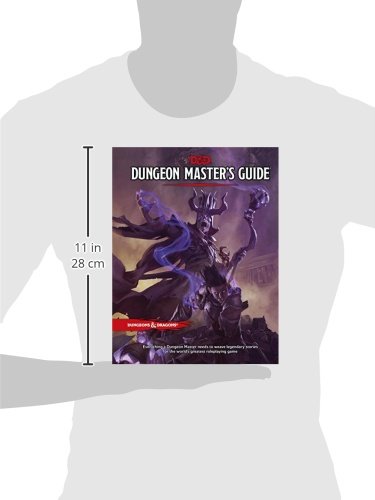
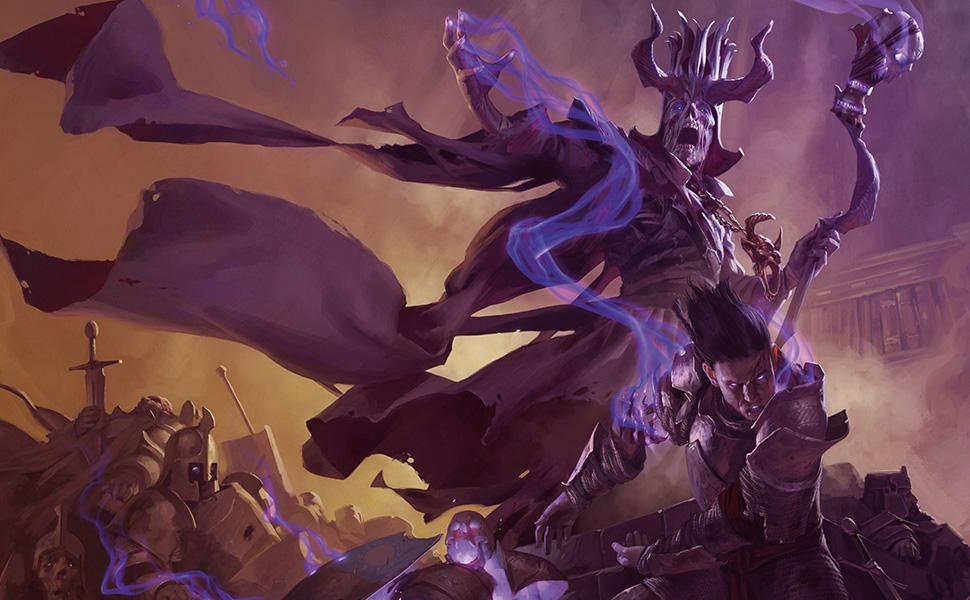
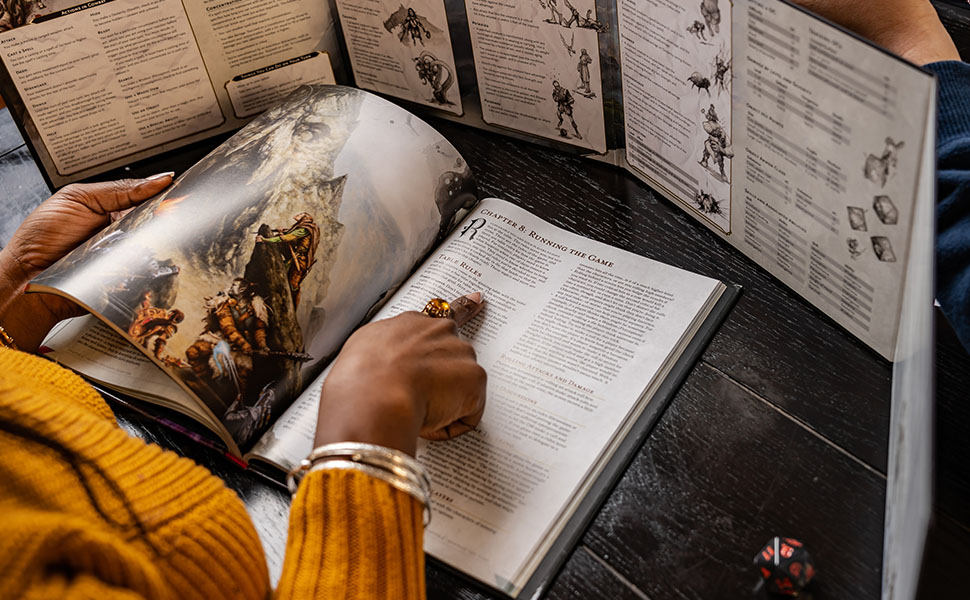
The D&D 2014 Dungeon Master's Guide is a 300+ page hardcover manual designed for Dungeon Masters aged 12 and up. It offers expert advice on world-building, encounter balancing, and hundreds of magic items to enrich gameplay. While not a beginner's rulebook, it is an indispensable resource for experienced DMs seeking to craft immersive, customizable adventures in the 5th edition of Dungeons & Dragons.


| ASIN | 0786965622 |
| Age Range Description | Age Range:12 Years & Up |
| Best Sellers Rank | #32 in Dungeons & Dragons Game #583 in Dragons & Mythical Creatures Fantasy (Books) #610 in Sword & Sorcery Fantasy (Books) |
| Brand Name | Dungeons & Dragons |
| Color | Multicolor |
| Customer Reviews | 4.9 4.9 out of 5 stars (30,773) |
| Educational Objective | Develop storytelling abilities and problem-solving skills through creating and managing engaging game sessions for the Dungeons & Dragons role-playing game. |
| Global Trade Identification Number | 09780786965625 |
| Included Components | HC Book |
| Is Assembly Required | No |
| Item Dimensions | 8.51 x 0.85 x 11.17 inches |
| Item Type Name | Tabletop Game |
| Item Weight | 1.11 Kilograms |
| Manufacturer | Wizards of the Coast |
| Manufacturer Maximum Age (MONTHS) | 1188 |
| Manufacturer Minimum Age (MONTHS) | 144 |
| Manufacturer Part Number | 786965622 |
| Material Type | Paper |
| Model Number | A92190000 |
| Number of Batteries | 1 Lithium Ion batteries required. (included) |
| Number of Players | 2-5 |
| Operation Mode | Manual |
| Power Source | Manual |
| Size | 0.85 inches x 8.51 inches x 11.17 inches |
| Subject Character | Monster |
| Theme | Adventure, Fantasy, Magic |
B**W
Everything a newbie DM could ever want to know about being a DM
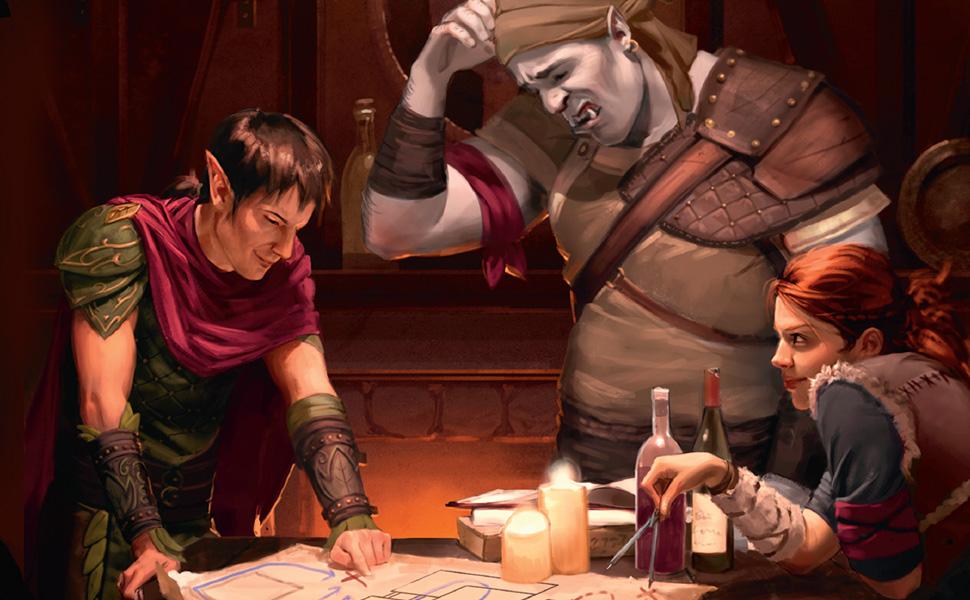
Previously, I wrote a review for the 3.5 edition of the Dungeon Master's Guide for Dungeons and Dragons, and I useful I found it for writing novels. All of that applies to the 5th edition too, but more so. I much prefer this edition as a writing aid. Oh yes, I also find it useful for running a Dungeons and Dragons campaign. This book is split into three main sections, each describing the responsibility of the Dungeon Master in the game. They are "Master of Worlds", "Master of Adventures" and "Master of Rules". The first is for creating the campaign world, the second is for creating the adventure, and the third is a list of rules to help the DM run the scenario, tweak situations to fit the campaign, and a section with advice on homebrewing elements. As a Dungeon Master, I find this book extremely helpful. I have several areas of it bookmarked for easier and quicker reference. One of them is the area for building encounters and managing random encounters. This helped break my previous conception of random encounters, which I picked up from video games. In video games, there is no point to a random encounter other to beatdown on the monsters for some droppable resource (Experience points, money, some form of loot). Then you move on. Not so in a Dungeons and Dragons session, where some groups play for 2-3 hours a week or even less. That can become tedious (as it sometimes happens in video games as well). This area of the book taught me how to make a random encounter more meaningful. There is a "Sylvan Forest" encounter table in here that I merged with another table in the Monster Manual to create the one for the area that my party is currently adventuring in. These "random" encounters provided the seed necessary to create events that are relevant to the here and now of the session. I also bookmarked the area that explains how to create maps for dungeons, settlements and wilderness, as well as adjudicating and describing what your players do in each. Because each area is different, different methods are used for each one. For instance, a dungeon is likely to be traversed room-by-room, as the player-characters check for traps and treasure. The wilderness, by contrast, is more likely to be a more general environment that does not involve the player-characters checking behind each tree or the top of each hill. Unless, of course, they are in a particular section of wilderness that doubles as a dungeon. Also, my players have done a lot of foraging recently so it is useful to have a table that enables me to quickly determine if they find something and how much they find. A third bookmark, of which I currently have seven in total, is a rule variant for chases. In Dungeons and Dragons 5th Edition, all creatures have a set movement speed, which makes chases deterministic and therefore less interesting. This area lists certain rules that can be used to add randomness to this otherwise pre-determined scenario, basically obstacles that both the pursuer and the quarry can run into, which can slow them down. There are also rules for determining when the chase begins, ends, or turns around and makes the hunter the hunted. Oh, I wish I had read this book cover-to-cover when I first started DMing. I thought I knew the rules well enough as a player and that I would do fine by imitating what our group's original DM did, but I didn't do fine. Not in the least. I have several embarrassing sessions under my belt, and this book could have prevented several of them. Particularly the Chase section; especially the Chase section. On another note, there is gorgeous art in this book. This review is mainly about the usefulness of the book for a Dungeon Master (and therefore also a novelist) but I have to mention the gorgeous art. You can see landscapes of everything from mountains and meadows to the Shadowfell or the Elemental Plane of Fire. You get portraits of an adventuring party consulting/drawing a map or in combat with a dragon. Most of the magic items listed in the treasure also get their own images along with their listing. Trickster Eric Novels gives "The Dungeon Master's Guide for D&D 5E" an A+
S**P
Good quality (with a nice new book smell)
Great quality book. Came in perfect condition. Can't wait to buy more of the books!
S**N
A Classic; DON'T buy this one first
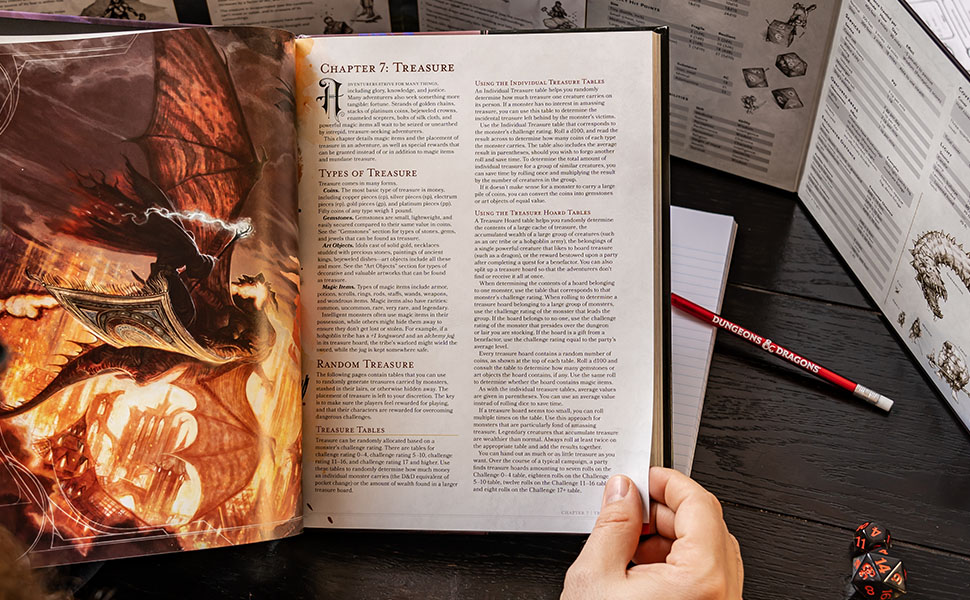
It's a common mistake for newbies to lean into the Dungeon Master's Guide in an effort to learn the game. I think it's weird that Wizards decided to market this as "All you need to run a Dungeons & Dragons game", because the DM's Guide doesn't actually tell you how to play D&D. It contains none of the essential rules. If you're approaching D&D for the first time, you should buy The Player's Handbook. Every single player and DM needs to know about Ch. 7 Using Abilities, Ch. 8 Adventuring, Ch. 9 Combat and Ch. 10 Spellcasting - this is the heart of the game. Once you're comfortable with the basics, you need to start customizing your game with "house rules", optional rules that work well for your group and playstyle. Your game will naturally flow between epic storytelling and gritty tick-tock action. Your players will do inspiring things worthy of reward. You'll sometimes need to ignore the dice, or follow the "Rule of Fun". The Dungeon Master's guide has solid, time-tested advice on all of that and more. Unfortunately all the good stuff is crammed in to Part 3; the DM's guide hasn't changed that much since the original bound AD&D version, including the awkward arrangement of chapters and information. Ch. 3 "Creating Adventures" and Ch. 5 "Adventure Environments" are important reads, and Chapter 8. "Running The Game" is what you think you're getting when you buy this - practical, detailed advice on running a D&D game. I really like Chapter 6 "Between Adventures", which helps you fill in the gaps with careers, philandering, politics and real-estate. All of Part 1 may as well be supplemental. It helps as background material for the official adventure modules, and can help ground your homegrown campaign in some official lore, but it's by no means essential, and you could get bored and discouraged if you tried to learn D&D by slogging through the differences between Arcadia vs Archeron vs Avernus. Save it for later. Chapter 7: Treasure. Ah, treasure. This is the other reason to get this book: it's the best all-in-one official sourcebook for D&D treasure. The stuff of legends. Some of this stuff - Boots of Elvenkind, Bag of Holding, Belt of Giant Strength - has been in the game 30+ years. There's newer treasure as well, and it all feels appropriately quirky and powerful. Old-school DMs have a reputation of granting treasure sparingly, and Chapter 7 has suitably stingy (but useful) random treasure tables, and additional random tables to give each magic item special characteristics - who made it and why, how is it activated, does it have a name? I like to hand-write the magic item's name, characteristics, background and quirky details on a 3x5 index card and hand it to players when they identify it - it makes getting one a little more special. All in all, the Dungeon Master's Guide is an absolute classic, but not an essential classic. You could play for a year before needing to crack it open, and I recommend buying The Player's Handbook and Monster Manual first. But once you've gained some experience as a DM, it provides tons of useful knowledge.
O**.
Not sealed in plastic shrink wrap but it is New and unused. almost 30% cheaper than buying it locally. so i can't complain. Perfectly Good for what it is.
P**S
Esse livro aborda uma gama tão grande de quesitos que mestres geralmente tem de levar em consideração, e consegue fazê-lo de uma forma que todos conseguem entender seu conteúdo (exemplo: você não precisa ser um geógrafo para entender a explicação que o livro dá sobre demografia e geografia. Basta apenas ler). Não é necessário para mestrar, afinal de contas, a única coisa que vc realmente precisa para jogar RPG é imaginação, mas com certeza é um excelente produto pra você conseguir deixar suas aventuras muito mais ricas, críveis e épicas.
A**E
Beautiful book, has the nicest cover and feel by a mile out of the 3. Has some interesting lore in it. Honestly, if you want to be a DM, really your main point is to learn the Player's Handbook off by heart. The book's split into 3 parts, Part 1, Part 2 and Part 3. Here's a rundown of what you get. Honestly, chapters 1-6 are nice for a bit of inspiration, but 6 onwards is really what you're buying this for. As a DM though you'll probably spend way more time in the PHB. I glance at this like once in a blue moon, it's not the type of thing you need on hand if you print yourself all the most useful bits and bobs for your DM screen. Part 1 (Master of Worlds): Chapter 1, which is about world building. Tbh this is very generic advice and it's mostly naturally intuitive anyway, but even if it wasn't you'd probably be best with like, a Kobold guide to Worldbuilding. Chapter 2 is about their setting's planes of existence, which is fairly useful if you want to use a generic setting and you think your campaign will last long enough to get into alternate planes. Part 1 I find pretty superfluous. Part 2 (Master of Adventures): Chapter 3: 10% of the chapter is super important - shows the rules for creating encounters. Useful because the online ones don't seem to actually work very well. 90% of this chapter however is "roll on this d20 table to invent a plot". Like, really, do people do that? Either you're going to invent your own worlds on the fly or you're going to use an adventure module. I mean, you can read this for ideas, but who is going to roll a d12 to find out what the climax of their adventure is? Chapter 4: Roll to make an NPC, same as chapter 3 (at least this is more likely if you quickly had to put something together). More importantly, contains Oathbreaker Paladin and Death Domain for the cleric. These are cool things to spring on a player who falls to the darkside. Also optional rule for Loyalty is in here, you may find useful. Chapter 5: Roll to make a world. Only really useful thing here are sample traps. (Again, read it for inspiration but not really useful). Chapter 6: Shows downtime rules. Useful if you break up your campaign that much? I tend to leave mine on cliffhangers and pick back up straight where we left off though. Nice after a campaign finishes and you want to give your PCs cool new bonuses though. CHAPTER 7: Finally things get good. This chapter is 99 pages on its own. Contains the rules for treasure drops, and then an absolute TONNE of magic items. Worth the buy just for that. Unless you can grab a copy of Forged In Magic: REFORGED perhaps. Part 3 (Master of Rules): Okay here's the entire point of the book. Chapter 8 contains all combat rules, ability checks, inspiration, travel, object use, improvising damage, using battle grids, adds flanking, chases, diseases, sieges, poisons, madness, potion crafting, ways to award xp, how to deal with absent players. Chapter 9 contains ways to modernise it with weapons and use alien technology, some combat options, and otherwise is a homebrew chapter that shows how to make monsters, spells, magic items, backgrounds. Appendices: A: Roll to make dungeons. B: Lists of monsters from the Monster Manual based on environment! Like Arctic, coast etc - super useful. Wish Tome of Beasts had this. Also based on CR. C: Some generic maps. I mean, it's beautiful, the writing is quality and I guess most of it is generically useful to all DMs but it feels like the first half is more for people who don't like to come up with their own material. It's the least useful of the 3 books though. You could probs live without it given that encounter and loot generators exist online and they're the main use, as long as you're comfortable with combat. (Which, tbh is mostly in the PHB anyway).
A**D
The only thing to improve this great guide are tabs.
N**S
Produkten är en bok, vad kan jag säga?
Trustpilot
Hace 1 mes
Hace 3 semanas