
DOWNLOAD THE APP


Customer Services
Copyright © 2025 Desertcart Holdings Limited
DOWNLOAD THE APP
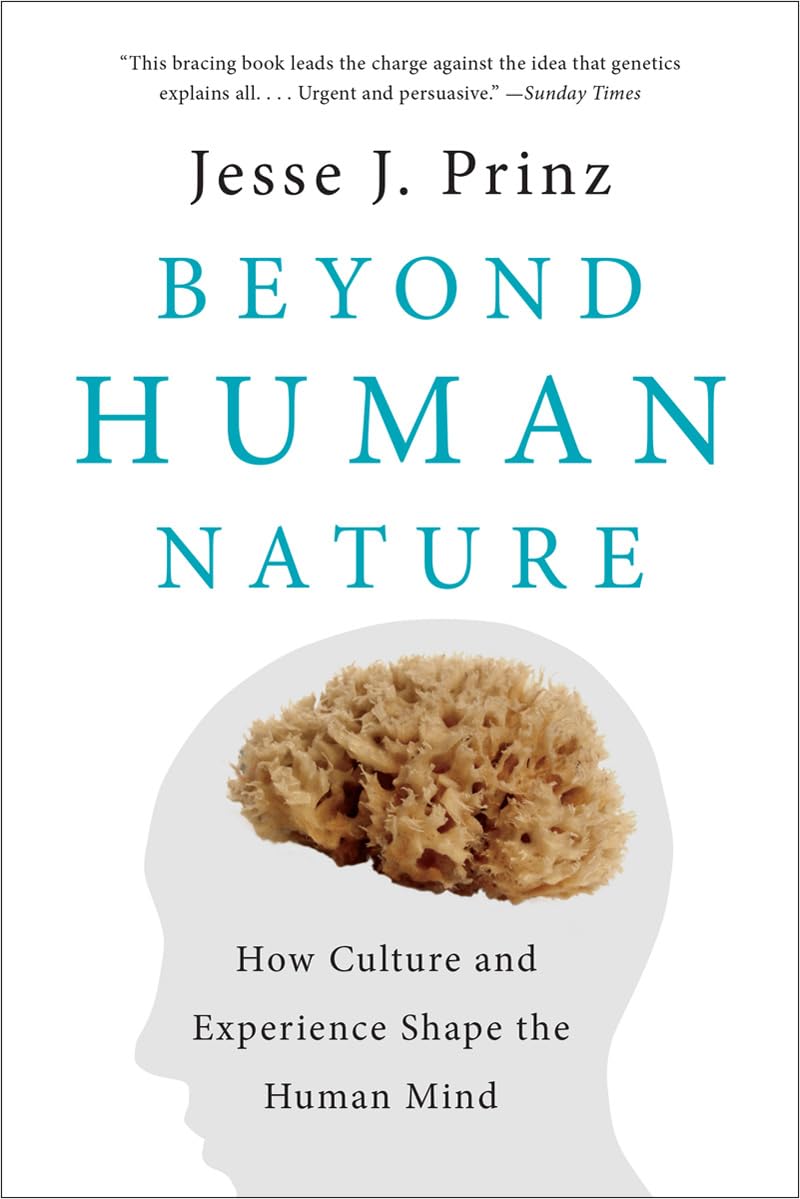
Beyond Human Nature: How Culture and Experience Shape the Human Mind
A**R
Five Stars
Fabulous - a very interesting, accessible and pertinent read.
P**W
Nature v. Nurture
For the most part persuasive, although at times difficult to follow. The first chapter on why overemphasizing the role of genes could lead us astray as a society is important - it details the history of Social Darwinism and the assumptions in the past (some not so distant) as to the role of inheritance v. culture. The discussion of the intelligence of men vs. women with regard to the sciences, the subject of controversy in the 1990s absorbing.
M**K
Even if you don't agree, you should know the arguments (and refute them if you can)
The book is about two scientific positions that exist since the times of the old Greeks, often reduced to the ‘nature-nurture’ issue. Emotions, language, traits and values – are they part of human nature, genetically determined and hard-wired in our brains, or are they the product of culture? Of course, neither nature nor culture can exist completely without the other, but how great a part each plays has been and is still the point of many academic debates.Prinz states early on, that he is on the side of culture, so the reader knows what to expect. If you have been a naturist so far, see if he can convince you. If you are a nurturist, see if his arguments are similar to yours. And if you never thought about the issue, then prepare for a roller coaster ride of ideas and reasoning! Prinz structures each chapter around a question (e. g. “Where does thinking come from?”), and answers it first by summarising the arguments of the naturist side. Then he takes them apart, step-by-step. He points at flaws in research methods, logical problems, over-interpretation of results and offers alternative explanations. To underpin his arguments, he quotes about 250 scientific studies from psychology, philosophy, sociology and anthropology, but he gathers these in form of end notes at the end of the book, which makes the text easier to read than a traditional psychological text (which quotes the names of the researcher in parentheses in the text). Sometimes he also speculates, but when he does he tells you, and as the speculations agree with the quoted research results, he thus shows that there are alternative ways to interpret the data, so more and cleverer research is needed.Reading original research is often hard for an outsider. Each discipline has more or less developed their own lingo (one reason why they don’t collaborate interdisciplinary), but Prince has succeeded well in translating the different dialects into normal English. His choice of examples and titles is often witty. And no matter what side one is on: there is some gymnastics for the brain in following his dialectic argumentation, and more than once did I have to revise my own convictions several times within minutes. Utterly exciting.The only critics I have is that Prinz obviously fell for one of Chomsky’s ideas, otherwise I cannot understand why he does not cite Skinner’s Verbal Behavior in the language chapter. And I also think adding some dynamic system thinking, which has appears also in developmental psychology could improve the argument.So I highly recommend this book for everybody who likes a bit of an intellectual challenge.
S**.
Two Stars
What a disappointment!
C**S
Powerful Critique of Biological Determinism
Today the dominant trend in the study of human nature is genetic and neural determinism, especially the latter. Ten years ago, coming up with a gene for everything - the gay gene, the God gene, the art gene - was all the rage, and the sequencing of the human genome was expected to finally reveal all the secrets of human nature. When that didn't pan out, the trend switched to the hot new field: neuroscience. Now everyone is coming up with a brain region for everything, and a fancy full-color fMRI to prove it.Jesse Prinz, a philosopher at CUNY, presents a sustained argument against any sort of simple biological determinism, genetic, neural, or anything else. He systematically points out the fallacies in such an approach. While genes have clear influence on simple physical traits (eye color, height, etc.), there is little evidence of their direct influence on psychological or behavioral traits. Similarly, there is little good evidence that the brain is "hard-wired" for particular traits or tendencies, such as Chomsky's "universal grammar" or intelligence/IQ. Prinz is at his best providing a critique of particular studies that purport to demonstrate evidence of fixed "human nature"; he demolishes in two pages for example the claim that there is a "cheater detection" module built into our brain. He criticizes psychologists in particular for their basic methodological assumption that there is a fixed human nature, and that the best way to understand behavior is to study the brain and the genes. This is philosophy at its best, scientifically informed and critiquing the assumptions and hasty conclusions of innumerable psychological studies.Prinz makes the overall point that the evidence clearly indicates that the essential, evolved feature of human nature is its flexibility and adaptability, not its fixity. Really, this should have been obvious from the start, given the enormous range of diversity of cultures and of individual behavior within cultures. To understand human behavior, the best place to look is not neuroscience or genetics, but sociology and history. There is nothing "soft" or "unscientific" about this approach; it is quite consistent with evolutionary biology to hold that human uniqueness consists in our ability to use culture to adapt our behavior to the circumstances. Whether it is religion, art, or gender, the source of our behavior is culture, not biology. Or more precisely, you cannot separate the two: it is our biology that empowers us to use culture to control our behavior.Not everything about the book is equally high quality. Prinz is at his weakest when he defends his own favorite position, moral relativism. For him, morality is just an emotional preference, and there is no objective basis for any moral principles. He loses his critical edge when he credulously accepts scientific studies that support his view of morality, such as Joshua Greene's flawed experiments on the trolley problem. And Prinz's moral relativism infects much of the book, so that we are given a highly cynical, materialistic, reductionist view of human nature and history, in which moral ideals play no role. All examples of moral progress, even the elimination of slavery, come down in Prinz's view to economic and selfish motives. He insists that the demise of slavery was due to the rise of industrial capitalism, making it no longer profitable. This is just bad history and economics, and it is rather willful denial of the fact that the abolitionist movement in Britain and the US were largely motivated by moral principles not economic self-interest. On the topic of morality, you would do much better to read Pinker's Better Angels of Our Nature, which includes a far more accurate account of the demise of slavery.Other than this one area of shortsightedness, Prinz's book is an important corrective to the current deterministic trends in psychology. The book will be highly controversial, as Prinz is fighting against a powerful tide of biologism, and attacks a lot of reputable scientists. But don't believe all the negative reviews, as many of them are pure defensiveness. This is a thoughtful and well-informed book.
Trustpilot
3 weeks ago
3 days ago