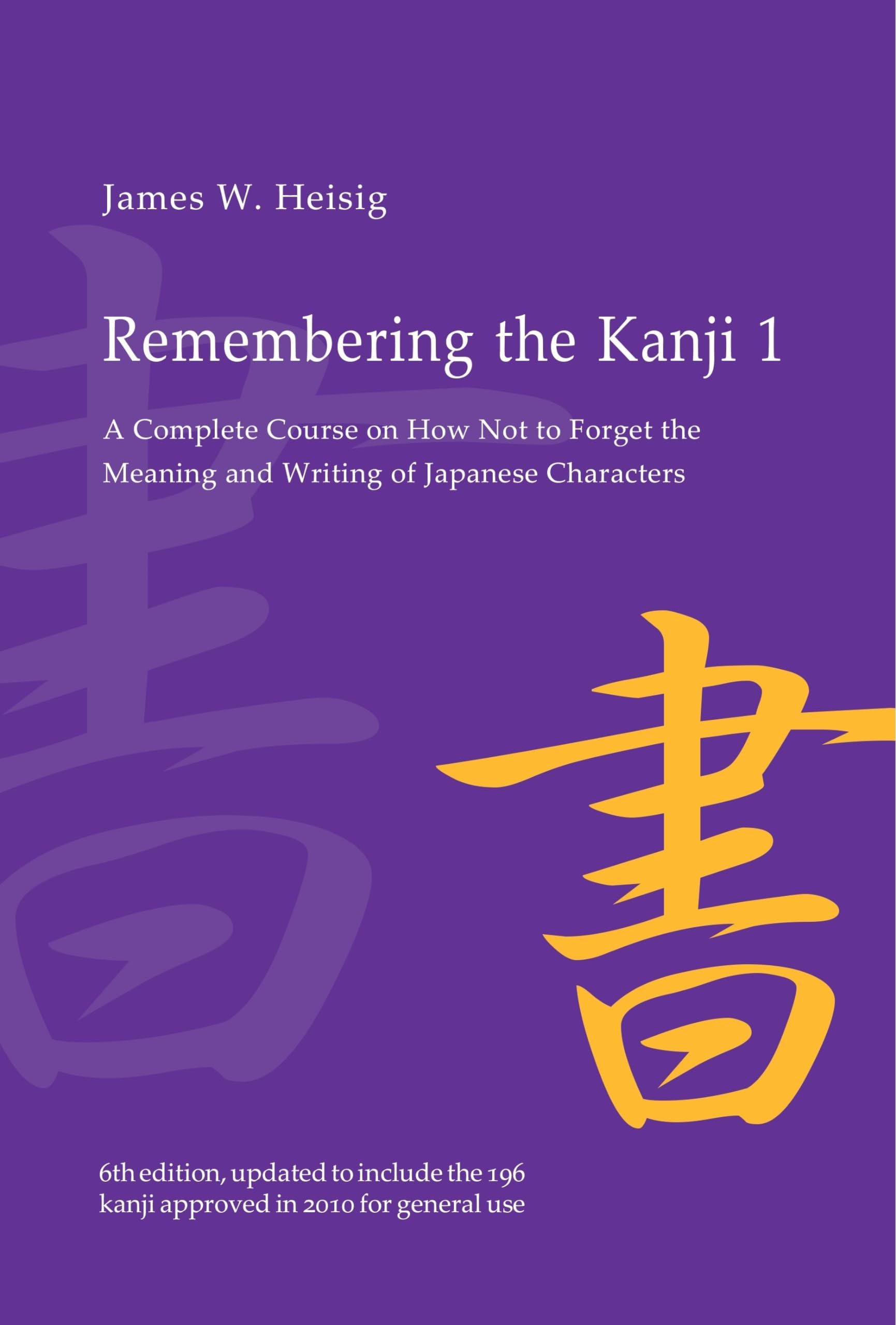

desertcart.com: Remembering the Kanji 1: A Complete Course on How Not to Forget the Meaning and Writing of Japanese Characters: 8601400140734: Heisig, James W.: Books Review: A very logical approach to learning kanji - This book is awesome. It presents kanji in a logical manner, allowing you to learn the kanji that make up other kanji first, which makes it much easier to learn and remember more complex kanji. It focuses on using what Heisig calls "imaginative memory" by coming up with simple stories to go with each kanji based on the primitives that make it up. For instance, the kanji for jealous is made up of the kanji for woman and stone, and Heisig suggests that you remember it based on the idea that a woman is jealous of the ring with a large stone on another woman's finger. Another example would be the kanji for bribe, which is made up of the kanji for money and possess, which you can then remember based on the idea that someone who has been bribed has been possessed by money or that you've possessed them using money. I think that my favorite is the one for elder brother, which is made up of the kanji for mouth and human feet (and used in other kanji to represent teenager); a mouth with feet is very obviously connected with a teenager or elder brother who's a teenager. The keywords that he uses for each kanji are often an oversimplification, I think, but it works well for learning them. This approach works better for some kanji than others (e.g. petition is made up of the kanji for meadow and head, and Heisig comes up with some story about you petitioning the Wizard of Oz's head in a meadow, which is downright weird, but it's not like it's symbol combination that has an obvious connection with the meaning of the resulting kanji). So, it's by no means perfect, but it's _way_ better than learning each of the kanji individually based on the frequency that they're used without taking into account which kanji are used to build other kanji. You get a very organized approach to constructing each of the kanji and making them easy to remember (or at least easier to remember) rather than trying to learn how to draw each of them without taking each of the others into account. Now, that being said, I think that Heisig puts too much store in imaginative memory and thinks that you shouldn't be practicing drawing each kanji over and over to help remember it. I have to argue that using multiple memory mechanisms is going to improve your chances of remembering something, and writing stuff down definitely helps. So, I think that practicing each character several times rather than just memorizing which kanji make it up and writing it maybe once (as Heisig seems to think you should do) is a worse approach. But the tools that he's giving you by organizing the kanji based on which other kanji make them up as well as giving you ways to remember them based on those pieces rather than simply what the kanji looks like as a whole are an _enormous_ help and makes learning more complex kanji far easier. So, while I don't agree with everything that he says, I think that his overall approach is very good. And since I'm an engineer, how logical and organized his system is is _very_ appealing to me. Now, a serious downside to all of this is that you're learning the kanji in a very different order than anything else is going to use. So, you're not going to get much help from elsewhere (and Heisig actually says that he thinks that learning the kanji using his method combines very badly with more traditional methods such that you shouldn't use this book if you're taking classes or using other textbooks at the same time). It also only covers the kanji themselves and not pronunciation or grammar or anything like that - which I don't think is a bad thing (Heisig points out that it makes it so that when you do learn those things, you're in a position closer to that which a Chinese person would be in, since they'd be familiar with the kanji and their rough meanings but not how they related to Japanese), but the other volumes are supposed to go into that stuff (I haven't gotten to them yet, so I can't comment on them in detail). But even if you were to switch to other textbooks after having learn the kanji covered in volume 1 of this series, you'd be able to go through them that much faster, because you'd recognize the characters and know how to write them, which is obviously a _huge_ barrier to learning Japanese. On a last note, I'd highly recommend that you pick up the mobile app that goes with this (at the moment, it's under $2). In addition to listing all of the characters in the order that they're in the book, giving you a handy referencee, it shows you how to draw them with an animation (the book shows you which order to draw each stroke but not the direction of the stroke), and it can be used for flash cards, which is fantastic (even allowing you to pick which kanji are in a study list rather than just having a preset set of flashcards). It does seem to be somewhat buggy at the moment, but it works well enough to be well worth it IMHO. Review: Great book, even better with supplemental tools! - Before you buy this book, it's important to realize what it will and will not do for you. This book will not teach you how to speak or even read Japanese or Kanji. It will not teach you how different combinations of kanji make up words. What it will do, is teach you how to write all of the ~2100 "regular use" and associate them with a single English "keyword" that reflects one of their (possibly more than one) meanings. And for this purpose, it is magnificent. As proof, I have only had this book for 66 days, and I already know 1075 kanji. Now you may wonder if there's any benefit in going through this book if it's not going to actually teach you to how to read/pronounce Kanji, but I really think there is. This book removes the "intimidation" factor from learning how to write/read Kanji, and it makes Kanji feel more like a familiar alphabet than a bunch of meaningless scribbles. For example, if you're trying to learn how to write "phone" in Japanese, without this book you would have to memorize "電話" but after going through this book, you'd just have to remember "electricity tale" easier, no? I also think that the methodology used in this book to teach kanji is much better than the "traditional" method used in classrooms. I took a single semester of Chinese in college, and they would teach us a (commonly used) word and then they would teach us the character to go with it. And we would learn the character through rote memorization, ie writing it over and over. And this is such a shame because the Chinese writing system, has a beautiful logic to it where all the characters are made up of smaller elements, and some characters are even made up of other characters. This book however, fully exploits the interrelatedness of kanji by presenting them in an order that is the most conducive to memorization. You will learn the character for "person" and then you will learn a whole bunch of other characters that use "person" in them. And this concept extends to complex kanji that are composed of other kanji, which are composed of simpler kanji etc. So in effect, you wind up often practicing multiple characters when you study a single complex character. For example, the character for "tenderness" contains the primitive elements "person" and "melancholy." And "melancholy" contains the primitive elements "head, crown, heart, and walking legs." So by studying the single character for tenderness you are reinforcing SIX other characters in your memory. The book also provides (or asks you to create) "stories" that act as mnemonic devices for each character and these can be really helpful, as well as fun to create or read. So instead of just having to memorize “wheat” and “saber” for the kanji “profit.” You will remember something like “A farmer’s profit is gained by harvesting wheat with his saber.” So all in all, I think this is an amazing book that accomplishes the goal it sets out to do very well. Just be sure that you understand what the goal is and is not before you buy it! Final note…if you decide to embark on learning kanji with this book, I wanted to pass on a few tips from my experience that may help: 1. Try to learn at a reasonable, steady pace. I have chosen to learn 10-20 kanji a day, and it’s worked pretty well for me. If you try to cram to fast, you risk not retaining a lot of what you learn. 2. USE ANKI!!! I love Anki, it’s helped me so much with learning kanji. Anki is software designed to help you memorize things through “spaced repetition.” Basically, it allows you to create (or download!) custom flash cards. It then quizzes you on the flashcards, and based on how you perform on each individual flashcard it decides how often you need to be shown it. Essentially, it manages your studying FOR YOU. So you don’t have to worry about what kanji you need to study, it will take care of that. It’s also on mobile devices, I use it almost exclusively on my iPhone and it’s great, I can draw the kanji with my thumb and I don’t ever even need paper! If you get Anki, I highly recommend downloading the shared deck for Heisig’s Remembering the Kanji. Then just suspend all the cards (using Anki on your computer), and unsuspend only the ones that you have learned. One caveat though, the shared deck for Heisig’s is for an older edition, so you will have to manually hunt down some cards that are in the newer edition, but not in the older. 3. The website kanji.koohii.com offers shared stories that can be really useful if you can’t think of a story for a given kanji. It also has a flashcard system but I prefer Anki personally. 4. There is an app for Heisig’s RTK that you can get for iPhone etc. It’s great because it lets you write a story for each kanji and store it in the app. I use that app to learn the kanji, then I use Anki to practice. Best of luck to you if you decide to embark on this journey!
| Best Sellers Rank | #11,284 in Books ( See Top 100 in Books ) #5 in Alphabet Reference #13 in Study & Teaching Reference (Books) #16 in Linguistics Reference |
| Book 1 of 3 | Remembering the Kanji |
| Customer Reviews | 4.6 4.6 out of 5 stars (2,135) |
| Dimensions | 6 x 1.11 x 9 inches |
| Edition | 6th Updated |
| ISBN-10 | 0824835921 |
| ISBN-13 | 978-0824835927 |
| Item Weight | 1.45 pounds |
| Language | English |
| Print length | 496 pages |
| Publication date | March 31, 2011 |
| Publisher | University of Hawaii Press |
J**S
A very logical approach to learning kanji
This book is awesome. It presents kanji in a logical manner, allowing you to learn the kanji that make up other kanji first, which makes it much easier to learn and remember more complex kanji. It focuses on using what Heisig calls "imaginative memory" by coming up with simple stories to go with each kanji based on the primitives that make it up. For instance, the kanji for jealous is made up of the kanji for woman and stone, and Heisig suggests that you remember it based on the idea that a woman is jealous of the ring with a large stone on another woman's finger. Another example would be the kanji for bribe, which is made up of the kanji for money and possess, which you can then remember based on the idea that someone who has been bribed has been possessed by money or that you've possessed them using money. I think that my favorite is the one for elder brother, which is made up of the kanji for mouth and human feet (and used in other kanji to represent teenager); a mouth with feet is very obviously connected with a teenager or elder brother who's a teenager. The keywords that he uses for each kanji are often an oversimplification, I think, but it works well for learning them. This approach works better for some kanji than others (e.g. petition is made up of the kanji for meadow and head, and Heisig comes up with some story about you petitioning the Wizard of Oz's head in a meadow, which is downright weird, but it's not like it's symbol combination that has an obvious connection with the meaning of the resulting kanji). So, it's by no means perfect, but it's _way_ better than learning each of the kanji individually based on the frequency that they're used without taking into account which kanji are used to build other kanji. You get a very organized approach to constructing each of the kanji and making them easy to remember (or at least easier to remember) rather than trying to learn how to draw each of them without taking each of the others into account. Now, that being said, I think that Heisig puts too much store in imaginative memory and thinks that you shouldn't be practicing drawing each kanji over and over to help remember it. I have to argue that using multiple memory mechanisms is going to improve your chances of remembering something, and writing stuff down definitely helps. So, I think that practicing each character several times rather than just memorizing which kanji make it up and writing it maybe once (as Heisig seems to think you should do) is a worse approach. But the tools that he's giving you by organizing the kanji based on which other kanji make them up as well as giving you ways to remember them based on those pieces rather than simply what the kanji looks like as a whole are an _enormous_ help and makes learning more complex kanji far easier. So, while I don't agree with everything that he says, I think that his overall approach is very good. And since I'm an engineer, how logical and organized his system is is _very_ appealing to me. Now, a serious downside to all of this is that you're learning the kanji in a very different order than anything else is going to use. So, you're not going to get much help from elsewhere (and Heisig actually says that he thinks that learning the kanji using his method combines very badly with more traditional methods such that you shouldn't use this book if you're taking classes or using other textbooks at the same time). It also only covers the kanji themselves and not pronunciation or grammar or anything like that - which I don't think is a bad thing (Heisig points out that it makes it so that when you do learn those things, you're in a position closer to that which a Chinese person would be in, since they'd be familiar with the kanji and their rough meanings but not how they related to Japanese), but the other volumes are supposed to go into that stuff (I haven't gotten to them yet, so I can't comment on them in detail). But even if you were to switch to other textbooks after having learn the kanji covered in volume 1 of this series, you'd be able to go through them that much faster, because you'd recognize the characters and know how to write them, which is obviously a _huge_ barrier to learning Japanese. On a last note, I'd highly recommend that you pick up the mobile app that goes with this (at the moment, it's under $2). In addition to listing all of the characters in the order that they're in the book, giving you a handy referencee, it shows you how to draw them with an animation (the book shows you which order to draw each stroke but not the direction of the stroke), and it can be used for flash cards, which is fantastic (even allowing you to pick which kanji are in a study list rather than just having a preset set of flashcards). It does seem to be somewhat buggy at the moment, but it works well enough to be well worth it IMHO.
J**N
Great book, even better with supplemental tools!
Before you buy this book, it's important to realize what it will and will not do for you. This book will not teach you how to speak or even read Japanese or Kanji. It will not teach you how different combinations of kanji make up words. What it will do, is teach you how to write all of the ~2100 "regular use" and associate them with a single English "keyword" that reflects one of their (possibly more than one) meanings. And for this purpose, it is magnificent. As proof, I have only had this book for 66 days, and I already know 1075 kanji. Now you may wonder if there's any benefit in going through this book if it's not going to actually teach you to how to read/pronounce Kanji, but I really think there is. This book removes the "intimidation" factor from learning how to write/read Kanji, and it makes Kanji feel more like a familiar alphabet than a bunch of meaningless scribbles. For example, if you're trying to learn how to write "phone" in Japanese, without this book you would have to memorize "電話" but after going through this book, you'd just have to remember "electricity tale" easier, no? I also think that the methodology used in this book to teach kanji is much better than the "traditional" method used in classrooms. I took a single semester of Chinese in college, and they would teach us a (commonly used) word and then they would teach us the character to go with it. And we would learn the character through rote memorization, ie writing it over and over. And this is such a shame because the Chinese writing system, has a beautiful logic to it where all the characters are made up of smaller elements, and some characters are even made up of other characters. This book however, fully exploits the interrelatedness of kanji by presenting them in an order that is the most conducive to memorization. You will learn the character for "person" and then you will learn a whole bunch of other characters that use "person" in them. And this concept extends to complex kanji that are composed of other kanji, which are composed of simpler kanji etc. So in effect, you wind up often practicing multiple characters when you study a single complex character. For example, the character for "tenderness" contains the primitive elements "person" and "melancholy." And "melancholy" contains the primitive elements "head, crown, heart, and walking legs." So by studying the single character for tenderness you are reinforcing SIX other characters in your memory. The book also provides (or asks you to create) "stories" that act as mnemonic devices for each character and these can be really helpful, as well as fun to create or read. So instead of just having to memorize “wheat” and “saber” for the kanji “profit.” You will remember something like “A farmer’s profit is gained by harvesting wheat with his saber.” So all in all, I think this is an amazing book that accomplishes the goal it sets out to do very well. Just be sure that you understand what the goal is and is not before you buy it! Final note…if you decide to embark on learning kanji with this book, I wanted to pass on a few tips from my experience that may help: 1. Try to learn at a reasonable, steady pace. I have chosen to learn 10-20 kanji a day, and it’s worked pretty well for me. If you try to cram to fast, you risk not retaining a lot of what you learn. 2. USE ANKI!!! I love Anki, it’s helped me so much with learning kanji. Anki is software designed to help you memorize things through “spaced repetition.” Basically, it allows you to create (or download!) custom flash cards. It then quizzes you on the flashcards, and based on how you perform on each individual flashcard it decides how often you need to be shown it. Essentially, it manages your studying FOR YOU. So you don’t have to worry about what kanji you need to study, it will take care of that. It’s also on mobile devices, I use it almost exclusively on my iPhone and it’s great, I can draw the kanji with my thumb and I don’t ever even need paper! If you get Anki, I highly recommend downloading the shared deck for Heisig’s Remembering the Kanji. Then just suspend all the cards (using Anki on your computer), and unsuspend only the ones that you have learned. One caveat though, the shared deck for Heisig’s is for an older edition, so you will have to manually hunt down some cards that are in the newer edition, but not in the older. 3. The website kanji.koohii.com offers shared stories that can be really useful if you can’t think of a story for a given kanji. It also has a flashcard system but I prefer Anki personally. 4. There is an app for Heisig’s RTK that you can get for iPhone etc. It’s great because it lets you write a story for each kanji and store it in the app. I use that app to learn the kanji, then I use Anki to practice. Best of luck to you if you decide to embark on this journey!
P**P
O método é extremamente eficaz, e faz com que você realmente se lembre dos kanjis quando os vê em diversas situações fora do livro. Não ensina gramática ou o idioma japonês mas sim o significado básico (ou um dos significados) de cada kanji. O início é extremamente rápido, mas senti uma certa dificuldade depois de um certo tempo pois os significados de cada kanji começam a se misturar um pouco na cabeça. No início são tods bem distintos, como "likeness", "admonish" e "village" etc, mas depois começam a vir significados que na nossa memória visual ocupam lugares muito próximos àqueles apresentados anteriormente, como "resemblance", "chastise" e "town" e assim é preciso se concentrar muito bem e visualizar as nuances de cada caso. Mesmo assim o método é muito bom para memorizar todos os kanjis. Ainda não cheguei na segunda parte do livro onde a própria pessoa define suas imagens mentais. Mas pelo que entendi até agora, é o caminho certo.
T**R
Absolutely brilliant book. I usually don’t write reviews and I read most of that brick in a library but I had to own it because it is the only intelligent and efficient alternative to rote learning I found. And believe me I looked. Apps, complete methods, websites, YouTube videos, every book on the shelf, you name it... this works. One thing though. This is not for the slackers out here. Actually the more committed you are to this method, the faster and more durably you learn. Everything adds up and if you just kind of remember that kanji number 200 from three months ago when you are learning kanji 1954, this won’t work. If you really - I mean really - want to learn kanji, look no further, stop procrastinating and go for a hundred kanji a week. I bought this book having read it already, that’s how much I’m grateful for it.
D**P
Great Seller, A+++++ Thank you.
T**R
The mnemonics are a little cringeworthy at times (lol), but they're good starter ideas if you can think of a better one. The book itself is well written and well paced. This will show you a logical list of the 2000+ kanji: both how to draw them in their correct sequential stroke order and what they actually mean as a pictograph. What it doesn't mention, and I have paired this up nicely with this: (https://www.amazon.co.uk/dp/4805311703), is the on/kunyomi pronunciations and some example words/phrases that you might see each kanji in. For example, this book will show you how to draw the kanji for 'moon'/'flesh'/'body part' but it won't then tell you that it can be pronounced "GATSU"/"GETSU"/"tsuki" nor that you might see it written in ICHIGATSU (meaning January = One + moon). Conversely, the second book doesn't include what this book shows. Together, the two books cover everything you'd want unless hunting for kanji outside the standard list, though the kanji are not listed in the same order of course, so there's a bit of page flicking. I would advise sticking with this book's order, as it has been specially written to facilitate ease of learning stroke order patterns rather than purely by level of difficulty of concept/stroke complexity. If you can find the kanji you're looking for in this book by how to draw it, or use this book to work out how it's drawn indirectly, it's then incredibly easy to count up the number of total brush strokes (and the general direction it's drawn in) and then look it up in a kanji dictionary or in the index. It's going to take a LOOOOOONG time to learn these, but every journey starts with a single step, right?
K**N
For readers who learnt chinese langauage, the book doesnt really make sense. But probably good for western readers who are learning oriental characters for the first time.
Trustpilot
5 days ago
2 weeks ago