We remain fully operational. Our teams are working around the clock to ensure your deliveries continue safely.

DOWNLOAD THE APP


Customer Services
Copyright © 2025 Desertcart Holdings Limited
DOWNLOAD THE APP
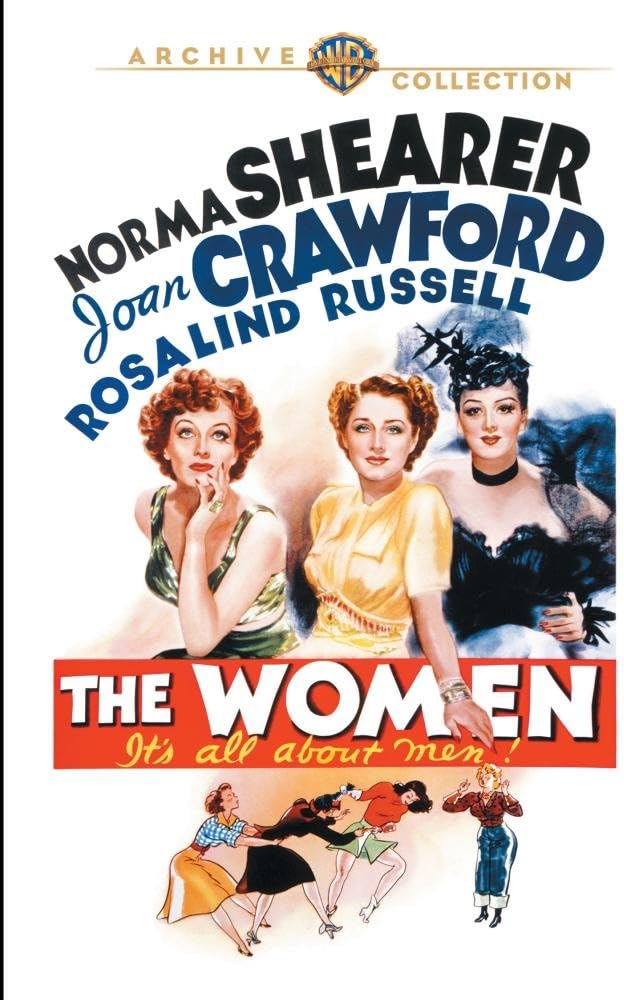
Be careful what you say in private. It could become a movie. Some gossip overheard by Clare Boothe Luce in a nightclub powder room inspired her Broadway hit that's wittily adapted for the screen in The Women. George Cukor directs an all-female cast in this catty tale of battling and bonding that paints its claws "Jungle Red" and shreds the excesses of pampered Park Avenue princesses. Joan Crawford, Rosalind Russell, Joan Fontaine, Mary Boland and Paulette Goddard are among the array of husband snatchers, snitches and lovelorn ladies. Norma Shearer is jilted Mary Haines, who ultimately learns to claw without ruining her manicure. All the glamming and slamming comes with a shimmery bauble: a fashion-show sequence in eye-popping Technicolor . Review: One of the greatest films of the 1930s. - “The Women”, as the title suggests is what they called a “woman’s movie” in Hollywood’s classic era, so much so that forty-five minutes in, there is a fashion show and its five minutes are in color, contrasting with the rest of the film’s black and white two hour and eight minute running time (the better to show off the clothes). But it’s so much more than that. This is a great classic film that has always had a big cult following and which can be enjoyed on many levels. Essentially a comedy, it nevertheless exposes deep issues in the lives of women from their absolute dependence on men in that era to internal frictions among themselves. Admittedly these are all wealthy women leading cushioned lives, but even they have their problems, not the least of which is the boredom of their existence unless their marriage is truly good. Even then, watch out - jealous friends and gossips will do what they can to upset your happiness.It’s no accident that a popular nail polish is named “Jungle Red”. A great deal of “The Women” is conversation, sharp, witty, often cutting conversation at that. The film is so rapid fire at times you really have to see it twice to get it all; preferably one time with the closed captioning on. Much time has gone by since the filming of “The Women” and you need to appreciate that these women were really rather liberated for their day. As Norma Shearer’s Mary explains to her mother, played by Lucile Watson, “It’s alright for you to talk of another generation when women were chattels and did what men told them to. But this is today! Stephen and I are equals.” Women still lived in almost entirely female worlds outside the home, but were relatively free to come and go as they pleased, at least if they could afford to. The cast was famously all-female as it was in Clare Boothe Luce’s hit Broadway play (written as Clare Boothe in 1936). An amazing cast of big stars and up and comers was assembled for this film. It opens with clever cameos showing each actress with an animal that represents their inner character. Norma Shearer as central character Mary gives one of the best performances of her career in what would be one of her last films. She is especially good and down to earth in her scenes with her daughter, played by Virginia Weidler. No one could have been better as her nemesis than Joan Crawford’s scheming salesgirl, Crystal Allen, all venom and ice. Crawford got a considerable career boost from this film after a period of declining popularity. She was also known not to particularly care for Shearer at the studio, which added an extra element to it all. Others received enhanced careers as a result of “The Women”. Rosalind Russell had mostly played bland nice girls (as in “China Seas”) or the other woman ( in “West Point of the Air”) but here she got to show a comic persona which became her signature for years to come. Lucille Watson had frequently played maids with little or no dialog but from this time on became a notable character actor in films from “Watch On the Rhine” to “The Thin Man Goes Home”. Marjorie Main plays comic relief as a ranch manager in Reno and would play essentially the same character in many Ma and Pa Kettle films. Joan Fontaine is sweet and innocent (her usual film personna) and Paulette Goddard is stunning as Rosalind Russell’s nemesis. Mary Boland’s over-the-top Countess De Lave is a character you won’t forget, divorcing her fourth husband but always proclaiming, “L’amour, L’amour!” Even small characters like the maids, sales women and an exercise instructor have choice lines, and Hedda Hopper appears as a gossip columnist. This big production filled with so much talent and so many egos could have been a mess but it was all held together by director George Cukor. He was known as a woman’s director and had done great work before with Hepburn, Harlow, Shearer, Garbo, Crawford, Jeanette MacDonald (at Paramount) and others. He resented that epithet and notably did fine jobs with male actors, including Clark Gable (in “Manhattan Melodrama”). He took on “The Women” after Selznick dismissed him from “Gone With the Wind”. The dismissal story is so long and tangled with two competing versions that it would be too much to go into here. It’s enough to know that this is among the best of his many great films. Enjoy! EXTRA NOTE: Clare Boothe Luce was an amazing woman herself. She not only wrote for and edited magazines but wrote stories and plays as well as war journalism. She was a rare woman writing Broadway plays without a male writing partner, and writing one with an all-female cast was truly daring for her time. She went on to be a Republican Representative in Congress from Connecticut for several terms and eventually Ambassador to Italy. Her second marriage was to Henry Luce, Publisher of Time and Life magazines. Her third play, “Margin of Error”, was an attack on the Nazis’ racist ideas. She also co-authored a law allowing Indians and Filipinos to immigrate to the U.S. and called for the repeal of the Chinese Exclusion Act. Review: ...and it's all about men... - I remember hearing four or five years back that a remake of the 1939 classic, "The Women," was in the offing. I don't know whatever happened to the plans for that remake, but it's hard to imagine that such a film could be made today. It reinforces just about every negative and politically incorrect stereotype about women imaginable, up to and including Norma Shearer's final line about pride being a luxury that a woman in love can't afford. It also includes other statements that couldn't be made today ("She thinks that because Lulu's dark he won't be able to see her" and "It's not her fault she wasn't born deaf and dumb"). The film, according to its trailer, has a cast of 135 women. I presume that they are talking about the speaking roles because there are certainly more women on screen than that. There is not a single man to be seen anywhere; even the various animals are female. There is one scene near the beginning where a photo of a man graces the back of a magazine cover; this shot stands out like a sore thumb each time I see it, and I wish somebody had caught it and corrected it. Despite its political incorrectness, "The Women" is one of the funniest and most rib-tickling films ever made. I've probably watched it more than any other film in my collection; I've even taped the soundtrack and listened to it, a thoroughly satisfying way to enjoy "The Women" in the car, for example. Of course the raison d'etre of this spectacular film is the bitchiness of almost all the leading characters, set off by Norma Shearer's near-saintly Mary Haines. Such a character would be considered a crashing bore nowadays--her scene with daughter Mary, played by Virginia Weidler, gets this very fast-paced comedy off to an incredibly leaden start--and I have a hard time believing that she ever carried the full sympathy of the audience. Even her wise old mother, delightfully played by Lucile Watson, displays more character; fumigating the room after a party attended by most of the of the other characters, she says "How do you stand those dreadful women?" Rosalind Russell as Sylvia Fowler gets the cattiest lines and somehow manages to be able to talk a mile a minute through the whole film, even while doing strenuous physical exercises. Her two scenes with Joan Crawford are the high points of the film. Joan had to fight for the relatively short but very important role of Crystal Allen, the "terrible man-trap" who steals Stephen Haines, Norma Shearer's husband, but her hunch paid off: despite the brevity of her role, Crystal dominates the film from the time of her first appearance. And even though she gets her comeuppance at the end (an element missing from the original play by the way), she leaves in triumph, looking gorgeous and with one of the best exit lines ever written. The supporting cast doesn't have a weak link. One standout is Paulette Goddard, the most beautiful woman in the cast and certainly one of the most spirited, as Miriam Aarons, a junior-league Crystal Allen. Another is Mary Boland as the ditzy but generous-hearted Comtesse de Lave; even after her fifth husband Buck Winston has left her for Crystal, she still refers to the radio moguls who wouldn't give Buck a job on the radio as "the old meanies." But all the leads are spectacular: Joan Fontaine as the naive Peggy, Marjorie Main as Lucy, the proprietess of the Reno dude ranch, Phyllis Povah as Edith (largely forgotten nowadays, she was brought over from Broadway to recreate her role for the film), Florence Nash as tweed-suited Nancy the author, and the others. One thing I have come to appreciate more with each viewing of this film is how many actresses, many of whose names I don't even know, created truly memorable characters with just a handful of lines or less. My own particular favorite is Virginia Grey, another very beautiful woman, as Crystal's pal/nemesis Pat in the delightful telephone scene (and anybody who thinks Crawford can't act should see this scene). But others such as Olga the manicurist, Butterfly McQueen as Lulu, and the wonderful model whose tag line is "Our new one-piece lace foundation garment; zips up the back and no bones," are just three more standouts in a hugely talented supporting cast. They prove the old adage that "there are no small parts, just small actors." "The Women" is one of those films that makes me feel especially sorry for people who claim they can't watch black-and-white films. I'm not referring to the technicolor fashion show sequence when I say that this is certainly one of the most colorful films ever made.
| ASIN | B079ZSSHPK |
| Actors | Joan Crawford, Mary Boland, Norma Shearer, Paulette Goddard, Rosalind Russell |
| Aspect Ratio | 1.33:1 |
| Best Sellers Rank | #41,983 in Movies & TV ( See Top 100 in Movies & TV ) #4,776 in Comedy (Movies & TV) #6,514 in Drama DVDs |
| Customer Reviews | 4.8 4.8 out of 5 stars (3,594) |
| Director | George Cukor |
| MPAA rating | NR (Not Rated) |
| Media Format | NTSC |
| Number of discs | 1 |
| Product Dimensions | 0.5 x 5.35 x 7.5 inches; 2.89 ounces |
| Release date | March 13, 2018 |
| Run time | 2 hours and 13 minutes |
| Studio | Warner Archive Collection |
J**F
One of the greatest films of the 1930s.
“The Women”, as the title suggests is what they called a “woman’s movie” in Hollywood’s classic era, so much so that forty-five minutes in, there is a fashion show and its five minutes are in color, contrasting with the rest of the film’s black and white two hour and eight minute running time (the better to show off the clothes). But it’s so much more than that. This is a great classic film that has always had a big cult following and which can be enjoyed on many levels. Essentially a comedy, it nevertheless exposes deep issues in the lives of women from their absolute dependence on men in that era to internal frictions among themselves. Admittedly these are all wealthy women leading cushioned lives, but even they have their problems, not the least of which is the boredom of their existence unless their marriage is truly good. Even then, watch out - jealous friends and gossips will do what they can to upset your happiness.It’s no accident that a popular nail polish is named “Jungle Red”. A great deal of “The Women” is conversation, sharp, witty, often cutting conversation at that. The film is so rapid fire at times you really have to see it twice to get it all; preferably one time with the closed captioning on. Much time has gone by since the filming of “The Women” and you need to appreciate that these women were really rather liberated for their day. As Norma Shearer’s Mary explains to her mother, played by Lucile Watson, “It’s alright for you to talk of another generation when women were chattels and did what men told them to. But this is today! Stephen and I are equals.” Women still lived in almost entirely female worlds outside the home, but were relatively free to come and go as they pleased, at least if they could afford to. The cast was famously all-female as it was in Clare Boothe Luce’s hit Broadway play (written as Clare Boothe in 1936). An amazing cast of big stars and up and comers was assembled for this film. It opens with clever cameos showing each actress with an animal that represents their inner character. Norma Shearer as central character Mary gives one of the best performances of her career in what would be one of her last films. She is especially good and down to earth in her scenes with her daughter, played by Virginia Weidler. No one could have been better as her nemesis than Joan Crawford’s scheming salesgirl, Crystal Allen, all venom and ice. Crawford got a considerable career boost from this film after a period of declining popularity. She was also known not to particularly care for Shearer at the studio, which added an extra element to it all. Others received enhanced careers as a result of “The Women”. Rosalind Russell had mostly played bland nice girls (as in “China Seas”) or the other woman ( in “West Point of the Air”) but here she got to show a comic persona which became her signature for years to come. Lucille Watson had frequently played maids with little or no dialog but from this time on became a notable character actor in films from “Watch On the Rhine” to “The Thin Man Goes Home”. Marjorie Main plays comic relief as a ranch manager in Reno and would play essentially the same character in many Ma and Pa Kettle films. Joan Fontaine is sweet and innocent (her usual film personna) and Paulette Goddard is stunning as Rosalind Russell’s nemesis. Mary Boland’s over-the-top Countess De Lave is a character you won’t forget, divorcing her fourth husband but always proclaiming, “L’amour, L’amour!” Even small characters like the maids, sales women and an exercise instructor have choice lines, and Hedda Hopper appears as a gossip columnist. This big production filled with so much talent and so many egos could have been a mess but it was all held together by director George Cukor. He was known as a woman’s director and had done great work before with Hepburn, Harlow, Shearer, Garbo, Crawford, Jeanette MacDonald (at Paramount) and others. He resented that epithet and notably did fine jobs with male actors, including Clark Gable (in “Manhattan Melodrama”). He took on “The Women” after Selznick dismissed him from “Gone With the Wind”. The dismissal story is so long and tangled with two competing versions that it would be too much to go into here. It’s enough to know that this is among the best of his many great films. Enjoy! EXTRA NOTE: Clare Boothe Luce was an amazing woman herself. She not only wrote for and edited magazines but wrote stories and plays as well as war journalism. She was a rare woman writing Broadway plays without a male writing partner, and writing one with an all-female cast was truly daring for her time. She went on to be a Republican Representative in Congress from Connecticut for several terms and eventually Ambassador to Italy. Her second marriage was to Henry Luce, Publisher of Time and Life magazines. Her third play, “Margin of Error”, was an attack on the Nazis’ racist ideas. She also co-authored a law allowing Indians and Filipinos to immigrate to the U.S. and called for the repeal of the Chinese Exclusion Act.
M**E
...and it's all about men...
I remember hearing four or five years back that a remake of the 1939 classic, "The Women," was in the offing. I don't know whatever happened to the plans for that remake, but it's hard to imagine that such a film could be made today. It reinforces just about every negative and politically incorrect stereotype about women imaginable, up to and including Norma Shearer's final line about pride being a luxury that a woman in love can't afford. It also includes other statements that couldn't be made today ("She thinks that because Lulu's dark he won't be able to see her" and "It's not her fault she wasn't born deaf and dumb"). The film, according to its trailer, has a cast of 135 women. I presume that they are talking about the speaking roles because there are certainly more women on screen than that. There is not a single man to be seen anywhere; even the various animals are female. There is one scene near the beginning where a photo of a man graces the back of a magazine cover; this shot stands out like a sore thumb each time I see it, and I wish somebody had caught it and corrected it. Despite its political incorrectness, "The Women" is one of the funniest and most rib-tickling films ever made. I've probably watched it more than any other film in my collection; I've even taped the soundtrack and listened to it, a thoroughly satisfying way to enjoy "The Women" in the car, for example. Of course the raison d'etre of this spectacular film is the bitchiness of almost all the leading characters, set off by Norma Shearer's near-saintly Mary Haines. Such a character would be considered a crashing bore nowadays--her scene with daughter Mary, played by Virginia Weidler, gets this very fast-paced comedy off to an incredibly leaden start--and I have a hard time believing that she ever carried the full sympathy of the audience. Even her wise old mother, delightfully played by Lucile Watson, displays more character; fumigating the room after a party attended by most of the of the other characters, she says "How do you stand those dreadful women?" Rosalind Russell as Sylvia Fowler gets the cattiest lines and somehow manages to be able to talk a mile a minute through the whole film, even while doing strenuous physical exercises. Her two scenes with Joan Crawford are the high points of the film. Joan had to fight for the relatively short but very important role of Crystal Allen, the "terrible man-trap" who steals Stephen Haines, Norma Shearer's husband, but her hunch paid off: despite the brevity of her role, Crystal dominates the film from the time of her first appearance. And even though she gets her comeuppance at the end (an element missing from the original play by the way), she leaves in triumph, looking gorgeous and with one of the best exit lines ever written. The supporting cast doesn't have a weak link. One standout is Paulette Goddard, the most beautiful woman in the cast and certainly one of the most spirited, as Miriam Aarons, a junior-league Crystal Allen. Another is Mary Boland as the ditzy but generous-hearted Comtesse de Lave; even after her fifth husband Buck Winston has left her for Crystal, she still refers to the radio moguls who wouldn't give Buck a job on the radio as "the old meanies." But all the leads are spectacular: Joan Fontaine as the naive Peggy, Marjorie Main as Lucy, the proprietess of the Reno dude ranch, Phyllis Povah as Edith (largely forgotten nowadays, she was brought over from Broadway to recreate her role for the film), Florence Nash as tweed-suited Nancy the author, and the others. One thing I have come to appreciate more with each viewing of this film is how many actresses, many of whose names I don't even know, created truly memorable characters with just a handful of lines or less. My own particular favorite is Virginia Grey, another very beautiful woman, as Crystal's pal/nemesis Pat in the delightful telephone scene (and anybody who thinks Crawford can't act should see this scene). But others such as Olga the manicurist, Butterfly McQueen as Lulu, and the wonderful model whose tag line is "Our new one-piece lace foundation garment; zips up the back and no bones," are just three more standouts in a hugely talented supporting cast. They prove the old adage that "there are no small parts, just small actors." "The Women" is one of those films that makes me feel especially sorry for people who claim they can't watch black-and-white films. I'm not referring to the technicolor fashion show sequence when I say that this is certainly one of the most colorful films ever made.
H**E
On a toujours dit que George Cukor était d'abord et avant tout un portraitiste de la femme par sa capacité à capturer la psychologie féminine. On ne s'étonnera donc pas que le cinéaste ait dirigé presque toutes les grandes actrices de son temps. Et c'est dans la comédie qu'il s’épanouit véritablement, se moquant sans trop d'outrance, des mœurs américaines. Fraîchement disponible après avoir été congédié du plateau d'Autant en emporte le vent, George Cukor s'impose logiquement comme le réalisateur idéal pour diriger "The Women" qui fut un des films majeur de sa carrière... un modèle d'harmonie, que ce soit dans les dialogues percutants, dans le scénario (d'une méchanceté revigorante), ou dans la pétulance des personnages féminins qu'il dissèque avec gourmandise. Sous les excès, le script est d'une grande finesse pour mettre à jour les questionnements soulevés par la situation de l'héroïne Norma Shearer toujours amoureuse mais ne pouvant surmonter l'humiliation de la tromperie. Dès le générique, on nous présente chacune des héroïnes associées à un animal qui serait le reflet de leur personnalité, allant du moins flatteur au réellement moqueur ! Norma Shaerer étant la biche... Joan Crawford, le léopard... Rosalind Russel, la chatte... Mary Boland, le ouistiti... Paulette Goddard, la renarde... Joan Fontaine, la brebis... Lucile Watson, la chouette... Phyllis Povah, la vache... Virginia Weidler, le faon... Margorie Main, la jument... On est donc bien au delà de la misogynie, dans une sorte de Vénus Beauté (institut) d'avant guerre. Les femmes caquetantes et frivoles se font enlever poches, rides, graisse... Nous virevoltons de femmes en femmes pour un total de 130 rôles plus ou moins conséquent... Car ici, pas un homme à l'horizon. On n'en verra d'ailleurs aucun durant le film. En revanche, on ne parlera que d'eux ! Ceux qui trompent, ceux qu'on aime malgré tout, ceux qu'on quitte, ceux à qui on pardonne... Ainsi c'est en misanthrope absolu que Cukor filme les médisances et les calomnies de cette Amérique engluée dans l'hypocrisie et la stupidité... où la liberté consiste à filer à Reno, la ville des divorces ! Le cinéaste parvient ainsi à ne jamais ennuyer le spectateur dans ce qui se résume à de longues conversation entre femmes... Et les répliques assassines même édulcorées (comparé à la pièce) pleuvent sans férir et rendent caduques et poussives les trois quarts des comédies américaines actuelles... Un film d'une durée de 2h15 et d'une élégance visuelle époustouflante tel cette irruption inattendue du technicolor le temps d'une somptueuse présentation de mode, aussi réjouissante qu'éphémère. Si Cukor n'est peut-être pas un grand cinéaste, il n'en a pas moins posé sa marque aux films qu'il signait, car aucun metteur en scène hollywoodien n'était aussi caractéristique que lui. A ce titre, il demeure un de ces grands marchands de rêve, d'illusion et d'ivresse... Attention... Ce DVD (zone 1) nécessite un lecteur multi-zone. Mais il existe une version (zone 2) avec le titre inscrit en français.
H**L
If you saw the idiotic remake, with Meg Ryan, you need to UNsee that, and watch the original. It's truly a masterpiece. Dated? Perhaps. BUT, there is many a home truth, and some darn slick acting throughout. It features both the reigning queen of MGM Norma Shearer and her real-life would-be nemesis Joan Crawford, both at their considerable peaks. An entire cast of women, of all shapes and sizes, with some pretty funny characters inserted along the way. Worth mentioning, Crawford's scene on the phone with her beau (Shearer's husband) which is so manipulative but so well done, it has to be seen to be believed. Not sure it was all that far from real life, as Crawford was constantly whining that Shearer got all the really prestigious roles because she was actually married to Irving Thalberg, the VP of MGM, and a truly gifted producer. There is not ONE man in this picture, and you know what? You won't miss 'em~ the women really carry this right through and it's a good time. The very first "Chick Flick", and without a doubt, one of the best. Get your girlfriends, some wine, some nibbles, and enjoy! PS there's a killer fashion show in the middle that's a HOOT.
L**N
Good Product.
S**E
Diesen raren Filmleckerbissen bekommt man nur sehr selten im Nachtprogramm zu sehen und auf DVD war er Jahre nicht erhältlich. Die größten Diven ihrer Zeit spielen sich hier gegenseitig an die Wand und parlieren gleichzeitig als Ensemble. Umwerfend komisch. In den Rollen ausschließlich Frauen. Und worum geht's ? Ausschließlich Männer... Das Remake kommt in keinster Weise an dieses Original heran. Ein echter Filmschatz.
S**B
Mit "die Frauen" schuf Clare Boothe Luce ein Theaterstück, das das Leben der Frauen in der High Society mehr als deutlich, zynisch und unterhaltsam darstellt. George Cukor hat die Vorlage brillant in seiner Filmversion umgesetzt. Jede Rolle verkörpert einen bestimmten Typ Frauen, so ist vom ahnungslosen Schaf über die dumme Kuh und die blökende Ziege bis hin zur gefährlichen Raubkatze alles vertreten. Dank des rasanten Tempos der Handlung, der mit Bosheit gespickten Dialoge und der teilweise überzogenen sentimental-melodramatischen Momente ist dieser Film bestens geeignet für einen kurzweiligen Abend. Wer also gute 2 Stunden im Kreise der mehr (oder weniger) feinen Gesellschaft verbringen möchte, ist mit diesem Komödienklassiker bestens beraten. Während Mary Haines zwischen ihrem untreuen Ehemann und ihrem Stolz hin und her pendelt, sorgen ihre Freundinnen und ihre Cousine mit allen Mitteln dafür, Verwirrungen und Intrigen zu schmieden. Gerüchte, Wahrheit, Klatschpresse - alles ergänzt sich perfekt und zwingt Mary in eine Lage, aus der sie sich zu befreien versucht. Und wenn es sein muss, auch mit dschungelroten" Krallen. Zugegebenermaßen ist das Frauenbild der 30er-Jahre heute etwas angestaubt, doch lässt man diesen Aspekt einmal unbeachtet, hat der Stoff noch immer seine Aktualität. Wer die Klatschspalten der Boulevardpresse gelegentlich liest, wird vieles davon wieder erkennen. Die DVD ist sehr schlicht gehalten, es gibt keine Extras zum Film. Die Bildqualität ist für das Alter des Films völlig in Ordnung, die Modenschau in Farbe strahlt in satteren Farben als bisher. Auch der deutsche Ton scheint bearbeit zu sein, er hat ein deutlich geringeres Grundrauschen als alle mir bekannten TV-Versionen des Films. Die einzige Ausnahme bildet eine Sequenz in der ca. 35. Minute, in der der Ton kurzzeitig für eine knappe Minute etwas dumpf wird. Ich kann jedem nur empfehlen, den Zickenterror der Aktricen mit einem Glas Sekt oder einem leckeren Cocktail zu verfolgen, die Beine hochzulegen und einfach nur zu genießen, wie die Frauen sich in der Öffentlichkeit das Leben schwer machen. La publicité!"
Trustpilot
3 weeks ago
1 month ago