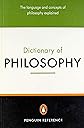
The Penguin Dictionary of Philosophy (Penguin Reference)
Product ID: 12496475
📚Extensive philosophical coverage
🧠Clear, accessible definitions
🕰️Spanning 2600+ years of thought
Desertcart purchases this item on your behalf and handles shipping, customs, and support to Mexico.
📖 Unlock the secrets of philosophy—because knowing is the new power move.
The Penguin Dictionary of Philosophy is a definitive, accessible reference book offering clear definitions and incisive overviews of key philosophical terms and thinkers from 600 BC to today. Featuring contributions from over 100 leading philosophers, it bridges classical and contemporary ideas, making it an essential tool for students, professionals, and curious minds alike.
| Best Sellers Rank | #513,230 in Books ( See Top 100 in Books ) #201 in Philosophy Reference (Books) #429 in Philosophy of Logic & Language #731 in Dictionaries (Books) |
| Customer Reviews | 4.6 out of 5 stars 205 Reviews |
T**R
Dictionary of Philosophy, edited by Thomas Mautner. Second edition, 2005.
Is (German) 'Geist' a 'mass noun'? Yes, for the world-spirit is without plural. No, for there are many languages naming it. An 'insolubile'? If we use English to translate the German, we can say 'Geist' is mind, but 'Geister' – the plural as in Kant's title on the '...Geisterseher...' or Spirits-Seer (Swedenborg) – stands for ghosts leaving (English) 'spirit' – more mental than the German equivalent. Other occurrences of 'paradox' are found in articles on antinomy ('near-synonym' to 'paradox'), on Jean-Paul Sartre ('playful paradox'). What is philosophy? is itself a philosophical question, and this 'autological' quality is shared by both, philosophy and language. But philosophy is less important than its practice, doing philosophy, or philosophizing. Judged by how close a wordbook brings us to this activity Dictionary of Philosophy, edited by Thomas Mautner (second edition, 2005; formerly 'The Blackwell Dictionary of Philosophy', 1996; 'The Penguin Dictionary of Philosophy', 1997) is the most philosophical currently available. It is also still the most comprehensive single volume small format manual on the subject in English. Dictionary of Philosophy is excellent on relativism, on logic ('iff'), often on cross-language comparisons ('right'; 'apperception'), as well as on the classical languages ('predicables'; 'rhetoric'), and on semantic change over time. It includes multiple tables and figures. Let me tell you, this handy book has a wealth of epiphanic experience(s) in store, an abundance of detail and literature on 664 + xxiv pages, small print. I would situate it in humanities philosophy (cf. also: 'antihumanism') as distinguished from philosophy understood as (a) social (meta-)science. This includes a good amount of language criticism – e. g. '-ism, -ist'; 'philosophy of...'. Dictionary of Philosophy is a five star enterprise. I'd purchase a new edition – (Edwards's) Encyclopedia of Philosophy got one. Gosh, that 'perennial intellectual magnetism' (William Gerber) – of words!
I**E
Very informative
Helps decipher meanings of words when reading essays or books about past philosophers
F**A
Great Dictionary for Philosophy
I have the Oxford Dictionary of Philosophy and it is falls seriously short of what the Penguin contains. If you get one dictionary for Philosophy, I recommend the Penguin.
K**S
Easy to understand
I bought this as a supplement to teach English Lit and have been extremely happy. It allows me to answer into-level philosophy questions without bringing out this big books!
B**T
Solid and Accessible
A nice addition to three other such dictionaries. Definitions that I have reviewed so far seem good and accessible. I particularly like the items that allow living philosophers to describe their own projects.
A**E
Must have
Without a doubt the handiest book for a student of philosophy.
L**.
Simply the best for non-professionals
I own three dictionaries of philosophy, but the Penguin Reference Dictionary of Philosophy has become my go-to guide. Its extensive entries are neither simplistic nor overbearing for the non-professional interested in topical summaries concerning individuals, systems, and terms commonly encountered in the study of philosophy. Highly recommended.
L**R
good
very helpful.good price
B**O
Perfecto
Producto que me fascina. Espero poder comprarlo de nuevo muy pronto como regalo en esa ocasión. Me llegó muy pronto. Quedé muy satisfecho.
C**S
Excellent resource for philosophy.
This really is a great resource for almost any given term or philosopher you can think of. It is set out like a normal word dictionary but with more detail given to each term, subject, or philosopher. Some definitions range from a few paragraphs, and others cover a few pages. It's all done in concise, detailed, bite-size chunks, that are perfect for quick consumption. It's a great value philosophy book, that isn't short on details / definitions, so I really can't recommend it enough.
M**A
molto buono, del resto la casa editrice è una garanzia
dizionario di consultazione, molto utile da tenere vicino al tavolo di lavoro, quasi veloce come web, ma distrae di meno, quindi consigliato
B**R
コスパ最強のハンディ哲学辞典
コンパクトにして網羅性も十分です。各用語の説明、英文の質が良い。哲学畑の英文読解力をつけるのに本書はコストパフォーマンスが高い。
M**T
The Penguin Dictionary of Philosophy
Ce dictionnaire Penguin de philosophie est excellent et tout à fait comparable aux "gros dictionnaires" d'Oxford ou de Cambridge. Les articles sont très clairs, très bien rédigés et agréables à lire. D'un contenu très riche, très complet, tant en ce qui concerne les concepts, que les auteurs, les écoles de pensée et les interprétations. C'est un très bon instrument de travail, pour acquérir ou réviser des connaissances. (Un rapport qualité/prix exceptionnel).
Trustpilot
2 weeks ago
3 days ago