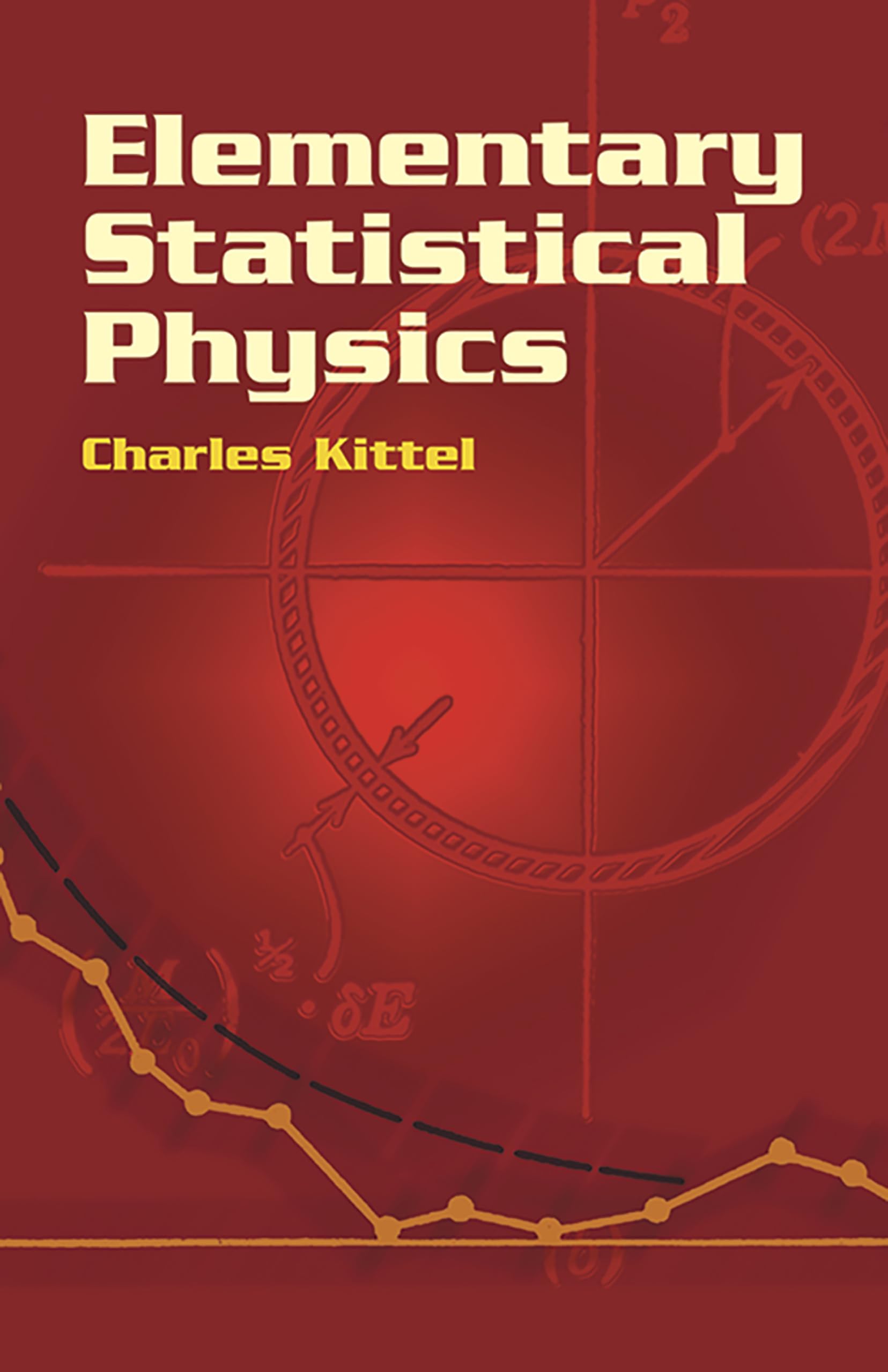
Elementary Statistical Physics (Dover Books on Physics)
Product ID: 14076198
Desertcart purchases this item on your behalf and handles shipping, customs, and support to Mexico.
Noteworthy for the philosophical subtlety of its foundations and the elegance of its problem-solving methods, statistical mechanics can be employed in a broad range of applications — among them, astrophysics, biology, chemistry, nuclear and solid state physics, communications engineering, metallurgy, and mathematics. Geared toward graduate students in physics, this text covers such important topics as stochastic processes and transport theory in order to provide students with a working knowledge of statistical mechanics. To explain the fundamentals of his subject, the author uses the method of ensembles developed by J. Willard Gibbs. Topics include the properties of the Fermi-Dirac and Bose-Einstein distributions; the interrelated subjects of fluctuations, thermal noise, and Brownian movement; and the thermodynamics of irreversible processes. Negative temperature, magnetic energy, density matrix methods, and the Kramers-Kronig causality relations are treated briefly. Most sections include illustrative problems. Appendix. 28 figures. 1 table. Review: Very comprehensive and useful - This book is a little gem: it offers a complete course in Statistical Mechanics all the way from Hamiltonian dynamics to the Fokker-Planck equation in 240 pages. All the classical examples in both classical and quantum statistical mechanics can be found in the text, presented in a very thorough manner (although not "for dummies"). Most of the calculational steps are presented; even a review of Fourier transforms is presented before entering the topics of noise and fluctuations, and there is also an appendix on the method of steepest descent. The way the chapters are organized, one small chapter per subject--there are 45 such chapters--makes the text suited for self-study: one chapter per day keeps flunking away! There are exercises scattered throughout the chapters, but not many: some chapters have none, some chapters have as much as 7-8, while most chapters have 1-3 exercises. They are all very pertinent and doable; do not miss them, as well as the "Examples" worked out by the author. All in all a very good textbook for a low price. Review: The physics is correct. - The physics described in this book is succinct and correct.
| Best Sellers Rank | #1,443,495 in Books ( See Top 100 in Books ) #1,889 in Physics (Books) |
| Customer Reviews | 4.5 out of 5 stars 41 Reviews |
J**A
Very comprehensive and useful
This book is a little gem: it offers a complete course in Statistical Mechanics all the way from Hamiltonian dynamics to the Fokker-Planck equation in 240 pages. All the classical examples in both classical and quantum statistical mechanics can be found in the text, presented in a very thorough manner (although not "for dummies"). Most of the calculational steps are presented; even a review of Fourier transforms is presented before entering the topics of noise and fluctuations, and there is also an appendix on the method of steepest descent. The way the chapters are organized, one small chapter per subject--there are 45 such chapters--makes the text suited for self-study: one chapter per day keeps flunking away! There are exercises scattered throughout the chapters, but not many: some chapters have none, some chapters have as much as 7-8, while most chapters have 1-3 exercises. They are all very pertinent and doable; do not miss them, as well as the "Examples" worked out by the author. All in all a very good textbook for a low price.
A**R
The physics is correct.
The physics described in this book is succinct and correct.
B**Y
Classic author - Kittel - is himself a fan another classic author i.e. Tolman.
The text is well written in reader friendly language. From the 1st chapter itself you'll get the idea that the author himself is great fan of Tolman's Stat. Mech., since he uses the latter's book words by giving honourable credit. Within just 250 pages, the author does a pretty good job in explaining you the concepts backed by the classic examples of ideal gas and ising spins. Useful exercises are there in some of the sections/chapters. I guess, the reader would be pleased on reading this classic lovely text by Charles Kittel.
C**E
A classic text
A dated classic, but still a clear introduction to elementary statistical physics.
A**R
Five Stars
Very Good book!
R**C
Good.
It is a great introduction to the subject.
D**P
Too Old Fashioned with Too Many Indices
The treatment uses notation which is hard for me to read. The treatment of the subject could have been clearer. Some good derivations here and there but spotty in general.
J**D
An Excellent Supplement. Not an Introduction.
Kittel is the author of several very standard works on solid state physics, a field in which he taught and did research for many years. At some point in his career, he was asked to teach a beginning graduate course in statistical mechanics at Berkeley. This book grew out of that class. Almost as soon as I started reading this book, I got the strong impression that Professor Kittel had basically decided to use this class as an opportunity to teach his students everything he thought his solid state students should already know about statistical mechanics, but apparently didn't. The result - this book - is a brain dump, but in a good way. The topics are frequently pretty elementary, but the treatment isn't. Instead this book has some of the most elegant derivations of basic results I have yet to see. Curiously, it also has a couple of perplexingly circuitous ones as well. The first half is dedicated to truly elementary topics. The treatment is entirely Gibbsian. Besides offering a number of elegant derivations, this book offers the best discussion of the two conventions used for internal energy for magnetic systems I have seen. I refer back to it often as similar considerations apply to other types of systems as well. Most of the chapters in this part require some familiarity with quantum mechanics. A few of the sections require more detailed knowledge, but really your basic quantum mechanics should be pretty decent before you crack open this book. Part two is devoted to fluctuations. We get the Weiner-Khinchin theorem, the Fokker-Plank equation, Onsanger Reciprocity, and the Principle of Minimum Entropy Production. All this in less than fifty pages. The final part is devoted to kinetic methods and transport theory. This includes a chapter on Karmers-Kronig Relations. Here, Kittel actually comes out and says this really isn't statistical mechanics per se, but physics student need to see it somewhere. This book should not be the first time you have seen the majority of this material. It is not an introduction, but it is an extremely valuable supplement that repays repeated reading. There are a fair number of exercises to help you test your understanding as you go - or as you come back. For preparation, I would recommend reading at least The Principles of Statistical Mechanics (Dover Books on Physics) , Noise and Fluctuations: An Introduction (Dover Books on Physics) and Classical Mechanics (3rd Edition) first.
F**N
Kittel: Elementary Statistical Physics
A classic text at introductory level. Ideal for 2nd year physics undergraduates who have already had a first course in thermodynamics. The foundations are developed using Gibbs ensembles within the framework of classical mechanics, but quantum statistical mechanics is also introduced, and most of the usual applications are covered in detail. The book is written with great pedagogical skill, and the Dover reprint of the 1958 Wiley original has been very well done.
S**N
Concise but intelligible Introduction to Statistical Mechanics
This little gem of a book provides a concise and very readable introduction to statistical mechanics. While the review of classical mechanics is too short to be of any use, the subsequent chapters on systems and ensembles, microcanonical ensemble, entropy and canonical ensemble show clearly the assumptions and the construction of the theory. In the second part the book offers a glimpse of the irreversible thermodynamics. Particularly helpful are chapters on random processes, Brownian motion and Nyquist theorem. These short chapters on random processes were the original reason I bought this book following the endorsement in Modern Classical Physics by Throrne and Blandford and I wish now I had this book during my studies. For a university student this book is too short and might seem a little outdated in particular in treatments of quantum gases and magnetism. I would accompany it by Statistical Mechanics by Schwabl which uses Quantum Mechanics from the beginning and Renormalization Methods by McComb which explains wonderfully critical phenomena and renormalization group methods.
V**O
libro compatto
Non mi ha fatto impazzire, trattazione poco sistematica. In ogni caso è molto compatto e contiene molte discussioni utili sulla meccanica statistica.
及**幸
わかりやすい統計物理の本
統計物理の数学的な面では、あまり固執したところがなく物理的な面を強調しているのでわかりやすい。 とはいえ、物理数学的に学部で学ぶ内容は必要だと思います。統計物理の基本を書いてある本としては 貴重な本だと思います。ただ参考文献が最新ではないことは考慮すべきでしょう。
W**A
Content and cover are not related
Unfortunatelly the book I bought has the cover of Kittel,s one and the content of Bertrand Russel’s introduction of Mathematical Philosophy.
Trustpilot
5 days ago
3 weeks ago