📖 Unlock the power of political philosophy—because leaders read Aristotle.
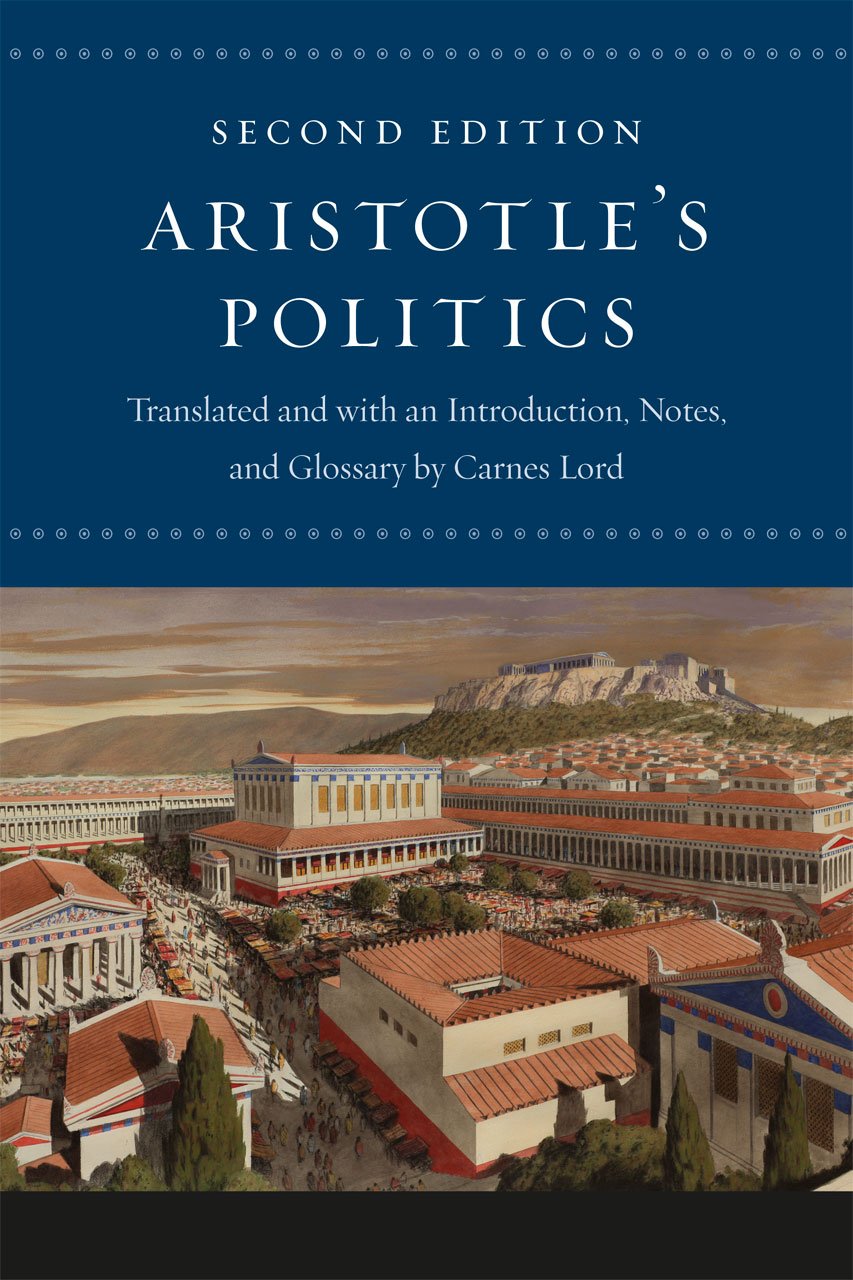
Aristotle's 'Politics': Second Edition, edited by Carnes Lord, is a highly regarded used book offering timeless insights into political theory. With a strong 4.7-star rating from 387 readers and a solid position among philosophy bestsellers, this edition combines scholarly rigor with accessible pricing and free delivery options, making it an essential addition for professionals seeking intellectual edge.


| Best Sellers Rank | 448,739 in Books ( See Top 100 in Books ) 10,089 in Philosophy (Books) 47,739 in History (Books) |
| Customer reviews | 4.7 4.7 out of 5 stars (389) |
| Dimensions | 15.24 x 2.03 x 22.86 cm |
| Edition | 2nd |
| ISBN-10 | 0226921840 |
| ISBN-13 | 978-0226921846 |
| Item weight | 1.05 kg |
| Language | English |
| Print length | 316 pages |
| Publication date | 4 Mar. 2013 |
| Publisher | University of Chicago Press |
A**R
Readers of Aristotle in English now have three very serviceable translations of the Politics - this second edition by Carnes Lord, Joe Sachs, and Peter L. Phillips Simpson. Barker's older Oxford translation should also be mentioned although it is not as literal as the others. They all have useful features apart from the translation itself to recommend them over say the Penguin translation. On balance, I would prefer Lord's second edition as he has tightened up translations throughout the work to make them more strictly literal beginning with "community" in place of "partnership" in the very first sentence of the book. Further, he has a very interesting introduction, excellent footnotes and glossary. It has to be said that both Sachs and Simpson have very useful analytical outlines and notes as well. Simpson's English is the most pleasant to read and has student friendly chapter headings and chapter introductions albeit non-authorial of course. The format of Carnes Lord's second edition has been made uniform to its University of Chicago Press twin "Aristotle's Nicomachean Ethics" translated by Robert Bartlett and Susan Collins but, unlike the later, it is without an interpretative essay which would have been most welcome. The natural appendix to the Politics is the Poetics ably translated by Seth Benardete and Michael Davis as "Aristotle On Poetics" under St. Augustine's Press. As of 2013, all three are highly recommendable as the best scholarly translations of these three works. One can only hope some enterprising scholar will now provide avid Aristotelians with a literal translation of Aristotle's "Rhetoric" to complete the series of his "philosophy of things human". [N.B.: This has now been done with Robert C. Bartlett's translation, "Aristotle's Art of Rhetoric".] As an addendum, the student of "Aristotle's Politics" would find in "Aristotle's Teaching in the Politics" by Thomas Pangle a good companion interpretation.
C**Y
Excellent.
R**N
The typeface is a bit small but I suppose that were it otherwise the book would be inconveniently bulky. The item was a gift for someone else; he thinks the editor/translator have done a good job.
C**.
my son is very happy to have his text for his class - thank you so much!
A**N
I initially read Sir Ernest Barker's translation of Aristotle's Politics in 1965. The present edition by Carnes Lord includes an excellent translation and introduction with helpful endnotes regarding the meaning of important Greek terms, relevant ancient history, alternative translations, and variations in the manuscript sources. As for Aristotle's work itself, one finds many objectionable things (slavery, the inferior role of women typical of ancient Athenian society, the also typical incorporation of the religious priesthood into the government of the polis, the limitations of citizenship, and so forth) as well as some important insights. Ever the empiricist, Aristotle discusses at great length the many varieties of government that the Greeks and others had created during and before his era. All in all, it is quite a puzzling picture for us denizens of the twenty-first century. The five-star rating is for the editorial and translation work of the subject edition. It is impossible to rate Aristotle himself, but the fact that his work has survived for more than two millennia is itself an indication that we can still learn from him, even while disagreeing with some of his apparent teachings. In this connection, no less a democrat than Thomas Jefferson wrote, with regard to the Declaration of Independence (which he substantially authored), that "[a]ll its authority rests then on the harmonizing sentiments of the day, whether expressed in conversation, in letters, printed essays, or in the elementary books of public right, as Aristotle, Cicero, Locke, Sidney, &c." Thomas Jefferson to Henry Lee, May 8, 1825, in Thomas Jefferson: Writings, ed. Merrill D. Peterson (New York: Library of America, 1984), 1501. Many historians and political scientists also attribute certain aspects of the U.S. Constitution (especially the mixed nature of the republican framework) to Aristotle's Politics. Aristotle is not the last word, but his contribution to political philosophy should not be ignored. As another reviewer mentioned, the translation by Joe Sachs is also very good, though I have not read the entirety of it.
Trustpilot
3 weeks ago
2 months ago