We remain fully operational. Our teams are working around the clock to ensure your deliveries continue safely.

DOWNLOAD THE APP


Customer Services
Copyright © 2025 Desertcart Holdings Limited
DOWNLOAD THE APP
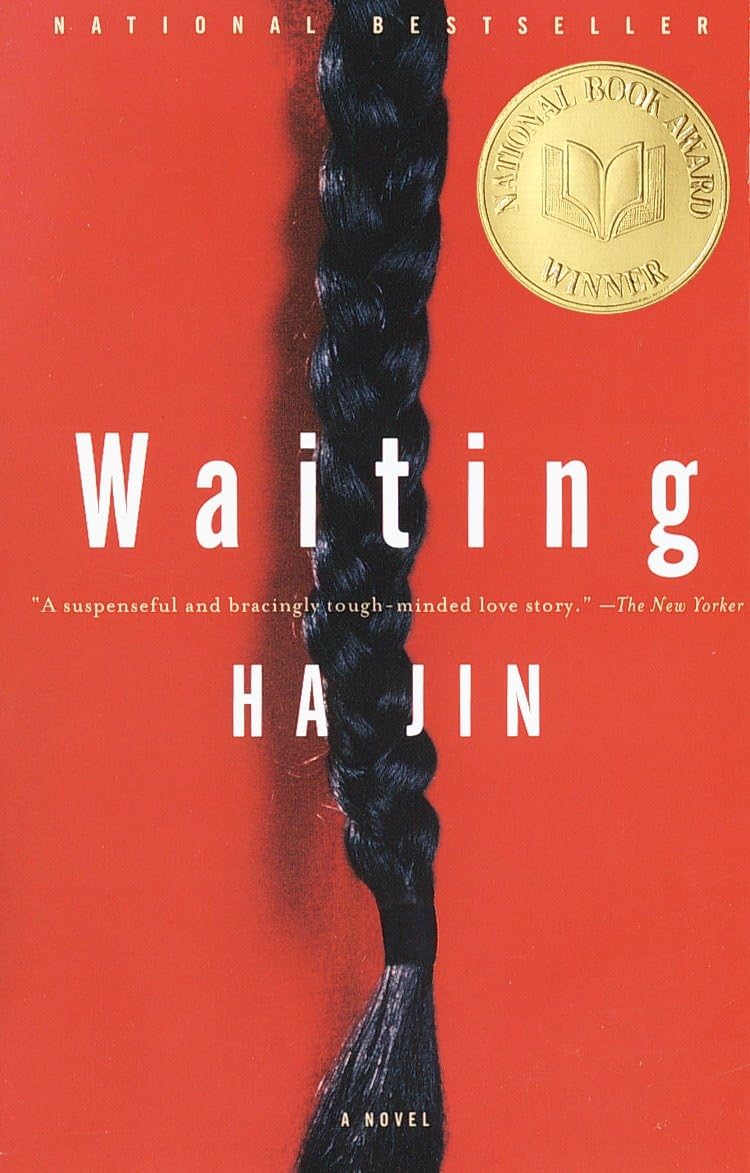
⏳ Unlock a timeless tale of love, duty, and cultural clash — don’t get left waiting!
Waiting: A Novel by Ha Jin is a critically acclaimed literary work set against the backdrop of China’s Cultural Revolution. It tells the slow, emotionally charged story of an army doctor caught between traditional obligations and forbidden love, offering readers a deeply immersive experience into a complex cultural and historical landscape.


| Best Sellers Rank | #231,368 in Books ( See Top 100 in Books ) #1,703 in Contemporary Literature & Fiction #8,730 in Literary Fiction (Books) #10,452 in American Literature (Books) |
| Customer Reviews | 3.9 out of 5 stars 1,000 Reviews |
A**R
Waiting for the rest of his life to begin �
This is one of these rare books that through reading you enter a whole different world with very different rules. It is an exceptionally well-written novel, with a great deal of details on life during and after the years of the Chinese Cultural Revolution. This is a work of creativity and sensitivity. It is the story of an army doctor, a man who worked his way out of an essentially peasant background through the help of his family. As tradition in China dictates, he needed to take a wife to care for his aging parents. An arranged marriage addresses the problem of the care of the elderly superbly but leaves him totally unfulfilled. Ha Jin portrays a sensitive, caring, weak and often frightened man, who is a victim of events and insecurities; and an ignorant loving peasant wife who accepts what the husbands offers and does not ask for more. As a reader you are tortured by the couple's blind adherence to custom. The main couple in the story though is the Doctor and the nurse girl friend. Unable to consummate their love they wait and wait and wait. Here you are more tormented by their total adherence to army and Cultural Revolution rules, mandates and norms, which are often at odds with the traditional Chinese culture. So here you have our great army doctor obliged to the wife through traditional values with no complaints, unable to marry the girl friend, but also due to army rules he's unable to have an affair with her and unable to divorce the peasant wife. Ha Jin's Waiting takes us to a whole different world, every time you pick it up, you travel across cultural and time zones; first to China and then on to the Cultural Revolution days. This is a truly wonderful work, not a novel of fast paced events; the main character is portrayed in very realistic terms, not necessarily sympathetically. For me I appreciated the slow, meandering movement of events, it made it far more realistic and transformed me totally to this fascinating culture at its most peculiar of times. Enjoy!
M**T
Requires patience
This is the second time I read this book. The first time, I totally dismissed it as boring. This time, I had more time and perhaps more patience. This book requires patience. It's slow, somewhat repetitious, yet interesting. The culture of China during the 1960-70's is more than just a backdrop to the story. The affects of the Cultural Revolution and the overwhelming philosophy of control so shape the main character that he is unable to come to grips with who he really is. He is a doctor, a brother, a husband, a father, a government worker, and those roles always determine what he thinks and who he is. He almost never contradicts what he thinks is expected of him; his life is always determined by others especially others who are the least personally involved in his life. His respect and feelings for his boss, his roommates, his professional acquaintances is stronger than his respect or feelings of his wife and the "other woman". Only his daughter can cause some kind of emotional reaction in him. Lin is a person who is entirely shaped by others, what people think and how they react to him. Everything is analyzed; nothing is felt. The wife, Shuyu, is almost unbelievably complacent, but again, that's the role that the culture assigned her. Manna, the woman who waits eighteen year to finally marry him, shows the most independent emotion, but she also is so restricted by the culture. This is a sad book in many ways. Lin thinks at one point: "How we're each sequestered in our own suffering" His life is an example of unintended selfishness; he simply knows no other way to be. He has no ability to emotionally connect with those who should be closest to him. It is so subtly sad that it is humorous at times. The deception and posturing of the characters is so exaggerated in places that it is laughable. Laughable to us in modern American; seriously repressive to those lives we see in this novel. The writing is beautifully done; the reader can almost feel the chill which seems to pervade the buildings and the air itself. It is a dreary and lifeless environment. The buildings are functional, concrete, where a few cuttings of red paper on the window can create a "festive" feel. Lin, in his effort to be perfect, simply forgets to live. He was "certain ..between love and peace of mind he would choose the later. He would prefer a peaceful home." Just too bad that love and relationships have to mess it all up. If you want an exciting read, this isn't it, but if you want to meet a man who is the exact opposite of Zorba, the Greek, come meet Lin Kong.
R**D
The title says it all
I really struggled with this book and I can’t tell if it’s a testament to the effectiveness of the storytelling or just a bad book. It is a tedious read. And I found it difficult to like any of the characters. But I have the sense that this was the authors aim, and if that’s the case it’s brilliantly executed. I mean, the title is called “waiting” and that’s precisely what it feels like to read it: you’re just waiting for something interesting to happen, or a character to actually do something. About 3/4 into the book I just set it down and I have yet to pick it up again, but my plan is to finish it and try to understand what made it worthy of its awards. Maybe it will become a work I ultimately appreciate. In the meantime…yuck.
G**R
Authentic, simple without being simplistic, fine and purposeful storytelling
This was the first book of Ha Jin's that I have read and it won't be the last. One really feels transported to northeastern, "revolutionary" China - specifically to the ways of a small village and a medium-sized town, and the distinctive atmosphere and social types of those places, especially in the 1960s but even up to the 1980s. Along with telling a highly engaging story, he has a gift for describing nature, from insects and birds to trees and the weather. And the story, while making some social commentary such as portrayal of Geng Yeng who would seem to represent the type of unprincipled, egotistic, and ruthless person who could run a factory in modern China, is really more about love. Love, spoken and unspoken, lustful or duty-bound, hidden or open, for appearance-sake or genuine, within the family and outside the family, for an individual's desire or socially useful. When things are at their most complicated, Lin Kong, the main character, reflects how what he really wants is just a peaceful domestic life. All the while, what makes the book most interesting is the ever-present background of communist China and its social mores and rules. For example, one must have approval to leave the countryside to live in the city, approval of your bosses to divorce etc. The book is a work of art in every way and highly recommended!
D**H
"How many years do you have in your life?"
One of the few extravagant touches in this plain-spoken, calmly narrated novel is its attention-grabbing opening line (''Every summer Lin Kong returned to Goose Village to divorce his wife, Shuyu.''). For nearly two decades, Lin has been trying to get his long-suffering wife to agree to a divorce so he can marry his coworker, Manna Wu, but Shuyu always changes her mind at the last minute, for one reason or another (usually under pressure from her meddlesome brother). Eighteen years of separation are required by law before Lin can be granted a divorce without his wife's consent, and the novel opens just prior to the end of this long delay. "Come on, next year I'll divorce her, whether she agrees or not. Let's just wait another year, all right?" "Another year?" Her voice turned rather shrill. "How many years do you have in your life?" This humorous beginning launches Ha Jin's reflective meditation on the nature of love and the lengths (chronological and emotional) that lovers go through to fulfill it. Many things other than the patience required by a wait of eighteen long years complicate the couple's journey: Lin's feelings toward his first wife, while not passionate, are hardly opprobrious; he is nearly a stranger to his only daughter; Manna Wu, a single and otherwise available woman, must suffer the reputation of a spinster and the aggressive advances of powerful men; and, most fascinatingly, every character in some way endures the clash between, on the one hand, "Western" ideas of literature and of divorce and, on the other, Communist ideology and Chinese traditions. Stylistically, "Waiting" is, as its very name implies, a quiet novel, but its simplicity is deceptive: the events and the characters it describes are fully animated. The prose itself is what the word "lyrical" was invented to describe. True--the resolution of the characters myriad affairs is somewhat expected, but the details of this comedy are a pleasure.
S**R
A beautiful portrayal of real life
I agree whole-heartedly with those who loved this book. It is sad that some readers saw so little in it. I believe that maturity is necessary to enable one to appreciate this story. It is about waiting, yes, and how we postpone what we want so often for what we OUGHT to do. But what some reviewers do not acknowledge is the element of choice involved for all characters. Lin CHOOSES not to divorce his wife for many years (he does not press the issue); Manna CHOOSES to wait for Lin; Shuyu CHOOSES to remain married. In the end, the great irony is that in most respects, every character gets what he or she wanted. And no, they do not live "happily ever after." Isn't that life? How many times do our choices turn out to be neither right nor wrong, but rather a mixture of both? Different choices would surely have resulted in different effects, but to what end? Would Shuyu have been happier if she had agreed to a divorce in the first place? Would Manna have been happier had she left Lin and married another? Would Lin have been happier had he remained in the country, or had he been able to marry Manna when they were young and so much in love? I think not. One way to view this story is that it has a happy ending. It is not a fairy tale, but a story of real people who make real choices and learn to live with them. If you're over the age of 35, you will surely see yourself at some point in this story. What a marvelous novel!
R**.
Aptly titled
. . . because what this book does is keep the reader waiting, and for a less than satisfying ending. It was difficult to sort out what aspects of the characters had to do with their culture and what was just a matter of weak personalities. In any case, it was difficult to feel empathy for them.
A**!
I Finished the Book and am Still Waiting!
This book was chosen for our book club to read, and I was looking forward to reading it as I love to learn about other cultures. Sadly this book was a huge disappointment. The characters were mostly unlikeable, the story slow and meandering and the world they lived in (Communist China) was not well illustrated. I guess I could have given the author a pass on all of that if the book came to some sort of conclusion, but ... nope. I think the title is very apt -- I was kept waiting throughout the book for something to happen. I am done with the book, and am still waiting. I am not even sure what the author was trying to convey. Skip this book and read The Good Earth by Pearl S. Buck.
Trustpilot
3 weeks ago
1 month ago