

🔌 Control with Confidence: Power your projects with precision and durability!
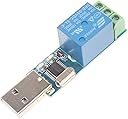
The NOYITO 1-Channel USB Relay Module is a compact, high-performance switch designed for professional-grade USB-controlled automation. Featuring a robust 10A relay capable of switching up to 250VAC or 30VDC, it integrates a CH340 USB controller chip for easy serial communication at 9600bps. Built to endure 100,000 relay cycles, it includes essential safety protections like overcurrent and freewheeling diode safeguards. Ideal for developers and tech-savvy professionals, this module offers reliable, programmable control for smart devices and custom projects, backed by a one-year warranty.
| ASIN | B081RLY4T8 |
| Best Sellers Rank | #2,606 in Single Board Computers (Computers & Accessories) |
| Brand | NOYITO |
| Brand Name | NOYITO |
| Coil Voltage | 5 Volts |
| Connector Type | Usb |
| Contact Current Rating | 10 Amps |
| Contact Material | Silver |
| Contact Type | Normally Closed |
| Current Rating | 10 Amps |
| Customer Reviews | 3.7 out of 5 stars 18 Reviews |
| Item Height | 15 millimeters |
| Manufacturer | NOYITO |
| Maximum Switching Current | 10 Amps |
| Maximum Switching Voltage | 250 Volts (AC) |
| Minimum Switching Voltage | 30 Volts (DC) |
| Mounting Type | Surface Mount |
| Number of Terminals | 3 |
| Operation Mode | Automatic |
| UPC | 680613663627 |
| Unit Count | 1.0 Count |
| Warranty Description | Manufacturer's One-year After-sale Warranty |
| Wattage | 2500 watts |
R**C
Exactly what I needed!
This is a Relay that you can control over USB. I purchased this to make a "smart" plug that I can control from software for a personal project. Read the description, the seller tells you everything you need to know to control this device. You'll need a driver to make the USB device show up as a serial port. Once that's there, you can either use a serial debugger to test it out, or write half a dozen lines of code to send the on/off commands over the serial port. It looks like we've got a relay, a arduino USB contoller, and a IC that turns the relay on and off in a convenient package. Well-made and no complaints!
J**Y
Works, flaws
First off, follow the CH340 drivers install help webpage documentation from sparkfun, and you must not forget the step to uninstall existing drivers. And these are (I think) unsigned drivers from a chinese company, for those concerned with IT security. To cut costs, they did not use the effectively universal FTDI chips, with drivers already installed in all OSes for the last 10 years. Secondly, don't overlook that the command example is hex bytes, as they say several times in the product description. How you send them from a terminal program for testing depends on that program.
S**B
UNSTABLE Relay, 2 Different Computers with Trial.
I created a very simple linux script: while [ 1 ]; do echo "starting test now" `date`; echo -en "\xa0\x01\x01\xa2" > /dev/ttyUSB0; sleep 3; echo "starting test now 2" `date`; echo -en "\xa0\x01\x00\xa1" > /dev/ttyUSB0; sleep 3; done All the script did was to toggle the relay every 3 seconds. It would toggle about 4 or 5 times and freeze up. I would then run the command stty -F /dev/ttyUSB0 speed 9600 baud; line = 0; -brkint -imaxbel But... other times at random it would respond with: stty -F /dev/ttyUSB0 speed 9600 baud; line = 0; -brkint -imaxbel Sorry, but this relay IS TOTALLY UNSTABLE. I tried it on Linux Mint X64 and Rasberry Pi Zero. 2 Different operating systems and hardward. It relay would freeze up for no real reason.
S**S
C# code sample below - no idea how long this device will work, just bought it
//made on a C# windows forms app, forgive the sloppy nature- just wanted to hear it click //added NuGet package in Visual Studio for System.IO.Ports (right click solution, manage NuGet Packages for solution, browse) //made 2 buttons - open and close relay //get your COM port from device manager after you plug it in // myPort.Write(new byte[] { 0xA0, 0x01, 0x01, 0xA2 }, 0, 4); -- OPEN // myPort.Write(new byte[] { 0xA0, 0x01, 0x00, 0xA1 }, 0, 4); --CLOSE ---------------------------------------------------------------------------------------------------------------------- using System; using System.Drawing.Text; using System.IO.Ports; namespace SingleChannelNoyitoTest { public partial class Form1 : Form { public static SerialPort myPort = new SerialPort("COM3", 9600, Parity.None, 8, StopBits.One); public Form1() { InitializeComponent(); } private void Form1_Load(object sender, EventArgs e) { } private void btnCloseRelay_Click(object sender, EventArgs e) { myPort.Open(); myPort.Write(new byte[] { 0xA0, 0x01, 0x00, 0xA1 }, 0, 4); myPort.Close(); } private void btnOpen_Click(object sender, EventArgs e) { myPort.Open(); myPort.Write(new byte[] { 0xA0, 0x01, 0x01, 0xA2 }, 0, 4); myPort.Close(); } } }
S**N
Relay stops being responsive with everyday use
I bought a couple of these for a project I was working on, involving a small automated lock, and while they were easy to use and initially did what I wanted, none of them lasted more than a couple of weeks before they stopped consistently working. I was setting them open/close through powershell, and inevitably they start ignoring the code occasionally and they only get worse over time. Not a good long term board. Will be looking for a beefier version or more stable alternative.
F**H
Works as advertised; noisier than others, could be enclosed.
This does exactly what it says it will do; I had to find a driver (search for CH340 drivers) for Windows 10, but Windows 11 seemed to recognize it immediately. It would be nice to have the option for an enclosure, or a link to a project kit that would enclose this. The switch itself is also noisier than the other switch I tested. The product description gives you what you need to control this relay; I'm including an image from the relay controller program I wrote in C# that gives an overview of how to build the byte string to output to the port to turn on/off (rather close/open) the switch.
C**N
PLEASE DONT GET IT
Tested with three different computers. Pain in the neck to operate from any OS or coding language. After a few weeks I started having to send the same command over 40 times just to get it to turn off.
Trustpilot
1 month ago
1 day ago