We remain fully operational. Our teams are working around the clock to ensure your deliveries continue safely.

DOWNLOAD THE APP


Customer Services
Copyright © 2025 Desertcart Holdings Limited
DOWNLOAD THE APP
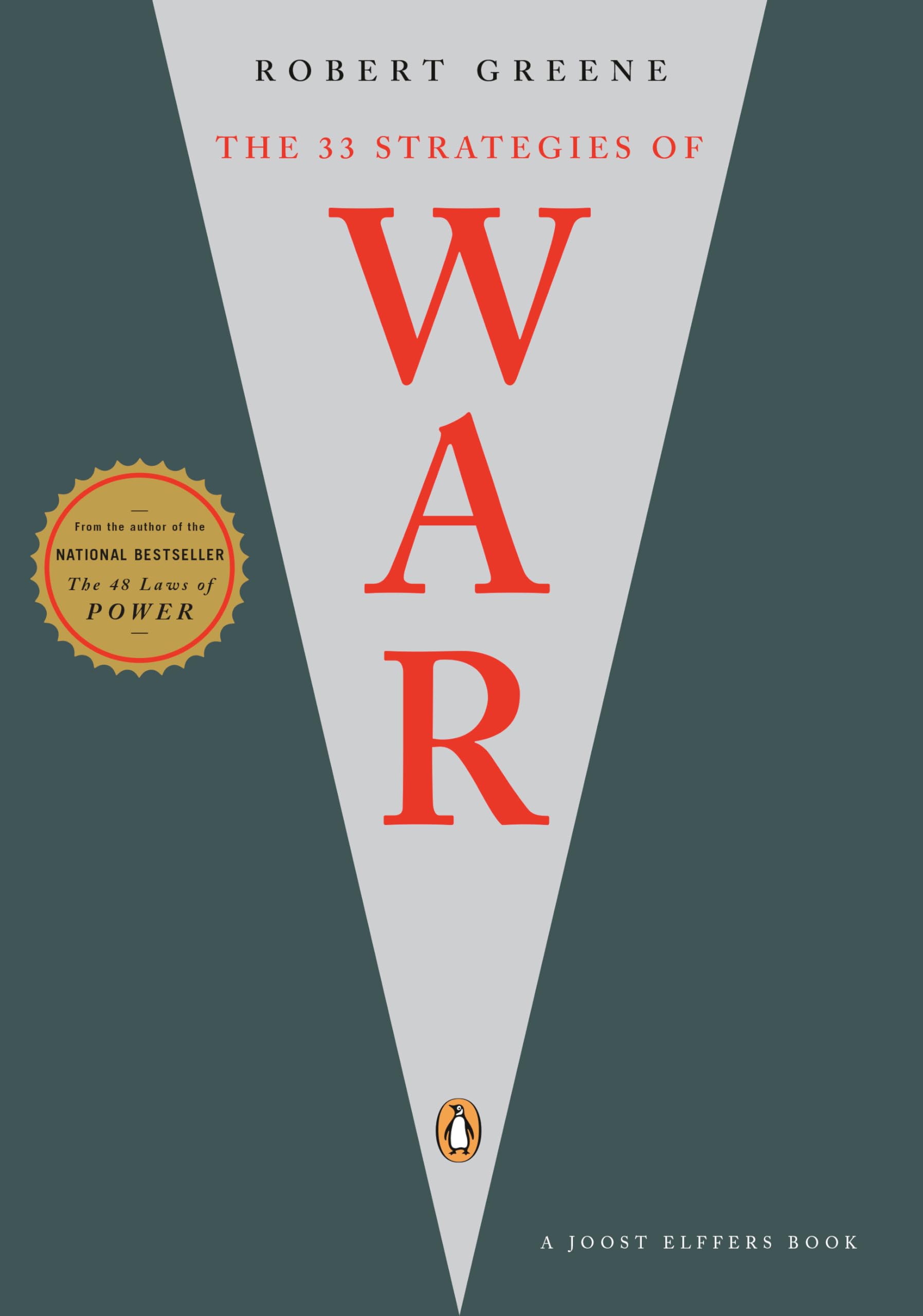
The 33 Strategies of War (Joost Elffers Books) [Robert Greene] on desertcart.com. *FREE* shipping on qualifying offers. The 33 Strategies of War (Joost Elffers Books) Review: A History of Military Strategy, Philosophy Applied to Our Daily Lives and the Battles We Face - Believe it or not, this was my introduction to Robert Greene. After reading this book, I bought The 48 Laws of Power, The Laws of Human Nature, and I'm now reading Mastery. He is one of the most insightful, eloquent writers that I have ever read. Robert Greene has a unique gift. He makes history, philosophy and human psychology and war feel like a manual you can use. That is what really blew me away while reading this book. There are so many insightful lines in 33 Strategies of War that I almost had to create a highlighting rubric, a criteria of what lines I was going to highlight for fear that the entire book from front to back was going to be yellow. That's almost not an exaggeration. This is pragmatic philosophy, wisdom from the battlefield. Ideas from ancient to modern warfare that to can turn into practice in the 21st century. Drawn from military genius of men such as Sun Tzu and Napoleon. This is about war translated to life. The timeless patterns of power and resistance played out in business, politics and interpersonal relationships. How to wage psychological warfare when facing injustice in your personal life or dealing with bad leadership in your career. Robert Greene's research is meticulous. His writing is second to no one. His insights are superb. This is not light reading. But it is compelling and he draws you in so effortlessly that a big that you might think would be like reading a heavy tome, once you start you realize that it's a page turner. Review: A modern-day classic of war strategy - This superlative book begins with a Table of Contents section that includes the chapter title and a portion of the chapter overview. This section provides a nice preview and, for later, an excellent refresher/reference. See the online “Look Inside” of the paperback version for this interesting and important overview. The Preface includes six fundamental ideals for transforming oneself into a strategic warrior in daily life: 1. Look at things as they are, not as your emotions color them. 2. Judge people by their actions. 3. Depend upon your own arms (mind/intelligence). 4. Worship Athena (goddess of strategic warfare/intelligence), not Ares (god of war). 5. Elevate yourself above the battlefield (focus on long-term objectives). 6. Spiritualize your warfare (challenge and improve yourself). General description of the book: There is one chapter for each of the 33 strategies, with no summary at the end. Each chapter is a collection of stories/examples of the discussed strategy in the way of extended quotes from other books, interspersed with shorter stories/quotes. Then comes an image in the form of a strategic thought with words filling a creative outline of the concept described. Then comes an “Authority” quote from a historic figure. Finally, there comes a “reversal” (counter or antidote to the strategy described). Surprisingly, there is no summary at the end of the book. Many of the strategies (“plans to gain an objective/win”) are stratagems (“artifices or tricks in war for deceiving and outwitting the enemy”). Some of the strategies are truly Machiavellian (amoral). However, the author neglects to emphasize that such strategies only work in the short term. The enemy learns. As well, your cohorts or allies also learn you are not to be trusted. A good bit of advice about character and virtue from Abraham Lincoln: “You can fool some of the people all of the time and all of the people some of the time, but you can’t fool all of the people all of the time.” Should the author ever wish to revise his book, here are a couple of items I would recommend he address: P 220 Sun-Tzu “4th century BC.” However, Sun-Tzu is claimed to have lived in the 6th century to the 5th century BC (544-496 BC). Page 231 “Next time you launch a campaign, try an experiment: do not think about either your solid goals or your wishful dreams, and do not plan out your strategy on paper. … Dreaming first of what you want and then trying to find the means to reach it is a recipe for exhaustion, waste, and defeat.” OTOH, this flies in the face of recommendations from many experts: First, determine your goal, then brainstorm for solutions, then evaluate your alternatives. At the end, if your effort provides no good path to your goal, consider adjusting your goal. P 316 “The North Vietnamese, meanwhile, did everything they could to win the peasants over and earned for themselves an army of millions of silent sympathizers.” The North Vietnamese Army and the Viet Cong intimidated and murdered the peasants as well. P 550 “…had it [the US] continued its march all the way to Baghdad in 1991, it could have forced Saddam Hussein out of office as a condition of peace, preventing a future war and saving countless lives.” Though the book was written in 2006, this option was and still is highly debatable. Mistakes were made both to how the Iraq I war (aka Gulf War, 1990-1991) started and ended, allowing Saddam to kill the Kurds in northern Iraq. In Iraq II (2003-2011), the demand for Saddam to rid himself of Weapons of Mass destruction was essentially forcing him to prove a negative (philosophically impossible). The end of Iraq II shows the US made plenty of mistakes, all of which goes to suggest that strategizing about Iraq was fraught with peril. P 587 Hitler’s “beloved dog, Biondi.” Blondi. P 668 “Tip and run raids by small bands of Cossacks.” Hit and run. “Tip and run” refers to a phrase used in the Second World War to denote a hurried and often indiscriminate air raid when small number of German planes crossed the English Channel and tipped (unloaded) their bombs onto coastal English towns and quickly headed back across the Channel. The above few issues notwithstanding, the book is outstanding. At 933 pages long, it is well-written and documented. Definitely a must-read for anyone interested in strategy! Of possible interest, a book on winning strategies used throughout history by 87 master strategists Strategic Advantage: How to Win in War, Business, and Life


| Best Sellers Rank | #2,852 in Books ( See Top 100 in Books ) #2 in Military Strategy History (Books) #98 in Motivational Self-Help (Books) #102 in Success Self-Help |
| Customer Reviews | 4.8 4.8 out of 5 stars (5,187) |
| Dimensions | 6.5 x 1.11 x 9.19 inches |
| Edition | Reprint |
| ISBN-10 | 0143112783 |
| ISBN-13 | 978-0143112785 |
| Item Weight | 2.31 pounds |
| Language | English |
| Print length | 512 pages |
| Publication date | December 14, 2007 |
| Publisher | Penguin Books |
E**G
A History of Military Strategy, Philosophy Applied to Our Daily Lives and the Battles We Face
Believe it or not, this was my introduction to Robert Greene. After reading this book, I bought The 48 Laws of Power, The Laws of Human Nature, and I'm now reading Mastery. He is one of the most insightful, eloquent writers that I have ever read. Robert Greene has a unique gift. He makes history, philosophy and human psychology and war feel like a manual you can use. That is what really blew me away while reading this book. There are so many insightful lines in 33 Strategies of War that I almost had to create a highlighting rubric, a criteria of what lines I was going to highlight for fear that the entire book from front to back was going to be yellow. That's almost not an exaggeration. This is pragmatic philosophy, wisdom from the battlefield. Ideas from ancient to modern warfare that to can turn into practice in the 21st century. Drawn from military genius of men such as Sun Tzu and Napoleon. This is about war translated to life. The timeless patterns of power and resistance played out in business, politics and interpersonal relationships. How to wage psychological warfare when facing injustice in your personal life or dealing with bad leadership in your career. Robert Greene's research is meticulous. His writing is second to no one. His insights are superb. This is not light reading. But it is compelling and he draws you in so effortlessly that a big that you might think would be like reading a heavy tome, once you start you realize that it's a page turner.
W**R
A modern-day classic of war strategy
This superlative book begins with a Table of Contents section that includes the chapter title and a portion of the chapter overview. This section provides a nice preview and, for later, an excellent refresher/reference. See the online “Look Inside” of the paperback version for this interesting and important overview. The Preface includes six fundamental ideals for transforming oneself into a strategic warrior in daily life: 1. Look at things as they are, not as your emotions color them. 2. Judge people by their actions. 3. Depend upon your own arms (mind/intelligence). 4. Worship Athena (goddess of strategic warfare/intelligence), not Ares (god of war). 5. Elevate yourself above the battlefield (focus on long-term objectives). 6. Spiritualize your warfare (challenge and improve yourself). General description of the book: There is one chapter for each of the 33 strategies, with no summary at the end. Each chapter is a collection of stories/examples of the discussed strategy in the way of extended quotes from other books, interspersed with shorter stories/quotes. Then comes an image in the form of a strategic thought with words filling a creative outline of the concept described. Then comes an “Authority” quote from a historic figure. Finally, there comes a “reversal” (counter or antidote to the strategy described). Surprisingly, there is no summary at the end of the book. Many of the strategies (“plans to gain an objective/win”) are stratagems (“artifices or tricks in war for deceiving and outwitting the enemy”). Some of the strategies are truly Machiavellian (amoral). However, the author neglects to emphasize that such strategies only work in the short term. The enemy learns. As well, your cohorts or allies also learn you are not to be trusted. A good bit of advice about character and virtue from Abraham Lincoln: “You can fool some of the people all of the time and all of the people some of the time, but you can’t fool all of the people all of the time.” Should the author ever wish to revise his book, here are a couple of items I would recommend he address: P 220 Sun-Tzu “4th century BC.” However, Sun-Tzu is claimed to have lived in the 6th century to the 5th century BC (544-496 BC). Page 231 “Next time you launch a campaign, try an experiment: do not think about either your solid goals or your wishful dreams, and do not plan out your strategy on paper. … Dreaming first of what you want and then trying to find the means to reach it is a recipe for exhaustion, waste, and defeat.” OTOH, this flies in the face of recommendations from many experts: First, determine your goal, then brainstorm for solutions, then evaluate your alternatives. At the end, if your effort provides no good path to your goal, consider adjusting your goal. P 316 “The North Vietnamese, meanwhile, did everything they could to win the peasants over and earned for themselves an army of millions of silent sympathizers.” The North Vietnamese Army and the Viet Cong intimidated and murdered the peasants as well. P 550 “…had it [the US] continued its march all the way to Baghdad in 1991, it could have forced Saddam Hussein out of office as a condition of peace, preventing a future war and saving countless lives.” Though the book was written in 2006, this option was and still is highly debatable. Mistakes were made both to how the Iraq I war (aka Gulf War, 1990-1991) started and ended, allowing Saddam to kill the Kurds in northern Iraq. In Iraq II (2003-2011), the demand for Saddam to rid himself of Weapons of Mass destruction was essentially forcing him to prove a negative (philosophically impossible). The end of Iraq II shows the US made plenty of mistakes, all of which goes to suggest that strategizing about Iraq was fraught with peril. P 587 Hitler’s “beloved dog, Biondi.” Blondi. P 668 “Tip and run raids by small bands of Cossacks.” Hit and run. “Tip and run” refers to a phrase used in the Second World War to denote a hurried and often indiscriminate air raid when small number of German planes crossed the English Channel and tipped (unloaded) their bombs onto coastal English towns and quickly headed back across the Channel. The above few issues notwithstanding, the book is outstanding. At 933 pages long, it is well-written and documented. Definitely a must-read for anyone interested in strategy! Of possible interest, a book on winning strategies used throughout history by 87 master strategists Strategic Advantage: How to Win in War, Business, and Life
K**N
Great Read!
Great read! Highly suggest young adults read this book. It will prepare you for the upcoming wars in life. Take your time and read each chapter with intent (don’t gloss over).
T**N
Great book
An excellent read.
B**K
The 33 Strategies of War: A Must-Read for Strategic Thinkers!
"The 33 Strategies of War" by Robert Greene is an insightful exploration of historical military tactics and their application to everyday life and personal challenges. This book offers a unique perspective on strategy, blending lessons from famous military leaders with practical advice for navigating conflicts, both big and small. Greene's writing is engaging and thought-provoking, making complex concepts accessible to readers from all backgrounds. Each strategy is backed by historical examples, providing a rich context that enhances understanding. From the "Self-Directed Warfare" strategy to the "Defensive Warfare" approach, Greene encourages readers to think critically about their own situations and how they can apply these lessons to achieve their goals. What I particularly appreciate about this book is its emphasis on psychological insight. Greene delves into the human mind, examining how emotions, perceptions, and social dynamics can influence outcomes in conflict. This depth of analysis sets it apart from other books on strategy and self-help. The layout of the book is also noteworthy, with clear headings and summaries that make it easy to digest the information. Each strategy is accompanied by actionable tips, making it a practical guide for anyone looking to improve their decision-making skills and approach challenges with a strategic mindset. Whether you're a business professional facing competition, a student navigating social dynamics, or simply someone interested in the art of strategy, "The 33 Strategies of War" offers valuable insights that can be applied in various aspects of life. Highly recommend for anyone seeking to sharpen their strategic thinking and enhance their ability to overcome obstacles!
A**ー
This book’s length, relative to its content is far too long. The author always follows the same approach: he tries to make a point by telling a long historical story and then adding a quote to proof his point. This does not feel very convincing to me (just scrambled quotes and stories). Furthermore, you tend to forget what he wanted to say. This book is not much more than a summary and does not contain much original content.
A**5
I couldn't imagine my life today without Robert's books.
J**D
Useful read. Practical for teaching too.
A**I
This book opened my eyes to the fact that many situations in my life, which seemed random, were actually well planned by others. It is a bible for anyone looking to improve the quality of their personal or professional life. The book provides clear methodologies to achieve goals when dealing with people, competitors, and family problems.
M**E
So well referenced and thought through, R.G is really a brilliant human behavior & psychology analyst. Very thorough and interesting!
Trustpilot
1 week ago
2 months ago