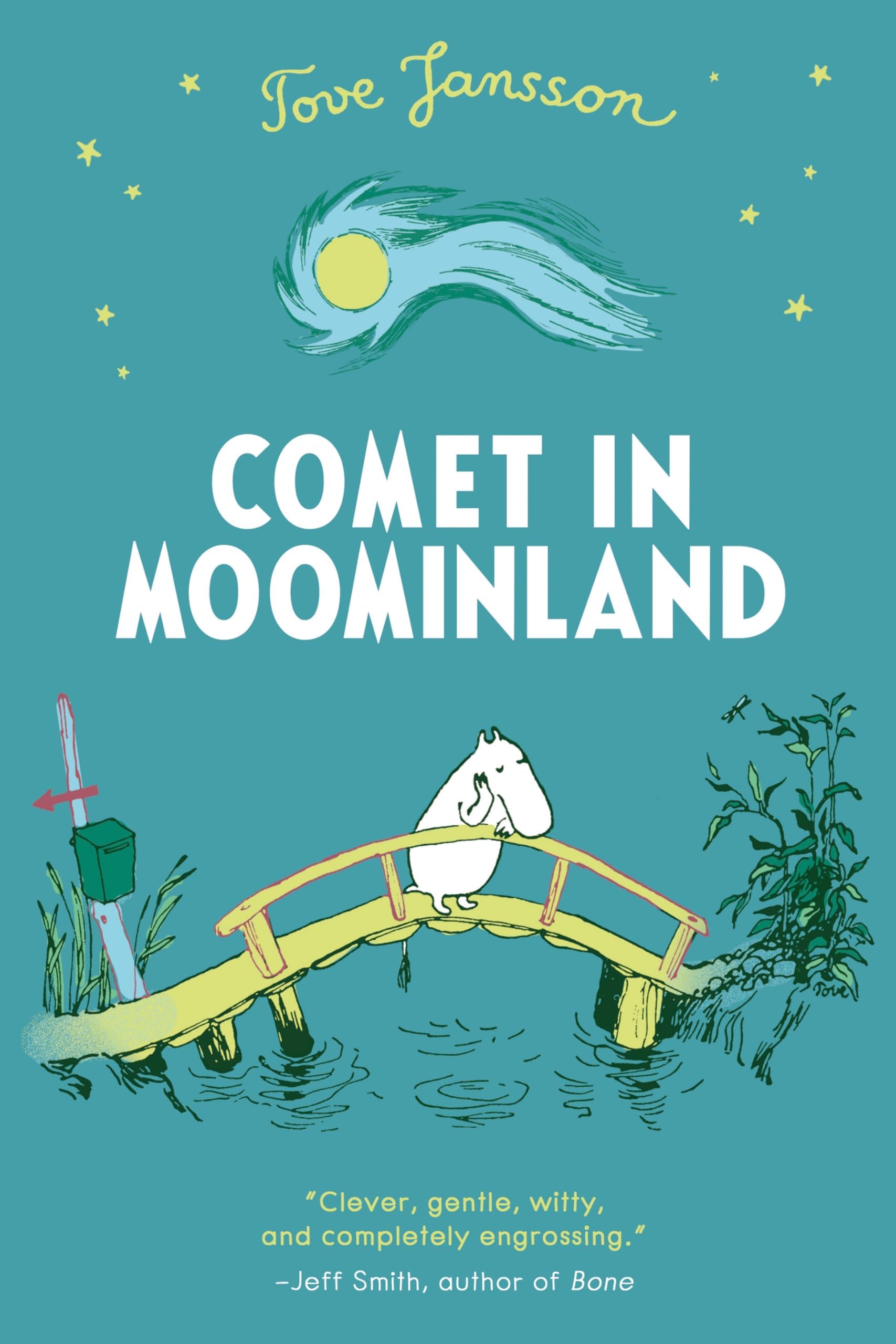
Square Fish Comet in Moominland
Desertcart purchases this item on your behalf and handles shipping, customs, and support to Mexico.
Description
🌠 Dive into Moominvalley — where childhood wonder meets timeless wisdom!
- EPIC COMET QUEST - Experience a thrilling narrative where adventure meets existential stakes, perfect for readers craving meaningful escapism.
- TIMELESS MOOMIN MAGIC - Join the beloved Moominvalley characters on a whimsical, unforgettable journey that blends joy and depth.
- BALANCE OF LIGHT DEPTH - Tove Jansson’s genius shines through a story that masterfully balances innocence with profound themes.
- CROSS GENERATIONAL APPEAL - A captivating read for all ages, making it the perfect bonding story for families and professionals alike.
- CRITICALLY ACCLAIMED CLASSIC - Boasts a stellar 4.9-star rating from 746 reviews, securing its place as a must-have in your literary collection.
Square Fish Comet in Moominland is a critically acclaimed children’s classic that follows Moomintroll and friends on a comet-driven adventure blending lighthearted fun with profound themes. With a 4.9-star rating from over 700 reviews, it’s a beloved story that resonates across generations, perfect for professionals seeking meaningful, nostalgic reads that spark joy and reflection.
Specifications
| Best Sellers Rank | #267,223 in Books ( See Top 100 in Books ) #774 in Classics for Children #1,308 in Fantasy for Children #1,703 in Children's Books on Family Life |
| Customer Reviews | 4.9 out of 5 stars 759 Reviews |
Reviews
J**E
My son is enjoying reading it
I would highly recommend this beautiful book to kids of all ages.
B**E
Comet in Moominland
It's the author's early work. Now I have the whole collection.
D**S
Marvelous story
My favourite books from childhood. Reading them again takes me back to summer holidays, freedom and adventures.
M**R
Good, Wholesome, Exciting Fun for Younger Audiences
Oh, where to begin?! This book, and the others in the Moomin series (though I haven't read ALL of them, I can only surmise that the ones I haven't read are similar in greatness) are just wonderful. I am the mother of a bright six-year-old who has enjoyed having chapter books read to her since she was two. It has at times been difficult to find chapter books that meet my exacting discrimination. There are a few things that I look for (or look to make sure they aren't there) in these types of books, to wit: 1) Well-written. I want there to be good sentence structure, good grammar, and VOCABULARY. Many writers of young people's fiction tend to write down to the child's level; I believe that the child can rise to the level of the book's writing (obviously, to an extent - I wouldn't expect my kindergartner to understand Crime and Punishment ). And leave the slang, out please. 2) Timelessness. I am not interested in books that refer to pop culture, technology, current events, etc. Even books that were written eighty years ago, such as Swallows and Amazons (Godine Storyteller) , can be utterly relevant, if they are focused on character and adventure instead of iPads and Justin Beiber (whoever he is). 3) Gentleness, Respect. I wouldn't want my child to hang out with an ill-behaved, discourteous, mean-spirited little brat, would you? So why spend time with them in books? For the life of me, I can't understand why anyone would want to read (or let their children read) something like Junie B. Jones and the Stupid Smelly Bus (Junie B. Jones, No. 1) , in which this utterly obnoxious child uses the word "stupid" about forty times on each page and is so rude and disrespectful to everyone around her that I couldn't get further than ten pages in before I threw the book away. Gag! Hey, writers - this is not funny! If you want to portray "real" children (who are by no means always walking around with their little halos saying "Yes, ma'am") and you want to be funny about it, take a lesson from Beverly Cleary in The Ramona Collection, Vol. 1: Beezus and Ramona / Ramona the Pest / Ramona the Brave / Ramona and Her Father [4 Book Box set ]. She manages to convey the reality of being (and parenting) a spirited child without making her character into an antagonist into the bargain. 4)Adventure, Excitement. Not much to add here. The plot has to keep moving. Often, this is best accomplished in books for younger children by making the book into a series of adventures, each one getting resolved as the book goes on. Well, "Comet in Moominland" has all of that and more (as does Finn Family Moomintroll (Moomintrolls) , book 2 in the series. The characters are all individual, unique "people" (imaginary creatures) with very distinct, yet believeable personalities. The main characters (Moomintroll, Sniff, the Snork and the Snork Maiden, possibly Snufkin) are all "children", and there are "adult" figures that come and go throughout the book as well, and they have a high degree of freedom. For example, when Moomintroll and Sniff (a small, treasure-obsessed animal reminding me somewhat of a rather feistier version of Piglet in The World of Pooh: The Complete Winnie-the-Pooh and The House at Pooh Corner (Pooh Original Edition) ) decide to go out on an adventure to the tallest mountain in the world, Moominmamma simply packs them a lunch and their "woolly trousers" and bids them farewell. It's fantasy fiction at its best, but for the 4-to-8 set. (Of course, adult lovers of juvenile fiction will adore the Moomins and the world Tove Janssen has created here.) This book has mystery, dangerous creatures, daring rescues, treasure, peril, friendship and delight by the bucketload. The dialog is superlative, the humor is wry and witty (and yet fully accessibly to children), and the meanness is kept to a minimum: the Snork can get a little snarky, and characters do occasionally tell one another to "shut up", which is unpleasant, but for this reader, those things were a small part of it, and served as "teachable moments" ("Gee, the Snork isn't acting very nice, is he?" and so forth). I highly recommend this book, and the next one in the series, and probably the rest of them as well, although I haven't read those yet. If Amazon had SIX stars, Comet in Moominland would get them all from me! (And my kid loves it too! She even ASKS to go to bed earlier so that we have more time to read!)
E**E
It’s Moomin!
Everyone loves Moomin!
Common Questions
Trustpilot