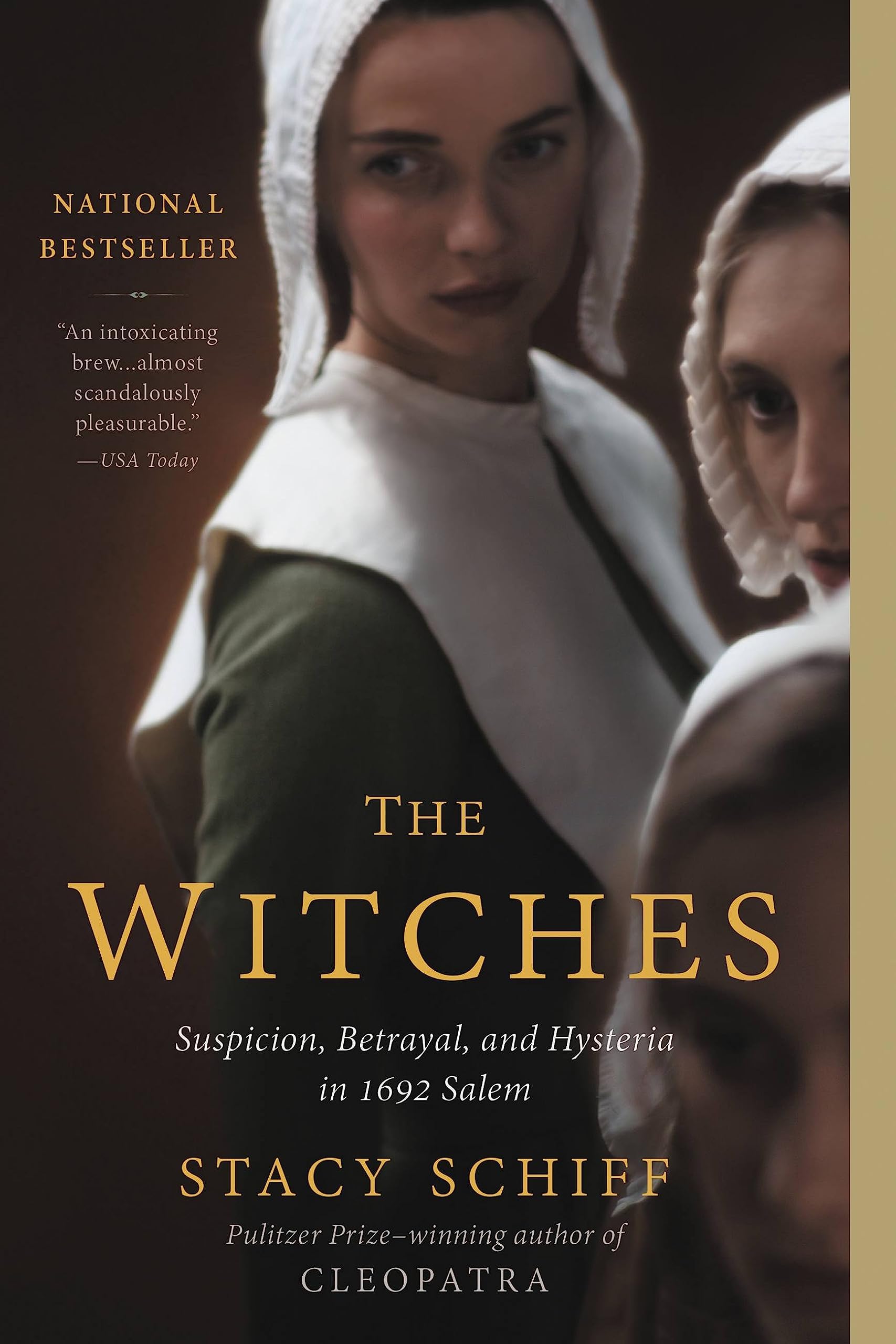
The Witches: Suspicion, Betrayal, and Hysteria in 1692 Salem
Product ID: 34074879
Buy anything from 5,000+ international stores. One checkout price. No surprise fees. Join 2M+ shoppers on Desertcart.
Desertcart purchases this item on your behalf and handles shipping, customs, and support to Mexico.
The Pulitzer Prize-winning author of the #1 national bestseller Cleopatra unpacks the mystery of the Salem Witch Trials. “ The Witches is the fullest and finest story ever told about Salem in 1692, and no one else could tell it with the otherworldly flair of Stacy Schiff.” ―Joseph J. Ellis, Pulitzer Prize-winning author of The Quartet It began in 1692, over an exceptionally raw Massachusetts winter, when a minister's daughter began to scream and convulse. It ended less than a year later, but not before 19 men and women had been hanged and an elderly man crushed to death. The panic spread quickly, involving the most educated men and prominent politicians in the colony. Neighbors accused neighbors, parents and children each other. Aside from suffrage, the Salem Witch Trials represent the only moment when women played the central role in American history. In curious ways, the trials would shape the future republic. As psychologically thrilling as it is historically seminal, The Witches is Stacy Schiff's account of this fantastical story—the first great American mystery unveiled fully for the first time by one of our most acclaimed historians. “Once again Stacy Schiff dazzles us. The Witches is a must read for anyone intrigued by this baffling and horrifying chapter from America's Puritan past. What Schiff uncovers is mesmerizing and shocking. Her meticulous research and lyrical writing lay bare an injustice that we should never forget-lest we repeat it.” ― Patricia Cornwell, author of True Crime and the Scarpetta novels Review: Excellent History of the Salem Witch Trials - This is a well-reseached , solid, coherent hisory of the Salem Witch Trials. On a subject that can be quite chaotic, Stacy Schief writes in an organized, coherent manner. She manages to convey a wealth of historic information without vering into the dry and academic. It is a subject matter that has a lot of "moving parts". I appreciated the "Cast of Characters" at the beginning of the book that helped me understand who was who, and kept the large cast of characters from becoming overwhelming. I apperciated how meticulous Schief is with the facts without becomming dry ans academic. I really enjoyed her engaging writing style. Her detailed discussion of what brought the trials to an end and rhe ensuing fallout was one of the best I've ever read. I'm a Salem descendant (Bridget Bishop) and I've read a lot of books on the Witch Trials. This is one of the best. Review: Not an Easy Read - A very interesting, but most depressing tale. The mass hysteria, instigated by by teenage girls encouraged by ministers, and followed by children turning on their parents, parents on their children, husbands on their wives, neighbor on neighbor, is incomprehensible, ending in the execution of 19 or 20 citizens, including 5 men and 14 women, with many others dying in the local dungeon that passed as a jail.Many confessed to being witches and were spared. Those that denied were sent to the gallows. If one believes in the devil and witches, it becomes understandable. But even the locals recognized that something was wrong and abruptly the trials stopped after a 9-month inquisition, forever leaving a indelible black mark on our national psyche. I couldn't wait to get through the book of endless trials and warped testimony. It was too unreal. The author presents some modern explanations that may or not be valid. I blame it on religious indoctrination, even though ministers were caught up in the crossfire. It doesn't say much for the Puritan ethic.The book is well researched and documented,but not a joy to read


| Best Sellers Rank | #28,250 in Books ( See Top 100 in Books ) #10 in U.S. Colonial Period History #47 in Women in History #54 in U.S. State & Local History |
| Customer Reviews | 3.6 out of 5 stars 2,098 Reviews |
S**Z
Excellent History of the Salem Witch Trials
This is a well-reseached , solid, coherent hisory of the Salem Witch Trials. On a subject that can be quite chaotic, Stacy Schief writes in an organized, coherent manner. She manages to convey a wealth of historic information without vering into the dry and academic. It is a subject matter that has a lot of "moving parts". I appreciated the "Cast of Characters" at the beginning of the book that helped me understand who was who, and kept the large cast of characters from becoming overwhelming. I apperciated how meticulous Schief is with the facts without becomming dry ans academic. I really enjoyed her engaging writing style. Her detailed discussion of what brought the trials to an end and rhe ensuing fallout was one of the best I've ever read. I'm a Salem descendant (Bridget Bishop) and I've read a lot of books on the Witch Trials. This is one of the best.
W**K
Not an Easy Read
A very interesting, but most depressing tale. The mass hysteria, instigated by by teenage girls encouraged by ministers, and followed by children turning on their parents, parents on their children, husbands on their wives, neighbor on neighbor, is incomprehensible, ending in the execution of 19 or 20 citizens, including 5 men and 14 women, with many others dying in the local dungeon that passed as a jail.Many confessed to being witches and were spared. Those that denied were sent to the gallows. If one believes in the devil and witches, it becomes understandable. But even the locals recognized that something was wrong and abruptly the trials stopped after a 9-month inquisition, forever leaving a indelible black mark on our national psyche. I couldn't wait to get through the book of endless trials and warped testimony. It was too unreal. The author presents some modern explanations that may or not be valid. I blame it on religious indoctrination, even though ministers were caught up in the crossfire. It doesn't say much for the Puritan ethic.The book is well researched and documented,but not a joy to read
R**N
Relevant today
As a direct descendant of one of the men who signed the first legal complaint against the first witch I have read more than a few books about Salem and the witch trials. I rate this book as the best I have read. It is the best because it left me with a more comprehensive understanding of many more of the participants than other books and how this could have happened. This is not a bedtime story. It is not about Wendy the good witch, Sabrina or Samantha Stephens. This is a most frightening book but not because of flying pigs or witches. I was frightened when I read about Rebecca Nurse, an accused witch. She had thirty-nine friends and family sign a petition in her defense. Signing a petition in those days was a very serious matter; it could easily turn against the signer. She was tried and the jury found her not guilty. The justice sent the jury back to reconsider. Again, the jury found her not guilty. The justice sent them back a second time until they got the correct verdict, guilty. An appeal to the governor resulted in a pardon for Rebecca Nurse. She was then indicted again for the same crime by the same judge, found guilty and quickly hanged. The judge benefited from the trials by eventually becoming the governor. All of this happened without the protection of a Bill of Rights or a Constitution. In this book you will read about the afflicted, who became a protected class. It was best not to say anything against the afflicted unless they become offended. Most of the girls being servant girls were relieved of household responsibilities and were supported by the rest of the community. You will also read about the accused citizens who had no defense. If they did protest and claim no offense was made they were declared guilty and often only by association. And who benefited? Those who came running to the defense of the afflicted gained the most; the people who were able to set one class against another. It only came to an end when the people being accused had had enough. All of this makes this book very relevant even today. Think about the continuing clash between rich and the poor; between religions; between races; between citizens and immigrants; and between political parties. All of these were issues in 1692. Today, who are the protected classes, who are the accusers and who are the people running to the rescue and then benefiting? Who benefits from a continued division? Who are the people rising up and saying enough political correctness? Is emotion trumping logic? Are you looking over your shoulder? You should be.
D**R
There Were Two Salems
The Salem witch trials were much more complicated than what I had been led to believe. Stacy Schiff sorts out all the variables for us with her extenstive research, thwarted somewhat by Massachusetts Bay's inability to preserve or outright destruction of court records. The first culprit in the happening was Samuel Parris, the Salem village minister, whose niece, Abigail Williams, was struck with strange afflictions, along with her nine-year old cousin, Parris's daughter Betty. “The cousins complained of bites and pinches by 'invisible agents' They barked and yelped. ..” We single out Samuel because he may have been overzealous as a minister, taking his job home with him. He also told his flock they had a duty to love him. Puritans were encouraged to examine their behavior and that of others for evidence of evil. An Indian slave, Tituba, made it worse by embellishing in elaborate detail on the witchcraft she'd seen as the girls and others of their ilk began to finger neighbors and even family members as witches and warlocks. Poor George Burrough's, Salem village's first minister, was labeled as the devil. His major crime may have been his rejection of Salem village when he left of his own accord, tired of the back-biting and the rumor mongering. As we know, 19 men and women were eventually hanged, including two ministers, and an old man was crushed to death. Then there's good old Cotton Mather, who couldn't seem to stop publishing, Over four hundred books, according to Schiff. At first Mather was rather helpful, when he insisted that “spectral evidence” such as witches flying through the air on boards was not reliable evidence. Later he changed his mind or seemed to anyway. He was also positive that the end times were near. As St. Augustine had feared when Revelation was added to the New Testament, its contents were viewed as literal. Just when you're thinking Mather is an utter ninny, the smallpox epidemic runs rampant in Massachusetts Bay. Mather, who had had some medical training, was for inoculations. He paid the price. Puritans didn't like to interfere in God's providence. Perhaps the man who bares the brunt of the blame is William Stoughton, the head magistrate of the trials. He was also acting governor and supreme court justice. When Rebecca Nurse was found not guilty, Stoughton called the jury back, pointing out that Rebecca had recognized two other accused witches when they entered the court and said something like “What are you doing here?” She had been in prison with them for months. Anyway, he sent them back to contemplate some more and she was found guilty. Stoughton's motto seemed to be “guilty until proven innocent”and sometimes not even then. Another variable was the animosity between the Putnam family of Salem Town and the Town family of Salem Village. This was a litigious society and the Towns and Putnams were constantly squabbling about property rights. Rebecca Nurse maiden name was Town. Stacy Schiff goes into extensive detail about what might have possessed the young girls who testified about the accused witches. She never quite says they were faking, as were the Swedish girls that Mather mentioned in his book on previous unexplained phenomena. But she implies that the girls might have had some adult help. Every time an accused witch entered the courtroom, they sent into convulsions as if they'd been coached. They also knew enough to calm down during the “touch test.” Supposedly, if you were a witch, and you touched a victim, your venom would bounce back on you and the victim would appear normal. Schiff also implies that this sort of hysteria has happened before, as in the Communism scare of the early fifties which resulted in the hearings on Un-American activities and McCarthyism; she never does say they're happening now with the paranoia involving ISIS, but she does say Americans have a penchant for this type of hysteria.
R**Y
Don't bother. If you are intersted in this topic read Wikipedia, you will learn more.
I purchased this book on the spur of the moment after reading about it somewhere on the internet. I never had a particular interest in the topic, but I am intersted in history. I was excessively disappointed from the very beginning. The writing is disjointed, and almost uncomprehendable. I had to pause at almost every paragraph to try to understand what the author was trying to relate. I reluctantly struggled though it optimistically hoping it would get better, but alas, it did not. It is clear the author did extensive research and had a good understanding of her topic, but her confusing style of writing is bewildering. When I finished with this book, I decided to see what I could find on the internet about the Salem witchcraft trials, and I feel I learned more from Wikipedia than from reading this book.
J**.
How I Wish She'd Organized It Better
If there's one historical event that the citizens of the United States had better never forget, it's the 1692 Salem Witch Craze, and historian Stacy Schiff's newest work could have gone a long way towards re-establishing the tragedies and injustices of the Witch Trials in the public consciousness--if the public could read it. In spite of all the laudatory blurbs provided to Amazon by the work's publisher, twice the number of Amazon Customer reviewers give it one or two stars than give it five. Three- and four-star reviews are in shortest supply. Sadly, there's a reason for this. "The Witches: Salem, 1692" is probably one of the most disorganized contemporary historical works that I've seen. The author begins by a caustic dismissal of perhaps the best known popular history of the Witch hysteria, Marion Starkey's 1949 "The Devil in Massachusetts", and undoubtedly the best known fictional portrayal, Arthur Miller's "The Crucible": "The Holocaust sent Marion Starkey toward Salem witchcraft in 1949. She produced the volume that would inspire Arthur Miller to write 'The Crucible' at the outset of the McCarthy crisis. Along with Nathaniel Hawthorne, Miller has largely made off with the story (p. 11)." That sounds an awful lot like sour grapes, but to be fair, Stacy Schiff may have one legitimate gripe. She argues that most recent historians before her, including Starkey, have utilized sources that have been traditionally viewed as primary, but which are actually secondary, to begin the witchcraft story--namely, the monographs the ministers Increase and Cotton Mather penned one to five years after the craze had subsided. Only from the Mather writings, she contends, do we get the idea that the girls of Salem Village were introduced to witchcraft by elementary voudoun and fortune telling practiced by the Parris family's West Indian slave, Tituba, and Schiff theorizes that this was a "must-have-been" hypothesis supplied by the Mathers rather than an "actually-was" fact that could be gleaned from court documents or other contemporary records. For all that, though, Schiff chooses to prove her point by an eye-crossing myriad of dry, repetitive, poorly-arranged data that goes in, around, up, down, across, and through the chronological line to suggest that not only interpersonal community tensions but a confusing Gordian knot of other contributory factors, including even the political attitudes of a cabal of ministers who had worked together to oust the previous governor of the Massachusetts Bay Colony, Edward Andros, and establish the new one, William Phips, all had their part in the great witch scare. I note with dismay how many other reviewers remark that they gave up trying to read the book, or simply started skimming, after so many pages along, because finally, on pp. 386-398, Schiff offers her own thoughts on the phenomenon's causes: hysteria, as defined first by Jean-Martin Charcot and later Sigmund Freud. And, by the anthropomorphic, schizophrenic-as-the-humans-who-thought-it-up God that the Puritans worshiped, she stands a danged good chance of being right. But if Schiff had only stated her thesis at her work's beginning and built her historical case around it in an orderly and logical manner, much as Marion Starkey had done with her own thoughts in 1949 however much they may have been influenced by Cotton and Increase Mather's after-the-fact hypotheses, Schiff could have produced a much more readable and compelling volume.
G**L
"We must not believe all that these distracted children say"...
The line in the title of this review was said by Martha Carrier, who was hanged as a witch in Salem, Massachusetts in 1692. Many years ago, when I was a child, I read and was utterly fascinated by a book called, "The Witch of Blackbird Pond", by Elizabeth George Speare. It's still in print today, so perhaps more recent generations of impressionable readers have also been "bewitched" by the book. "Blackbird Pond" started me on a lifelong interest in the Salem witch hunt. (The book was set, I vaguely remember, in Connecticut but the story seemed to be about the real Salem witch trials.) Now American author Stacy Schiff has published a wonderfully written book of non-fiction about the whole crazy time in Salem town and Salem village when the townspeople saw witches, witches everywhere. Stacy Schiff takes a very measured approach to the nine or so months in 1692 when young girls and some older women accused other women - and a few men - of witchcraft. The "accusers" ran wild when brought face to face with those they were accusing. The girls threw fits and saw strange apparitions in the presence of the "witches". The authorities - both civil and clerical - tended to believe the claims of the girls, until they became too outlandish. And they were already outlandish; flying sticks, sicknesses, and possessed animals were claimed by the accusers. What caused what amounted to mass hysteria for those months? Daughers accused mothers; husbands "remembered strange goings-on" by their wives. "Touch tests" were performed on those accused. Eventually, 22 people - both male and female - were executed as witches. Most by hanging, though death-by-pressing was also carried out. (What a charming way to die...) But what Stacy Schiff does best in her book is to give an overall view of both time and place and the societal pressures that resulted in the accusations of witchcraft. Stacy Schiff's book on the trial and the aftermath is compulsively readable. In fact, I stayed up much of last night reading the book. (If this review is somewhat incomprehensible, my tiredness is the cause!) I can heartily recommend "The Witches: Salem, 1692". And now I think I'll go download and read that old childhood fav - "The Witch of Blacbird Pond".
W**N
Best Examination of Salem I've Ever Read
Stacy Schiff deserves her reputation as one of our greatest living writers and historians. I was engrossed by "The Witches" and I thought it so good that I was sorry to finish it. Schiff's writing is elegant, and her psychological insights are subtle and persuasive. Given the paucity of the record for this event, that's an important skill. For anyone who only knows this episode through "The Crucible," you don't know the half: the corruption of the local sheriff, the nakedly propagandistic motives of the ministers, the seeming heartless and robotic posture of the judges, and despite what some other reviewers missed as they "skimmed" the book, the explicit assertion that some of the girls did collude with each other to put innocent neighbors to death, and more, will be revelations to you. This is one of America's most important and perennially relevant lessons, and right now, this is the book to explain it.
Á**N
No
Damaged and dusty
A**E
Tolles Buch.
Sehr empfehlenswert.
C**Z
As expected
As expected
C**E
Only the Lord knows why
Stacy Schiff has a marked gift for story-telling. She has peppered her compendious narrative with lively sketches of the main players, making them more understandable to modern readers. She depicts the physical appearance of the confessors as if she had met with them. She devotes a great deal of attention to the environment as well: we feel the cold, the darkness, the barren aspect of the land. That was on the plus side. But there is a negative side. For all her immersion into this oppressive world, Stacy Schiff rarely addresses the most interesting and vexing issue: why did all this happen ? How could the authorities hang or otherwise kill 14 perfectly innocent villagers on the eve of the 17th century, at a time when "witches" had practically disappeared from European courts. Why and why so late ? What element of the historical context might help to understand ? In spite of the tons of books and articles written on the subject, the answer to this crucial question still largely eludes us.
C**E
A good, solid book for those beginning their journey into Salem
I have long been curious about the Salem Witch Trials and chose this book as an intoduction of the whole episode and as such it was very satifactory. I have little experience reading other Salem books but this seemed to be very well researched and does a great job of making what must a confusing, convuluted mass of papers into a straightforward narration of events. I found all the different names quite confusing and on occasion it did drag however I think this can be put down to a lack of the human details which obviously have been lost to history and thus not the authors fault. An unexpected treat were illustrations included at the very back which proved to be informative and interesting. I would definitely recommend this book mostly for people who wish to learn the whole story and are unfamiliar with its details. It is those same details which maybe interesting to others more versed in the Story of Salem making this a good choice no matter your levels of knowledge.
Trustpilot
1 week ago
1 month ago