We remain fully operational. Our teams are working around the clock to ensure your deliveries continue safely.

DOWNLOAD THE APP


Copyright © 2025 Desertcart Holdings Limited
DOWNLOAD THE APP
Buy anything from 5,000+ international stores. One checkout price. No surprise fees. Join 2M+ shoppers on Desertcart.
Desertcart purchases this item on your behalf and handles shipping, customs, and support to Mexico.
📖 Unlock the Southern mystery that everyone’s whispering about — don’t miss out on this literary rite of passage!
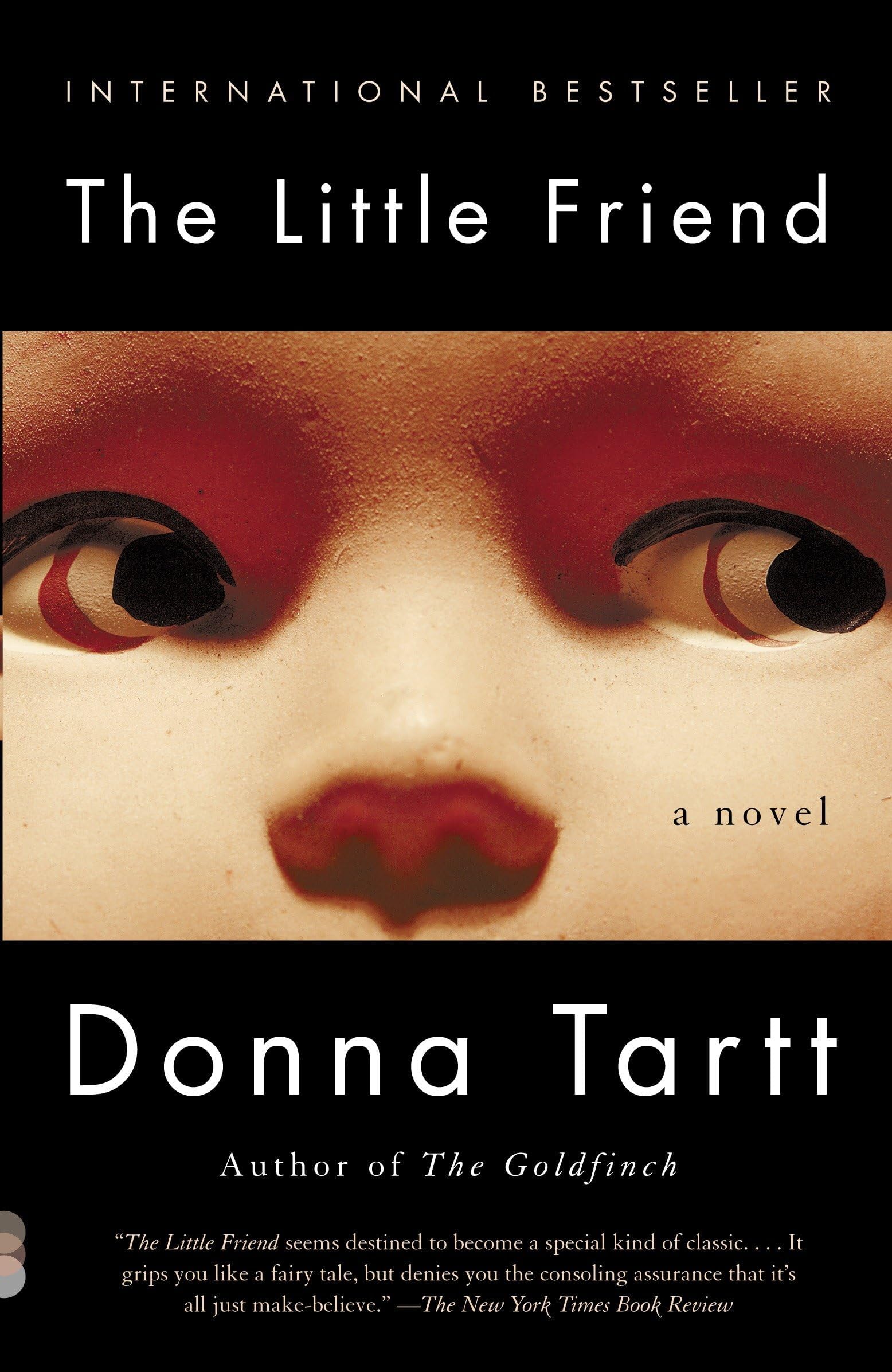
Donna Tartt’s The Little Friend is a 624-page literary novel set in 1960s Mississippi, blending a murder mystery backdrop with a deep exploration of grief, social dynamics, and a fiercely independent young protagonist. Ranked among the top literary fiction titles, it offers richly detailed storytelling that challenges conventional genre expectations and rewards readers who crave complexity and atmospheric depth.


| Best Sellers Rank | #20,726 in Books ( See Top 100 in Books ) #916 in Literary Fiction (Books) #1,765 in American Literature (Books) #5,992 in Genre Literature & Fiction |
| Customer Reviews | 3.8 3.8 out of 5 stars (7,694) |
| Dimensions | 5.14 x 1.12 x 7.93 inches |
| Edition | Reprint |
| ISBN-10 | 1400031699 |
| ISBN-13 | 978-1400031696 |
| Item Weight | 1 pounds |
| Language | English |
| Print length | 640 pages |
| Publication date | October 28, 2003 |
| Publisher | Vintage |
E**S
One of the Best Books I've Ever Read
Had I paid any attention to the reviews at either Goodreads or Amazon, I might have been dissuaded from reading The Little Friend by those who didn't like the book, calling it "boring", "too long", "bad ending". That would have been a sad thing, because I'm putting it in that Difficult-to-Get-Into club of mine called "One of the Best Books I've Ever Read". It's very hard for me to see this as anything less than a 5-star book, so let me try to convince you readers who are contemplating reading it but are on the fence because of the book's detractors. However, let me temper that with a caution to those who want a quick read, a tied-up-in-a-bow ending, or who aren't willing to get deep into a character and the character's milieu---if you are one of those, go with a John Grisham. The paperback edition I read was a hefty 624-pages, and I savored every one of them. The editor's description of The Little Friend (TLF) will lead you to believe that this is a murder mystery, and perhaps that's why some readers are ticked off that it lacks the typical and expected structure of a murder mystery. In fact, that's likely what enticed me to buy it. But while TLF does, indeed, begin with a mystery---the 12-year old, unsolved murder of the brother of the main character, Harriet. The mystery is also the impetus for the quest that is the book's focus. But the mystery is simply the background and jumping off place. This is really a story about Harriet, one of the most compelling characters I've ever encountered; the town where the story takes place (Alexandria, Mississippi); and the recently desegregated and deeply racist social climate in which the action occurs. Harriet was a baby when her brother, Robin, is murdered. When we meet her 12 years later, she's like an urchin from a Dickens' story. If it were not for the inconsistent and eclectic parenting she receives from the family's African-American housekeeper, her stern and cold grandmother, and a gaggle of great-aunts, Harriet would be just a step away from being raised by wolves. Her mother has been in a drug-induced slumber since the day of the murder, and her father lives in Nashville and only visits on holidays. Harriet is an old soul. She's intelligent, indomitable, opinionated, delightfully odd, and very well-read. The tales of Kipling, Stevenson, Doyle, and those of true-life adventurers fuel her imagination. A summer without the structure and diversion of school, and the general lack of parental supervision the children receive, provide a fertile ground in which Harriet and her devoted acolyte, Hely, set out to find Robin's killer. But, again, though it's an important one, this "detecting" is simply the backstory. TLF's prologue is one of the best I've ever read. It begins: "For the rest of her life, Charlotte Cleve would blame herself for her son's death because she had decided to have the Mother's Day dinner at six in the evening instead of noon, which is when the Cleves usually had it." Its 15 pages concisely and brilliantly provide us with everything we need to know to prepare us for the rest of the story. We clearly understand the family dynamics and a bit of its history. We meet many of the characters and, in very few words, we learn a lot about each one of them. We know the horrific event that forever after alters the family and sets in motion its disintegration. But from that point forward, each subsequent chapter is minutely detailed. Many readers found that maddening, but others, like me, loved and appreciated those details. I found myself rereading passages to savor them, and noticing now beautifully crafted and essential all those lovely words were. One of the things that I found the most amazing was how well Tartt captured the time and place: the casual and cruel racism, the decaying town, the cadence and sound of the voices across the spectrum of social classes; and the thinking of the children: their fertile imaginations, their terrible decisions, the pains they must endure at the hands of the careless and unthinking adults who rule their worlds. My early childhood was spent in a small Missouri town in the 1950s, and Tartt's descriptions brought back the sights, sounds, and feelings (both physical and emotional) of that time and place. Other reviewers have compared TLF to To Kill a Mockingbird and The Heart is a Lonely Hunter. I was also making those comparisons. But to be clear, TLF by no means mimics those books---it holds its own and is unique in its voice, but it shares the keen sense of place and the uncanny understanding of the characters' interior lives that those other books have. Many reviewers complained about the book's ending. I'm trying not to spoil it for readers by what I'm going to say next, so if you are even a tad concerned about that, stop reading this review now. The ending is not all tied up in a bow, with the author going over clues we should have picked up on, and detailing for us why the killer did what he/she did. If you are expecting such an ending, this book won't deliver. But I contend that Tartt wrote the perfect ending for this particular book. It's is purposefully and carefully written, and A Little Friend would be a completely different book with anything but the ending Tartt gives us. I believe that the Prologue and ending are a pair of perfectly matched bookends. I loved this book and highly recommend it for people who want beautifully written prose and a whopping good story. I'm in awe of Donna Tartt's talent and insight into the human spirit, and immensely glad I found her. I'm reading Tartt's The Secret History next.
D**R
Reminds one of TO KILL A MOCKINGBIRD
Donna Tartt had to have been thinking of TO KILL A MOCKINGBIRD while she was writing this book. There are too many similarities to ignore. The book is set in Alexandria, Mississippi, just a stone's throw from Maycomb, Alabama. Harriet Cleve Dufresnes, the lead character, could be Scout Finch six years later. The villain of the piece, Farish Ratliff, will remind you of Bob Ewell. Harriet even has a little boyfriend who worships the ground she walks on. Harriet is a great character, feisty and brave, willing to take on a copperhead in order to get even with Danny Ratliff, whom she blames for the murder of her brother who'd been found hanging from a black-tupelo tree when she was a baby. Just as captivating are Harriet's great aunts, Edie, Addie, Libby, and Tat. These are truly original characters; no one has written senior citizens better since LADIES OF THE CLUB. Edie, Harriet's grandmother, is an older version of Harriet. When she looks Harriet in the eye, she sees herself looking back at her. This is a finely textured book, with lots of atmosphere and folklore that Tartt positions between action sequences. Tartt is great at foreshadowing. There's a scene at the beginning where Harriet learns how to hold her breath (like her hero Houdini) that will come in handy later on. There's so much to like about this book I have to give it at least a four, but it's not a seamless novel. There's too much description, the kind that the author had to have put in later to give the book verisimilitude. Much of this is repetitive, lots of light playing off of the sides of buildings. I'm not the type to skip description, but I can understand why some readers might want to skim over some of this. The ending is also disappointing, leaving the reader dangling. Any mystery lover (as I am) is going to want to throw the book up against the wall when he finishes. What happens to Danny Ratliff is also completely unrealistic. You'd think at least one of the forty-some people Tartt thanks in her acknowledgments would have balked at some of this.
2**0
What a wonderful story. Imaginative, creative, humourous, human. I can highly recommend it. The book gives us great insight into Mississippi life - before the advent of air-conditioners apparently - and the suble nuances in southern society. I loved the child's perspective. Although the children seem to be the most observant witnesses to the adults' stories and dramas, they remain "invisible". They act on what they think is right, but only have snippets of the larger picture. It all comes together in the end in a wonderous and marvelous way. Donna Tartt is nothing short of a great story-teller.
H**O
A mí el libro me ha gustado mucho, la verdad. Es verdad que puede resultar pesado y largo para las personas a las que no le gustan las descripciones porque Donna Tartt hace mucho uso de ellas. Como dicen las críticas, no es The Secret History, pero no por ello es un mal libro.
K**.
A beautiful reflection on grief and the repercussions of a violent act on two families that couldn't be more different from one another: The Cleves, a middle class and matriarchal close-knit group, and the dirt-poor meth-making Ratliffs. Usually, I don't like children as main characters, but with Donna Tart as a writer, I was more than willing to make an exception and I'm glad I did because this is a masterpiece. Harriet's quest to avenge her brother is dark and menacing, riddled with guilt and failure and most of all loneliness. There is a stark contrast between her troubled mind and the carefree attitude of her best friend Hely, for whom childhood is as it should be, with caring parents. All the surrounding characters, from both families are very well crafted and multilayered; they all have their qualities, their vices and soft spots but my favorite was without a doubt Edie, capable and pragmatic but also cold and starting to feel her body and mind ageing. The themes are dark and actual, ranging through all societal issues like racism, male chauvinism, unemployment, drug use and of course murder. On this note, don't get wrong footed by other reviews; this book is not about who killed little Robin, it is about all the aftershocks this one act provokes. In that way, it reminder me very often of Reservoir 13 . If you are looking for opulent prose, a young but powerful heroin, with a splendid tapestry of characters on the hot and humid background of 1970's Mississippi, then look no further and dive into the melancholy and wonderful world of little Harriet Cleve Dufresne.
I**N
Kitabın hem sayfaları kıvrık hem üstünde hasarlı geldi.
N**P
The whole point of Donna Tartt IS the beautiful but long story. That ending though!
Trustpilot
1 month ago
3 weeks ago