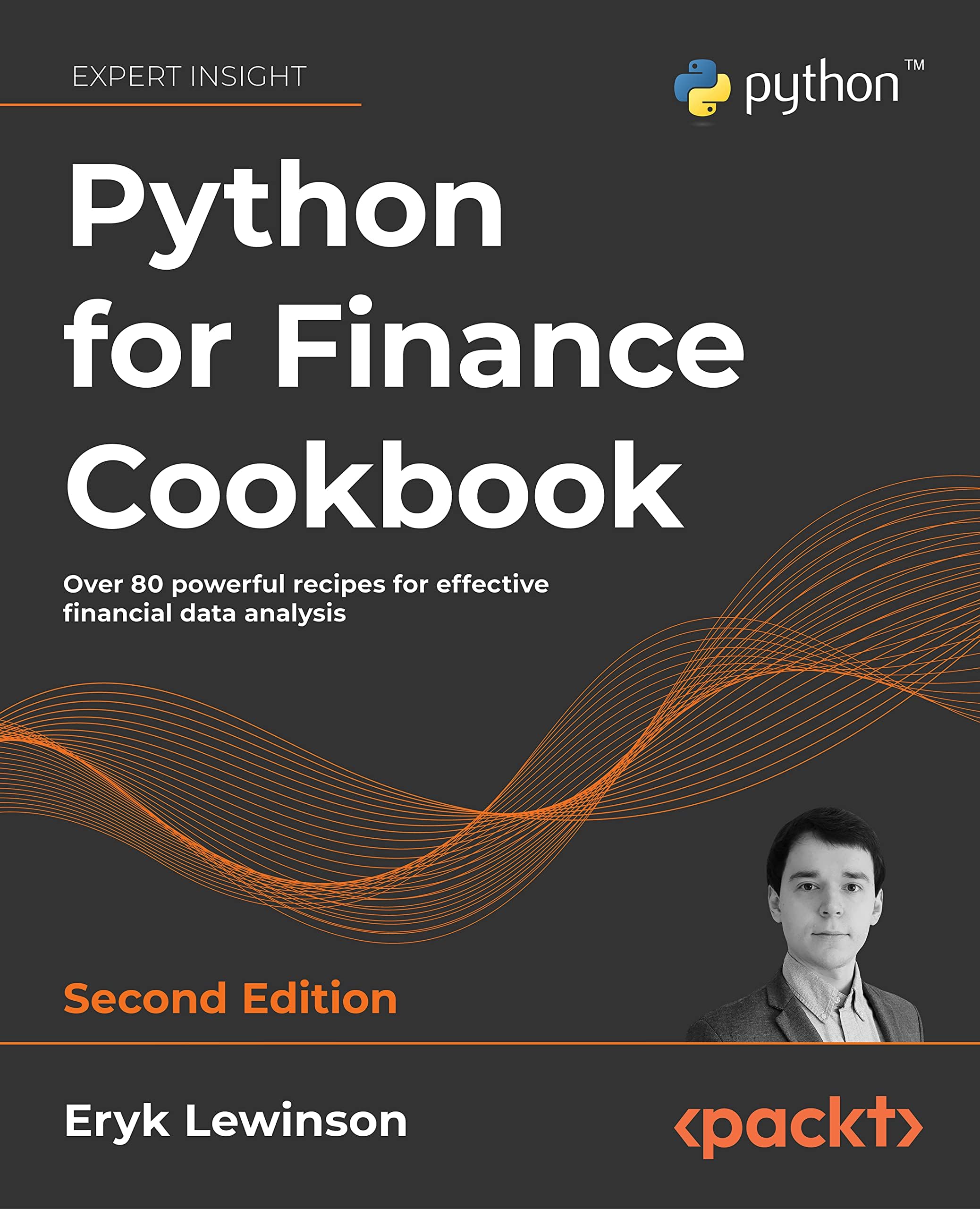
Python for Finance Cookbook: Over 80 powerful recipes for effective financial data analysis, 2nd Edition
Product ID: 465676619
Desertcart purchases this item on your behalf and handles shipping, customs, and support to Mexico.
Use modern Python libraries such as pandas, NumPy, and scikit-learn and popular machine learning and deep learning methods to solve financial modeling problems Purchase of the print or Kindle book includes a free eBook in the PDF format Key Features Explore unique recipes for financial data processing and analysis with Python Apply classical and machine learning approaches to financial time series analysis Calculate various technical analysis indicators and backtest trading strategies Book Description Python is one of the most popular programming languages in the financial industry, with a huge collection of accompanying libraries. In this new edition of the Python for Finance Cookbook, you will explore classical quantitative finance approaches to data modeling, such as GARCH, CAPM, factor models, as well as modern machine learning and deep learning solutions. You will use popular Python libraries that, in a few lines of code, provide the means to quickly process, analyze, and draw conclusions from financial data. In this new edition, more emphasis was put on exploratory data analysis to help you visualize and better understand financial data. While doing so, you will also learn how to use Streamlit to create elegant, interactive web applications to present the results of technical analyses. Using the recipes in this book, you will become proficient in financial data analysis, be it for personal or professional projects. You will also understand which potential issues to expect with such analyses and, more importantly, how to overcome them. What you will learn Preprocess, analyze, and visualize financial data Explore time series modeling with statistical (exponential smoothing, ARIMA) and machine learning models Uncover advanced time series forecasting algorithms such as Meta's Prophet Use Monte Carlo simulations for derivatives valuation and risk assessment Explore volatility modeling using univariate and multivariate GARCH models Investigate various approaches to asset allocation Learn how to approach ML-projects using an example of default prediction Explore modern deep learning models such as Google's TabNet, desertcart's DeepAR and NeuralProphet Who this book is for This book is intended for financial analysts, data analysts and scientists, and Python developers with a familiarity with financial concepts. You'll learn how to correctly use advanced approaches for analysis, avoid potential pitfalls and common mistakes, and reach correct conclusions for a broad range of finance problems. Working knowledge of the Python programming language (particularly libraries such as pandas and NumPy) is necessary. Table of Contents Acquiring Financial Data Data Preprocessing Visualizing Financial Time Series Exploring Financial Time Series Data Technical Analysis and Building Interactive Dashboards Time Series Analysis and Forecasting Machine Learning-Based Approaches to Time Series Forecasting Multi-Factor Models Modelling Volatility with GARCH Class Models Monte Carlo Simulations in Finance Asset Allocation Backtesting Trading Strategies Applied Machine Learning: Identifying Credit Default Advanced Concepts for Machine Learning Projects Deep Learning in Finance Review: Excellent book. Must have as a reference - Excellent book. Good discussion on each topic, self-contained code examples and they work! I hope author will come up with an updated version covering newer techniques in detail e.g., using pytorch !! Must have as a reference Review: Pretty solid bood - Good; I think the one for Machine Learning for Algorithmic training is a little better



| Best Sellers Rank | #141,862 in Books ( See Top 100 in Books ) #20 in Business Finance #30 in Data Modeling & Design (Books) #91 in Python Programming |
| Customer Reviews | 4.3 out of 5 stars 78 Reviews |
P**R
Excellent book. Must have as a reference
Excellent book. Good discussion on each topic, self-contained code examples and they work! I hope author will come up with an updated version covering newer techniques in detail e.g., using pytorch !! Must have as a reference
P**S
Pretty solid bood
Good; I think the one for Machine Learning for Algorithmic training is a little better
H**B
Great Book
Really great book with super detailed explanations. I was honestly amazed at how clearly and systematically everything was explained — it made it so much easier to follow and stay interested.
H**Z
Best Review
amazing
C**.
Enjoying the book
As the title states is a Cookbook. It introduces many python libraries to analyzed and apply Machine Learning (ML) applications to financial time series data. Does a great job on how to download financial data. All the code in the book is available from the URLs provided in the book. I found the book very useful and recommend the book, for those getting started in analyzing and forecasting financial time series data in python.
L**N
Book helped me to find a 0.8 sharpe ratio algo
Time series section gave me info and idea to find out a sharpe ratio 0.8 strategies (2020-). But i rate this book as 4 stars as the model factor section makes no sense to me. I am expecting the author shows me cookbook to use stock leading factor (as mentioned in the opening of the section in the book) to put in the model and how to use this model on algo strategy. But it turns out the code example is nothing related to it.
S**N
Good book
Love this book since it is really useful for my study and work!
R**D
Great for Data Analyst's with an interest in finance and investing!
I recently picked up "Python for Finance Cookbook," which is tailored perfectly for a data analyst like me who studies finance and investing on the side, and it is an understatement to say I was truly impressed! This book seamlessly integrates the complexities of finance with the versatility of Python, offering an invaluable guide to harnessing financial data for insightful analysis. Right from the start, Chapter 1, "Acquiring Financial Data," grabbed my attention. As someone who values accurate data, the step-by-step instructions for gathering data from diverse sources like Yahoo Finance, Nasdaq Data Link, and more were indispensable. Chapter 2's data preprocessing techniques, covering everything from handling missing data to adjusting for inflation, were equally beneficial, streamlining my analysis process. The book's coverage of visualizing financial time series data in Chapter 3 elevated my understanding of plotting financial data. Techniques like creating interactive visualizations and understanding seasonal patterns provided fresh perspectives on market behavior. Chapters 4 to 6 further explored data analysis and forecasting, while Chapters 7 and 8 bridged the gap between data analysis and investment strategy, showing how machine learning can enhance forecasting and estimating models. As I delved deeper, the book's advanced topics, including volatility modeling, Monte Carlo simulations, and deep learning applications, kept pushing my boundaries. Each chapter concluded with a concise summary, reinforcing key takeaways and ensuring I grasped the essentials. In summary, the "Python for Finance Cookbook" is a treasure trove for data analysts with an investing interest. It fuses Python programming with financial concepts seamlessly, empowering readers to confidently analyze data, forecast trends, and make informed investment choices. My skills as a data analyst and investor have undeniably grown through this book, and I'm excited to implement its insights in my future pursuits.
A**K
Excellent
Really well structured, well written, and the code is thoughtfully put together. This is a complex topic and the direct writing style and real world insights make this a book well worth the asking price. Solid.
F**Y
Praktischer Einstieg
Guter Einstieg in Python, Pandas, Numpy und grundlegende Vorgehensweise in Quant programming mit Python. Es macht Spaß es durchzuarbeiten und ist pragmatisch aufgebaut. Der Autor kommt auch gleich auf den Punkt... so mag ich das. Heutzutage leider keine Selbstverständlichkeit mehr - diese Fachbuch hat gut lesbaren Schriftsatz.
C**2
Split and read, combo!
Read all the chapters, simple and easy to understand. Recommended revision with AI recipe. Thick and heavy, split for reading during commute.
S**T
Terrible Copy
Low level printing quality disaster copy from Poland but book is GOOD
R**H
Good Financial Analysis with Python
Review: Python for Finance Cookbook – Second Edition This book offers a solid blend of financial concepts and Python programming, making it a valuable resource for anyone looking to apply coding skills to real-world finance problems. The financial objectives are well-chosen, and the Python examples are clear, practical, and well-explained. The only downside is that some of the data sources referenced have changed or become outdated. However, with minor adjustments or alternative APIs, the code can still be adapted effectively. Overall, it remains an excellent learning tool for finance-focused Python developers.
Trustpilot
2 weeks ago
2 weeks ago