
Desertcart purchases this item on your behalf and handles shipping, customs, and support to Mexico.
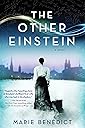
From beloved New York Times and USA Today bestselling author Marie Benedict comes the story of a not-so-famous scientist who not only loved Albert Einstein, but also shaped the theories that brought him lasting renown. In the tradition of Beatriz Williams and Paula McClain, Marie Benedict's The Other Einstein offers us a window into a brilliant, fascinating woman whose light was lost in Einstein's enormous shadow. This novel resurrects Einstein's wife, a brilliant physicist in her own right, whose contribution to the special theory of relativity is hotly debated. Was she simply Einstein's sounding board, an assistant performing complex mathematical equations? Or did she contribute something more? Mitza Maric has always been a little different from other girls. Most twenty-year-olds are wives by now, not studying physics at an elite Zurich university with only male students trying to outdo her clever calculations. But Mitza is smart enough to know that, for her, math is an easier path than marriage. Then fellow student Albert Einstein takes an interest in her, and the world turns sideways. Theirs becomes a partnership of the mind and of the heart, but there might not be room for more than one genius in a marriage. Marie Benedict illuminates one pioneering woman in STEM, returning her to the forefront of history's most famous scientists. " The Other Einstein takes you into Mileva's heart, mind, and study as she tries to forge a place for herself in a scientific world dominated by men."― Bustle Recommended by PopSugar , Bustle , Booklist , Library Journal and more! Other Bestselling Historical Fiction from Marie Benedict: The Mystery of Mrs. Christie The Only Woman in the Room Lady Clementine Carnegie's Maid Review: Easy read - Great book; easy read; it’s always interesting to read about famous people who aren’t so nice in real life Review: An intensely human story - Despite the fact that this book gets off to a very slow start, about a third of the way in, it gets very absorbing. It tells the story of a brilliant woman whose light is nearly extinguished in the presence of an equally brilliant man at time when university educations and careers for women in the traditional mens’ fields of science and mathematics were practically unheard of. Despite the background of science and mathematics, it is an intensely human story and that for me, is the appeal of this novel. Kudos to the author for making the references to incredibly complex scientific principles manageable for the average reader. These references are necessary to the story but easily navigable. Bottom line: you will likely experience a change in whatever perspectives you may have regarding Albert Einstein. You may find him to be both more and less than what you thought before.


| Best Sellers Rank | #20,938 in Books ( See Top 100 in Books ) #43 in Biographical Historical Fiction #46 in Biographical & Autofiction #925 in Literary Fiction (Books) |
| Customer Reviews | 4.3 out of 5 stars 16,688 Reviews |
E**A
Easy read
Great book; easy read; it’s always interesting to read about famous people who aren’t so nice in real life
T**9
An intensely human story
Despite the fact that this book gets off to a very slow start, about a third of the way in, it gets very absorbing. It tells the story of a brilliant woman whose light is nearly extinguished in the presence of an equally brilliant man at time when university educations and careers for women in the traditional mens’ fields of science and mathematics were practically unheard of. Despite the background of science and mathematics, it is an intensely human story and that for me, is the appeal of this novel. Kudos to the author for making the references to incredibly complex scientific principles manageable for the average reader. These references are necessary to the story but easily navigable. Bottom line: you will likely experience a change in whatever perspectives you may have regarding Albert Einstein. You may find him to be both more and less than what you thought before.
N**N
An incredible story that paints Einstein in a poor light; brings forth Milena in a much better one.
This book is about Albert Einstein 's first wife, Mileva "Mitza" Maric, a Serbian woman with a limp whose parents didn't believe she had any hopes of a future with a husband but was rather brilliant with math and science and could possibly have a future as a professor and doing research. Switzerland was a progressive country that was allowing women into its colleges and universities and Mileva was accepted into Swiss Federal Polytechnic in Zurich. She took up lodging at Engelbrecht Pension an all-girl boarding house where she became friends with Milana, Ruzica, and most especially Helena who also had a limp. She had never had friends before.as.She was always teased and ridiculed. In class, Dr. Weber was particularly hard on her because she was a woman and because she was Serbian. One student reaches out to.her and that student was Albert Einstein. He flirted shamefully with her and she turned him down. Her friend Ruzica talked her into going into one of the cafes where Einstein and his friends were having an intellectual discussion on science and she found herself drawn into the discussion. When Einstein found out about the women's playing music after dinner he showed up uninvited with his violin to play with Milena. The other women don't much care for him, though. Helena and Milena have made a pact to not have a man in their lives and to focus on their careers. But soon, Helena has found a man to love and has broken the pact. So, Milena doesn't see why she has to keep the pact too, especially when her mother is encouraging her to pursue romance even though her father is against it. Einstein and Milena have talked about marriage and while Einstein has graduated now and is looking for work, which is hard because his teachers aren't giving him good recommendations due to his absentees from class and his disrespect toward them. Milena took a semester off her second year in order to cool off her feelings for him and got behind in school which meant that she had to wait another year before she could take the test. Einstein talks her into taking a vacation at Lake Como where they can make love before they get married. Milena comes back pregnant and Einstein won't marry her without a steady job. She flunks the exams due to her pregnancy and he refuses to come to her home to talk to her parents about the pregnancy. He has a lead on a job in the Patent Office but for now, he's tutoring. She takes the train up to the next stop to see him but he refuses to take the train up to the next stop to see her. Eventually, her money runs out and she must go back home furious at him for not seeing her. She has a baby girl that he asks her to leave with her parents six months later because he got the patent office job and he listed himself as unmarried and he can't show up with a child in tow. So she does for now. On a paper they worked on together he asks that she take her name off of it in order for him to get better job prospects when he shows it to a friend. A year later their daughter comes down with scarlet fever and dies. On the way home riding the train, she comes up with the Theory of Relativity. The year 1905 was known as Einstein's Year of Wonder. He published four groundbreaking papers. Milena's name was supposed to be on them but he took her name off of them. She was furious. This cracked their marriage. Not to mention the infidelity. Einstein was a real bastard. While this book plays a little fast and loose with the facts in that no one really knows what really happened and the author is imagining what she thinks happened, it is indeed a possibility. You really feel sorry for Milena who loses everything in her association with Einstein. This was a really good book that tells an incredible story. I give it five out of five stars. Quotes I had become the embodiment of the old Serbian phrase the house doesn’t rest on the earth but on the woman. -Marie Benedict (The Other Einstein p 175)
S**L
Great Potential, Yet Slow
April 2021 has been a month of firsts for me as far as authors. The Other Einstein was my first Marie Benedict book, and I so wanted to love it. I expected something akin to The Paris Library, which I did enjoy very much. And in fact, Marie Benedict does a lot of things well in The Other Einstein. For me, the novel's biggest draw was main character Mileva "Mitza" Maric. I adored her and considered her a fictional sister from our first meeting. From her scholarly bent to her mild disability, I felt like Mileva and I were almost twins from different eras. My heart broke for her as she was marginalized based on disability and sex, but I cheered for her gumption, determination, and intelligence. Better, Mileva is a three-dimensional and fully human character. She is not an "inspiration" just because she happens to be a disabled woman in a time period inhospitable to both those distinctions. Although I will admit, to a person with a literature brain instead of a science brain, Mileva certainly inspired me with her acumen for and dedication to physics. I also loved the scenes with Ruzica, Milana, and especially Helene. They are the kinds of friends I wish I'd had growing up and while pursuing advanced degrees. And while I knew the point of The Other Einstein was to take a look at well, Einstein's wife, I kind of rooted for the quartet to somehow stay "together," single and pursuing their careers in an early twentieth-century example of feminism. But if I couldn't have that, the friendships and dialogue are wonderful enough. Mileva's relationship with Helene is particularly interesting, feminine without being silly and sometimes painful without being full of angst. I also applaud Marie for delving, at least somewhat, into the social climate of Germany, Switzerland, and the Austro-Hungarian empire of the time. I wasn't familiar with Eastern European culture before reading this book, and while I knew a little of the prejudice ethnic groups like Serbians faced, I didn't know much about that, either. Marie taught me a lot without being pedantic or dry, and without driving it into my head that bigotry was a huge obstacle for the Einsteins. In fact, the constant presence and "normality" of anti-Serbian attitudes, anti-Semitism, anti-feminism and the rest made it all the more jarring. I even caught glimpses of what Germany, Austria, and fellow countries would face in the ensuing half-century. Finally, I appreciate Marie's work in delving into a character, a real person, about whom history tells us almost nothing. Under her hand, Mileva Maric Einstein becomes relatable. She enjoys the same things modern women do, like hanging out at coffee houses or visiting beautiful forest haunts, with her own spin on that enjoyment thanks to her prodigy status. She looks for God in science and science in God, and has to struggle to form her own identity and philosophy after being told, "You can only do certain things, fit into certain places, accomplish what is approved." Not only Mileva herself, but the people and settings around her, written with such detail, carried the story for me. Okay, so what's the problem? Well, "problem" kind of depends on who you ask. For me, about halfway through and even before that, The Other Einstein became tediously slow. Mileva was growing, events were happening...and yet she always seemed acted upon, not like a self-determined person. Part of that is probably her time period; no such thing as politically correct history, after all. But also, her character voice became bogged down. Telling over showing, a hazard of first-person POV, eventually became a problem, as did some obvious and sensory phrases. For example, during a scene where Mileva is infuriated, she straight up says, "I felt rage." Additionally, it seems odd, but I didn't like the presence of Einstein in this story. I don't know much about him personally, so Marie's portrait may well have been accurate. That wasn't my issue. My issue was that I could see where his and Mileva's relationship was going a mile away, and thus, what the lesson or point of the book would be. Combine that with the ever-slowing pace, and I got bored and disappointed. With this said, the things I didn't like about The Other Einstein were probably down to Marie's stylistic choices. If you're a fan of her writing style, you'll probably love the book, and as noted, there's a lot to like regardless. I'm disappointed The Other Einstein wasn't a favorite, but willing to try more like it and recommend it to particular audiences. My recommendation is stronger if, like me, you enjoy stories of smart or prodigy women, or women with unusual talents or circumstances, making their way in what was and sometimes still is a man's world.
C**E
Mrs Einstein
Albert Einstein: brilliant narcissistic man. Plagiarist , but loved for his charm and unconventionality was a monster where family and empathy were concerned. His first wife was an idealist and also unconventional , sacrificed to her own biology and societal norms , suffered as the spouse of Albert Einstein
B**E
great read.
It moved along with a good ending. A good fictional portrayal of Einstein. Fun read I would recommend it as a quick read
A**S
I steeled myself
"I have watched the rise of Albert as a secular saint. But never once have I returned to the role as his wife. I have only ever wanted to return to the role of Lieserl's mother." So writes Mileva 'Mitza' Maric, the first wife of Albert Einstein. The public does not know much about her - she was not really up to brilliant Einstein's standard, a youthful mistake, someone the physicist reluctantly supported. So much for the official story; until a school assignment given to her son prompted Marie Benedict to dig deeper, read some letters from Einstein to Mitza, the many astonishing documents, and find answers to many questions. Arnold wrote a fascinating novel of a crippled girl from the backwaters of the Austro-Hungarian empire, gifted and pushed by her father, resolved to study and become a professor at a university. A very lofty goal and only attainable in Western Europe, most likely nowhere but Switzerland. The novel follows Mitza to the classroom of Professor Weber, a renowned physicist, who does not make her entrance into his class easy. She proves herself to her classmates, who all warm to her as soon as she proves herself a superb mathematician. One of these classmates is Albert Einstein, dishevelled, easy to take offence and seemingly at odds with Weber. Soon Mitza becomes Einstein's companion, his lover, and pregnant. Mitza fails miserably in her exams, has to return home in disgrace, while Einstein's behavior towards her changes. Two children and several mistresses later, Mitza leaves her husband and returns to Zurich. An unbelievable tour-de-force! I highly recommend that you read the Einstein documents listed in the Afterword.
S**L
history comes alive!
I was inspired to start this book from an episode of Legends of Tomorrow where Mileva plays a central role. I had never heard of this woman before and was fascinated to learn that she might have played such a central role in Einstein's theories and fame. Books about obscure historical figures, especially female ones, always interest me. I was excited to start this one. The heart of this novel is this amazing woman who had so much potential yet got lost to history. I feel she's a prime example of how women have gotten lost in the shuffle of possible famous historical figures, smothered in the achievements of the men in their lives. She had so much to give and unfortunately was not given the credit she was due. Yet part of the problem I feel was her. I don't know if historically her personality had any basis in fact. However as portrayed in this work, I can see why history forgot her. She started out strong, with dreams as large as the world and the guts to pursue those dreams with all of her being. She faced down family condemnation, societal blocks, and physical limitations to pursue a degree and a dream of making a name for herself in the intellectual world. Once she hooked up with Albert romantically however, it seems like her dreams, personality, and needs became subsumed by his. It didn't happen all at once but gradually. By the time we approached the end of the book, she finally drew the line in the sand and struck out on her own. However, the journey to that decision was painful. I watched this woman I had grown to admire make herself subservient and a second-class citizen to her own husband. She put his needs above her own so many times that she lost track of what she actually wanted. She put her trust in him again and again, never learning the lesson once he betrayed her over and over. At least by the end, she found her spine and stood up to Albert once his demands reached a certain unbelievable level. By the books send, I admired her again. Now Albert... that's a figure that's interesting in this book, whether it's in the fashion of an admirable figure in science or a douche bag on the level of Hitler is up to the individual reader. If even a quarter of what he did in this book really happened, I have to question the level of admiration given to him by history. I do know for a fact that the list presented to Mileva at the end of the book did happen; that alone makes me distain him as a human being. But throughout the entire book he treats Mileva horribly. He steals her ideas, cheats on her, physically and emotionally abuses her, and threaten the lives of her and his children for his ego. At least I can say the author shows her skill at characterization by making such an icon of scientific history so ultimately flawed as a human. I think that’s what can be taken away from this book and what makes it such a gem. The author’s skill at making her characters so flawed and unlikable yet making us root for them all the same takes serious characterization chops. Even though I hate Albert as a person, his brilliance and charisma still stand out. And Mileva… the crap that woman went through, partly what she allowed herself to go through, shaped her into a person that at the end I could admire and root for. The character journeys portrayed in this book are its heart and soul. To me, this book was about Mileva as a person and historical figure. I feel the world lost out on a treasure once she hooked up with Mr. Douche-bag. The author takes the reader on emotional character journeys that leave you gasping and heart-wrenched. Whether you grow to love or hate Mileva and Albert, at least through this work, they still touch you in a deeply emotional way, right to your soul. I highly recommend this work to anyone looking for an incredible character journey or who enjoy obscure historical figures.
R**Y
Great read
Loved the book read it with my book club
M**S
Increíble libro
Bien documentado con mezcla de ficción. Te hace sentir el amor que fluye y el coraje que puede producir compartir su vida con alguien como su esposo. Lo recomiendo en su idioma original el vocabulario es muy formal. Me encanta.
A**E
Excellent Book
Very good and engrossing
C**I
The Other Einstein
Wow what an amazing surprising story… no longer look up to Albert Einstein but rather his wife who was the brilliant one. Highly recommended to understand how it all happened.
M**A
Adoro los libros de esta autora
Me encantó este libro y me dio visibilidad sobre la historia que no conocemos. Me encantan los libros que escribe Marie que da visibilidad a figuras femeninas de la historia
Trustpilot
1 month ago
3 weeks ago