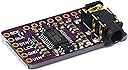
🎧 Elevate Your Audio Game!
The Teyleten Robot PCM5102 I2S IIS Lossless Digital Audio DAC Decoder Module is a high-quality digital-to-analog converter designed for seamless integration with Raspberry Pi and Arduino. Featuring the PCM5102A DAC, this module delivers superior audio performance compared to onboard analog options, with a pre-soldered stereo jack for effortless setup.
| ASIN | B09C5QX228 |
| Brand | Teyleten Robot |
| Customer Reviews | 4.3 4.3 out of 5 stars (44) |
| Interface | USB |
| Manufacturer | Teyleten Robot |
| Maximum Supply Voltage | 5 Volts |
| Mounting Type | Board Mount |
| Number of Channels | 2 |
| Number of Pins | 3 |
| UPC | 755454865971 |
J**J
Three of them for similar price to one, so was skeptical of quality, but wired it up and worked first try. Definitely would recommend.
C**N
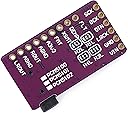
READ THIS BEFORE YOU SOLDER THIS ONTO YOUR PROJECT!!!! I bought this for an MT32-Pi project I was building. The first one didn't produce any sound, so I removed it and soldered another. After talking with some others in the retro computing/maker community near me, they told me the quality is hit or miss. After some time had passed, I was looking at another project that uses these. It noted the BACK side needs to have specific pads soldered/jumpered. I checked mine, NONE of them were set. One quick desolder off the MT32-Pi's PCB, connecting the appropriate pads, and resoldering it back, it NOW WORKS PERFECTLY. Check the attached image and make sure you short/solder these pads as shown so you don't end up like me. When it's jumpered/working properly, there is a red LED on the DAC itself showing it's initialized/active.
Z**I
I got this to build a DIY bluetooth speaker with an ESP32, it works wonderfully. The sound quality is better than I expected. It will easily drive headphones or the line-in on an amplified speaker.
C**E
It worked for me with basic sound from a FPGA though I am not an audiophile and can't comment much about the sound quality except that it's good enough for me. Some technical info follows. The is marked as Burr-Brown PCM5102A. The four jumpers 1, 2, 3, 4, at the bottom allows to connect FLT, DEMP, XSMT and FMT, to ground or vdd,. These four signals are also connected to the pads 1, 2, 3, 4, an the default is L, L, H, L. The four digital inputs SCK, BCK, DIN, and LCK, are connected via 220 ohm serial resistors to the IC, and the solder jumper new the SCK pad can be shorted if you don't use SCK (that's what I did, using the IC's PLL). There are two +3.3V LDOs that are fed from the VIN pad. One goes to AVDD and the other goes to CPVDD and DVDD. If you connect VIN to 3.3V they are almost like shorts and pass on the 3.3V. I connected VIN to 5V to have actual regulation and noise filtering on the board. The digital input are still at 0-3.3V level due to the DVDD regulator. The two outputs (on the jack and on the L and R pads) are connected through 470 ohms resistors. I replaced them with 1.5K to reduce the sound level with the headset I use (35 ohms per side). Overall it's a well designed board and I am happy with it.
D**E
I purchased these for my Raspberry Pi's. Very easy to connect and come with wire for hookup. DOES require 5v to work properly. Sound quality good and they appear well built. Great for those DIY projects that require sound using SPI connection. You can plug in earphones or wire it to larger jack's..
Trustpilot
1 month ago
3 weeks ago