


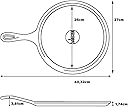


Lodge Cast Iron Round Griddle - 10.5 Inch
Product ID: 579108
Details
- BrandLodge
- Capacity10.5 cubic
- ColorBlack
- MaterialCast Iron
- Special FeatureMade without
🌿PFAS-free, non-toxic finish
🔥Even heat distribution
🛡️Pre-seasoned, ready to use
Desertcart purchases this item on your behalf and handles shipping, customs, and support to Mexico.
🔥 Elevate every meal with timeless cast iron craftsmanship!
The Lodge Round Seasoned Cast Iron Griddle is a 10.5-inch, pre-seasoned, PFAS-free cookware piece designed for even heat distribution and versatile use across stovetops, ovens, grills, and campfires. Made from durable cast iron, it offers a naturally non-stick surface that improves with use, supports chemical-free cooking, and comes backed by a lifetime limited warranty.

| ASIN | B00008GKDN |
| Additional Features | Made without PFOA or PTFE |
| Best Sellers Rank | #2,046 in Kitchen & Dining ( See Top 100 in Kitchen & Dining ) #2 in Griddles |
| Brand | Lodge |
| Brand Name | Lodge |
| Capacity | 10.5 cubic inches |
| Coating Description | Natural, Seasoned |
| Color | Black |
| Compatible Devices | Stovetop, Oven |
| Customer Reviews | 4.6 out of 5 stars 45,911 Reviews |
| Handle Material | Cast Iron |
| Included Components | Cast Iron Griddle |
| Item Highlight | Non-Toxic Round Cast Iron Griddle Pan, Pre-Seasoned & Compatible with Stovetop, Oven, Grill & Campfire |
| Item Type Name | Lodge Cast Iron Rectangular Griddle |
| Item Weight | 4.7 pounds |
| Manufacturer | Lodge Logic |
| Manufacturer Part Number | L9OG3 |
| Manufacturer Warranty Description | Lifetime limited manufacturer's warranty |
| Material | Cast Iron |
| Material Type | Cast Iron |
| Maximum Temperature | 650 °F |
| Metal Type | Cast Iron |
| Model Name | Pre-Seasoned Cast Iron |
| Model Number | Lodge Cast Iron Rectangular Griddle |
| Number of Items | 1 |
| Number of Packs | 1 |
| Product Care Instructions | Hand Wash Only, Oven Safe |
| Recommended Uses For Product | Use in the oven, on the stove, on the grill, or over a campfire |
| Shape | Round |
| Special Feature | Made without PFOA or PTFE |
| Specific Uses For Product | Bake, Braise, Broil, Fry, Saute, Sear |
| UPC | 075536341057 |
| Unit Count | 1 Count |
C**A
I ALMOST bought a crepe pan...
So, I had a craving for Crepes Suzette and hit the YT to find a recipe. Most videos showed a crepe pan and they are cheap enough but unfortunately they are cheaply made and don't last- especially with a nonstick coating. I am the kind of cook that values quality and shies away from specialty products or gadgets. That and after a few crepe sessions, how many times would I use a crepe pan? Or the wood spatula? I know I will always pull out a piece of cast iron cookware, either char veggies and peppers, cook a hearty stew, or to make an English breakfast and I own only Lodge cast iron products. This Lodge Griddle could be used for mini pizzas, charring, French toast, pancakes, and CREPES! This griddle comes preseasoned but I washed it and oiled it before use. My first attempt at crepes was less than perfect though and I narrowed my technique down to two flaws: one I didn't let the batter rest for one hour and two, I didn't apply enough batter to completely cover the griddle. They fell apart and were stringy, like when you have a dribble of batter and it leaves that crusty trail? That was on the bottom 1/4 of the pan because I didn't have enough batter to cover the pan. The next batch was improved but with the same recipe; it was allowed to rest and I used a soup ladle-full of batter and turned the pan quickly. This batch turned out fantastic! I used a large metal Wilton spreading knife to flip the crepes. The pan heated evenly, the crepes released effortlessly, and they were paper thin. I mean, they were so thin a piece of tissue paper called them thin! If the crepes were a little durable, I'd replace my windows with them. Thin. If Lady GooGoo knew how thin these crepes were, she'd wear them as an outfit. Thin. Anyway, the two down sides, you can guess both if you own cast iron. First, this pan is heavy. Not so heavy that you couldn't handle it, twist it to distribute the batter, or to flip your items, but heavy enough to burn a few extra calories to have an extra serving of whatever you're cooking. Be extremely careful when flipping your items over and onto a glass plate. I clinked the two a couple of times but you know Corelle, that stuff is tough! You might not be so lucky if the griddle slips. Be careful. The other one, a little more serious, the handle does get hot. I typically use a kitchen towel on the fly but I used my lodge frying pan last week so I had my red handle cover handy- so I used it. DO not try to grab this handle without protection. If you do, you won't make that mistake again. Now a couple of tips, based on the reviews I have read about this pan. Rust. Rust doesn't ruin this pan. Look up how to clean and season cast iron. Food sticks. Season your pan and oil accordingly before applying food. Sometime I add oil, sometimes I don't. Sometimes I add water, yes water. This all comes back to cooking though. If you get this griddle because it is a great price but don't know how to use it, that's not cast iron's fault. It's the cook. Cast iron works! Rough edges or finish. You can use a file, sandpaper, or a grinder to knock of rough spots. Don't go nuts and more often than not- just leave it alone unless it becomes a health hazard. I have only had to do this once and I have two dutch ovens, a griddle plate for our grille, three frying pans, lids for everything, a few cornbread molds, and our newest edition this griddle pan. If you are uncomfortable with any potential warranty canceling modifications, get another one through Amazon exchange, or contact Lodge. I bet both will be happy to help. Bottom line, don't get discouraged and give this griddle pan a try. Finally, enclosed you will find a few pictures of this pan and its products and the end result, Crepes Flambe. I always thought Crepes Suzette was set alight but not true! A video by Chef Stéphane of the French Cooking Academy showed what true Crepes Suzette were- but personally, I want fire! Anyway, after the crepes were made, I used a taller pan for the orange sauce and final preparation because to use the low walled griddle would be extremely dangerous and irresponsible. Good luck, happy cooking, and get this griddle pan!
B**N
♣️♣️♣️ a KiTCHeN eSSeNTiaL — BuiLT To LaST FoR GeNeRaTioNS ♣️♣️♣️
This cast iron griddle is truly the MVP! From pancakes and eggs in the morning to searing steaks and warming tortillas in the evening, this griddle does it ALL — evenly, efficiently, and with that unbeatable cast iron heat retention. What I love the most is the versatility — it works beautifully on the stovetop, in the oven, over a campfire, and even on my grill. Once it’s properly seasoned, it becomes virtually non-stick, and cleanup is a breeze with just hot water and a brush. You can feel the quality in the weight and craftsmanship. It’s the kind of cookware you pass down to your kids. I also appreciate that it’s made in the USA and comes pre-seasoned — so it was ready to use right out of the box. So, if you’re serious about good cooking or just want to elevate your daily meals, this is the griddle to grasp because Lodge NEVER disappoints! PRO TIP:: Give it a little extra oiling and bake it a few times when you first get tit though Iif interested, I’ll tell you how below) — you’ll fall in love with the results. Use an oil with a high smoke point and that forms a good layer of seasoning, like canola oil, Crisco (vegetable shortening), or grapeseed oil. I’ve used vegetable oil too. Avocado oil, I think can be used too, but don’t quote me on that particular one as I’ve never used it. But if I take a guess, I THINK it can be. But the FIRST thing you do even before oiling it and baking it is wash it thoroughly as soon as you get it with a teeny-tiny bit of soap and hot water, EVEN IF IT SAYS IT IS PRESEASONED! But ONLY DO THIS ONCE! After this first wash, you won’t have to use soap ever again! This is to remove any of the factory residue. But you are then to dry the pan completely. Then with a think layer of oil (I pour a bit on the pan and then take a paper towel and wipe it completely with oil in all of the nooks and crannies inside and out and the handle with an even coat of whatever oil you choose to use. Place it upside down on your top oven rack and put a baking sheet (or if you want to line the bottom rack with foil you can do that instead of the baking sheet) on the bottom rack to catch the excess oil that drips off the pan. Bake this @ 450 degrees for 45 minutes to an hour. Then turn the oven off and let it cool completely inside the oven to allow the oil to set. Now, for a smoother, non-stick finish, it’s BEST to repeat this process 2 or 3 times, BUT you don’t have to. I like to though, but who knows,…maybe it’s because I’m extra. Then, BOOM! Your brand new cast iron is ready to make some magic happen!! Enjoy!!
W**L
Easy Does It
Cooking on cast iron is an art. I grew up with these as a child so I instinctively know what to do. Some aficionados here on Amazon pride themselves on seasoning their cookware with flax seed oil. My dad was a professional chef and we never did that when I was a kid so I don't do that now. It's really simple. You never cook dry. This is old school cooking 101. You never pour a cake mix into a baking pan without buttering the pan. And you never put anything on a heated griddle unless you oil or butter it first. When I bought this I decided to try coconut oil and it works pretty well. Another reviewer advised against vegetable oil and he's right in the sense that if you overheat vegetable oil on a griddle you will essentially create a glue that will cause things to begin to stick to the griddle. This isn't a problem if you're vigilant and avoid burning the vegetable oil. But the better advice is simply not to mess with it. As has been mentioned by others, if you always treat the surface before cooking on it, you won't have any trouble with anything sticking to it EVER. I bought this to make pancakes and it's been nothing but joy. I also filled the entire pan with egg batter and made scrambled eggs and then mixed that in a mixing bowl with rice which I had made in the rice cooker to produce egg-fried rice. Worked great. There's nothing like cooking on cast iron. It creates a self-contained uniform heat that produces wonderfully consistent results. On the other hand, when used without care, it produces burnt food that seemingly requires a jackhammer before you can remove it from the pan. If you're a patient person you'll do fine. If you think cooking goes faster by turning the burner on high, then this is not for you. The best advice I can give is to ALWAYS keep it oiled. Until you get used to it, UNDER heat rather than overheat. If you overheat with a cheap oil, you now have glue and you have failed to ALWAYS keep it oiled (not glued). The natural result of producing glue will be food sticking to the pan. If you fail to remove ALL of the glue, you will CHRONICALLY experience food sticking. Heat the griddle slowly. Run some cold water on your hand. Then flick the water onto the pan. When the water bubbles up and evaporates the surface is ready for cooking. If the water immediately steams off, the surface is too hot. Turn down the burner and wait. DO NOT PUT FOOD ON THE SURFACE until it cools down some. When it has cooled down, re-oil the surface. Do the flick test again and if the water bubbles and then evaporates, you're ready to cook. Remember, cast iron stores and maintains heat. It doesn't get instantly hot. And turning the burner on high won't make things happen any faster. Don't go past medium. Give it a chance to store the heat. If you turn the burner on high, here's what happens: The griddle begins storing LOTS of heat. But it still is warming up slowly. By the time you think that the cast iron is hot, it has STORED up a tremendous amount of heat. It's WAY too hot. At that point you turn down the heat. But it doesn't matter because the heat is STORED. At this point, the former vegetable oil is now turning into plastic. And it's at this point that the fool begins to cook. The food now begins bonding to the plastic. And any further cooking just enhances the bonding process. The fool's conclusion: "cast iron is no good." If you're an impatient person, this is not for you. If want to watch television and knit while you're cooking, this is not for you. However, if you enjoy cooking and you're looking for an item that will improve and enhance your results, this is definitely for you. Take your time. Begin slowly warming up the griddle in advance while you're mixing up ingredients so that you don't have to rush. I love this griddle and you will too! Just remember: Easy Does It.
S**5
Bought for homemade tortillas. It'll be perfect!!
Recieved my comal iron skillet and am going to attempt to make homemade flour tortillas on it. Im still waiting on the skillet conditioner I ordered but just by looking at it I have no doubt it is going to do just fine in making some good old fashioned homemade tortillas. The size is perfect for up to a 10 inch tortilla. The handle will be a nice to move it on or off of the stove. It didn't come with a lid and a comal or skillet like this doesn't need a lid. The skillet is made up of cast iron and is quite heavy. Appears very well made and I am sure it will work perfectly whenever I make my tortillas.
P**K
Great for crepes and fajitas
I have been cooking with Lodge cast iron for thirty years and have never been disappointed. I have two skillets, grill pan, muffin pan, cornbread pan, dutch oven, and now the griddle. The latter was a replacement for a more expensive French made carbon steel crepe pan that just wasn't up to snuff. I wanted a crepe pan that was naturally non-stick. The Lodge griddle certainly is - now. The reason I am giving it 4 rather than 5 stars is the griddle arrived with a defect. A tiny granular bump in the middle of the pan that no amount of seasoning was going to smooth out. Fortunately my husband had a grinding tool that made short work of the defect. I washed the pan, dried it, rubbed bacon grease (best for seasoning) on it and then seasoned again in the oven. Since then eggs slide right off the surface. I have made incredible sliced steak with onions and peppers. Tonight I put it to the ultimate test: I made crepes. Worked like a charm. The only drawback I can see is the weight of the pan. Like all cast iron cookware it is heavy. No problem for me, but I am a man. If making a lot of crepes fatigue might be an issue using the swirling method to distribute the batter. Should not be a problem if cooking for just a couple of people or even a family of four. I paid $20 for the griddle. The fancy French pan easily cost twice that much. The Lodge griddle is going to outlive me. You just can't beat that kind of value.
R**R
Great pan
I ran a palm sander with 40 grit for a little bit and made it smoother. MADE SOME GREAT SMASH burgers so far. Thing heats up fast and holds heat
N**M
More long-term reliability and fun than non-stick and better for the environment.
When the ceramic coating started chipping off my waffle maker, I was not happy. The only cookware I have that is long lasting is cast iron. But I can't find a castiron waffle maker from a source I trust buying. I decided to start making crepes because I don't like the soggy floppiness of pancakes. But the non-stick electric crepe maker made me uncomfortable each time I took it out of the cupboard. I wanted to feel at ease with all my cookware, not just my cast iron, but that seemed very unlikely for making waffles. I immediately washed the griddle with soap and water, rinsed thoroughly, and seasoned a couple times in my oven. Before this griddle arrived, I researched a few recipes in preparation. So I made crepes for several days. Not a single crepe burned or stuck to the griddle. Every crepe slid off easily onto a waiting rack. I have never made crepes on a griddle or skillet but it was easier than using the electric crepe maker. And I didn't have to shuffle zen garden tools around my small work area. Making crepes wasn't my only interest for this new griddle. I have other Lodge cast iron, 12 at the time of this review. They are of a solid build and versatile. Making crepes is just doing the same thing, same batter, same heat setting, same spatula again and again. You learn a lot more about your cooking abilities with using cast iron when you make different food. No one wants leftover fried chicken or pizza that is soggy. Using this griddle as a sheet pan in the oven is perfect for reheating leftovers. Bits of cheese didn't stick when making grilled cheese. Peppers and onions can be sauteed quickly. Homemade bread rolls, biscuits, and dough wrapped sausages bake with an even crust color. Using cast iron, you owe it to yourself to do some experimenting. Use stainless steel spatulas with your cast iron? Yes! If you are really heavy handed you might get a scratch or two. But repeatedly seasoning your griddle makes it so it's practically self-healing. Keep using the cast iron and those scratches disappear more quickly than you can guess - as you season. I cut food while still on the griddle regularly and I can't see a single scratch. You can use a mild soap when cleaning the griddle. I usually only use soap before the first use. I have not had food stick to the point where I have to soak it in water. Run water, use a brush or scraper, and a little coarse if needed. Cleaning is done in about a minute, then dry and season. For me, doesn't matter if it's as soon as the griddle has cooled, or the next day. That's not heavy maintenance at all. Any one tells you cast iron is too much time and work to maintain is just lazy or not well informed. The first Lodge cast iron I purchased for myself was a 12" skillet and with each new Lodge, I am more than satisfied with the performance and excited to explore new recipes and make old recipes more fun. Yesterday I made giant 10 inch cookies with this griddle. Rumors that sugar ruins cast iron seasoning are false. I make cookies, brownies, cobblers, hand pies, cheesecakes, pound cakes, scones, etc. often because I have a passion for baking. My giant cookies released from the griddle after using an angled spatula in one spot. Cookie nearly popped up like a jack-in-the-box. Again, success and easy cleanup, much better than my old non-stick cookie sheets ever did. Am I pleased with this griddle? Yes, absolutely! Would I recommend it for crepes, pancakes, reheating food, making giant cookies? Yes, certainly! I know this griddle is a Lodge and as always reliable cast iron. I also know that I am looking forward to learning to make the most of it and learn to make food I have not tried, like dosa, corn tortillas and whatever recipes others want to share.
D**E
5 Stars – Excellent Quality and Great Value!
I recently purchased the Lodge L9OG3 Cast Iron Round Griddle (10.5-inch), and I am thoroughly impressed! Here's my detailed review: Pros: Excellent Quality: The quality of this cast iron griddle is outstanding. It’s heavy-duty, well-made, and feels incredibly durable. Lodge is known for its high-quality cast iron cookware, and this griddle lives up to the brand’s reputation. Pre-Seasoned for Convenience: The griddle comes pre-seasoned, which means you don’t have to worry about seasoning it yourself before use. The non-stick surface works well for cooking a variety of foods, from pancakes to grilled sandwiches, and cleanup is a breeze. Versatile Cooking Surface: The 10.5-inch size is perfect for most stovetops, and it provides plenty of space for cooking. Whether you’re cooking breakfast, searing meats, or making flatbreads, this griddle does it all with ease. Safe and Reliable: Cast iron is known for being safe and non-toxic, and this griddle is no exception. It’s a great option for those looking for a reliable, safe cooking surface without worrying about chemicals often found in non-stick cookware. Long-Lasting and Durable: Cast iron is incredibly durable and can last a lifetime with proper care. This griddle is built to withstand high temperatures and heavy use, making it a great investment for anyone who enjoys cooking. Great Price for the Quality: Given the durability, brand reputation, and versatility of this griddle, the price is very reasonable. You’re getting a high-quality product that will last for many years, making it a solid value for your money. Cons: Heavy: As expected with cast iron, the griddle is a bit heavy. It’s not the easiest to lift, especially when it’s hot. However, this is a minor issue considering the overall quality and performance. Requires Proper Care: Like all cast iron cookware, it requires proper maintenance (such as seasoning and occasional re-seasoning) to maintain its non-stick surface and prevent rust. But this is standard for cast iron and easy to manage. Final Thoughts: The Lodge L9OG3 Cast Iron Round Griddle is a fantastic addition to my kitchen. It’s of excellent quality, easy to use, and built to last. The pre-seasoning is a nice touch, and the griddle cooks food evenly and efficiently. If you’re looking for a durable, versatile, and affordable piece of cast iron cookware, I highly recommend this griddle. It’s definitely worth the investment!
P**K
Should last a lifetime
Excellent quality, worth paying the money for something that should last a lifetime and has none of the poinsonous non stick junk on it. The quality comes with it being heavy, it'll be interesting to see how I cope with tossing pancakes in it, great size, versatile for other frying. Cleaning is easy and stability is no issue on my hob,
د**م
ثقيلة بس خامتها جيدة
منتج ممتاز
B**N
薪ストーブでピザを焼くために購入
薪ストーブでピザを焼きたくて購入しました。 おそらく400度近い温度だとおもうが、あっという間に外カリ、中もちの美味しいピザができました。焦付きも全くなく、IHでもつかえるので、美味しいステーキも簡単に作れました。手入れは、お湯で洗って、オリーブオイルを薄く塗っておくだけなので、簡単です。 当たり前だけど、無茶苦茶重たいので、気を付けないと落としたら大変そうです。
A**V
Excelente producto
Este comal, sartén es súper funcional, me encantó el producto
D**K
We can make perfect dhosa everytime
We are happy with lodge brand and we can make perfect dhosa
Trustpilot
3 weeks ago
2 months ago