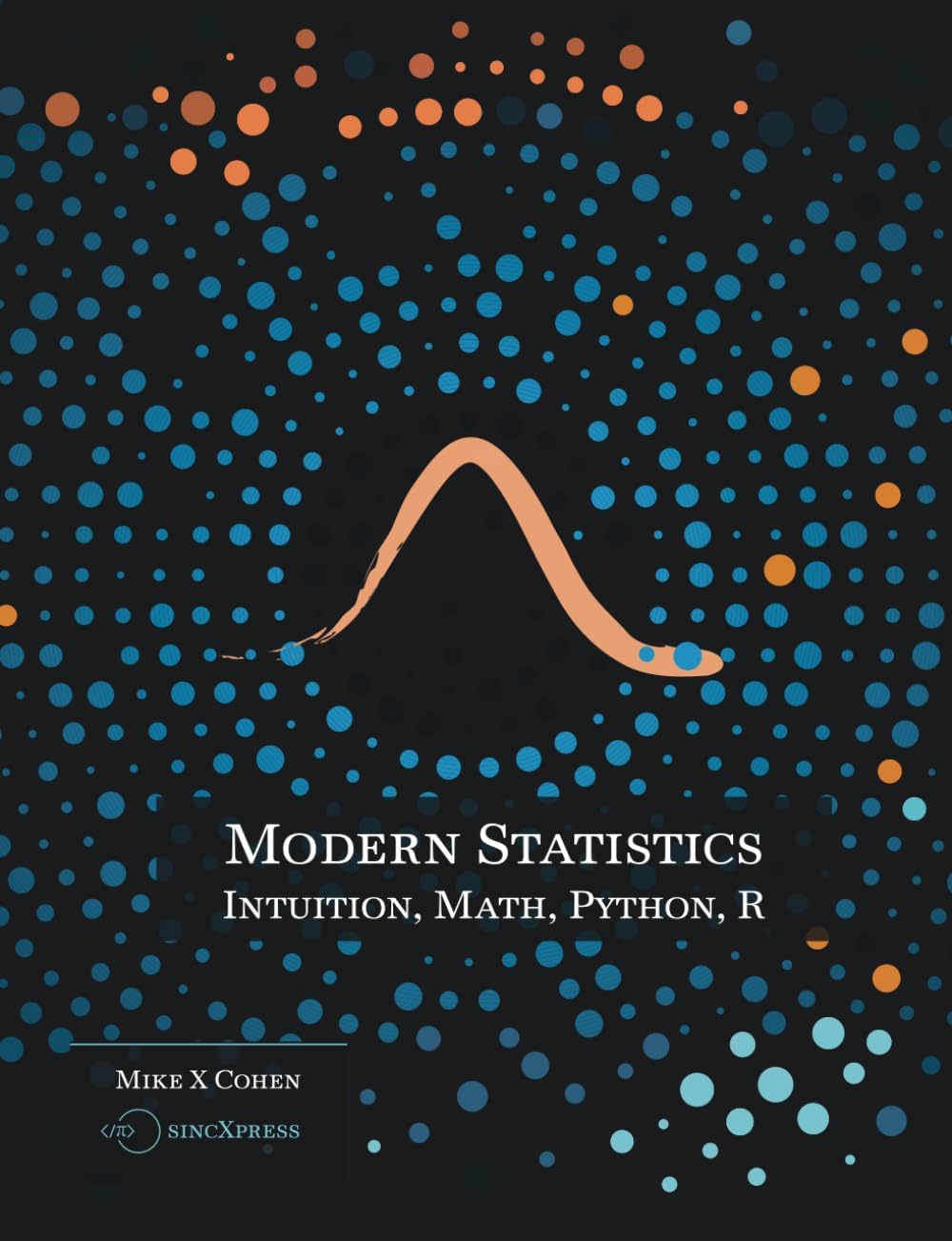
Modern Statistics: Intuition, Math, Python, R
Product ID: 598153487
Buy anything from 5,000+ international stores. One checkout price. No surprise fees. Join 2M+ shoppers on Desertcart.
Desertcart purchases this item on your behalf and handles shipping, customs, and support to Mexico.
All code files and exercise solutions are available at https://github.com/mikexcohen/Statistics_book "Modern Statistics: Intuition, Math, Python, R" is an authoritative and comprehensive textbook designed to guide university students and professionals through the intricate world of statistics, data science, and machine learning. This extensive 700-page volume, with its impressive array of 390 figures and over 35,000 lines of code (all code and a sample chapter are freely available on github), offers a unique blend of theoretical and practical knowledge, making it an indispensable resource for those seeking to deepen their understanding of statistical methodologies and their applications in the modern digital era. Beginning with foundational concepts, the book delves into what data are and how they can be visualized, setting the stage for more complex subjects. It covers key areas such as descriptive statistics, data simulation, transformations, and data quality assessment and improvement, providing a robust framework for data analysis. The exploration of probability theory, sampling, and distributions paves the way for an in-depth discussion of hypothesis testing, including a detailed examination of the t-test family. The book places a strong emphasis on the practical implementation of statistical techniques, with extensive Python and R code examples that bring to life the concepts of correlations, confidence intervals, ANOVA, and regression analysis. The chapters on permutation tests, power and sample size calculations, biases, and data communication underscore the importance of robust statistical practice and effective data storytelling in research and professional settings. This textbook is not only a rich source of statistical knowledge but also a practical guide to applying these concepts using the latest software tools. It bridges the gap between statistical theory and real-world data analysis, ensuring readers are equipped to tackle complex data challenges with confidence. Whether you are a student embarking on your statistical journey or a seasoned professional looking to refine your skills, "Modern Statistics: Intuition, Math, Python, R" is a vital addition to your educational toolkit. Targeted at those who appreciate the rigor of statistical analysis and the nuances of data interpretation, this book is a testament to the ever-evolving field of statistics and its pivotal role in the age of data science and machine learning.
| Asin | B0CQRGWGLY |
| Dimensions | 7.44 x 1.57 x 9.69 inches |
| Isbn 13 | 979-8867723736 |
| Item Weight | 2.67 pounds |
| Language | English |
| Print Length | 694 pages |
| Publication Date | December 20, 2023 |
| Publisher | Independently published |
| Reading Age | 13 - 18 years |
User
An oasis in a desert of statistics books!
Having thoroughly read the first six chapters, I believe I am in a good position to comment on the book thus far.First, to legitimize my opinions, it is important to mention my background in Science. I am a pharmaceutical chemist, and I have a master's degree in Biochemistry. I recently did an online specialization in data analysis with R through Duke University.Usually what you expect when you begin reading a Statistics book is to start by learning concepts about probability and you will have to be comfortable solving exercises using dice; instead, Cohen’s book starts with even more fundamental topics, critical to understand, comprehend and play around with more advanced concepts. Starting by reviewing subjects like data, visualization, transformations, and, in particular, simulations, allows you to leverage your thinking as a researcher. Examples like those outlined in section 5.6.1 and exercises 4.8, 5.1 and 5.2, to mention just a few, are so insightful.All the chapters so far are full of very valuable information derived from the author's experience, even addressing questions that other books catalog as “out of the scope of this book”. Reading this book, you feel as though you are being guided by a real wise professor, with wisdom derived from his experience in the field of data analysis. But most importantly, from a pedagogical point of view, the book was designed and structured in the same way as higher education should be: the professor, in this case the author’s book, guides us through the concepts, but the reader shoulders the responsibility of learning, in particular, by going thoroughly through the exercises, exercises which were very, very well designed and structured, having a specific pedagogical goal in mind: make the reader discover by himself the reasoning behind every single algorithm, statistical procedure or concept. Sometimes one exercise lays the groundwork for the next one, and after finishing all the end-chapter exercises, you have essentially completed a full workshop on the topic! In this way, one can learn statistical concepts in concrete scenarios utilizing creative simulated experiments rather than by throwing dice. One has to figure out why and how a particular problem should be tackled, and then, one must figure out why and how particular code should be used and implemented. These drills, which I found highly challenging, will be absolutely useful for solving future problems in our role as data analysts. In addition, the book delightfully merges statistical concepts with the underlying mathematical foundations.Caveat: You should try to solve the exercises by yourself. If that is definitively impossible, analyze the code provided by the author. Don’t get intimidated by the code presented! Be patient and seek additional information on the Internet about new R commands you come across, and why the author used them, and how. In my case, I spent many hours trying to decipher the code stated for a single exercise, but it has paid off. In order for you to improve your coding skills even further, I suggest that once you have understood the whole code, try to implement new ways of solving that particular exercise, ways that make more sense to you or that are more intuitive to you. I have discovered that some exercises could be tackled with fewer lines of code and in a more intuitive way.In summary, up to this point in my reading (chapter 6), the author has done exceptional work in regard to structure, content, and explanations. The statistical reasoning one acquires by working on those simulations is phenomenal, not to mention the skills acquired on R coding. I think this is the type of book targeted at researches who want to leverage their (mathematical) comprehension of statistics concepts to be applied as part of their tools to understand the Universe, not for those folks who wants to earn some bucks by introducing data into a statistical software, copy and paste some code, then present the yield as an “analysis”.Thank you Professor Cohen for the effort you put into this book.I will update my review as I continue reading chapters.
User
Clear, Engaging, and a Great Resource!
I love Dr. Cohen’s clear and engaging tone! Having taken his EEG, stats, and MATLAB courses, I was thrilled to get this book. It’s a great resource with very intuitive explanations of statistical methods. I especially recommend it for those without a neuroscience or experimental background who haven’t collected data before. It helps build an understanding of data such as outliers and emphasizes that there’s no one-size-fits-all approach to analysis. Plus, the wide margins make it perfect for taking notes. Highly recommend! 📖✨
User
Perfect text on statistics
This is an amazing text on Statistics written from the field, not like some BS ivory tower professor’s book. I wish I had seen this book before I spent hours trying to figure out inconsistent notations, formula proofs in other books. This book should be a prerequisite for anyone who wants to learn what statistics knowledge is necessary today.
User
incredible - i wish i was thought like this in school
Instead of just arbitrary rules and formal symbols, we learn what we’re doing as if we were doing them by hand and get an intuition of what we’re doing and why. I would read this for every math discipline there is.
User
Best basic Statistics book out there!
If you truly want to learn AND understand statistics, then this is the book! Very detailed yet conversational and easily digested. Superb explanations for each statistical analysis and type.
User
Fantastic and intuitive!
This book is an absolute must-have for those wanting to develop an intuitive understanding of statistics. Cohen has a knack for explaining concepts in an accessible way, and the coding exercises do a great job of reinforcing the content.
User
Kindle version clearly was neglected
Clearly nobody cared about the kindle version when writing and editing this book. Most sidebar content runs off the pages. "See figure x.yz" and it's just 2 words and some lines clearly truncated.
User
Easily the best more straight-forward and comprehensive statistics book.
Mr. Cohen has a talent for writing in a clear and plain manner. I have all of his books. His Linear Algebra book is a must have for Data Scientists.
User
Buen libro, recomendado
👍
User
Low print quality
Seems a good and comprehensive book on statistics, but printing quality is quite bad, seems printed by a cheap laser printer with low toner
User
Builds practical intuition and deep understanding
The author teaches you important statistical concepts in a way that builds very deep, intuitive understanding to where you can use these skills in the real world, highly recommend this book.
User
Remmomend to all students, data analysts/scientists
Great book and a Brilliant Teacher. Maybe, it would be even better with Mixed Effects Models, maybe in a future book, Overall a big 5*
User
Resultó ser una gran compra.
Es un buen libro, actualizado y una contrbución importante.
Trustpilot
2 months ago
2 months ago