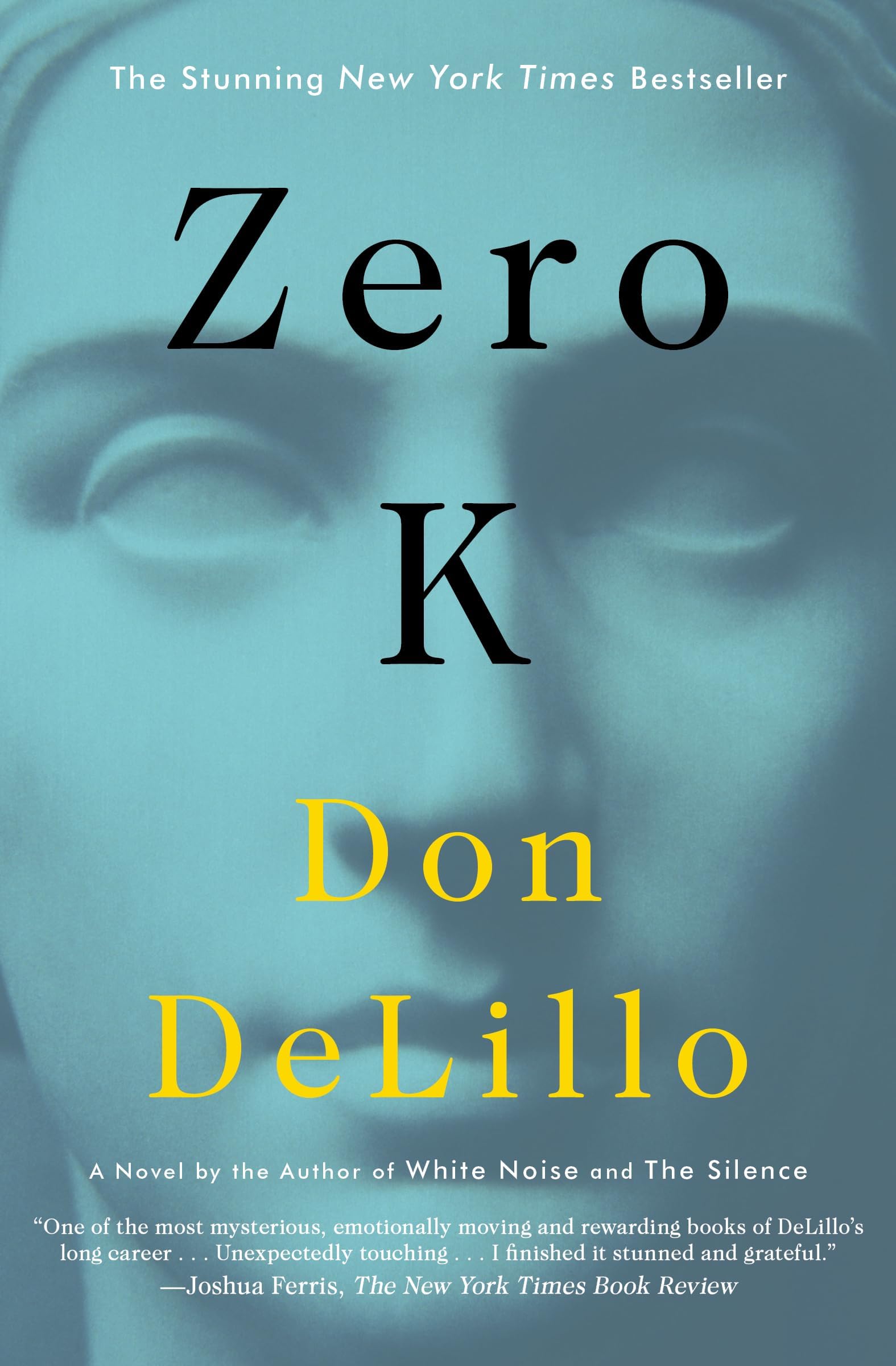

Zero K: A Novel [DeLillo, Don] on desertcart.com. *FREE* shipping on qualifying offers. Zero K: A Novel Review: Life, unpaused but still - There's a strange video screen in the sorrowful underground of the main setting for Zero K; it plays non sequitur videos that seem unlikely, if not impossible, to capture. Like a Bill Viola exhibit injected with personal reality, narratives unfold on them silently in dreamy, terrible landscapes. Like Robert Capa or Sean Flynn war photos, they seem too true to be real. This is Delillo territory now, and has been in pieces for his career. Scenes are dead weird; characters experience crippling or overwhelming anomie, inhabiting extremes -- of wealth, of arid desert, of grief and of intense desire. Each book itself turns over like the next flipper of a steel sea serpent undulating through modernity. They're different, but the skin is the same, the shape familiar, the propulsion outsized and extraordinary. What you need to know about the book: It muses, as always, on the riddle of living when death is certain, in a world where its inevitability robs joy and hope. Its characters display ample wit, self-knowledge, and care, but find themselves trapped in a centrifugal vortex that forces them to alienate themselves in a grief of contemplation. The language, as always, is precise, and evokes Mamet. There is an absurdist core, but Delillo shows great kindness and compassion for the human inability to release itself from a rage for sorrow. The plot satisfies, but not conventionally. In truth, the book is in the same territory as the videos it depicts: Clear as distance in a world without atmosphere, life in it unlikely but uncommonly precious -- indeed, more so, because of the absolute certainty of its doom. Review: A return to lyrical abstraction and contemplation over mortality - Zero K returns to many of DeLillo's themes and preoccupations, particularly how human beings process mortality and our relationship with the planet. I feel that certain aspects of DeLillo's writing have improved with time, in particular the pensive, meditative voice of the text, in which he manages to articulate deep abstract concepts in a lyrical manner. For example, "This was the aesthetic of seclusion and concealment, all the elements that I found so eerie and disembodying. The empty halls, the color patterns, the office doors that did or did not open into an office. The mazelike moments, time suspended, content blunted, the lack of explanation." Passages like these provide a unique, estranged sense of interiority, which works particularly well for exploring how human beings mentally process mortality. One issue I have noticed in DeLillo's most recent texts, however, is that its subject matter goes so deeply cerebral and abstract I find myself searching for characters and a sense of a living community in the text. It's like when you see a Sims game and immediately realize the people in that fictional community are just sort of there, present, but no sense of real life being lived between them. People in his texts feel more like generic propositions of people than they do relatable individuals. That balance between the inner voice of the narrator, and the lives of other characters in the text, often feels neglected, more so than it did in earlier novels like White Noise, which also had mortality as one of the central preoccupations in the book. Overall I found Zero K an enjoyable read because of its refined style, voice, and linguistic craftsmanship. I would recommend it as a good concept-based novel, rich with poetic and philosophical appeal – BUT if that's really not your cup of tea this might not hold your attention.


| Best Sellers Rank | #313,311 in Books ( See Top 100 in Books ) #240 in Humorous American Literature #1,830 in Family Life Fiction (Books) #6,326 in Literary Fiction (Books) |
| Customer Reviews | 3.5 3.5 out of 5 stars (1,356) |
| Dimensions | 5.25 x 0.6 x 8 inches |
| Edition | Reprint |
| ISBN-10 | 1501138073 |
| ISBN-13 | 978-1501138072 |
| Item Weight | 8.3 ounces |
| Language | English |
| Print length | 288 pages |
| Publication date | May 16, 2017 |
| Publisher | Scribner |
W**T
Life, unpaused but still
There's a strange video screen in the sorrowful underground of the main setting for Zero K; it plays non sequitur videos that seem unlikely, if not impossible, to capture. Like a Bill Viola exhibit injected with personal reality, narratives unfold on them silently in dreamy, terrible landscapes. Like Robert Capa or Sean Flynn war photos, they seem too true to be real. This is Delillo territory now, and has been in pieces for his career. Scenes are dead weird; characters experience crippling or overwhelming anomie, inhabiting extremes -- of wealth, of arid desert, of grief and of intense desire. Each book itself turns over like the next flipper of a steel sea serpent undulating through modernity. They're different, but the skin is the same, the shape familiar, the propulsion outsized and extraordinary. What you need to know about the book: It muses, as always, on the riddle of living when death is certain, in a world where its inevitability robs joy and hope. Its characters display ample wit, self-knowledge, and care, but find themselves trapped in a centrifugal vortex that forces them to alienate themselves in a grief of contemplation. The language, as always, is precise, and evokes Mamet. There is an absurdist core, but Delillo shows great kindness and compassion for the human inability to release itself from a rage for sorrow. The plot satisfies, but not conventionally. In truth, the book is in the same territory as the videos it depicts: Clear as distance in a world without atmosphere, life in it unlikely but uncommonly precious -- indeed, more so, because of the absolute certainty of its doom.
S**E
A return to lyrical abstraction and contemplation over mortality
Zero K returns to many of DeLillo's themes and preoccupations, particularly how human beings process mortality and our relationship with the planet. I feel that certain aspects of DeLillo's writing have improved with time, in particular the pensive, meditative voice of the text, in which he manages to articulate deep abstract concepts in a lyrical manner. For example, "This was the aesthetic of seclusion and concealment, all the elements that I found so eerie and disembodying. The empty halls, the color patterns, the office doors that did or did not open into an office. The mazelike moments, time suspended, content blunted, the lack of explanation." Passages like these provide a unique, estranged sense of interiority, which works particularly well for exploring how human beings mentally process mortality. One issue I have noticed in DeLillo's most recent texts, however, is that its subject matter goes so deeply cerebral and abstract I find myself searching for characters and a sense of a living community in the text. It's like when you see a Sims game and immediately realize the people in that fictional community are just sort of there, present, but no sense of real life being lived between them. People in his texts feel more like generic propositions of people than they do relatable individuals. That balance between the inner voice of the narrator, and the lives of other characters in the text, often feels neglected, more so than it did in earlier novels like White Noise, which also had mortality as one of the central preoccupations in the book. Overall I found Zero K an enjoyable read because of its refined style, voice, and linguistic craftsmanship. I would recommend it as a good concept-based novel, rich with poetic and philosophical appeal – BUT if that's really not your cup of tea this might not hold your attention.
L**F
Missed the marks.
I looked forward to how DeLillo would combine futurism with a character study and was disappointed. The science fiction is already yesterday's news (Ted Williams) and the characters are one dimensional, less than believable and even if believable, not very compelling.
C**S
Annoying at best, maddening at worst
I purchased this as a Kindle book on the first day of its release. This was my third Delilo, having enjoyed White Noise and Falling Man previously. Is this book for you? Let’s try this sample paragraph. “I eat sliced bread because I can make it last longer by refrigerating it, which doesn’t work with Greek or Italian or French bread. I eat thick, crusty bread in restaurants, dining mostly alone by choice. All of this matters even if it’s not supposed to matter. The bread we eat. It makes me wonder who my forebears were, but only briefly.” How did that sample grab you? Did you enjoy it? Think it clever? The sample I mean. And what about the sentence fragment? If you liked it, there’s a whole lot more of that type thing in this book. If you didn’t like it, you will probably loathe this book. If you came to Zero K looking for colorful, creative sentences like those you’ll find in White Noise, then you've come to the wrong place. The characters in the book often speak in identical fashion to the way the author writes the narrative, with sentence fragments, unanswerable questions, and cryptic answers. The characters? The narrator and main character Jeff has OCD and a need to assign a name to every stranger he meets. His other compulsions include counting his steps as he walks, checking and rechecking for his wallet and keys, and checking and rechecking doors. Rather than taking medicine for his condition, or just suffering in silence, Jeff torments the reader with his obsessive thoughts repetitiously throughout. Jeff is a lot like Stak, his girlfriend’s adopted son, an egghead genius twerp, who, like no other child ever, orders broccoli, and nothing else at a restaurant, because it’s good for his bones. In short, the characters, their behavior, and the manner in which the story is told are all annoying at best, maddening at worst. Good news! The last chapter is good. The ending is compact and abrupt, but satisfying, perhaps even hopeful. I’ll shut up and avoid the risk of spoiling one of the few good things about this otherwise very dreary novel. If you’ve trudged through to the end, God knows you’ll deserve a pick-me-up when it’s over. Now go reread White Noise.
A**R
I mean it s don
L**O
Metodo di scrittura molto particolare, deve piacere il genere.
B**U
In an interview with Ed Caesar in The Times in 2010, DeLillo suggested that "reading a novel is potentially a significant act" because of its exploration of human experience. In comparison with DeLillo's other novels, Zero K demands readers' attention. Most words, like "purely atmospheric" have a double, sometimes triple meaning. In spite of the austere writing style in part one, the play between words and images produces such emotive effects all throughout the narration that you do not realize what has hit you at the end. If you pay attention to the algebra homework - sine cosine tangent- Jeff mentions in part one, you may enjoy the sun set at the end of the novel in awe. All you need is an angle to choose from many artistically created perspectives to remind yourself what it means to be human in the twenty-first century.
J**L
Don DeLillo is probably my favourite author. Here he's back to his best with a wonderful work on the (at first sight unpromising) theme of end of life. Humanity wins through.
V**L
De Lillo ist seit Underworld einer meiner Lieblingsautoren, aber dieses Buch ist banal und so depressiv, dass man es bitte am besten ungelsen wieder weglegt oder verschenkt.
Trustpilot
5 days ago
1 day ago