Desert Online General Trading LLC
Dubai, United Arab Emirates
Desert Online General Trading LLC
Dubai, United Arab Emirates
Full description not available
P**N
A Reformation in Islam?
Two magisterial works of German Quaranic scholarship are at last available in English: Noldeke’s History of the Quran and Luling’s Challenge to Islam for Reformation. Both are available from amazon. Luling’s book is far more accessible in English than was the first German edition from thirty years ago. Dr. Luling writes a bit like the apostle Paul, even his tangents go off on tangents, but it works far better in English than it did in German. The book is nicely produced in India and his English translation from a completely revised second German edition reads very well. Luling’s thesis, although a challenge to traditional dogmatic Islamic scholarship, is very favorable toward Islamic religion. Like many other critical source Quran scholars today it seeks to recover the original words of the messenger of Allah. Luling’s mastery of Arabic grammar and syntax plus his ready recognition of the sixteen attested metres of Arabic poetry allow him to see though the encrusted dogmatism added to the prophet’s revelation after his death. This book and its thesis should not offend the religious beliefs of any Muslim who seeks to know the truth about the Quran. One sees no reason to even question the assumption that the messenger of Allah was inspired by an angel, perhaps not by a named archangel, rather by an angel from the prophet’s ethos, more like Walter Wink defines an angel (see Wink, The Powers That Be, ISBN 9780385487528). That is, the Zeitgeist from his own historical time and context. Inspiration can come through many different channels as the Greek Muses taught us long ago. The four theses of Luling’s method allow him to take suras from the Quran, starting with Sura 96, traditionally considered the first, and “mirror” image them using what we now know about early Arabic and foreign word meanings, grammar, syntax, and Arabic poetry metre, to arrive at a consistent clear reading of ambiguous suras from internal evidence alone. Mohammed has long been criticized for being a poor poet, but Luling shows that he was a far better poet than were his redactors. As other critical Quran source scholars (Arthur Jeffery, Christoph Luxenburg, inter alia) have shown, these recovered suras look a lot like non-Trinitarian Syro-Aramaic Christian hymns and religious “tracts” from Northern Syria circa 500 AD. Based on the research described in this book Dr. Luling hypothesizes an Ur-Quran which was much nearer Mohammed’s original recitations than the one that has come down to us today. Luling is able to identify Allah’s unneeded “partners,” so frequently condemned by Mohammed, not as pagan goddesses like Uzza and Manat, but the Holy Spirit and Jesus Christ as they were defined by the Council of Chalcedon in 451 AD. Luling argues that Mohammed raged not against polytheists, but rather against the Trinitarian Christians in Arabia. Luling has gone a second mile for readers who do not know any Arabic or Hebrew by suggesting a technique for mastering the book’s thesis by selective and somewhat repeated reading of certain chapters. I can recommend this book without reservation, not only to religious Christians, Jews, and Muslims but also to the non-religious reader wanting to better understand the three Abramic religions and their connections.
M**
Damage book cover.
This review is from how I received the book. The book cover is damaged and the internals of the book had a bad smell like rotten milk. It’s frustrating.
P**Y
Lots of research in this book
This book was for my husband.
W**5
Islam is at least 700 years older than Christianity, so Islam derives much from Christianity
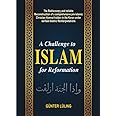
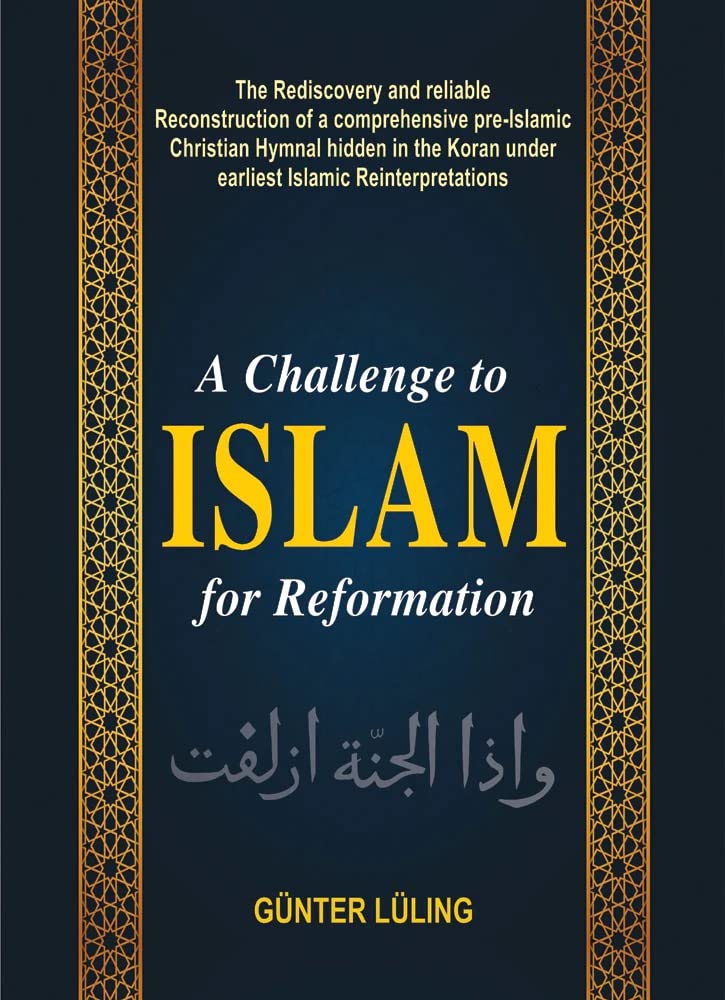
A Challenge to Islam for Reformation: The Rediscovery and Reliable Reconstruction of a Comprehensive Pre-Islamic Christian Hymnal Hidden in the Koran Under Earliest Islamic Reinterpretations by Günter Lüling is a thought-provoking and controversial work that delves into the historical and linguistic roots of the Quran. Lüling, a Protestant theologian, presents a thesis that challenges traditional Islamic interpretations by suggesting that a significant portion of the Quran contains pre-Islamic Christian hymns.Lüling’s central argument is that the Quran, as transmitted by Muslim orthodoxy, includes layers of text that originally belonged to a pre-Islamic Christian hymnal. He posits that these texts were later reinterpreted and incorporated into the Quran during its compilation. This perspective is particularly significant because it suggests that the Quran’s origins are more complex and intertwined with Christian traditions than traditionally believed.The book is divided into several chapters, each focusing on different aspects of Lüling’s thesis. He begins with an overview of the historical and linguistic context, explaining the prevalence of Christian hymns in the Near East before and during the early Islamic period. Subsequent chapters delve into specific Quranic verses, providing detailed linguistic analyses and proposing alternative translations. Lüling supports his arguments with extensive references to ancient texts, lexicons, and historical records, demonstrating a deep scholarly rigor.One of the key arguments in the book is that the Quran’s language and structure reflect a strong influence from pre-Islamic Christian hymns. Lüling provides numerous examples where traditional Islamic interpretations of Quranic verses are either unclear or contradictory. By reinterpreting these passages in the context of Christian hymnody, he claims to uncover meanings that are more coherent and contextually appropriate.Despite its scholarly approach, A Challenge to Islam for Reformation has been met with mixed reactions. Some scholars and readers appreciate Lüling’s innovative perspective and the light it sheds on obscure Quranic passages. They argue that his work opens new avenues for understanding the Quran’s historical and linguistic background, contributing to a more nuanced appreciation of Islamic scripture.However, the book has also faced significant criticism. Many traditional Islamic scholars reject Lüling’s thesis outright, arguing that it undermines the Quran’s divine nature and the authenticity of its Arabic language. Critics also point out that Lüling’s reliance on pre-Islamic Christian texts can sometimes lead to speculative and less convincing interpretations. The book’s controversial nature has made it a focal point of intense academic and theological debate.In conclusion, A Challenge to Islam for Reformation is a thought-provoking and challenging work that invites readers to reconsider long-held assumptions about the Quran’s language and origins. Lüling’s meticulous scholarship and bold reinterpretations offer a fresh perspective on Islamic scripture, making the book a valuable contribution to Quranic studies. Whether one agrees with his conclusions or not, Lüling’s work undeniably enriches the ongoing discourse on the Quran's historical and linguistic context.
K**P
no dust cover and mildew smell, but no evidence of mildew
I see one review wondering why dust cover missing. mine missing as well. another review stating a wet smell. I believe the smell is mildew, but there is no evidence of it on or in the book. i assume the dust cover was removed for this reason.it's too hard to find, there should be ebooks of this material, so I won't be returning it. it's near a heater to dry out. obviously don't want it to catch fire but the smell is worrisome. I have only just received. will have to sit in a chair with it, it's very heavy. please make this into ebook.
S**N
Why wrire a book like this? Just to put virtually all readers off?
An extremely difficult book by an academic for academics. It would make more sense to write in in a way that all interested people can read and understand it.
Trustpilot
1 week ago
2 weeks ago
2 months ago
1 month ago