Desertcart purchases this item on your behalf and handles shipping, customs, and support to Mexico.
🌬️ Seal the leaks, save the bucks, and join the energy-smart elite!
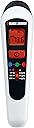
The BLACK+DECKER Thermal Leak Detector (TLD100) uses an infrared sensor and color-coded LED display to quickly identify temperature leaks around your home, helping reduce heating and cooling costs by up to 20%. Featuring an easy-to-read LCD, ergonomic grip, and a practical 5-step guide, it empowers homeowners to improve insulation and energy efficiency while also serving as a versatile diagnostic tool for HVAC, refrigeration, and engine heat checks.


| ASIN | B0044R87BE |
| Alarm | Visual |
| Best Sellers Rank | #144,293 in Industrial & Scientific ( See Top 100 in Industrial & Scientific ) #144 in Gas Detectors & Alarms #960 in Temperature & Humidity Measurement |
| Brand | BLACK+DECKER |
| Built-In Media | BLACK+DECKER Thermal Leak Detector (TLD100) |
| Color | Black |
| Customer Reviews | 4.4 out of 5 stars 5,230 Reviews |
| Global Trade Identification Number | 00885911106337 |
| Item Type Name | BLACK+DECKER Thermal Leak Detector (TLD100) |
| Item Weight | 10.4 ounces |
| Manufacturer | Black & Decker |
| Manufacturer Warranty Description | 2 Years |
| Mfr Part Number | TLD100 |
| Model Number | TLD100 |
| Number of Items | 1 |
| Operating Humidity | 50 percent |
| Power Source | Battery Powered |
| Product Style | modern |
| Style | modern |
| UPC | 885911106337 |
| Unit Count | 1 Count |
C**Y
A great tool for finding heating or cooling leaks - or just measuring temperatures
I wanted a remote-measuring thermometer for checking my home for hot spots (in summer) or cool spots (in winter). This one is great! It couldn't be simpler to use, and it's very accurate. It projects a green, red or blue spot onto the wall or other surface being measured. The green spot represents the baseline temperature of a wall or other surface measured when the unit is powered on. The spot turns to red when scanning a surface that is hotter than the baseline temp, or blue when scanning a surface cooler than the baseline temp. The colored spot makes it really quick and easy to scan for hot and cold areas, since you don't need to pay close attention to the actual temperature reading until you find a zone of interest. At first I thought that the colored spot might just be a gimmick, but, in practice, I have found it to be a really useful feature. My background is in science and engineering, so I appreciate instruments that are accurate and work well. I checked this thermometer against several others that I know are accurate and it consistently agrees with the others +/- 2 degrees or better. This is within the specs for this device, and pretty good for under $30. Be aware though, that this unit remotely measures the temperature of surfaces, so it is not a good choice for medical use, for cooking and for other jobs where you need to measure internal temperatures. That said, it will measure the temperature of your skin pretty accurately. It will not accurately measure the temperature of shiny or transparent surfaces, but you can stick a piece of masking tape or duct tape on the surface and measure that. It's so sensitive that it will easily measure the residual heat left by my bare foot standing on a cool wood floor. Leave your foot in place for a minute or so, so that the temperature of the floor is increased by your warm foot. Move your foot away, then measure the temperature at the spot where your foot was, and the surrounding floor. The red LED light will light up when the thermometer is aimed at the outline of your foot, but will turn to green for the surrounding area. (Note: this probably will not work for concrete floors, since they will not warm up enough). You start by aiming the unit at a reference surface, such as a wall, to establish a baseline temperature. (Note: a switch in the battery compartment sets either Farenheit or Celsius for the readings) Then you can select one of three ranges: +/- 1F*, +/- 5F* or +/- 10F*. (.5, 3.0, 5.5 C) I like to start out with 10F*, since that will quickly let you zero in on any serious hot or cold spots. Spend your time fixing those spots first, and you'll get the best bang for your buck. After those spots are fixed, or if you don't find any in the ten-degree range, then move to the 5-degree range and repeat. Aside from its real value in finding and fixing thermal leaks, this thing is a heck of a lot of fun just to play with. My grandkids had fun searching for hot and cold things around the house. On the 5-degree setting, you'll find that just about anything that runs on electricity and stays on all the time (clocks, power cubes, etc.) will turn the LED to red. A/C ducts will turn the LED to blue if cool air is coming out.
S**E
Does what it claims...
I've used thermal guns before but this 3 color light indicator is way cool. It makes checking temp delta's very quick. With the old gun (with laser pointer), it was, point at the area you wanted to test and then look at the meter, repoint the meter to a new location and look at the meter again. With this TLD100, it was just move the light around the area you are checking and the only time you have to actually look at the meter is when the color changes. It completely eliminates this looking back and forth at the target, then the meter, then the target, then the meter,... A comparison would be the difference between using a box end wrench or a rachet wrench to remove bolts. It makes the process much simpler and faster. I bought my unit at the wrong time of year when the outside temp was, at maximum, only 30 degrees different then the inside temp so even though I found some leaks, they were minor. My house is about 40 years old and since I bought it a few years ago, I installed storm doors and had added insulation to the attic. All the windows and doors are relatively new and from what I can tell, this house is relatively tight. Even though I didn't find any major problems, it's gives a certain peace of mind to know that everything is okay. This summer when the temps hit the 90's, I'll retest. The bottom line is that for home use and price, this is a very good meter. As some posters have pointed out, there are more accurate meters available and IR camera's that have far more versitility, but for what they cost, it would be much cheaper to not fix your leaks and just pay for the extra energy costs. Addendum: I've owned this product for a while now. When I first got it, it took under a minute to figure out how to use it. The concept behind it is very simple and very well done. At first, to my chagrin, my house seemed very tight and I found no hot or cold spots of any significance. I almost felt like I wasted my money, but there is a certain amount of consolation knowing that everything is in order. Recently, I bought a whole house fan, but my attic access was too small to get it into the attic, so I enlarged the opening. I knew that I would have to insulate the cover to the new opening, but before I got around to it I used this product to see what to expect. It was a warm day and I had the air on at about 77 degrees. When I pointed the meter at the new attic cover, it was reading almost 100 degrees. What that meant was that I had a radiating surface of about 7 square feet at 23 degrees over the interior of the house temperature. Looking toward the future when the winter would come, I could have a temperature differential of over 100 degrees during very cold days. In the summer when the temperature gets into the mid 90's or more, my attic temp exceeds 140 degrees. This would give me a temperature differential of over 65 degrees. I figure that this knowledge alone would pay for the meter in short order. Anyway, I really like having this meter and contrary to what some posters have said about it's accuracy, it's the delta (temp difference) that is the most important thing to be concerned about in this case.
H**Y
Good Product
Appeared to be a good product. Did not use it for long
P**R
Find all your leaks the easy way
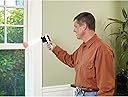
Want to find out where all those little drafts are coming from without having to crawl around on the floor or get out a ladder? This handy little device is so easy to use, just "point and shoot" and you'll see where there is a variance in the temperature on most surfaces. Point it around the edges of a door to see if your weather stripping needs to be replaced. Point it around your windows to see if there are gaps that need to be filled in there. We had a fan installed at the peak of a room where the vaulted ceiling comes together and this device showed us an area on one side where we needed to use some of that spray on foam stuff Dow Chemical Co. 157854 Do it Best Triple Expanding Foam Sealant to get a better seal because cold air was getting in. It doesn't work well on shiny surfaces because of the reflection, so the instructions suggest putting a piece of masking tape over the area before pointing at it. If you point it at a window it just shows the temperature of the window. This detector is very easy to use. When you turn it on, whatever you're pointing it at is the reference point and that is the reference temperature. It shows the temperature in a little LED window. Then, there are three settings, 1, 5 or 10 degrees that you choose on a little gauge right on the front of the unit. This determines how much of a difference there has to be from the reference point in order to register an alert which is a red or blue colored beam. The beam is green when pointed at your reference point and will stay green until you move it to an area that is colder which will turn it blue, or warmer which will turn it red. So this works just as well in the summer as in the winter. In the summer you can see where hot air is leaking into your nice air conditioned room and in the winter where cold air is leaking in. It's also a good way to see if your refrigerator has any leaks around the door. If you're interested in cutting your energy bills and finding out easily where those leaks are, this is a great little device
K**.
Great Product
I got the B&D TLD100 for Christmas and it was my favorite gift. I knew I had some cold spots in the house but I was unwilling to start attempting to seal them without a better knowledge of exactly where the leaks were. With the TLD100, I knew precisely the area to start searching in. I possibly could have used a standard IR thermometer to do the same task but seeing that light turn blue from cold air convinced me I had a problem that needed immediate attention. It turns out I did have a serious problem. As other reviews have stated, using the TLD100 is really simple. With the three different ranges of settings of 1 degree, 5 degrees, or 10 degrees for the three color spot light I quickly found the exact area that needed investigation. After accessing the area (I had to remove the ceiling panels on my back porch) I found that my upstairs bathroom had a 2 foot square area that was exposed to the attic above my back porch. After removing the porch ceiling you could see the backside of the upstairs bathtub!!! It seems the contractor who remodeled the kitchen failed to go back and seal and insulate above the area where he put in two new windows. No wonder my poor heat pump couldn't seem to keep the house warm! But that's not all. I also found where the original builder didn't seal and insulate the end of the floor joists. I'm still in the process of getting that issue fixed. I haven't even got to where I'll check the doors, windows, and electric outlets for leaks yet. I'm hoping with these major air leaks fixed my heating bill will drop significantly. Already we're seeing the heat cycle on less often and the house feels much less drafty. Way to go, Black and Decker for taking and everyday IR thermometer and turning it into a very useful tool and hopefully saving a lot of electricity.
J**S
Not quite a helpful as you might wish
I bought this an alternative to renting a thermal imaging camera to detect leaks/poor insulation in our 110 year old house. The TLD100 is a step up from my infrared thermometer, and is decent for spot checks, but in the end it really doesn't cut it. To be completely honest it really isn't the device's fault. It does its job as advertised. The fact is, a device of this type really is of limited use when you're trying to get a good picture of the temperature differences along a surface. I almost want to say that the TLD100 is a gimmick, but that insinuates that it's not useful. The fact is, if you don't already have an infrared thermometer, the TLD100 has some nice features (gimmick or not). If you already have an infrared thermometer, you'll find the TLD100 doesn't really give much in the way of additional capabilities.
P**R
Cool way to find leaks, and designed for the average homeowner...
I purchased this on a Gold Box deal for $29... I had been looking at this type of item for a while, but couldn't see spending $50 or more on one. Other than not including a battery, the unit is ready to go out of the box. With a slider switch to determine how much temperature variance you are looking for, and a light that projects on the area you are measuring (red for hotter, green for similar, and blue for colder temperatures than your target temperature), this unit is very user friendly. I've not done any serious weatherproofing with this yet, but I've gone around in my house and identified the cold spots on days when the outside temperature was in the 30s, and the light really makes it easier to identify the location than simply pointing and then having to figure out where the area was. I would not call this a highly scientific instrument, but rather a tool that would help the average homeowner, or anyone looking to find out where they could close gaps or insulate to save on their utility bills. I would have given this a four star rating, but with the ease that it can be used by an average person, I felt a five star rating was in order. Anyone looking to fix issues with leaks in their house could start using this within a few minutes of it arriving on their doorstep, given that they have the 9-volt battery on hand to power it. A definite recommend if you are energy conscious....
J**R
Cool device provides valueable insight to your energy bills
Neat toy, You point the device at for instance your wall and it sends a green light to indicate where its measuring. When you scan over a temperature variation the color of the LED changes either to red to indicate it senses a higher temp or purple to indicate a lower temp at the same time you get a the temperature displayed on the units LCD screen. A few years ago I had a company run CAT5, coax and a a ton of Siemens wire for some security cameras along with satellite TV an alarm and some updated phone lines. Well it turns out that in the process of running all that cable they made a TON of air leaks everywhere. Found a spot where when they drilled through the fire stop they messed up the insulation and that area was 10 degrees warmer than the surrounding areas you could feel the heat coming in from the outlet they put there. While playing with the scanner I noticed that the Smarthome keypadlincs and other smarthome light switches I have generate a TON of heat! For instance a keypadlinc that is a x10 transmitter only read 85.5 degrees compared to the surrounding wall that was 9 degrees cooler. A keypadlinc that contains a built in dimmer measured 95.37 degrees. Compare that to a normal electrical switch that generates no heat and uses no electricity to sustain itself. Now your thinking thats cool but how does that affect me? Well heat is power loss regardless of whether you are talking about loss through the transfer of from inside to outside the home or heat created by the consumtion of energy it all cost you money. I really need to look into how much its costing me just to have these smarthome switches in place. If they are generating that much heat are they consuming 3-5 watts per hour? multiply that by 15 switches in the house over the course of a year and that adds up! The question then becomes does the convenience of being able to control multiple lights from 1 switch outweight the annual cost? Don't know yet. This thing has tons of uses from measuring how inefficient your insulation is to seeing where your air conditioner and furnace ducts are not properly sealed, were hot water pipes aren't insulated properly (mine aren't at all yet)or just which windows aren't properly sealed. I should point out that the family is a bit ticked off at me lately as I have been walking around the house pointing this thing at everything. I made my older son unplug his cell phone & tooth brush charger because they were generating heat and consuming energy I put a power strip on our loft TV which rarely gets used but yet the tv, receiver, subwoofer cable box and dvd player were once again all generating heat all using electricity even though they were turned off. (even in standby the cable box was generating INSANE heat 92 degrees IN STANDBY!!) I also ordered a P3 International P4460 Kill A Watt EZ Electricity Usage Monitor from amazon that hasn't come yet but with that I will get a dollar amount on how much energy we are wasting. As a final note the reason I am going through all this trouble? Well last months electric bill was $375 and I almost popped my pants well this months bill? $482.00!! Yeah i did %^$% my pants! Personally, I thought we were ok energy wise, every bulb in the house is either florescent or LED, the only halogen bulbs I have are some landscape lights (300 watts worth) but these last two months have opened my eyes. Next few months I'll be making changes so that I will never see any more bills like those.
A**.
A friend in need
This is a great detector, with changing lifestyles a must have home instrument
A**R
Good
Nice product
S**A
Semplice e utile
Esperienza ottima. Perfetto per individuare spifferi dagli infissi, con una buona precisione e di facile utilizzo. Segnala con cambiamenti di colore del fascio luminoso la differenza di temperatura sulle superfici rispetto a quella di riferimento. Buon rapporto qualità/prezzo. Imballaggio impeccabile.
J**L
Bien
Muy fácil de usar, apuntar y disparar. Parece fiable, y con mirar el color del foco ya se sabe si la temperatura es inferior o superior, sin tener que mirar la pantalla.
C**U
bien
très bien fonctionne bien
Trustpilot
2 days ago
2 months ago