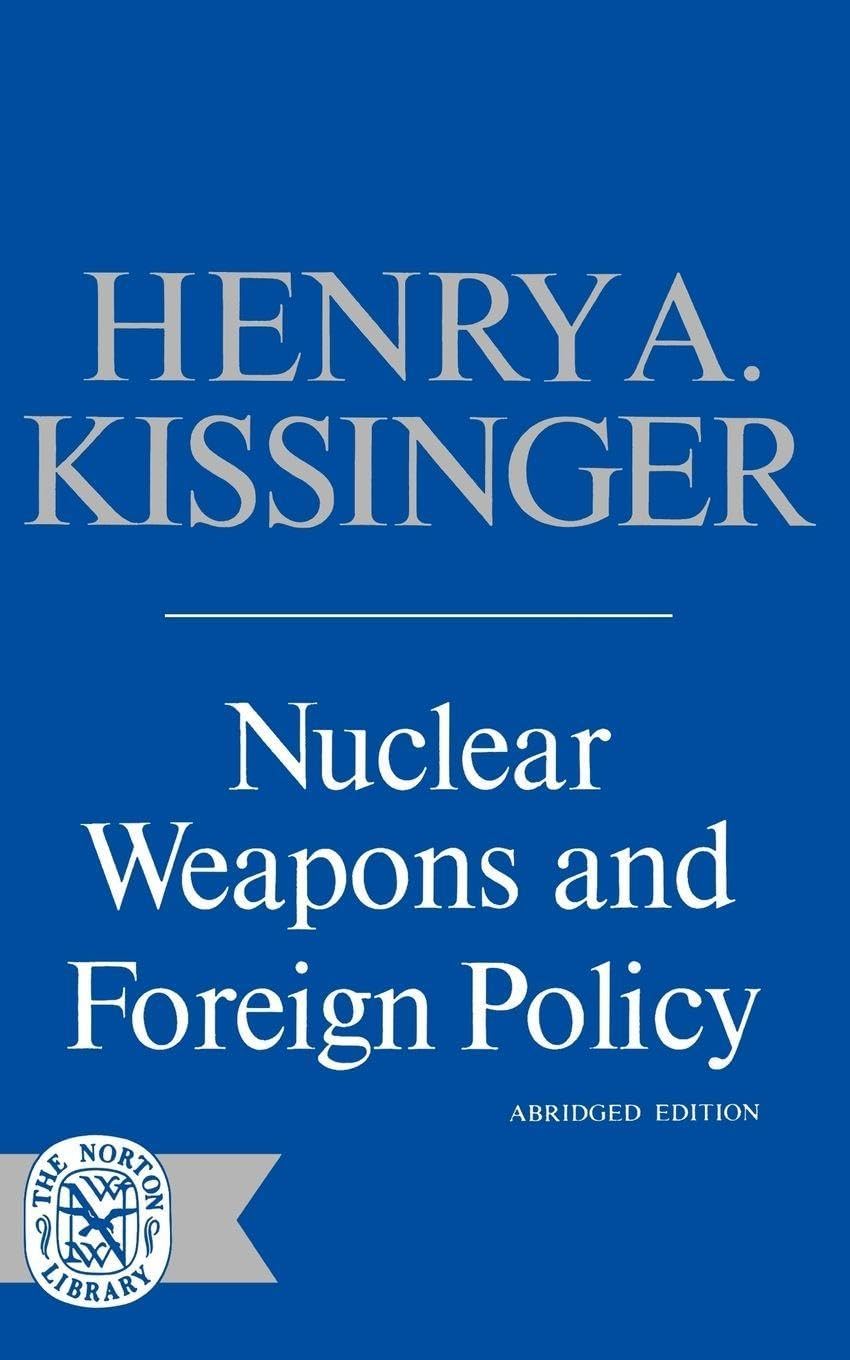
Nuclear Weapons & Foreign Policy
Product ID: 8094693
Desertcart purchases this item on your behalf and handles shipping, customs, and support to Mexico.
In this book Professor Kissinger examines the framework of our foreign policy, the stresses to which that framework is being subjected, and the prospects for world order in an era of high international tension. The three essays were written before Professor Kissinger took leave from Harvard to serve as Assistant to President Nixon for National Security Affairs. Review: A Brilliant Discourse on Humankind's Condition at the Inception of a New Age - My father fought through the last great battle of WWII, Okinawa. He was one of only 4 in his platoon of 47 men not killed or wounded. Then on another Pacific island, he was training with his fellow soldiers to further invade Japan when the atomic bombs dropped on Hiroshima and Nagasaki. Pandemonium broke out on the island. The war was over. No atomic bombs have been used since then. Teilhard de Chardin in a posthumously published book, "The Future of Man", 1964 (he died in 1955), has a chapter entitled, "Some Reflections on the Spiritual Repercussions of the Atom Bomb". His hope was (expressed in a later chapter of this book), that man would eventually learn to channel his conflictual reality into "war in a naturally sublimated form". It has now been almost eighty years since these first atomic bombs were used. None have been used since then; although a nuclear arsenal of hydrogen bombs, at about a thousand times their potency, are possessed by many nations. Whether we are conscious of it or not, their presence haunts our existence. I found this book, "Nuclear Weapons and Foreign Policy" (1957) by Henry Kissinger, to be of great historical significance. Kissinger was trying to work out just how we could and should fight in a world where physical conflict was a logistical reality-- in the shadow of the awesome, annihilatory power of thermonuclear bombs. Since Kissinger's book, humankind has been able to avoid nuclear destruction, yet we have still been plagued with bloody warfare since then. There may be a failure of human imagination. How do we get to Teilhard's peaceful, ethical "war in naturally sublimated form"? Perhaps we could transplant the morality of sport, mentally and physically, into the world-at-large. To date, no ethical schemata "to solve the problem of war" has appeared on the human radar screen. Perhaps in the future one or more such "solutions" will. Until that time, perhaps Kissinger's prescriptions will be the best we can do. Review: Piece of art - Transparency, the art of practicing freedom. Kissinger ’s book was explicit , firm and bold. Understanding the psychology of American’s statesmen was the key to address the problem. Kissinger ideas were mind blowing in this book , it deals with humanity’s worst nightmare scenario ; nuclear war. The plan prerequisites is not easy , Kissinger understands that more than any one else.History was the answer to all of humanity’s problems, however the nuclear dilemma is new challenge never faced before. The spirit of pragmatism and realism is overwhelming in the chapters, which tends to challenge the reader’s mind. Author’s criticism of a country that just won the WWII , he managed to find imperfections in perfection some could argue. The result was a force de tour. A must read ,astonishing,masterful and accurate guide to the nuclear age.
| Best Sellers Rank | #853,433 in Books ( See Top 100 in Books ) #153 in Arms Control (Books) #3,825 in Technology (Books) #5,236 in Political Science (Books) |
| Customer Reviews | 4.7 out of 5 stars 43 Reviews |
J**E
A Brilliant Discourse on Humankind's Condition at the Inception of a New Age
My father fought through the last great battle of WWII, Okinawa. He was one of only 4 in his platoon of 47 men not killed or wounded. Then on another Pacific island, he was training with his fellow soldiers to further invade Japan when the atomic bombs dropped on Hiroshima and Nagasaki. Pandemonium broke out on the island. The war was over. No atomic bombs have been used since then. Teilhard de Chardin in a posthumously published book, "The Future of Man", 1964 (he died in 1955), has a chapter entitled, "Some Reflections on the Spiritual Repercussions of the Atom Bomb". His hope was (expressed in a later chapter of this book), that man would eventually learn to channel his conflictual reality into "war in a naturally sublimated form". It has now been almost eighty years since these first atomic bombs were used. None have been used since then; although a nuclear arsenal of hydrogen bombs, at about a thousand times their potency, are possessed by many nations. Whether we are conscious of it or not, their presence haunts our existence. I found this book, "Nuclear Weapons and Foreign Policy" (1957) by Henry Kissinger, to be of great historical significance. Kissinger was trying to work out just how we could and should fight in a world where physical conflict was a logistical reality-- in the shadow of the awesome, annihilatory power of thermonuclear bombs. Since Kissinger's book, humankind has been able to avoid nuclear destruction, yet we have still been plagued with bloody warfare since then. There may be a failure of human imagination. How do we get to Teilhard's peaceful, ethical "war in naturally sublimated form"? Perhaps we could transplant the morality of sport, mentally and physically, into the world-at-large. To date, no ethical schemata "to solve the problem of war" has appeared on the human radar screen. Perhaps in the future one or more such "solutions" will. Until that time, perhaps Kissinger's prescriptions will be the best we can do.
A**H
Piece of art
Transparency, the art of practicing freedom. Kissinger ’s book was explicit , firm and bold. Understanding the psychology of American’s statesmen was the key to address the problem. Kissinger ideas were mind blowing in this book , it deals with humanity’s worst nightmare scenario ; nuclear war. The plan prerequisites is not easy , Kissinger understands that more than any one else.History was the answer to all of humanity’s problems, however the nuclear dilemma is new challenge never faced before. The spirit of pragmatism and realism is overwhelming in the chapters, which tends to challenge the reader’s mind. Author’s criticism of a country that just won the WWII , he managed to find imperfections in perfection some could argue. The result was a force de tour. A must read ,astonishing,masterful and accurate guide to the nuclear age.
T**Y
A book our leaders need to read
This book by Henry Kissinger, written in 1955 is even more important today, 2023-24 than then. He deals with the interservice rivalry of the Army, Navy and Air Force at the beginning of the nuclear bomb age. He deals with the growing nuclear threat of the USSR, it's plan of world domination. We are currently observing Russia's attempt at overtaking America from within. I have not yet finished, what is described is in the first two chapters.
B**S
Limited nuclear warfare
Pernicious is the best way to describe Kissinger's Nuclear Weapons & Foreign Policy. His argument for limited nuclear war being not only possible, but under certain circumstances effective, is compelling. It is both a necessary and dangerous book, but one which everyone opposed to war and to understand the threat facing the world today, should read.
P**R
G-R-E-A-T
I ordered what I thought would be a paperback book, but to my suprise I was shipped a hardback cover book. I highly recommend ordering from this seller.
C**L
A wonderful look into policy.
This was a wonderful look into the minds of policy makers during the heights of the Cold War. Highly recommend.
A**D
From nukes to marriage a book for everyone
An incredible piece on psychology, game theory, and strategy. Kissinger proves his work in this old book that was key to him gaining his positions in government. What’s really fascinating about this book is how applicable it is to daily life and relationships. Sure we can quit a job or marriage but how do we stop things from getting that bad in the first place? Can’t bash your girlfriend but sometimes that nuclear threat is required to keep her in line.
I**R
It reads like something out of Dr
This book advocates the use of nuclear weapons in "limited" wars: "we would use weapons of not more than 500 kilotons explosive power" -- unless the enemy used them first, then you can break out the bombs over 500 kt. For reference, the "Fat Man" bomb was about 20 kilotons. So Kissinger felt that fifty times that, and NOT MORE, would be okay to use as a first move in a "limited" war, to drop on human beings. So you get a review of one star. Let's hope the author never gets an important government job -- can you imagine the damage this kind of mind might inflict on the world? I shudder to think. It reads like something out of Dr. Strangelove, and yet it was published even before that movie came out!
F**D
核戦略論の古典中の古典
キッシンジャーと言うと今や政治家として有名になっているが、本書はハーバード大学教授時代のキッシンジャーの出世作であり、現在でも核戦略論の古典中の古典と呼ばれている名作である。まず感じられるのが言葉の難解さと内容の古さである。キッシンジャーはドイツからの移民であり、関係代名詞が非常に込みいった長い文章を好む傾向があり、非常に読みにくい。また、本書は1957年に書かれたものであり、朝鮮戦争やソ連による最初の核実験、スエズ動乱などが同時代のものとして書かれている。 しかしながら、やはり古典と言われるだけあって、言い回しの難解さやうわべの古さが全く気にならない濃密な議論を展開している。圧巻は、核時代の全面戦争の性格と問題点をこれでもかというくらい多面的に分析している点である。核時代においては戦争を限定戦争にとどめることが重要であり、戦争のエスカレーションを防ぐために当方の戦略的意図を常に先方に理解させることこそが現代の外交において重要であると喝破している。 また、米国の歴史や伝統に起因する弱点についても詳細に分析されている。例えば、米国人は経験主義的であるため、物事が起こってからでないと腰を上げず、またカルヴァン主義が根強い米国人は原理主義的であり、一度敵と見なした相手には理性を失って徹底的に殲滅しようとする、とキッシンジャーは分析する。9/11後のアメリカの外交政策を表現しているかのような文章である。また、本書は抽象的な戦略論にとどまらず、米軍を戦略軍、戦術軍そして海軍へと再編成する、国防予算を単年度式ではなく2年周期にする、といった具体的な政策提言も行っている。 読み進めるには肉体的・知的な体力を要するが、それに見合ったものを学ぶことができる名著だと思う。
M**O
Per tesi
Libro interessante e pieno di spunti
鳥**仁
キッシンジャーの核兵器と外交について
北朝鮮の状況を考えればこのタイトルは当然大きな関心を寄せざるを得ない。
Trustpilot
1 day ago
2 weeks ago