Tarzan: The Complete Russ Manning Newspaper Strips, Vol. 1 (1967-1969)
Product ID: 8499525
Buy anything from 5,000+ international stores. One checkout price. No surprise fees. Join 2M+ shoppers on Desertcart.
Desertcart purchases this item on your behalf and handles shipping, customs, and support to Mexico.
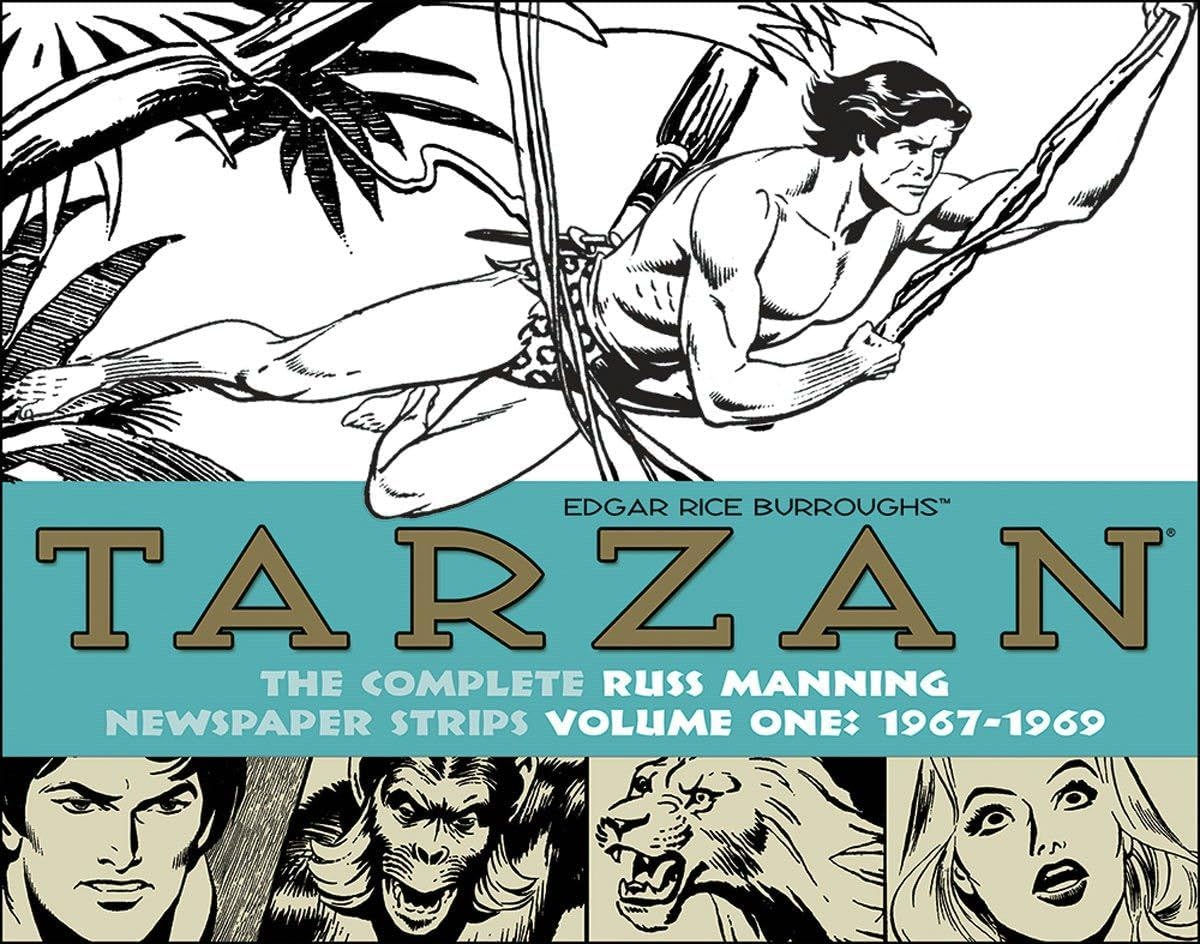
Tarzan: The Complete Russ Manning Newspaper Strips, Vol. 1 (1967-1969) [Russ Manning, Edgar Rice Burroughs] on desertcart.com. *FREE* shipping on qualifying offers. Tarzan: The Complete Russ Manning Newspaper Strips, Vol. 1 (1967-1969) Review: Russ Manning plus Tarzan equals comic art bliss - "In 1967 the Edgar Rice Burroughs estate asked Russ Manning to take over the "Tarzan" newspaper strip and bring it back to the original Burroughs vision..." ...and so a classic comic strip was reborn. The above quotation is taken from the dustcover to "Edgar Rice Burroughs' Tarzan: The Complete Russ Manning Newspaper Strips: Volume One: 1967-1969," a 285 plus paged hardcover book collecting the master storyteller's first three years writing and illustrating the daily and Sunday comic strips of the legendary "Lord of the Jungle." For fans of Russ Manning (particularly his North American admirers), this book, the premiere volume of a planned 4 book collection, is akin to at last finding the fabled jewels of Opar. Mr. Manning's beautiful rendition of the classic character has rarely been seen outside of the fortunate cities that featured the comic strip in their local newspapers. When it was occasionally reprinted, for example, in the DC Comics "Tarzan" series of the 1970s, the strip was heavily edited. Mr. Manning's strips were also reproduced in the now hard to find Comics Revue magazine from 1992-1999 and 2003-2006. But thanks to IDW Publishing, this memorable work is finally being showcased in an archival collection worthy of its status as a classic example of comic strip art. Russ Manning (1929-1981) came to the "Tarzan" newspaper strip after establishing himself as one of the foremost comic book creators of his time. After being mentored by veteran "Tarzan" comic book artist Jesse Marsh (1907-1966), Mr. Manning contributed his artistic skills to the "Brothers of the Spear" series, which first appeared in Gold Key Comics' "Tarzan" ongoing book in 1952. As his talent gained approval from enthusiastic comic fans, Mr. Manning created "Magnus Robot Fighter 4000 A.D." in 1963 for Gold Key; a science-fiction comic adventure he wrote and drew for 21 issues, his "Tarzan of the future" is highly regarded to this day. Also in 1963, Mr. Manning was assigned another comic series by Gold Key, "Korak Son of Tarzan," a companion book to the company's long-running "Tarzan" comic, which he illustrated for a total of 12 issues. When in 1966, Jesse Marsh died after a lingering illness, Mr. Manning was chosen to succeed his friend and mentor on the "Tarzan" comic. During his memorable run on the series, he collaborated with writer Gaylord Dubois (1899-1993) in adapting 10 of Mr. Burroughs' "Tarzan" novels into comic book form. With his interpretation of the classic Burroughs creation achieving great acclaim, Mr. Manning was given the privilege and challenge of furthering his vision of the "Tarzan" character in the ongoing newspaper strip. The gifted writer/artist would take up the task with the following words, spoken by "Tarzan" in his inaugural daily strip, published on December 11, 1967: "Too long have I adventured in strange lands! It is time I returned to the best land of all - home!" Thus, Mr. Manning returned the king of the Great Apes to Edgar Rice Burroughs' version of Africa. There, "Tarzan" was reunited with Jad-Bal-Ja, the Golden Lion, his beloved wife, Jane, and their son, Korak. Characters and settings familiar to fans of the classic novels would also be showcased, like the lost city of Opar, its devolved denizens, the beastmen, and their Queen, the beautiful, tragic La of Opar (Ohh, La!). Mr. Manning would echo this approach in the Sunday story continuity with "Tarzan" adventuring into Burroughs' mythic Africa, along with Korak, who enjoyed adventures of his own. This is a truly beautiful comic strip. Mr. Manning was a fan of science-fiction and a great admirer of Edgar Rice Burroughs' work, from his iconic creation, "Tarzan," but also John Carter of Mars, and David Innes of the underground world, Pellucidar, all romantic adventure heroes. He encorporated this view into his tales of "Tarzan." With his superb storytelling abilities, Mr. Manning excelled in showcasing the "Lord of the Jungle" in his element; protecting his lovely wife, Jane, battling the prehistoric creatures of Paul-Ul-Don, or simply communing with the Great Apes, who raised him to become the noble figure he was. Mr. Manning illustrated the heroic ideal, personified in "Tarzan," and he rarely looked better. A perfect example of this is the December 23, 1967 daily strip: in just 3 panels, Mr. Manning depicted 3 distinctive, classic images of "Tarzan." Each individual drawing encapsulated the totality of the character in his most primal form...and it was just one strip! The daily strip continuity moved at an exciting, barely non-stop pace and the full color Sunday strips conveyed the full power of Mr. Manning's art. A showcase of this is on the back of the hardcover, a panel from the June 30, 1968 Sunday strip: in it, "Tarzan" and his comrade, Mugambi of the Waziri tribe, along with a trio of Great Apes, battle a huge reptile-man and his alligators. Former master "Tarzan" strip artist Burne Hogarth (1911-1996) must have smiled with approval at the dramatic power of this action-packed scene! To keep up with the rigorous demands of producing both a daily and Sunday strip, Mr. Manning worked with a team of talented assistants: Mike Royer, William "Bill" Stout (who provides an affectionate forward to the book), and a young Dave Stevens, but it was his uniquely elegant style and vision that culminated in the true majesty of the strip. Mr. Burroughs' "Tarzan" was in very capable hands when Mr. Manning wrote and drew his adventures. IDW Publishing has released this hardcover collection under its "Library of American Comics" imprint and the book is a respectful addition to their previously published reprint volumes. But, this reviewer was slightly disappointed in the size of this tome. While first perusing the pages of daily strips, I noticed the strips seemed a little smaller than I expected. When I later placed the book atop a copy of IDW's "X9: Secret Agent Corrigan" reprint series, which I happily own, I realized the Russ Manning "Tarzan" collection was about an inch smaller in dimensions to the volumes that collect the classic work of Archie Goodwin and Al Williamson. It's a little nit-picky thing, but this critic wishes the "Tarzan" daily strips by Mr. Manning were of a comparable size to those reproduced in the "X9" 5 book set...just so this Russ Manning fan could better gaze at this master's great artistry with his aging eyes. Fan is short for fanatic, after all...! Despite that one inch flaw, this is a wonderfully reproduced collection. The artwork is reprinted on high quality, non-glossy paper and the daily strips, printed three per page are clear and crisp in all their black and white beauty! The Sunday pages share the same quality and it is important to note that their colors, restored by IDW editors Lorraine Turner and Dean Mullaney, are unchanged from their original newspaper publications. This is unlike the revised color work done on the Tarzan Archives: The Russ Manning Years Volume 1 , released by Dark Horse Comics in December of 2013. Even the book's cover is cleverly designed, with its front cover adorned with a minimal amount of color, while the back cover displays the above mentioned full color action sequence, subtly suggesting the inner design format of the volume: daily black and white strips featured in the front of the book and the full color Sunday strips showcased in the back of the thick tome. The illustrated cover to the book is reprinted on both its dustcover and its hardback design; and the collection has a sewn binding featuring a gold ribbon book mark. For lifelong Russ Manning fans like myself, this book is perhaps the one reprint collection of his artistic genius we've been most eagerly awaiting. This reviewer can honestly state that I have been waiting for a book of this quality, devoted to Mr. Manning's "Tarzan" work for decades. As I complete this critique and look at my longheld dream finally realized... ...I am a very happy man! But the artistry of Russ Manning is not just for old fans of comic books and comic strips. Mr. Manning's art, like all great art is for every generation who loves this magical medium called comics. This book contains treasures for all. "Edgar Rice Burroughs' Tarzan: The Complete Russ Manning Newspaper Strips: Volume One: 1967-1969" comes with my absolute highest recommendation! Truly enjoy! Review: "I start looking at the drawings... and by the third or fourth panel I'm hooked on the story." - This has been a golden twelve month period for all fans of Russ Manning's 'Tarzan'. Dark Horse has given us Tarzan Archives: The Russ Manning Years Volume 1 , Korak, Son of Tarzan Archives Volume 1 , and the (not entirely unrelated) Brothers of the Spear Archives Volume 1 . Flip through any of them, and I defy you not to be captivated by Manning's glorious art. But this brings me back to that quote I used as the headline for this review. That was John Romita (Sr.) on Milton Caniff, when interviewed by 'The Comics Journal' in 2002. More than six decades after a certain dramatic event in The Complete Terry and the Pirates, Vol. 4: 1941-1942 Romita could vividly recall the emotional punch of a particular storyline. And this segues in neatly with something that William Stout says in the foreword to this book: 'His beautiful art is so captivating that it's easy to understand how it might overshadow his scripts.' What separates this hefty tome from the Dark Horse books mentioned above is that here Manning was granted complete creative control of the Jungle Lord. Or at least as 'complete' as it gets when dealing with a property that is not yours. Caniff could do pretty much what he liked with Terry, Pat, and the Dragon Lady. But Manning had not created, and did not own, Tarzan. Or Jane. He probably couldn't remove even Jad-Bal-Ja from the scene. Given those constraints Russ Manning did a fine job. No, scratch that, he did a fine job, period. There is actual character development, as for instance in the case of Jane. As early as January 4, 1968, Jane looks at a Dum-Dum and finds herself wondering, "My husband... and son... part of thar screaming animal madness! How can I ever again feel that I truly know... and understand... them?" It is an important point because it will tie up with the very last panel of this volume, the Sunday strip of May 11, 1969. Jane's unease with, and Tarzan's complete acceptance of, their fantastic homeland is encapsulated in a daily strip, on April 18, 1969, when he tells her where he has left Korak. Jane's outrage is almost palpable. That final Sunday strip also ties up with the first strips in another way. Manning begins his run on Tarzan with the Jungle Lord expressing his desire to "return to the best land of all -- home!", but once home M'Bela hands him a letter from Korak announcing that Jane is missing. And in that climactic Sunday strip I mentioned earlier M'Bela hands Tarzan another letter, announcing... but no, you have to read this book for yourself. Some might, of course, argue that the bookending of the two letter sequences is the result of some fine editing by Dean Mullaney and Bruce Canwell. This may be true but Manning's writing talents are at their best and subtlest in the Auric Head sequence that runs from January 30 to March 15, 1969, with a reprise from September 13 to September 23, 1969. 1969 was a year of anti-war protests across the country. In 1968 a U.S. officer had been quoted saying, "It became necessary to destroy the town to save it." Auric begins with, "Now you are free! No longer will Tarzan make you slave for him...!" But when the Africans make it clear that they don't buy into his vision of development he yells out in fury, "Until you get it into your heads that I have come to help you, you will be detained... under guard!" And from there it is a quick step to, "They opposed me! Simple savages too backward to understand what I could do for them!" It is a classic account of how quickly idealism can be debased. I have no idea whether Manning was a hawk or a dove. I have no idea whether this was a deliberate mocking of ideologues, or whether Manning was simply responding unconsciously to the spirit of the times. What is relevant that even forty-four years later it is possible to have a debate on the subtext and the context of Manning's writing. Don't let the above give you the idea that the whole book is about serious stuff. It is, after all, an adventure strip set in a fantasy land -- so you also have dinosaurs (who bring an end to Auric's tyranny on the Ides of March), winged men (with a sly message on inter-racial marriage?), and long-lost Egyptian civilizations. And, of course, you have Manning's glorious art. I strongly recommend reading earlier reviews on this page, particularly by Dennis M. Roy, L. W. Swint, Diego Cordoba, and Trollbeard, who write with far greater knowledge than I possess. Diego Cordoba has made the point that it's unfortunate that the Library of American Comics didn't publish the Sundays separately and in a larger format. As a card-carrying member of the Bigger-is-Better Club I am always up for this. And there is a precedent in the form of LoAC's own Archie: The Classic Newspaper Comics (1946-1948) and Archie's Sunday Finest , with the Sundays being visibly larger. On the other hand, I have never seen comic strips in actual newspapers that were printed at anything more than postage stamp size, so who am I to complain? William Stout was correct; Manning's writing is often overshadowed because of the enthusiasm for his art. Dipping into this lovely book I, like John Romita decades ago with Caniff, started by looking at the art but was soon hooked by the story. Enthusiastically recommended!
| Best Sellers Rank | #1,873,296 in Books ( See Top 100 in Books ) #2,828 in Comic Strips (Books) #24,839 in Superhero Comics & Graphic Novels #109,056 in Fantasy (Books) |
| Customer Reviews | 4.9 out of 5 stars 88 Reviews |
L**T
Russ Manning plus Tarzan equals comic art bliss
"In 1967 the Edgar Rice Burroughs estate asked Russ Manning to take over the "Tarzan" newspaper strip and bring it back to the original Burroughs vision..." ...and so a classic comic strip was reborn. The above quotation is taken from the dustcover to "Edgar Rice Burroughs' Tarzan: The Complete Russ Manning Newspaper Strips: Volume One: 1967-1969," a 285 plus paged hardcover book collecting the master storyteller's first three years writing and illustrating the daily and Sunday comic strips of the legendary "Lord of the Jungle." For fans of Russ Manning (particularly his North American admirers), this book, the premiere volume of a planned 4 book collection, is akin to at last finding the fabled jewels of Opar. Mr. Manning's beautiful rendition of the classic character has rarely been seen outside of the fortunate cities that featured the comic strip in their local newspapers. When it was occasionally reprinted, for example, in the DC Comics "Tarzan" series of the 1970s, the strip was heavily edited. Mr. Manning's strips were also reproduced in the now hard to find Comics Revue magazine from 1992-1999 and 2003-2006. But thanks to IDW Publishing, this memorable work is finally being showcased in an archival collection worthy of its status as a classic example of comic strip art. Russ Manning (1929-1981) came to the "Tarzan" newspaper strip after establishing himself as one of the foremost comic book creators of his time. After being mentored by veteran "Tarzan" comic book artist Jesse Marsh (1907-1966), Mr. Manning contributed his artistic skills to the "Brothers of the Spear" series, which first appeared in Gold Key Comics' "Tarzan" ongoing book in 1952. As his talent gained approval from enthusiastic comic fans, Mr. Manning created "Magnus Robot Fighter 4000 A.D." in 1963 for Gold Key; a science-fiction comic adventure he wrote and drew for 21 issues, his "Tarzan of the future" is highly regarded to this day. Also in 1963, Mr. Manning was assigned another comic series by Gold Key, "Korak Son of Tarzan," a companion book to the company's long-running "Tarzan" comic, which he illustrated for a total of 12 issues. When in 1966, Jesse Marsh died after a lingering illness, Mr. Manning was chosen to succeed his friend and mentor on the "Tarzan" comic. During his memorable run on the series, he collaborated with writer Gaylord Dubois (1899-1993) in adapting 10 of Mr. Burroughs' "Tarzan" novels into comic book form. With his interpretation of the classic Burroughs creation achieving great acclaim, Mr. Manning was given the privilege and challenge of furthering his vision of the "Tarzan" character in the ongoing newspaper strip. The gifted writer/artist would take up the task with the following words, spoken by "Tarzan" in his inaugural daily strip, published on December 11, 1967: "Too long have I adventured in strange lands! It is time I returned to the best land of all - home!" Thus, Mr. Manning returned the king of the Great Apes to Edgar Rice Burroughs' version of Africa. There, "Tarzan" was reunited with Jad-Bal-Ja, the Golden Lion, his beloved wife, Jane, and their son, Korak. Characters and settings familiar to fans of the classic novels would also be showcased, like the lost city of Opar, its devolved denizens, the beastmen, and their Queen, the beautiful, tragic La of Opar (Ohh, La!). Mr. Manning would echo this approach in the Sunday story continuity with "Tarzan" adventuring into Burroughs' mythic Africa, along with Korak, who enjoyed adventures of his own. This is a truly beautiful comic strip. Mr. Manning was a fan of science-fiction and a great admirer of Edgar Rice Burroughs' work, from his iconic creation, "Tarzan," but also John Carter of Mars, and David Innes of the underground world, Pellucidar, all romantic adventure heroes. He encorporated this view into his tales of "Tarzan." With his superb storytelling abilities, Mr. Manning excelled in showcasing the "Lord of the Jungle" in his element; protecting his lovely wife, Jane, battling the prehistoric creatures of Paul-Ul-Don, or simply communing with the Great Apes, who raised him to become the noble figure he was. Mr. Manning illustrated the heroic ideal, personified in "Tarzan," and he rarely looked better. A perfect example of this is the December 23, 1967 daily strip: in just 3 panels, Mr. Manning depicted 3 distinctive, classic images of "Tarzan." Each individual drawing encapsulated the totality of the character in his most primal form...and it was just one strip! The daily strip continuity moved at an exciting, barely non-stop pace and the full color Sunday strips conveyed the full power of Mr. Manning's art. A showcase of this is on the back of the hardcover, a panel from the June 30, 1968 Sunday strip: in it, "Tarzan" and his comrade, Mugambi of the Waziri tribe, along with a trio of Great Apes, battle a huge reptile-man and his alligators. Former master "Tarzan" strip artist Burne Hogarth (1911-1996) must have smiled with approval at the dramatic power of this action-packed scene! To keep up with the rigorous demands of producing both a daily and Sunday strip, Mr. Manning worked with a team of talented assistants: Mike Royer, William "Bill" Stout (who provides an affectionate forward to the book), and a young Dave Stevens, but it was his uniquely elegant style and vision that culminated in the true majesty of the strip. Mr. Burroughs' "Tarzan" was in very capable hands when Mr. Manning wrote and drew his adventures. IDW Publishing has released this hardcover collection under its "Library of American Comics" imprint and the book is a respectful addition to their previously published reprint volumes. But, this reviewer was slightly disappointed in the size of this tome. While first perusing the pages of daily strips, I noticed the strips seemed a little smaller than I expected. When I later placed the book atop a copy of IDW's "X9: Secret Agent Corrigan" reprint series, which I happily own, I realized the Russ Manning "Tarzan" collection was about an inch smaller in dimensions to the volumes that collect the classic work of Archie Goodwin and Al Williamson. It's a little nit-picky thing, but this critic wishes the "Tarzan" daily strips by Mr. Manning were of a comparable size to those reproduced in the "X9" 5 book set...just so this Russ Manning fan could better gaze at this master's great artistry with his aging eyes. Fan is short for fanatic, after all...! Despite that one inch flaw, this is a wonderfully reproduced collection. The artwork is reprinted on high quality, non-glossy paper and the daily strips, printed three per page are clear and crisp in all their black and white beauty! The Sunday pages share the same quality and it is important to note that their colors, restored by IDW editors Lorraine Turner and Dean Mullaney, are unchanged from their original newspaper publications. This is unlike the revised color work done on the Tarzan Archives: The Russ Manning Years Volume 1 , released by Dark Horse Comics in December of 2013. Even the book's cover is cleverly designed, with its front cover adorned with a minimal amount of color, while the back cover displays the above mentioned full color action sequence, subtly suggesting the inner design format of the volume: daily black and white strips featured in the front of the book and the full color Sunday strips showcased in the back of the thick tome. The illustrated cover to the book is reprinted on both its dustcover and its hardback design; and the collection has a sewn binding featuring a gold ribbon book mark. For lifelong Russ Manning fans like myself, this book is perhaps the one reprint collection of his artistic genius we've been most eagerly awaiting. This reviewer can honestly state that I have been waiting for a book of this quality, devoted to Mr. Manning's "Tarzan" work for decades. As I complete this critique and look at my longheld dream finally realized... ...I am a very happy man! But the artistry of Russ Manning is not just for old fans of comic books and comic strips. Mr. Manning's art, like all great art is for every generation who loves this magical medium called comics. This book contains treasures for all. "Edgar Rice Burroughs' Tarzan: The Complete Russ Manning Newspaper Strips: Volume One: 1967-1969" comes with my absolute highest recommendation! Truly enjoy!
A**T
"I start looking at the drawings... and by the third or fourth panel I'm hooked on the story."
This has been a golden twelve month period for all fans of Russ Manning's 'Tarzan'. Dark Horse has given us Tarzan Archives: The Russ Manning Years Volume 1 , Korak, Son of Tarzan Archives Volume 1 , and the (not entirely unrelated) Brothers of the Spear Archives Volume 1 . Flip through any of them, and I defy you not to be captivated by Manning's glorious art. But this brings me back to that quote I used as the headline for this review. That was John Romita (Sr.) on Milton Caniff, when interviewed by 'The Comics Journal' in 2002. More than six decades after a certain dramatic event in The Complete Terry and the Pirates, Vol. 4: 1941-1942 Romita could vividly recall the emotional punch of a particular storyline. And this segues in neatly with something that William Stout says in the foreword to this book: 'His beautiful art is so captivating that it's easy to understand how it might overshadow his scripts.' What separates this hefty tome from the Dark Horse books mentioned above is that here Manning was granted complete creative control of the Jungle Lord. Or at least as 'complete' as it gets when dealing with a property that is not yours. Caniff could do pretty much what he liked with Terry, Pat, and the Dragon Lady. But Manning had not created, and did not own, Tarzan. Or Jane. He probably couldn't remove even Jad-Bal-Ja from the scene. Given those constraints Russ Manning did a fine job. No, scratch that, he did a fine job, period. There is actual character development, as for instance in the case of Jane. As early as January 4, 1968, Jane looks at a Dum-Dum and finds herself wondering, "My husband... and son... part of thar screaming animal madness! How can I ever again feel that I truly know... and understand... them?" It is an important point because it will tie up with the very last panel of this volume, the Sunday strip of May 11, 1969. Jane's unease with, and Tarzan's complete acceptance of, their fantastic homeland is encapsulated in a daily strip, on April 18, 1969, when he tells her where he has left Korak. Jane's outrage is almost palpable. That final Sunday strip also ties up with the first strips in another way. Manning begins his run on Tarzan with the Jungle Lord expressing his desire to "return to the best land of all -- home!", but once home M'Bela hands him a letter from Korak announcing that Jane is missing. And in that climactic Sunday strip I mentioned earlier M'Bela hands Tarzan another letter, announcing... but no, you have to read this book for yourself. Some might, of course, argue that the bookending of the two letter sequences is the result of some fine editing by Dean Mullaney and Bruce Canwell. This may be true but Manning's writing talents are at their best and subtlest in the Auric Head sequence that runs from January 30 to March 15, 1969, with a reprise from September 13 to September 23, 1969. 1969 was a year of anti-war protests across the country. In 1968 a U.S. officer had been quoted saying, "It became necessary to destroy the town to save it." Auric begins with, "Now you are free! No longer will Tarzan make you slave for him...!" But when the Africans make it clear that they don't buy into his vision of development he yells out in fury, "Until you get it into your heads that I have come to help you, you will be detained... under guard!" And from there it is a quick step to, "They opposed me! Simple savages too backward to understand what I could do for them!" It is a classic account of how quickly idealism can be debased. I have no idea whether Manning was a hawk or a dove. I have no idea whether this was a deliberate mocking of ideologues, or whether Manning was simply responding unconsciously to the spirit of the times. What is relevant that even forty-four years later it is possible to have a debate on the subtext and the context of Manning's writing. Don't let the above give you the idea that the whole book is about serious stuff. It is, after all, an adventure strip set in a fantasy land -- so you also have dinosaurs (who bring an end to Auric's tyranny on the Ides of March), winged men (with a sly message on inter-racial marriage?), and long-lost Egyptian civilizations. And, of course, you have Manning's glorious art. I strongly recommend reading earlier reviews on this page, particularly by Dennis M. Roy, L. W. Swint, Diego Cordoba, and Trollbeard, who write with far greater knowledge than I possess. Diego Cordoba has made the point that it's unfortunate that the Library of American Comics didn't publish the Sundays separately and in a larger format. As a card-carrying member of the Bigger-is-Better Club I am always up for this. And there is a precedent in the form of LoAC's own Archie: The Classic Newspaper Comics (1946-1948) and Archie's Sunday Finest , with the Sundays being visibly larger. On the other hand, I have never seen comic strips in actual newspapers that were printed at anything more than postage stamp size, so who am I to complain? William Stout was correct; Manning's writing is often overshadowed because of the enthusiasm for his art. Dipping into this lovely book I, like John Romita decades ago with Caniff, started by looking at the art but was soon hooked by the story. Enthusiastically recommended!
K**S
Best Comics Version of Tarzan
They have finally started a complete reprinting of Russ Manning's Tarzan newspaper comic strips. This is a must have for anyone who likes adventure or superhero strips. While numerous other great comics artists drew Tarzan over the years, Manning was the only one to really capture the spirit of Burroughs. The beauty of Russ Manning's artwork is on a high plateau with Hal Foster, Burne Hogarth, and Joe Kubert, but the storytelling is where Manning truly distinguished himself. He made use of the Burroughs mythology, and the ERB method of intersecting story lines, to create page turning high adventure. I read through this book with two years worth of strips in one sitting! I couldn't stop reading until I was done! Hal Foster's work was pioneering, and beautifully done in a classic illustrator fashion. Burne Hogarth's work on Tarzan was lush and almost baroque in its detail. But both those artists worked in a "picture story" format that separated the text from the art. This divided the artwork from the narrative flow of the story. It did NOT flow smoothly. When looking at their old strips from the 1930's and '40's, it often feels like a chore to read the story. Not so with Russ Manning's version. In the early 1970's, Joe Kubert did a great job drawing Tarzan for DC comics. In my opinion, he did the best job of adapting the first two ERB Tarzan novels. But when it came time to write original material for stories of his own, he (or the DC scripters who worked with him) faltered. They really couldn't get that Edgar Rice Burroughs feel into the stories. They resorted to lame tales about Elephant graveyards and mean old poachers, etc. But Manning succeeded where the others failed. Regarding the comments that other reviewers have made concerning the size of the reproductions, I thought there was no problem at all with this edition. My 53 year old eyes could see all the details without glasses (which I now need for fine print). I didn't feel the artwork lost anything at this size. I give this my highest recommendation! This IS the definitive version of Tarzan!
S**N
So Much More Than I Expected!
I REALLY enjoyed this volume. Over the years I have had various publications of the Phantom, Terry and the Pirates, Dick Tracy, Prince Valiant and even Lord Greystroke. With some of those volumes I have read parts of the stories, cut up or edited. These are complete and these stories stroke a great note. Some of these seemed familiar so I think I read them as a young boy or maybe my parents read them to me. The pace of each story is great, not a lot of recap that you see in other strips but lots of action. Manning is a master, no one can argue against that. His Magnus and other comic book work show it and here he is just outstanding. The art is dynamic, fluid and again, full of action! There are hidden lands, ant men, dinosaurs, Jane and other beauties and Korak, son of Tarzan with some awesome battle scenes with fine details. The text pages also pull back the curtain on Russ Manning and his work with Tarzan. Very interesting and it seems Manning was a true gentleman, like a certain jungle lord. Tarzan is Lord of the Jungle and Manning is a Lord of GREAT TARZAN adventures, have fun reading these and maybe like me, travel back to those days of playing Tarzan in the woods near home. Within days of reading this I had ordered volume 2. Now begins the long wait for volume 3.
F**D
Tarzan swings into high adventure
This is an excellent volume! The comic strips are incredibly readable, and they flow smoothly. I am trying hard to take my time about finishing the book, because I want to savor every panel. Yet the narrative moves along at such a breathtaking pace that the book is very hard to put down. Not only is the story gripping and for the most part excellent, the artwork is very accessible as well. The lines are sharp and clean. The characters are rendered with amazing precision, always looking on-model no matter from what angle they are shown. This book has the feature of including not only the black and white dailies, but the color Sunday strips as well. The volume is nicely laid out, and while a little on the large side, it does ample justice to the presentation of the comic strips. Russ Manning's style is at once complex and simple--both the art and the writing. The simple design of the characters is complemented by the rich and lavish backgrounds. The stories are gripping, yet simple enough for an uninitiated reader to follow casually on any given day. The characterizations of Tarzan, Jane, and Korak make them seem like old friends one has known all along. I cannot say enough about Russ Manning's Tarzan--if anything, the comic strip version is an improvement over the comic book version, and that is going beyond excellent. Bring on Volume Two!
T**D
Another gorgeous LOAC book!
Before writing this review I did 2 things- #1, I followed Diego Cordoba's advice and picked up the Italian Russ Manning "Tarzan" editions on eBay (I got lucky and purchased the Italian publisher's bound copies of "Italian Super Tarzan" 1-10 which are the dailies from 1967-1972, and the "Italian Tarzan Special" 1-9, encompassing the Sunday strips from 1968 through 1976.) And #2, I re-read the first few issues of Magnus Robot Fighter, which I haven't done in a long time, to re-establish Russ Manning in my mind. To me these "Magnus" issues are the "perfect" benchmark I hold Russ Manning to. I got a couple of surprises. First of all, I found that my memory has been kinder to the Magnus books than I'd thought. During this latest reading I found plenty of "awkward" moments in the art, which I did NOT recall noticing previously. Maybe I'm getting too picky (and nutty) in my old age. Initially I was going to blame Mike Royer, but according to the internet he didn't even start inking Magnus until #12 or so. Did Manning ink the earlier first issues himself? I just can't figure it- to me, some of the faces and figures are just perfect, and others seem just a little bit off, as if Manning inked some of them (especially the females which are almost always perfect) himself and let an assistant do the others. But maybe not. Or maybe I'm getting cockeyed. At any rate, I take back an earlier comment I made to Dennis Roy about a certain "awkwardness" that I percieved in this Manning "Tarzan Newspaper Strips" books' inking. Using Magnus as a standard, the inking in, "Tarzan: The Complete Russ Manning Newspaper Strips Volume 1" is not awkward at all- it's top-notch. Being an absolute book nut, I also wanted to compare the Italian editions to this IDW book and see if I agree with Dean Mullaney that we can "finally let our Italian imports of Manning's "Tarzan" go." Here's my take- Diego already went over some of this, but let me refresh your memories- IDW's dailies are presented at about 8 3/4" x 7 1/2" per page. The Italian book has them at 9" x 7 3/4". So that's a quarter inch difference per page. Not much. And the detail in both books seems to be exactly the same. As Diego said, IDW's paper is better. SO, for the dailies, IDW gets my vote. Regarding the Sundays, IDW's are given at 10" x 6 5/8". The Italian book has them at 10 5/8" x 7 1/4". So that's 5/8" difference per page. Also not a lot. And interestingly enough, although IDW's book is slightly smaller, as far as I've seen, IDW's detail is greater. For example, looking at the Crocodile-men strip from 6-30-68, in the Italian version a lot of facial lines are dropped from that Hogarthian Tarzan figure in the first panel. There are other examples, including the 6-16-68 strip, in which the Italian version drops some lines from Jane's face and some muscle lines from Tarzan. Not a big deal, but I couldn't find any examples of IDW's book being less-detailed than the Italian. So again, I have to rule in IDW's favor. The final nail in the coffin is that IDW presents the Sunday strips in color. I'm not normally a big color-guy. For example I like Russ Cochran's oversized EC Library books better than the Gemstone color versions, because I love black and white art. But certain strips (like Little Nemo) have so much color stuff going on that they must be seen in color. In this Tarzan book, many of the strips can go either way, but there are a few (like 1-28-68) where Jane is drifting down through the sky in the midst of colorful explosions that are not drawn in by Manning, that MUST be seen in color. So, although I'm very glad to have the Italian versions in my collection, especially because it's nice having the run of dailies and the run of Sundays in separate (complete) volumes, if I had to choose only one version of Manning's Tarzan newspaper strips, I'd definitely go with IDW's.
R**N
Tarzan
Great quality and great read
E**P
Great format for a great artist!
Russ Manning is the artist I associate the most with Tarzan. I loved his Gold Key Tarzan as a youth, so this book is a real treasure for me. Along with Hal Foster, Burne Hogarth, and Joe Kubert, Russ Manning is one of my all time favorite Tarzan artists. When I form a mental image of Tarzan however, it is the Russ Manning Tarzan I see. This is such a well done book, so nicely put together, I just wish there were more than four, and more Manning art books. Great book!!!!
Trustpilot
1 week ago
1 week ago