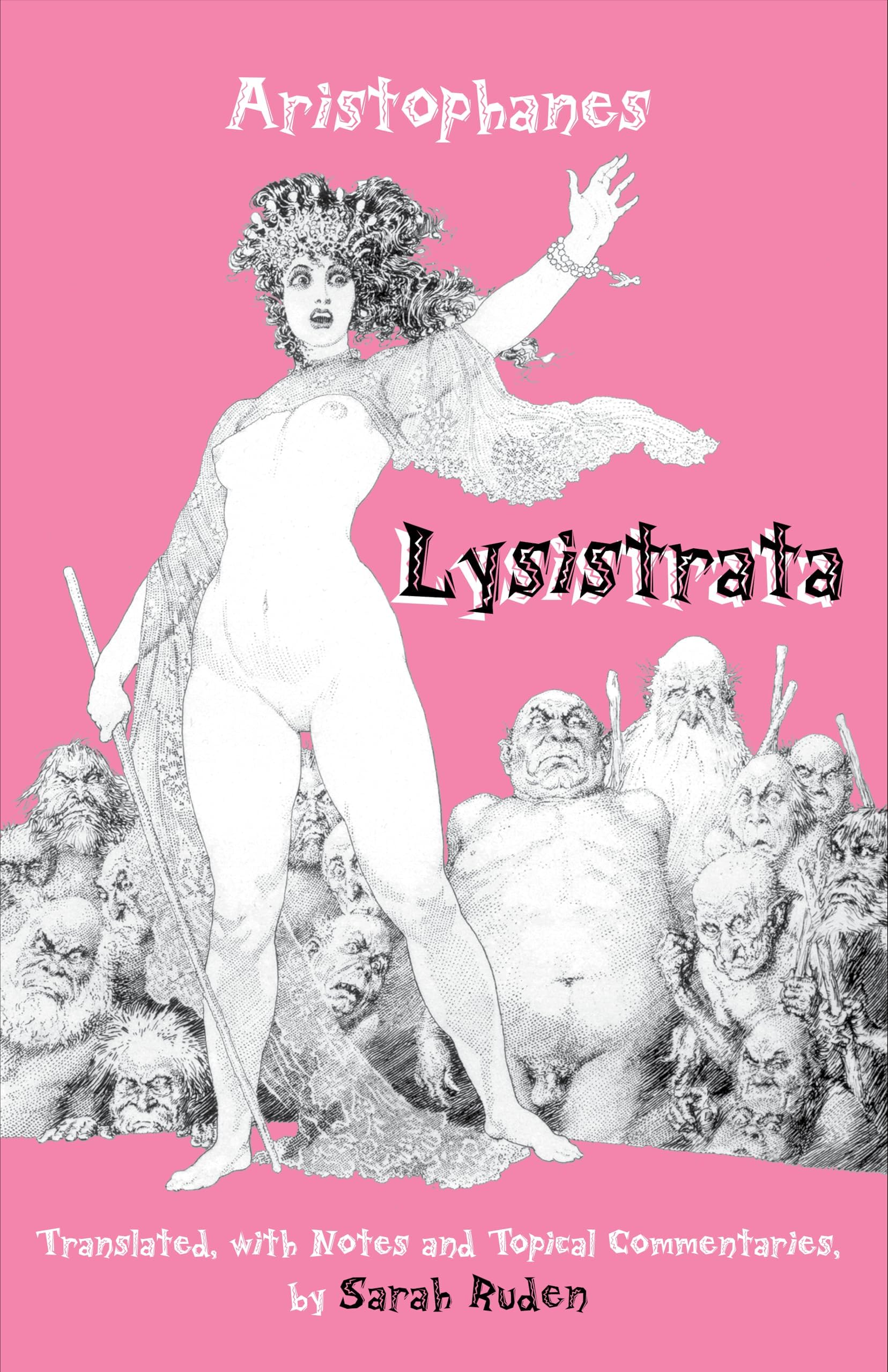
Lysistrata (Hackett Classics)
Product ID: 8602823
Buy anything from 5,000+ international stores. One checkout price. No surprise fees. Join 2M+ shoppers on Desertcart.
Desertcart purchases this item on your behalf and handles shipping, customs, and support to Mexico.
This rollicking new translation of Aristophanes' comic masterpiece is rendered in blank verse for dialogue and in lyric meters and free verse for the songs. Appended commentary essays--on Athenian democracy, ancient Greek warfare, Athenian women, and Greek Comedy--offer lively and informative discussions not only of Aristophanes, but of the broader fifth-century social, political, and cultural context as well. Review: Pretty crazy, lewd, crude, bawdy, fun and smart - I am not one who reads much "serious" fiction generally. Nor do I often read any plays...I'd read most of Shakespeare's plays, but that was decades ago. Nonetheless, I found myself with a copy of Lysistrata, a Greek play from ancient times. In the past I had read some translations of Greek books and plays, and they were okay, but this play! Goodness, what a crazy idea. All the women of Greece stop putting out for their husbands and boyfriends...until the men agree to stop the war. The war had been going on for ages, and only men in the old Greek democracies could vote. But in Lysistrata the women take charge. The play is quite clever and often very funny, too. I never realized how racy some of the Greek plays were, but I suspect modern translators somehow sanitized them, made them "more appropriate" for general audiences, students, etc. But with this translation from scholar Sara Ruden, nothing is cleaned up, softened, toned down...just the opposite. Perhaps if we'd had more spot-on translations of old plays like this when I was young, I might well have dove deeper into the life and times of the Greeks, founders of democracy. A damn good read & a whole lot of fun, too. *I should add also, that the commentary at the end, is an education in itself, and like the play, very readable, not your typical PhD studious (boring!) stuff at all. I am encouraged now, to try another of Sarah Ruden's books. Review: A keeper in tons of translations! - I wanted to find an accessible translation by a woman to Lysistrata, since I started using Women on the Edge: Four Plays by Euripedes in my theatre history classes. That book is excellent and the women who did the translating did an impressive job of translating without adapting or making the language too contemporary. I was hoping I would find one of the 4 women who translated and edited that book to have published some Aristophanes' translations. In the search I landed on this book,and my students and I really enjoyed this read. The gloss that Sarah Ruden has added to the translated text is excellent, and she explains why she chose to translate a certain phrase in the way that she did. It really opened my students' eyes to the responsibility of a translator, and how a personal agenda cam creep into the translation. As with Women on The Edge, he most valuable aspect of this book in my mind is the excellent commentaries she added on Athenian Democracy, Ancient Greek Warfare, Athenian Women, and Greek Comedy. There is about 10 pages on each of these subjects and, wow, they are so beneficial. I will use this as a required text from now on because it is not expensive and the material included in the commentaries is an invaluable supplement to any theatre history text. Both this book and Women on the Edge provide solid historical context in a way that I have yet to find in larger anthologies or cheaper single play editions. I should add that my students, who are are reading the Greeks at the start of a more extensive theatre hist and lit class, gave both the translation and the commentaries thumbs up! However, one thing to be aware of is that this translation doesn't try to tone down the sexuality in the script. It is very direct ( and again Ruden explains her choices). If you are uncomfortable with the explicit language the Athenians used, or you are looking for an aggressive feminist theory approach to the theatrical text, maybe you won't like this. I want my students to understand the historical context, the laugh lines, and the theatricality of the text. It fits my goals very well. And check out the 4 plays and commentary in Women on the Edge, if you are a Euripides fan!
| Best Sellers Rank | #557,306 in Books ( See Top 100 in Books ) #216 in Ancient & Classical Dramas & Plays #420 in Ancient & Classical Literary Criticism (Books) #1,525 in Literary Criticism & Theory |
| Customer Reviews | 4.5 out of 5 stars 103 Reviews |
T**N
Pretty crazy, lewd, crude, bawdy, fun and smart
I am not one who reads much "serious" fiction generally. Nor do I often read any plays...I'd read most of Shakespeare's plays, but that was decades ago. Nonetheless, I found myself with a copy of Lysistrata, a Greek play from ancient times. In the past I had read some translations of Greek books and plays, and they were okay, but this play! Goodness, what a crazy idea. All the women of Greece stop putting out for their husbands and boyfriends...until the men agree to stop the war. The war had been going on for ages, and only men in the old Greek democracies could vote. But in Lysistrata the women take charge. The play is quite clever and often very funny, too. I never realized how racy some of the Greek plays were, but I suspect modern translators somehow sanitized them, made them "more appropriate" for general audiences, students, etc. But with this translation from scholar Sara Ruden, nothing is cleaned up, softened, toned down...just the opposite. Perhaps if we'd had more spot-on translations of old plays like this when I was young, I might well have dove deeper into the life and times of the Greeks, founders of democracy. A damn good read & a whole lot of fun, too. *I should add also, that the commentary at the end, is an education in itself, and like the play, very readable, not your typical PhD studious (boring!) stuff at all. I am encouraged now, to try another of Sarah Ruden's books.
J**H
A keeper in tons of translations!
I wanted to find an accessible translation by a woman to Lysistrata, since I started using Women on the Edge: Four Plays by Euripedes in my theatre history classes. That book is excellent and the women who did the translating did an impressive job of translating without adapting or making the language too contemporary. I was hoping I would find one of the 4 women who translated and edited that book to have published some Aristophanes' translations. In the search I landed on this book,and my students and I really enjoyed this read. The gloss that Sarah Ruden has added to the translated text is excellent, and she explains why she chose to translate a certain phrase in the way that she did. It really opened my students' eyes to the responsibility of a translator, and how a personal agenda cam creep into the translation. As with Women on The Edge, he most valuable aspect of this book in my mind is the excellent commentaries she added on Athenian Democracy, Ancient Greek Warfare, Athenian Women, and Greek Comedy. There is about 10 pages on each of these subjects and, wow, they are so beneficial. I will use this as a required text from now on because it is not expensive and the material included in the commentaries is an invaluable supplement to any theatre history text. Both this book and Women on the Edge provide solid historical context in a way that I have yet to find in larger anthologies or cheaper single play editions. I should add that my students, who are are reading the Greeks at the start of a more extensive theatre hist and lit class, gave both the translation and the commentaries thumbs up! However, one thing to be aware of is that this translation doesn't try to tone down the sexuality in the script. It is very direct ( and again Ruden explains her choices). If you are uncomfortable with the explicit language the Athenians used, or you are looking for an aggressive feminist theory approach to the theatrical text, maybe you won't like this. I want my students to understand the historical context, the laugh lines, and the theatricality of the text. It fits my goals very well. And check out the 4 plays and commentary in Women on the Edge, if you are a Euripides fan!
J**I
Fed up with endless war?...
Well, then, this play should resonate… including the effective method of bringing it to an end. During yet another long war – the American involvement in Vietnam – I became aware of this play, but regrettably never saw a production of it, nor read it. Proving that numerous “classics” are never “out-of-date,” Spike Lee’s latest movie CHI-RAQ is based on this play. So I figured a read was long overdue. There are a number of versions available on Amazon, and I would have preferred to have read it on my Kindle. However, after reading a number of reviews, I was lead to purchase the paperback version with was translated by Sarah Ruden. In addition to the play itself, there is a most informative preface that provides the context and setting for the play, plus four 10-page each commentaries, concerning: Athenian Democracy. Ancient Greek Warfare, Athenian Women, and Greek Comedy. Aristophanes was a Greek playwright, most famous for his comedies, who lived from about 450 to 385 BC. For the greater part of his adult life the Peloponnesian Wars (431-404 BC) were being fought. These wars were mainly between Athens and Sparta, a Greek civil-war of sorts, after the unifying effect of the wars against Persia was removed by a final peace treaty in 448 BC. More than 25 years of war, particularly in one’s adult life, can seem “endless.” Lysistrata literally means “Dissolver of Armies.” She is the principle character in Aristophanes play, who decides the most effective way of bringing peace is to deny men what they most desire. And goes to great lengths to unite the other women in denying their men their accustomed “conjugal pleasures” until they lay down their arms and make peace. Ruden’s translation is wildly bawdy, even raunchy at times, with numerous double entendres. It is filled with the slang of today. Naturally there is a play on the homophones peace/piece. Some other reviewers objected to the bawdy language, and/or the “hip style” but it certainly worked for me. Translations from one language to another can be quite difficult, since often the cultural nuances and meanings of one setting and culture are not properly conveyed in the other. Literal translations across different languages and two and a half millennium are virtually impossible. Thus, I felt Ruden’s “sense of the passage” style was much more appropriate, and allowed me to laugh, and even snicker, as the ancient Greeks did. Seemingly new-found truths were so well understood 2500 years ago. Lysistrata’s advice to the “sisterhood” if their husbands force themselves upon us: lay still. The reason? “No husband’s going to like to screw… Unless he knows his woman likes it too.” I found numerous insights in Ruden’s commentaries. For example, she effectively compared tragedies with the comedies, and said of the latter: “…that comedy could be nasty, hilarious, and sublime at the same time.” She summarized the Greek playwright’s outlook: “Gandhi Aristophanes was not. But he made an important case for an end to hostilities. For a constant proponent of drinking parties, he had a sober understanding of what war was doing to his homeland.” Do we? 5-stars, at least for raising the question, yet again.
R**S
Good translation.
Good translation. Perhaps the best part of it, is it's historical appendices. Probably comes as close to capturing what we know of Athenian "humor" as any translation I've read. There are some allusions that are just lost to history, but still the story and the sharp dialogue is great.
K**E
Solid translation
A classic, obviously! Great play, with some awesome commentary and translation. This is a preferred version for me, and I would reccomend for class or personal use!
D**C
This is the best version to perform!
After reading five other translations, I chose Ruden's translation to direct at our local community theatre. Yes, it was profane and bawdy but it was the most "performable" of all the translations I read. The footnotes and essays helped actors (and the director) to "get it" and the colloquial language made it accessible to contemporary audience members and those who are just reading the script. The actors and audience loved it! My favorite version...fun and scholarly!
E**L
Easy read and great condition
Liked how fast this came in the mail. Also easy to read. Had to buy for a class and will end up keeping it!
Q**N
good content
good content
A**S
good edition of play
notes useful and text clear to read. Rather raunchy for 6th form but suitable for Degree course-we did it when I was at uni.
デ**!
読む前にやられた。
津波に流され焼けました。
A**R
Five Stars
arrived on time and as described.
S**A
Five Stars
Worth reading
Trustpilot
2 months ago
1 day ago