


Desertcart purchases this item on your behalf and handles shipping, customs, and support to Mexico.
🔧 Power your projects like a pro — don’t get left in the dark!
The HiLetgo 5pcs DC-DC Buck Step Down Module is a compact, high-efficiency USB charger module designed to convert 6-20V DC input to a stable 5V output at up to 3A. Featuring ultra-low static current, built-in reverse polarity protection, and industrial-grade temperature tolerance, it’s ideal for Arduino projects, automotive power supplies, and DIY electronics requiring reliable, safe voltage regulation.
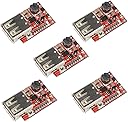
| ASIN | B01HXU1C6U |
| Best Sellers Rank | #311,249 in Tools & Home Improvement ( See Top 100 in Tools & Home Improvement ) #1,354 in Power Converters |
| Brand | HiLetgo |
| Color | Red |
| Customer Reviews | 4.4 out of 5 stars 406 Reviews |
| Input Voltage | 6 volts |
| Manufacturer | HiLetgo |
| Mfr Part Number | 3-01-1126-B |
| Model Number | HiLetgo-... |
| Number of Items | 1 |
| Number of Outlets | 1 |
| Number of Packs | 5 |
| Output Voltage | 5.1 volts_of_direct_current |
| Plug Format | NO |
| Plug Type | NO |
| Power Source | DC power supply |
| Unit Count | 5 Count |
J**L
DIY Charger
Excellent boards for making your own USB chargers. I've bought many of these sets and they all work great.
I**E
Charge a tablet mounted on the wall from 25 feet of low voltage cable.
I have a number of tablets, Samsun Galaxy type, which are used for home assistant panels. They are mounted on the walls round my house but when i try to run a USB cable to charge them that is more than 3 feet lone they do not charge. There is too much voltage drop. Using these power supplied allows me to run 12V to the tablet and convert to USB 5V right at the tablet itself and they charge perfectly.
T**N
The positive and negative pads are NOT labelled and there is no shcematic.
The plus and minus not labeled and no literature so I cam back to see if I could find some info. Someone else posted a photo saying theirs are labeled now and it had been a problem, but as you can see, mine are not labelled. I must have gotten old stock that was not labelled. I haven't tested it yet because it wasn't labeled and not literature but I will try going off the photo that someone posted showing one that was labelled. Can't give it a 5 star rating it the terminals aren't labelled. Sure it says it has reverse polarity protection so perhaps if you wire it wrong you could reverse the leads but .... I prefer to be able to to the job correctly the first time.
I**3
These run Raspberry Pi 3 B+ and Pi 4 with no power issues.
I bought 15 of these, and run them directly from Creality Ender 3 printer power supplies (which are 24V), so that I can integrate my Pi's into the printers, and also free up precious wall plugs that I was needlessly running out of by using pi power supplies. The first batch of these arrived all bent up inside their bag, and I had no issue with them replacing them. Out of the 15, I had one that would not power on, and one that would give me the lightning bolt icon in octoprint, signifying that the pi was not getting enough current. All the other ones worked flawlessly and had no issues with underpowering even the pi 4's. For the price, and the ability to supply enough power in this small form factor, I can overlook 2 out of 15 of them being bad. Also, I saw earlier comments stating that they did not have positive and negative marked out, but they must have rectified that because mine were labeled.
M**N
Excellent 5-Pack of 6-20V In to 5V Out Buck Converters
I have a rechargeable video doorbell I wanted to keep solar charged. I obtained an 18V solar panel (intended for other purposes - which I had to modify) and needed a downconverter. These seemed perfect - and indeed they were. In full sun the solar panels produced 18V and the converter output was a comfortable 5.25V. As the doorbell battery is good for more than a week, I doubt I will now ever have to remove it for recharging. I did use a thin blade hobby knife to score along the line between devices with no problems separating them. I doubt my application draws more than 0.5 Amp (2.5 Watt) peak so cannot confirm the 15 Watt capability claimed for these. And OBTW: the input resistor is an R100 which is 0.1 ohms, not 1.00 ohms.
D**D
As advertised
works perfect, the only issues I had was the solder holes/pads are a little fragile. Use caution attaching the power wires and the product will work perfect. I used it the power a dash camera from my overhead lamp in my truck. I ran the wires under the headliner and used double sided tape the stick the unit to the windshield.
A**R
Cuts off output when input is over 20 volts. At 20.4v input, output is 0.
These are economical modules, and they do what they say, but I'm finding some really annoying limitations. I tried using them with DeWalt 20v batteries to step down to power an Arduino through its USB port. The problem I'm hitting is that the adapter works well with a battery at 70% charge or lower, but if I plug in a freshly charged battery, it outputs nothing. So frustrating... The actual battery voltage when fully charged is probably 20.4 or so. But there must be an internal cutoff and it just doesn't produce any output when the input voltage is over 20v. And yes, you would have to solder on the + and - wires. The board has those labeled well. I would have preferred to have bolt-on connectors for a little more money.
D**A
Power for my raspberry pi
I built a project that requires 12volts DC but also includes a Raspberry Pi 3B+ which runs on 5volts from a USB port. I tapped the 12v supply to feed one of these modules and was able to simply plug in the pi with a short USB cable. Seems to work fine, and saved me from having to use two separate wall warts just to power this project. The boards arrived as two sets of three modules each, so you need to separate them yourself. The PC board is lightly scored between modules so you can snap them apart. I’m sure the remaining ones will find a use in some future projects.
S**E
N'acheter pas ce produit si plus dr 12 volts
Jai acheter ce produit pour faire ded chargeur a partir du source de 18 volts(batterie). J'ai fabriquer 10 unitée... les 10 unitées ont allumées la premieres foies pour ensuite produire une fumé et mourire... Desapointé
Trustpilot
2 weeks ago
2 months ago