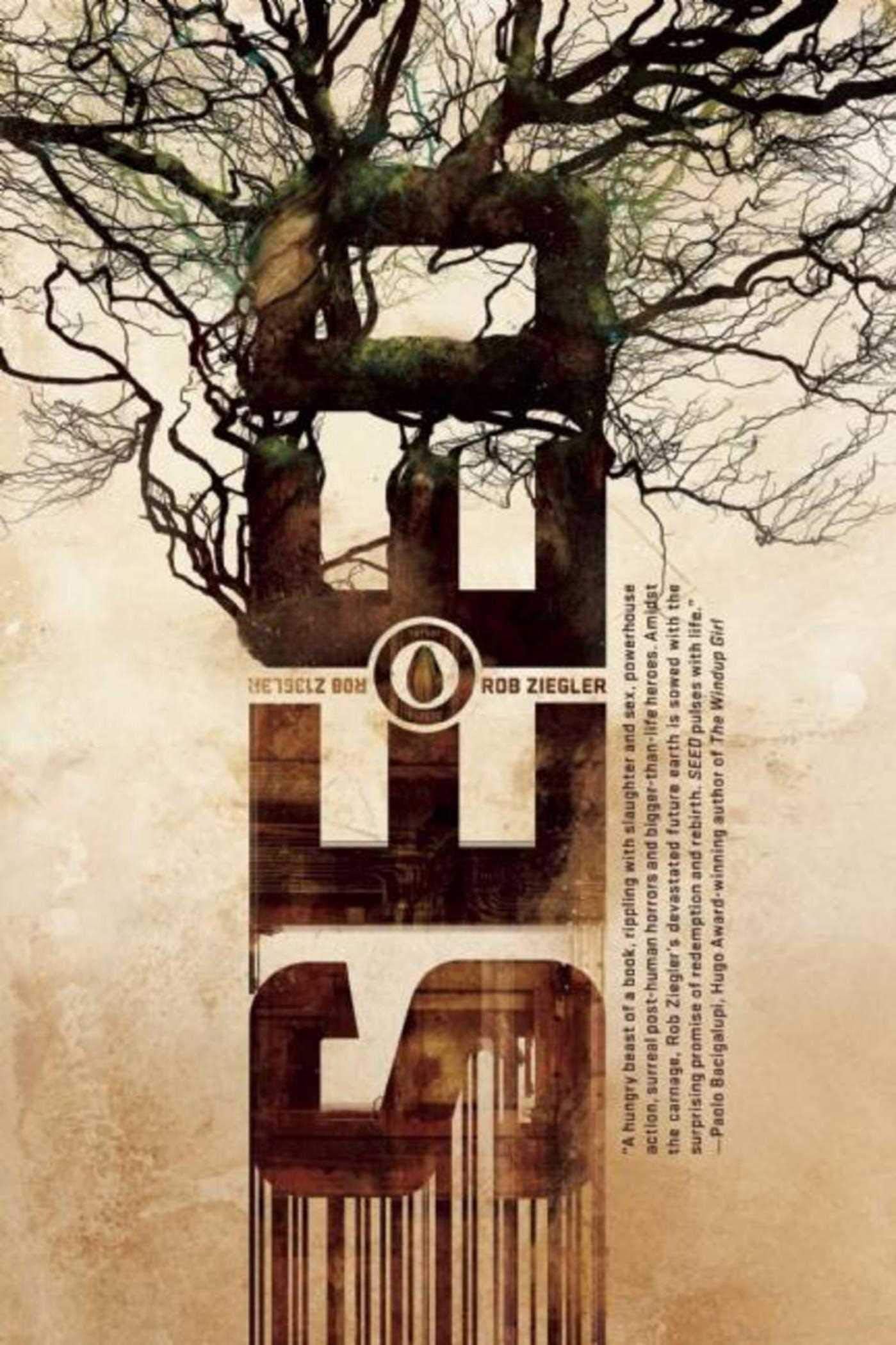
Seed
Product ID: 97283980
Buy anything from 5,000+ international stores. One checkout price. No surprise fees. Join 2M+ shoppers on Desertcart.
Desertcart purchases this item on your behalf and handles shipping, customs, and support to Mexico.
It’s the dawn of the 22nd century, and the world has fallen apart. The United States has become a nation of migrants — starving masses of nomads who seek out a living in encampments outside government seed-distribution warehouses. In this new world, there is a new power. Satori is more than just a corporation; she is an intelligent, living city that grew out of the ruins of Denver. Satori bioengineers both the climate resistant seed that feeds a hungry nation and her own post-human genetic Designers, Advocates, and Laborers. What remains of the United States government now exists solely to distribute Satori seed; a defeated American military doles out bar-coded, single-use Satori seed to the nation’s starving citizens. When one of Satori’s Designers goes rogue, Agent Sienna Doss is tasked with bringing her in: the government wants to use the Designer to break Satori’s stranglehold on seed production and reassert themselves as the center of power. As events spin out of control, Sienna finds herself at the heart of Satori, where an explosive climax promises to reshape the future of the world. Review: Gloomy Biopunk; Simple but Satisfying - Seed is a book that does exactly what it says on the tin, and no more. Short, straightforward and crisply-written, Rob Ziegler does not add many new ideas to the biopunk genre but delivers a solid pulp thriller. It deals with the intertwined tales of Brood, a destitute orphan, Doss, a government agent, and Sumedha, one of the post-human 'Designers' responsible for genetically modifying crops to survive in Seed's exceedingly bleak post-apocalyptic world. Set in the new dustbowl of an American southwest ravaged by climate change and resource depletion, each of Seed's central trio of characters are - in their own ways - fighting to survive. Brood is perhaps the most sympathetic character, one of millions of migrants ranging the wilderness in search of briefly stable micro-climates in which to raise crops. Doss, too, is well-written; an ageing veteran of numerous government ops, traumatised but driven to succeed, knowing that the moment she looses her usefulness to the corrupt regime in 'New DC' she will be out on her ear. Doss' chapters always entertain and do the most to drive the plot forwards; she also gets to play with the few high-tech toys remaining in Seed's apocalyptic world. Sumedha, by contrast, features rather too much post-human weirdness to be of much interest. He develops into a decent villain, but his early chapters are amongst Seed's least interesting. That said, all three principle characters get decent arcs, whilst adding their own flavour to the unfolding tale. Running through Seed is a pitch-black thread of quiet despair. Brood lives hand-to-mouth, only ever having known a post-collapse world, only once does he express telling surprise at the fact that he needs to plan beyond the next meal. Doss, by contrast, has an understated nostalgia for the former glories of the USA which underpins her contempt for New DC's apathetic elite, and later a bloody quest for revenge. Her encounters with an incompetent general and his battalion of child soldiers are amongst Seed's most haunting. There are some good reflections on loss and hopelessness tucked in between the book's generally action-packed passages. Such gloomy themes, however, make the reader long for a more uplifting conclusion than Seed's ambivalent coda. Implicit in the book's misery is an indictment of the present day's myopic attitude to climate change. Fortunately Ziegler has the restraint not to have his characters harp on about the failings of their predecessors. Insofar as Seed has a message, it is as a cautionary tale. But have no illusions; Ziegler's debut is a punchy thriller, but has no Big Ideas to help it stand out in an increasingly crowded genre. Its plot and characters are perhaps a little too straightforward to be truly memorable. Ultimately Seed is an enjoyable book, but an inessential one. Review: Daring and original - SEED is a book that takes a bit of time getting in to. The author has crafted a dark post-apocalyptic world where genetically manipulated foodstuffs - seed - is the most coveted of substance, and where government is subservient to massive corporations who control the creation of these superfoods. The technology in SEED is not explained in detail early on, which means a reader is left guessing as to the exact nature of a specific technology - or even people created through such technology - but as you read on things become clearer and the novel turns from slightly frustrating to greatly rewarding. The book rewards those who stick with it, and its ending is epically magnificent and satisfying. Those who like their hard sci-fi with liberal sprinklings of grit, violence, and gloom will definitely enjoy SEED.
| Best Sellers Rank | 15,838 in Military Science Fiction (Books) 18,381 in Post-Apocalyptic |
| Customer Reviews | 3.8 out of 5 stars 59 Reviews |
R**W
Gloomy Biopunk; Simple but Satisfying
Seed is a book that does exactly what it says on the tin, and no more. Short, straightforward and crisply-written, Rob Ziegler does not add many new ideas to the biopunk genre but delivers a solid pulp thriller. It deals with the intertwined tales of Brood, a destitute orphan, Doss, a government agent, and Sumedha, one of the post-human 'Designers' responsible for genetically modifying crops to survive in Seed's exceedingly bleak post-apocalyptic world. Set in the new dustbowl of an American southwest ravaged by climate change and resource depletion, each of Seed's central trio of characters are - in their own ways - fighting to survive. Brood is perhaps the most sympathetic character, one of millions of migrants ranging the wilderness in search of briefly stable micro-climates in which to raise crops. Doss, too, is well-written; an ageing veteran of numerous government ops, traumatised but driven to succeed, knowing that the moment she looses her usefulness to the corrupt regime in 'New DC' she will be out on her ear. Doss' chapters always entertain and do the most to drive the plot forwards; she also gets to play with the few high-tech toys remaining in Seed's apocalyptic world. Sumedha, by contrast, features rather too much post-human weirdness to be of much interest. He develops into a decent villain, but his early chapters are amongst Seed's least interesting. That said, all three principle characters get decent arcs, whilst adding their own flavour to the unfolding tale. Running through Seed is a pitch-black thread of quiet despair. Brood lives hand-to-mouth, only ever having known a post-collapse world, only once does he express telling surprise at the fact that he needs to plan beyond the next meal. Doss, by contrast, has an understated nostalgia for the former glories of the USA which underpins her contempt for New DC's apathetic elite, and later a bloody quest for revenge. Her encounters with an incompetent general and his battalion of child soldiers are amongst Seed's most haunting. There are some good reflections on loss and hopelessness tucked in between the book's generally action-packed passages. Such gloomy themes, however, make the reader long for a more uplifting conclusion than Seed's ambivalent coda. Implicit in the book's misery is an indictment of the present day's myopic attitude to climate change. Fortunately Ziegler has the restraint not to have his characters harp on about the failings of their predecessors. Insofar as Seed has a message, it is as a cautionary tale. But have no illusions; Ziegler's debut is a punchy thriller, but has no Big Ideas to help it stand out in an increasingly crowded genre. Its plot and characters are perhaps a little too straightforward to be truly memorable. Ultimately Seed is an enjoyable book, but an inessential one.
B**S
Daring and original
SEED is a book that takes a bit of time getting in to. The author has crafted a dark post-apocalyptic world where genetically manipulated foodstuffs - seed - is the most coveted of substance, and where government is subservient to massive corporations who control the creation of these superfoods. The technology in SEED is not explained in detail early on, which means a reader is left guessing as to the exact nature of a specific technology - or even people created through such technology - but as you read on things become clearer and the novel turns from slightly frustrating to greatly rewarding. The book rewards those who stick with it, and its ending is epically magnificent and satisfying. Those who like their hard sci-fi with liberal sprinklings of grit, violence, and gloom will definitely enjoy SEED.
R**B
Good ingredients, but the wrong recipe.
Keeping it high level to avoid spoilers. There's a lot the author is trying to do, but never quite delivers on it. There are several sub-plots that do get resolved, though somewhat abruptly. It's fairly easy to read, owed to the author's skilled writing, but there are some inconsistencies in flow that disrupt the narrative. For example, the point where a depleted uranium artillery shell is fired on a character as a dead-man's switch. They are injured, but still walking and talking, and the story marches on. If the author had reigned in his scope, he has the talent to deliver a compelling story in a dystopian world with a lot of potential.
B**U
A bold and welcome edition to the rising tide of ecopunk
I blurbed this book. Here's what I said about it: "If The Windup Girl had been born in the American Southwest, and had had the genes of Akira spliced to it in utero, you'd have something like Seed, a gritty, sobering story about the fallout of climate change. When Seed hits it hits hard, but there are parts that are surprisingly tender. The writing is intricate and bright, the plot sings, and through fascinating extrapolation, Ziegler has created a world that feels foreign and familiar both. The bottom line? Seed is a bold and welcome edition to the rising tide of ecopunk." Beyond this, what I can say is that Seed is a book that constantly challenges you. It's inventive and immersive. The world feels consistent and fascinating. I haven't gotten a feel from a book like this in a while. The last time I recall feeling this sort of wonder was when I'd read William Gibson for the first time. For those that like their sci-fi with a harrowing plot and characters that live and breath, Give seed a try. You'll be glad you did.
R**J
Not perfect, but very satisfying and enjoyable.
A very satisfying postapocalyptic SF novel indeed. The setting was well crafted and the characters were enjoyable. The number of characters and the intertwining plots came together in a satisfying way, although the ending wasn't quite as head-smackingly good as it could have been. I would definitely say this is worth reading if you are the kind of person to enjoy science fiction, postapocalyptic stuff, global climate change scenarios, or speculative future-fiction.
C**D
Action-packed stroll through the American wasteland
Premise? Solid. World? Intriguing. Execution? Stumbles. Seed is a book with a lot of promise, but unfortunately, it fails to live up to all of it. Let me begin by saying: don't mistake me. It's a good book, it's simply not a great one. As a exercise in ideas and potential, it is absorbing, and there are a lot of directions it could have taken. As a stand-alone novel, I think it went in the right direction story-wise, but the problem in its execution was two-fold: poor editing and unfortunately shallow characters. Seed is post-apocalyptic sci-fi centered in a world where climate change has run amok and brought about a second dust bowl. It's the 22nd century (so, first of all: hurray! We made it to the 22nd century!), and as the residents of America struggle through a perpetual migrant existence, a corporation has risen to the top of the food chain (literally). Satori manufactures climate-resistant seed to feed humanity, while doing predictably darker things behind the scenes. The nomadic life and particularly the incorporation of many Hispanic and other multiracial characters and themes (characters and themes tragically skipped over in many fantasy and scifi works) lends a unique air to things that immediately piqued my interest. Mexican slang and a decent amount of the dialogue is in (pretty easy to figure out) Spanish. These characters also come with, what appears to be, a rich amount of background to draw from: a special-needs brother, traumatic family situations, military backgrounds, partner/love interests. Unfortunately, while many of the characters seem to think "about" these things, we rarely get any depth to them. We get quick glimpses, but much of the writing style is just that--quick-paced, never seeming to want to dwell too long on any one particular point. In that regard, at least there's no "bog down," but we also sacrifice an emotional and sensory complexity that might have otherwise pulled us deeper into the depths of Ziegler's world. If you want action, you will have plenty. That is one thing that is never sacrificed, and generally speaking, if there's going to be an action scene, there are going to be consequences. You will feel for the characters therein; largely because you may be about to lose some of those you quite liked. The character Doss is typically the star of these particular scenes, and while she could have been something more, unfortunately, her role largely is to be the "action star" of the book, while the character Brood gives us the more human angle of things, as well as experiences some actual growth. The writer is obviously skilled, with a lot of ideas, but the editing is not great. I mean this in several ways. 1. While post-apocalyptic settings aren't necessarily grounded in the scientific, sci-fi has a strong tradition of bearing up that undertone, and particularly where we are getting into genetically modified crops, seemingly organic cities, and clones, we somehow weave through them all with very little explanation. There was no "grounding." 2. Furthermore, it's not uncommon to happen across things like "souls of their feet" and skin "pealing" off, grammatical and spelling errors, as well as a great many reused bits of language to describe certain happenings. A solid editor could've corrected many of these, and while taken individually one might say, "Things happen," the fact that there are so many really does add up over time. In all, this book can be choppy at times and it's nothing that's going to knock your socks off, but for a couple days' entertainment, it's a fun and active stroll through the wasteland. It has its issues, but Seed is worth a read.
J**R
Seed
This story was most confusing. Terminology was used which was never explained and never made sense to me. I lost interest about half way, and quit.
Trustpilot
5 days ago
3 weeks ago