Desert Online General Trading LLC
Dubai, United Arab Emirates
Desert Online General Trading LLC
Dubai, United Arab Emirates

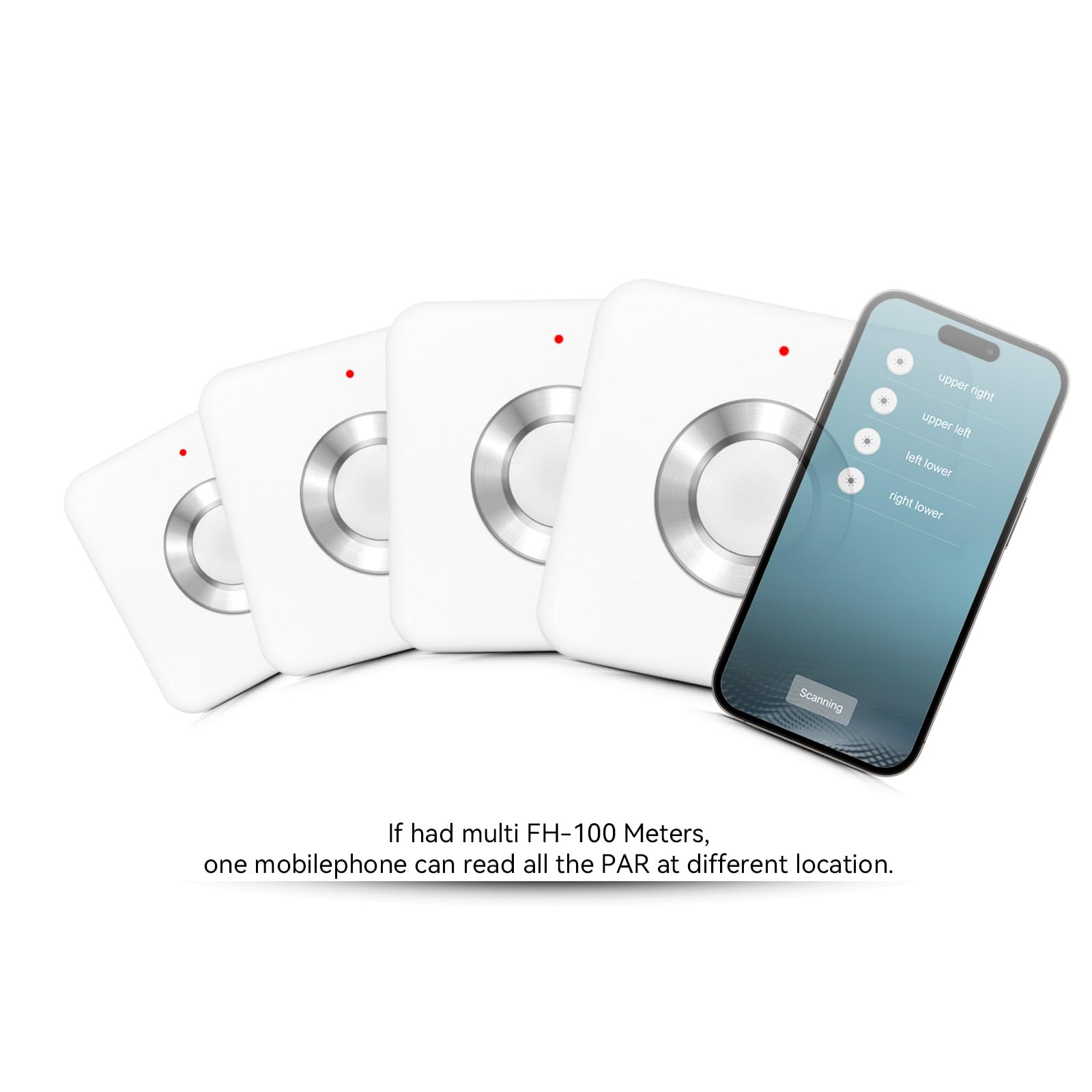
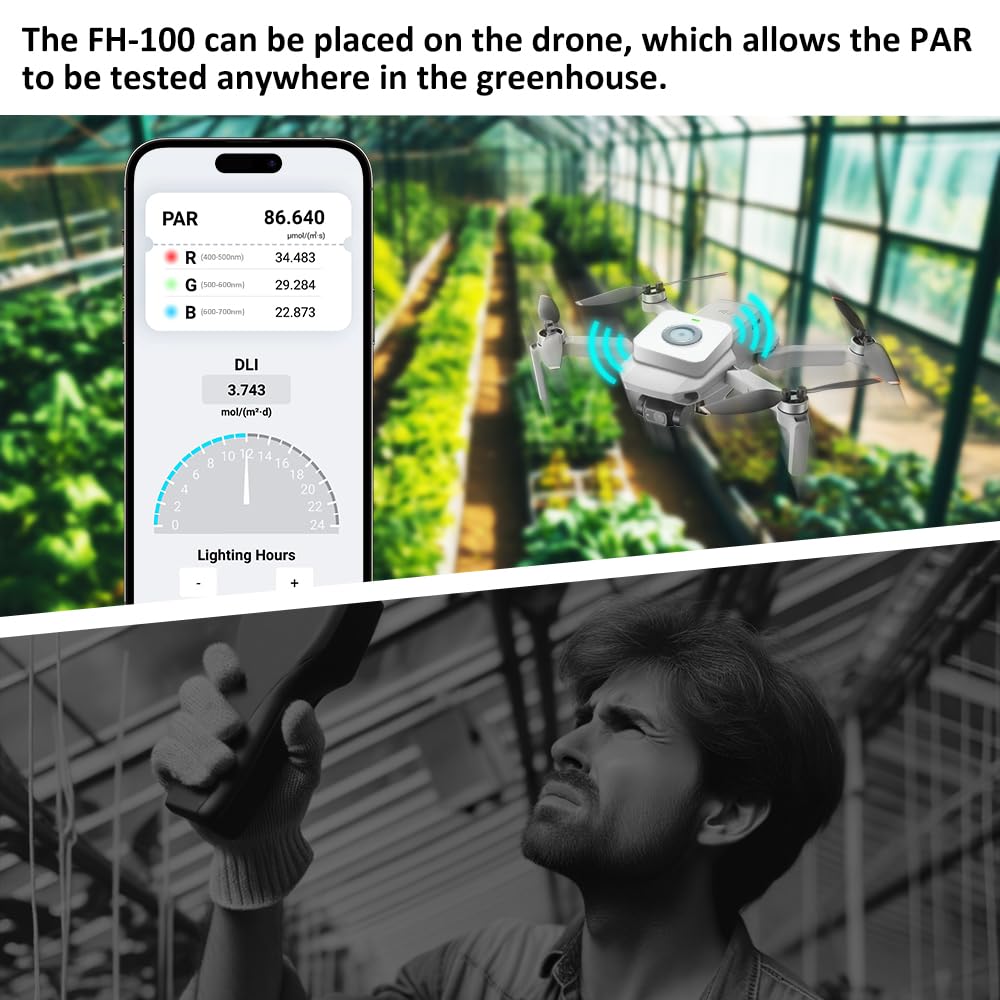
🌱 Elevate Your Grow Game with Precision!
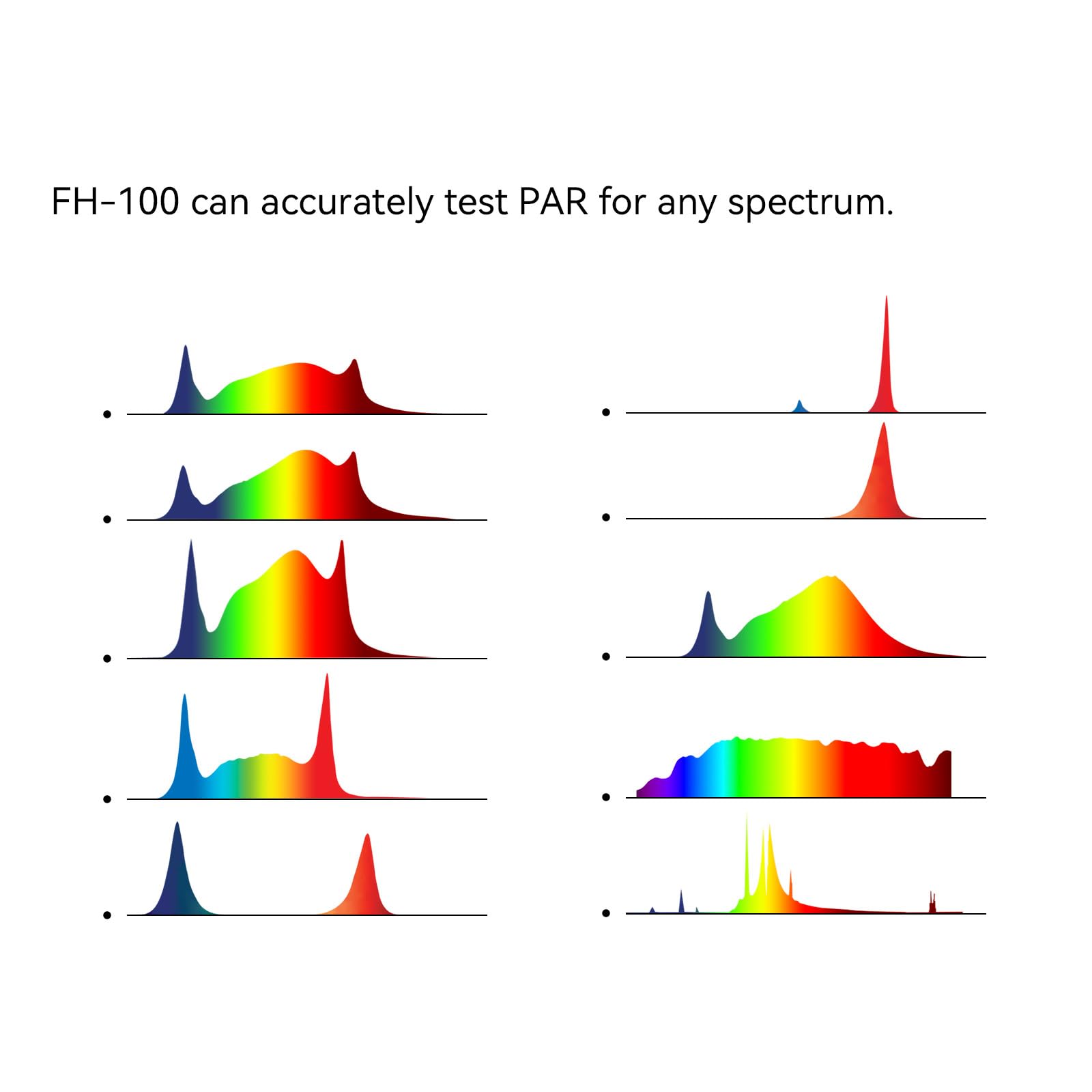
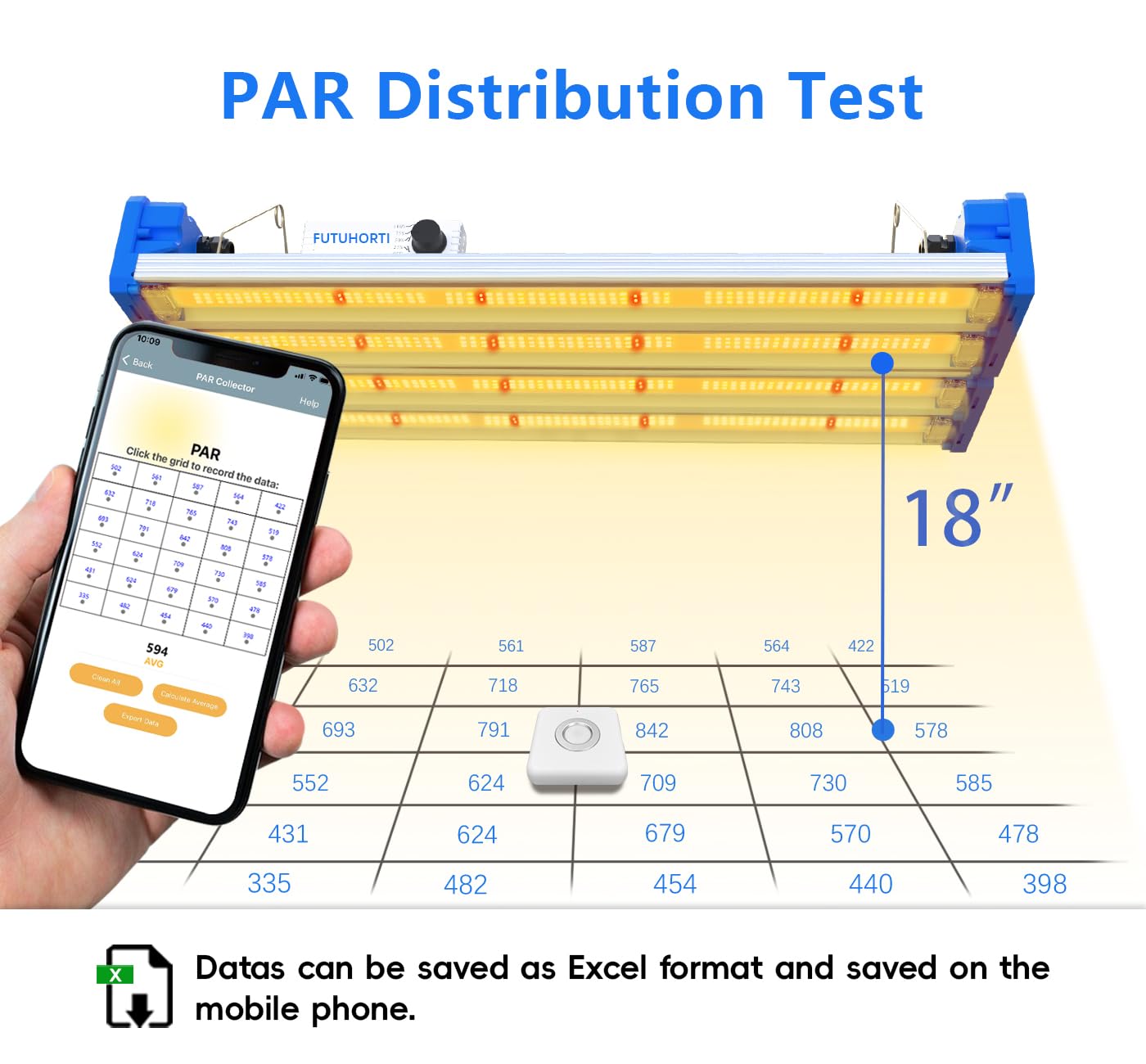
The Quantum PAR Meter FH-100 offers cutting-edge technology for measuring Photosynthetically Active Radiation (PAR) with a focus on both red and blue light spectrums. It features a user-friendly app for data collection and analysis, Bluetooth connectivity, and the ability to record PPFD distribution, making it an essential tool for serious growers looking to optimize their plant health and yield.


| Number of Batteries | 2 AAA batteries required. (included) |
| Display Type | LCD |
| Compatible Devices | Some Bluetooth-enabled smartphones |
| Power Source | Battery Powered |
| Item Dimensions L x W | 2.9"L x 2.9"W |
| Color | White |
P**L
Seems good
I was hesitant to try a PAR meter in this price range, but after determining I wasn't going to be able to afford the $500 one I really want this year, I picked one with good ratings that looked easy to use. And so far, it looks good. It delivers the readings I would expect on the lights I know and trust, gives me reasonable readings in natural light, and tells me that the bad lights I knew I needed to replace were even worse than I thought. As the comparative tool I needed, it seems to deliver. I'm afraid to judge accuracy without reference sources or other meters, but it looks good based on the data points I have.They're piggy-backing on an unrelated app to bluetooth connect and get readings on the phone, but it works well if you follow the instructions in the printed material (don't create an account). I have to choose the (only) paired device with a Chinese character name, but after that it's all in English. It seems to help to turn the device on before opening the app, and then waiting for the "bluetooth not connected" symbol to go away in the app if it appears.
L**L
Good For Mapping Grow Lights
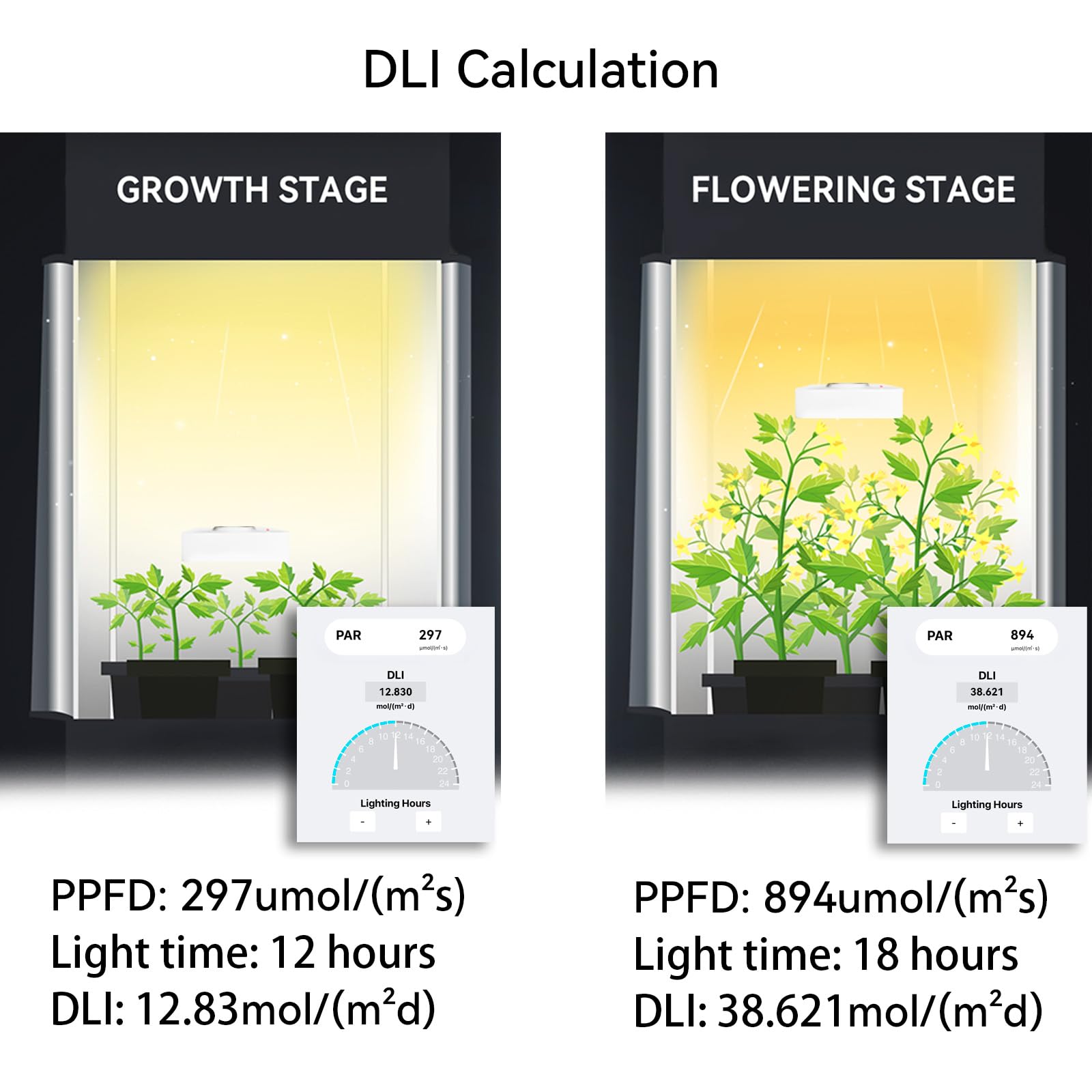
Making a PPFD Map Using the FH-100 PAR Meter for the Sunco 80 Watt Grow LightFirst a couple of definitionsPPFD=Photosynthetic Photon Flux Density. It is measured in micromoles per square meter per second and is a measurement of light intensity over a defined area at a specific distance per second.DLI=Daily Light Integral. It is measured in moles per square meter per day and is a measurement of how much light has shown on a defined area at a specific distance per day. (PPFD * #seconds of light provided per day divided by 1,000,000).Customer Service at Sunco could not provide a PPFD Map or any PPFD values for any distance on this grow light. Clearly they did not understand, and could only tell me to put the plants 12"-37" below the light. So I bought a meter that reads PPFD (the FH-100) and produced my own map at appropriate heights for the tomato seedlings I will be growing. Turns out the recommended height is way off of where it needs to be.This grow light will be fine for my tomato seedlings (which optimally take a minimum of 300 PPFD for a 13.0-17.3 DLI), but this light cannot provide enough PPFD intensity for mature tomato plants (takes around 700 for optimal fruiting). Tomato seedlings can take up to 700 PPFD without damage. For those of you looking to grow pot, it likes even higher (>1000 PPFD) for good yields. Having sufficient PPFD for an appropriate DLI is important for plant growth. Hanging the light 6.6 inches directly above my 3 seed starting trays should get me in the sweet spot for all 45 cells, except for the outer four on each end. I intend to experiment with foil covered cardboard sides to reflect light back onto the outside 8 cells. My source of information is here:https://www.ncbi.nlm.nih.gov/pmc/articles/PMC4235429/The 3 trays trays are centered directly underneath the light. PPFD measured by placing sensor directly on top of each cell in the trays. Measured width is 6" between centers of front and back cell. Measured length is 42" between centers of far left and far right cells.Some quick measurements (maps at 6.5" and 9.5" are in photos below):Center cell was 900 PPFD @ 1" below bulbCenter cell was 705 PPFD @ 2.5" below bulbCenter cell was 503 PPFD @ 4.5" below bulbCenter cell was 380 PPFD @ 6.5" below bulbCenter cell was 290 PPFD @ 9.5" below bulbCenter cell was 212 PPFD @ 13" below bulbSunlight in late afternoon on sunny Winter day in Indiana was 1400 PPFD. Seems reasonable to me - but accuracy is not verified against another meter. Readings in different cells at different light heights were quite repeatable. This meter seems a very good value.So much for 12"-37" distance for anything else than low-light plants like violets, for the Sunco 80W grow light. I need to place it at 6.5" to grow tomato seedlings.
G**E
A wonderful new tool to measure light.
I’ve only just begun to use this new tool but I will say that it seems to work exactly as promised.The smart app that runs it is very clever and allows one person to be able to measure things that couldn’t be measured before.I haven’t had that much experience with it yet so I can’t give it anything more than three stars in several categories. Perhaps I will in time because the light meter does seem to work exactly as stated.I use it to determine if they’ll be enough light on art pieces and will know a lot more in just a few days.For the cost I think it’s a bargain and assuming it does work, it’s a fantastic new tool to help lighting experts do their job.
S**N
Works great
Pretty accurate and works really well! Spend the moola and get this if you are serious about your grows
T**E
It works for me.
I don't know how accurate it is. I do know that when I use it to set my grow lights my plants are happy. This was the best value I could find for a PAR meter. I use it as a guide and then listen to my plants. (yes they talk to me)The meter paired well with my Android phone, the app works just fine, and it's nice to be able to set it under the lights while reading the results remotely on your smartphone. This meter helps you map your space from a plant's point of view. Hopefully, it will last.
D**A
Not entirely accurate
It seemed to work well for a couple weeks. I bought a new light, tested it, and the meter reported nearly no blue light, which was impossible for a 4,000K light. I thought my light was defective but my plants love it; so, the meter must be wrong. I think the overall umol reading is correct, though.
Trustpilot
3 weeks ago
1 day ago
2 months ago
4 days ago